
Why Italy’s Foreign-Born Museum Directors Fear They Are No Longer Welcome
A brief period of relative autonomy enjoyed by many of Italy’s
leading state museums appears to be over. Museum boards are being
abolished, and the contracts of foreign-born directors seem
unlikely to be renewed as Italy’s government rolls back many of the game-changing
reforms introduced four years ago.
A new decree signed by culture
minister Alberto Bonisoli, which came into effect on August 22,
signals an end to a bold experiment that began in 2015 when, under
the government of Matteo Renzi, foreign candidates were encouraged to
apply to direct a number of leading museums. Seven international
directors were appointed to helm some of Italy’s top institutions,
including the German expert in Renaissance and Baroque sculpture,
Eike Schmidt, who has helped modernize the Uffizi Galleries in
Florence. Among other feats, Schmidt introduced timed entrances to
the Uffizi, cutting down the notoriously endless lines outside the
galleries. For the first time museums could manage their own
budgets, and their directors could rehang galleries, arrange
international loans, and raise private sponsorship as they saw
fit.
Now, the culture ministry in
Rome is taking back control. While many fear a return of the dead
hand of bureaucracy, and the increased politicization of the
country’s cultural heritage amid a rise of nationalism, the
ministry insists the changes will “rationalize” and “simplify”
museum management. A spokesman for the Italian ministry of
culture says that museum boards will be dissolved after October 1
because they were “considered useless.” In their place there will
be “scientific committees,” to which the director will be allowed
to appoint one member, with another being selected by local
authorities.
An International Exodus
Many of Italy’s foreign-born
museum directors have seen the writing on the wall and found new
positions abroad. Eike Schmidt announced in 2017 that he would be
leaving Florence for the Kunsthistorisches Museum in Vienna at the
end of his term. The Austria-born Peter Aufreiter, who heads up the
National Gallery of Marche, will move on to lead the Technical
Museum in Vienna, and his fellow countryman Peter Assmann announced
last November that he will be leaving Mantua’s Palazzo Ducale to
head up the Austrian National Museum.
Although the new rules do not
prevent international museum directors from applying for the vacant
roles, Bonisoli stated in January that he thinks there is enough
talent at home in Italy to fill the country’s top museum
jobs. Speaking to artnet
News, the culture spokesman rowed back on Bonisoli’s nationalist
statement, saying that the minister “never said that he prefers
Italian directors than international ones,” but that “the point is
that they must be as highly trained as possible.”
Peter Assman tells artnet News
that the new changes effectively reduce museums’ autonomy, despite
what the ministry claims. Shifting power back to Rome “means
immobility,” he says. “The museums will have their hands tied,” he
adds.
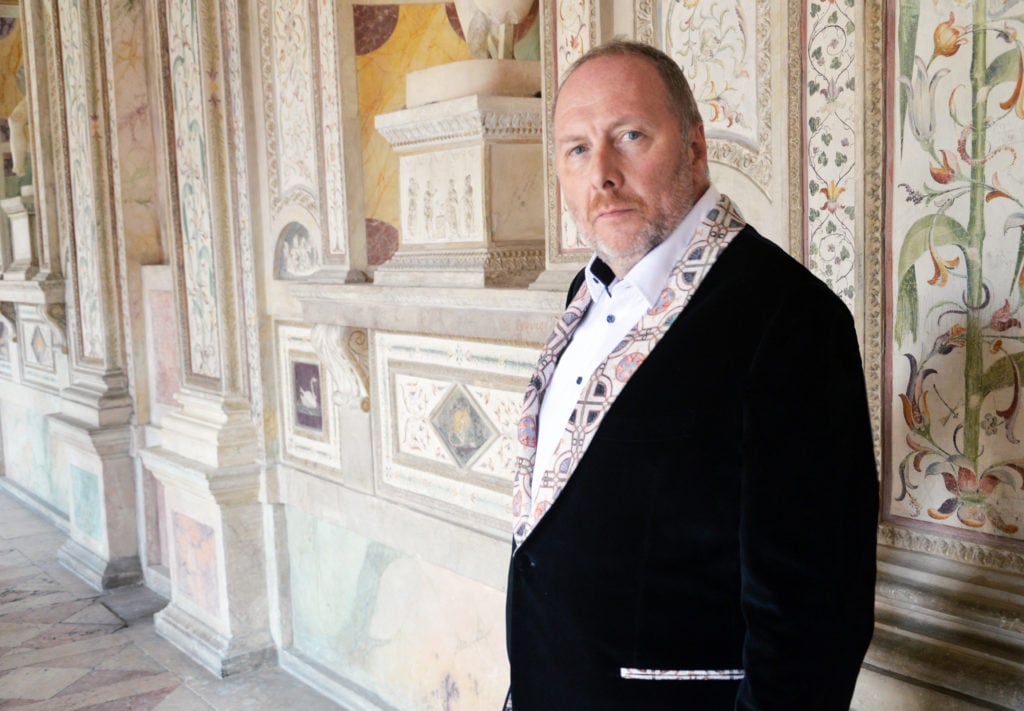
The director of Mantua’s Palazzo Ducale,
Peter Assman.
Assman says that he was
available to stay at the Palazzo Ducale, and repeatedly asked for
meetings with the ministry to discuss the matter,
but after receiving only silence he took up the post in
his native Austria. “The line, before the current government
crisis, was largely dictated by the League: ‘Italians first,’”
Assman says, referring to the far-right party led by Matteo
Salvini. “All right, I said to myself, we are no longer
welcome.”
Assman says: “We will see if now something changes,” as a new
coalition government is formed, thwarting Salvini’s bid for
power. The Democratic Party
leader Nicola Zingaretti promises a new government will mean a
change of direction, away from nationalist politics. It remains to
be seen how this will affect Italy’s cultural
institutions.
A Step Backwards
For now, things are not looking
good for the remaining international museum directors in Italy.
Cecilie Hollberg, the German director of the Galleria
Dell’Accademia in Florence, which is home to Michelangelo’s
David, was forced out of her position shortly after the
reforms were implemented. Hollberg’s contract was suddenly and
unexpectedly terminated before it was due to expire in November,
just as the new reforms meant the management of the art museum was
merged with the Uffizi Galleries.
Hollberg tells artnet News that
the reforms are an “anachronistic step backwards,” and will mean
that “museum directors will become administrators.” She says that
state museums were
successfully modernizing thanks to their autonomy. “We changed
things for the better, even if we did not have a lot of staff.”
Under her leadership, she says the Galleria Dell’Accademia
increased its attendance by 22 percent in the past three years,
with revenue growing 14.5 percent each year. “This will destroy
what we built in the last four years,” Hollberg fears. “Museums
will lose their identity and turn back into isolation.”
Hollberg says that no one
explained the early termination of her contract, although she
guesses that there are “important political-financial interests” at
play. Indeed, critics of the reforms think that they are setting up
a path for the government to use Italy’s rich cultural heritage as
a political football.
Earlier this year, Italy was caught up in a
political tug-of-war with France over previously agreed upon
loans of works by Leonardo da Vinci to the Louvre for an exhibition
this fall marking 500 years since the death of the Renaissance
master. The government spokesman confirms that international loans
will be supervised by the ministry, “to better coordinate
international relationships between Italy and foreign
countries.”
The new changes also see a
merger of a number of smaller museums with larger institutions.
Along with the Galleria Dell’Accademia, the San Marco Museum in
Florence will now fall under the directorship of the Uffizi
Galleries, for example. The ministry defends this as a way of
distributing financial resources more evenly across the state
museum system. It promised to redistribute an extra €10 million
($11 million) by raising the culture ministry’s share of ticket
revenue from 20 percent to 25 percent.
It is as yet unclear how the
German-born Gabriel Zuchtriegel, who directs the Paestrum
Archaeology Park, the British-Canadian museum director James
Bradburne, who heads Milan’s Pinacoteca di Brera, and the French
art historian Sylvain Bellenger, who manages the Capodimonte Museum
in Naples, will be affected by the reforms. Artnet News reached out
for comment but did not hear back by press time.
For its part, the Italian
ministry insists that museums will remain autonomous under the new
rules, explaining in a press release that directors will maintain
control over institutions’ budgets. According to the ministry, they
will still be allowed to raise funds, complete existing contracts,
and establish new ones.
The post Why Italy’s Foreign-Born Museum Directors Fear They
Are No Longer Welcome appeared first on artnet News.
Further reading


Leave a comment