
The Studio Museum Residency Has Shaped the World’s Understanding of Black Contemporary Art. That’s a Lot of Responsibility
In 2015, the artist E Jane began
uploading selfies taken by black women to a website under the
banner “Alive.” The aim was to show that while Sandra Bland, who
had died earlier that year, was no longer living,
other black women are. The artist (who uses they/them
pronouns) and others posted the images to social media with the
hashtag “notyetdead.”
A few years later, E. Jane
included the “Alive” project in an application for the Studio
Museum in Harlem’s artists-in-residence program. The residency is
one of the most competitive and closely watched initiatives of its
kind in the country, with more than 100 alumni including Kerry
James Marshall, Njideka Akunyili Crosby, and Simone Leigh. But it
has a reputation for selecting mainly painters, not performance or
new-media artists. Still, alumnus Eric Mack encouraged E to
apply—and they ended up being the first internet artist the program
has ever accepted.
This year’s cohort—which also
includes musician and performance artist Elliot Reed and painter
Naudline Pierre—may suggest a shift for a program that has been
exceedingly influential as a career-defining platform for
generations of black artists. And that shift will likely have
broader implications for the kind of art that makes its way into
the market and institutions for years to come.
Still, some wonder, as the field
continues to grow, whether one program—while exceedingly valuable
to many of its alumni—should hold so much responsibility in shaping
the discourse on black contemporary art.

E. Jane, Alive (Not Yet Dead)
(2015). Courtesy of the artist.
Filling a Void
There’s something about the
story of the Studio Museum residency that’s hard to crack. The
program, which dates back to the museum’s founding in 1968,
provides artists of African and Latinx descent with studio space
for 11 months in New York City and a $20,000 stipend.
Most residents feel relieved,
after years spent navigating majority-white art schools or other
institutions, to finally be around other black people—from curators
to secretaries to security guards. “I was so excited to be around
folks who look like me, who just understood the weird
contradictions,” says Jibade Khalil Huffman, who was part of the
2014–15 cohort with now-prominent artists EJ Hill and Jordan
Casteel.
Hill concurs. “At school or
other professional workplaces, my shoulders were up near my ears,”
he says. “I got to relax a bit there.”
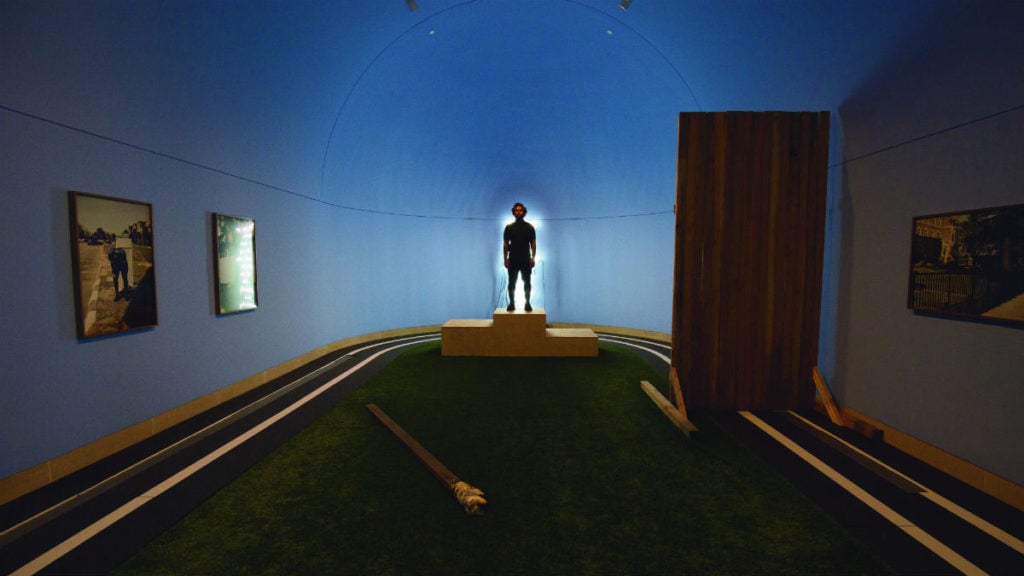
EJ Hill, Excellentia, Mollitia,
Victoria (2018.) Installation and durational performance.
Courtesy of the artist and Commonwealth and Council, Los Angeles.
Photo: Chisa Hughes.
This environment can be
creatively fulfilling and reassuring in ways artists haven’t
experienced elsewhere. Bethany Collins, who participated in the
residency from 2013–14, says she was grateful that discussions
about her work were not cut short by a disinterest in talking about
race, a problem she confronted quite a bit in graduate school.
“Some of the critiques I got were, you know, ‘I don’t see race so I
just can’t critique this work,’” she recalls. “So that’s not
helpful.”
Nearly every artist I spoke to
had a strong reaction to the news that two performance artists had
been chosen for this year’s residency. While they had different
ideas on what, exactly, the year’s selections signaled about the
museum, they all felt that the decision meant
something—a
strategy while the museum is closed for its $122 million expansion,
perhaps, or, more fundamentally, a sign that the museum is
deepening its commitment to non-object based art (and, therefore,
to artists with less established career paths and market
opportunities).
Market Impact
The Studio Museum residency has
taken on heightened significance as the market for work by black
artists has grown. When Wardell Milan II went through the program
more than 15 years ago, he and black artists of his generation
“definitely saw it as a launching pad, because so few of us during
the 2000s were represented by significant galleries,” he
says.
By the time abstract painter
Cullen Washington nabbed to the residency in 2011, meanwhile, he
felt comfortable enough with the visibility the residency afforded
to set securing gallery representation as his goal for
it.
According to Patricia Banks,
author of Diversity and
Philanthropy at African-American Museums, the market interest in artists of African
descent has seen a “nice, steady uptick” from the late ‘90s into
the 2000s, followed by a much steeper incline over the past five
years. She attributes some of this movement to Studio Museum
director Thelma Golden’s effort to raise the symbolic capital of
black art, and, in turn, the profile of the museum in choosing
it.
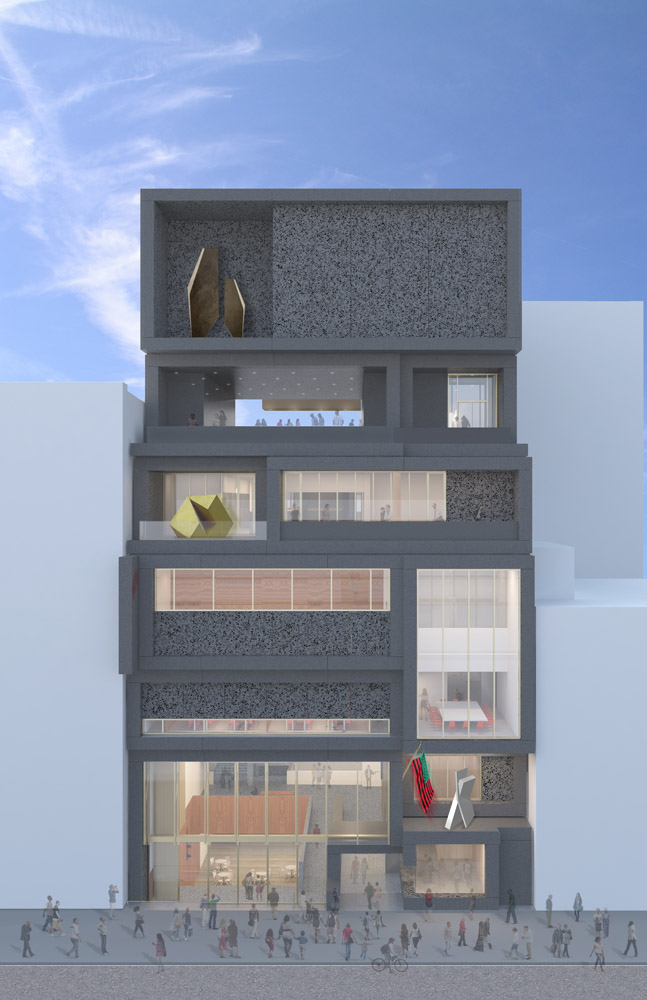
The facade of the Studio Museum Harlem.
Courtesy Adjaye Associates.
“Because the work is in the
marketplace in a more meaningful way,” Banks says, “there might be
more sensitivity to the role of black museums in legitimating
culture” to the broad cultural world.
Many are quick to note that the
Studio Museum’s artists in residence have often been somewhat
industry-tested. They’ve gone through the Yale MFA program or the
Skowhegan residency, or had run-ins with assistant or associate
curators, who sometimes scout for new talent.
Although none of the upcoming
residents were “previously known to everyone on the selection
committee,” associate curator Legacy Russell wrote in an email, she
had been acquainted with E. Jane for years. After being introduced
through a mutual friend, Russell put E. Jane in a show on digital
art.
Exceedingly Influential
From the moment that Golden
arrived at the Studio Museum in 2000 and curated “Freestyle,”
a show that characterized the work of 28 black artists as
“post-black” (a term meant to indicate that they no longer wanted
an ethnic label to constrain their work), the black art community
has been evaluating the museum’s deployment of this mandate. And
the residency program is one stage for it to play
out.
After “Freestyle,” Clifford
Owens, for one, applied to the residency, thinking it would be a
hospitable place for his performance-based practice. “The
residency, and the museum at that time, was at the center of the
[post-black art] discourse,” he says. “It just seemed appropriate
for the work that I make to be there.”
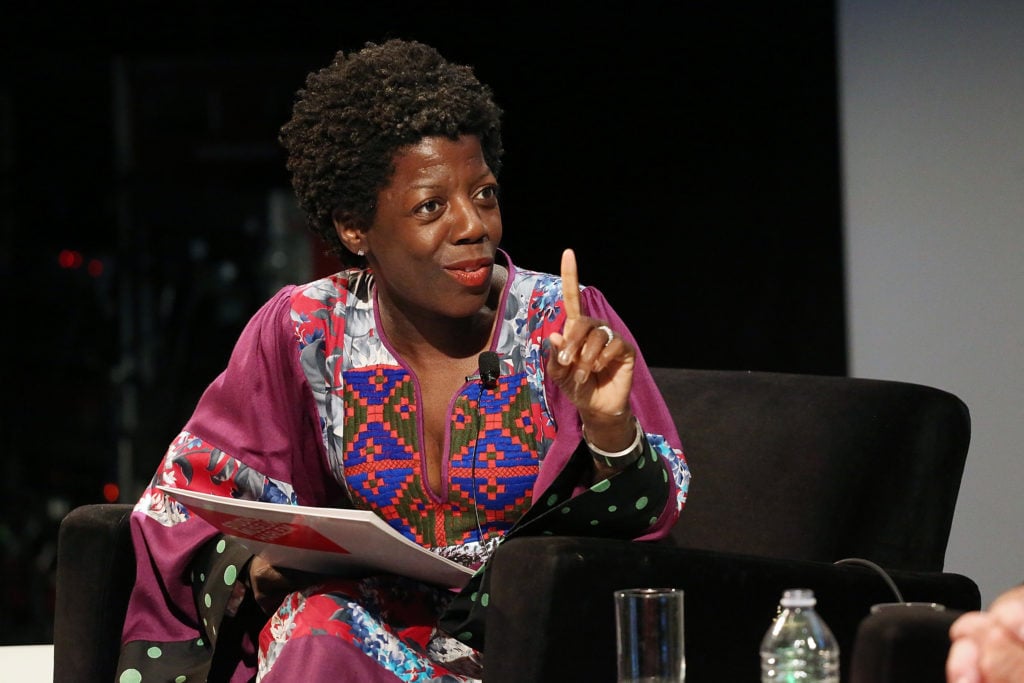
Director and Chief Curator of The Studio
Museum in Harlem, Thelma Golden. (Photo by Mireya Acierto/Getty
Images)
But over time, the residency’s
selections seemed to crystallize a particular point of view for the
institution. Many say the museum has remained committed to
figuration and work with clear signifiers of the black
body.
Opinions differ on how much the
museum balances those aesthetic leanings with other types of work.
Milan, who went through the residency in 2001–2, says, “I can
remember a time when we wouldn’t see a certain kind of work at the
museum.” He felt as though the institution steered clear of more
“difficult” work—like performances by artist Kalup Linzy, for
example—in order to, genre aside, represent blackness in a
digestible way. But he adds that he thinks the residents have
gotten far more aesthetically and conceptually diverse in recent
years.
Artist Lyle Ashton Harris,
meanwhile, maintains that along with supporting “artists who have
gone on to robust commercial success, the institution has also a
strong mandate to support discursive events” like his Michael
Jackson-themed performance Performing MJ.
What Is Black Art, Anyway?
The type of work that fits
within the Studio Museum’s wheelhouse at any given moment is a
complicated equation to solve. The interests of the institutional
stakeholders are fluid and are only known to a select few. Also, as
artist Xaviera Simmons notes, what’s considered “of the moment,”
authentic, or radical shifts over time, is contingent on who’s
looking, and is shaped by the institution’s place (and function)
within the broader art community.
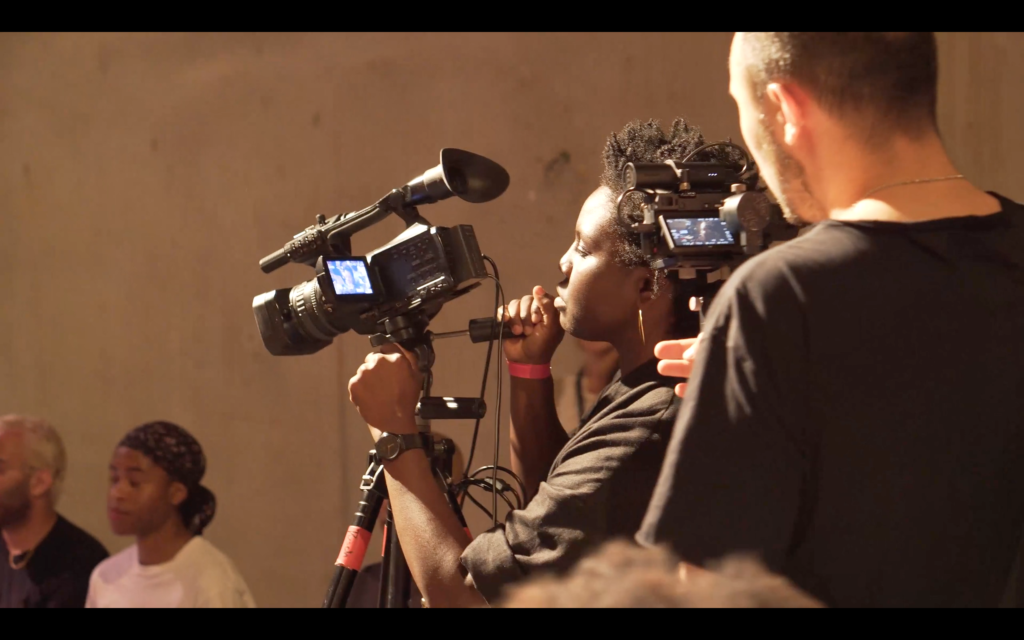
Autumn Knight, Sanity TV: On
Location, 2018. Performance view, Akademie der Kunste, Berlin.
Courtesy of the artist.
But the fact remains that the
announcement of the Studio Museum’s residents behaves as an annual
rethink for how the museum is spearheading the conversation on
black art—with artists continually trying to gauge what kind of
work the museum likes in order to become part of its distinguished
legacy.
Autumn Knight, who came out of
the program last year, jokes that she moved from Houston and
arrived at the museum expecting “a council of elders to welcome
me.” She felt that as a resident at the Studio Museum, she had
access to a “vault of black art knowledge that goes back
centuries.”
Acceptance into the Studio
Museum’s residency program is not just an avenue for commercial
success. Derek Murray, a professor of art history and visual
culture at the University of California, Santa Cruz, suggests that
“it’s also about racial legitimacy and being valued by one’s
culture.”
While the Studio Museum is,
Russell writes in an email, responsible to “answer to and reflect
the world around it,” many wonder how much the institution,
especially one almost single-handedly changing the course for black
art within such a conservative, white-dominated space, can
realistically take on.
As a result, the museum is faced
with the same dilemma that Golden and artist Glenn Ligon were
trying to correct for when they established the post-black art
dictum at the start—how no one term or, in this case, institution,
can preside over the totality of what black people
make.
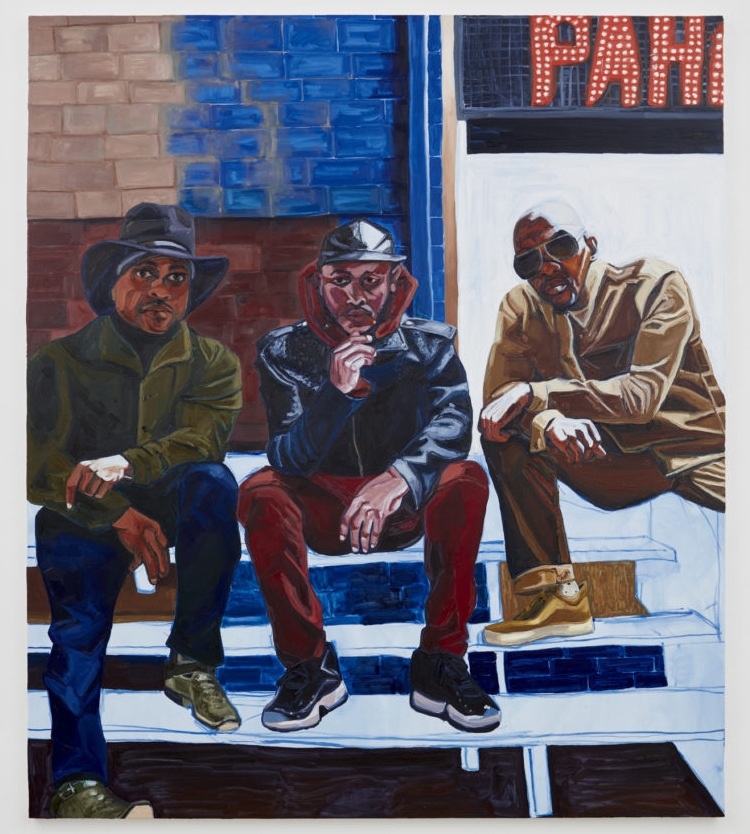
Jordan Casteel, Cowboy E., Sean Cross,
and Og Jabar (2017). Photo: Jason Wyche, courtesy the artist and
Casey Kaplan, New York.
Membership Benefits
“I think there are conceptions of what comes out of the Studio
Museum program that is potentially pandering, but if you actually
pay attention over time,” says 2007–8 resident Saya Woolfalk, the
museum “is constantly supporting all sorts of different kinds of
voices.” She considers the residency an area where “curators are
given the latitude to experiment.” For her, and many others,
the museum’s backing, through friendships and connections,
continues to pay tremendous dividends.
Huffman also acknowledges that the museum’s plugged-in curators,
who canvas for the residency, provide an important breeding ground
for unconventional work, but feels like there should be room
for more. Five years after his time at the museum,
he feels cut off from the institution and has a strong feeling
that what he made didn’t quite fit into the wider
institutional agenda. He and others say that while its
aesthetic mission is meaningful and
potentially paradigm-shifting for black art, it can’t
possibly represent the entire field of black art-making
(which, incidentally, the museum itself was instrumental in opening
up).
Regardless of the extent of his engagement with the museum after
the residency ended, Huffman still considers himself part of the
Studio Museum network, a sentiment echoed by many alumni. “I feel
like you’re always part of the family,” says Abigail DeVille, who
participated in the residency in 2013–14. “If you need support,
like in terms of promotion of a project that you’re doing? [The
museum is] just down for you, period, like you’re in the fold
now.”
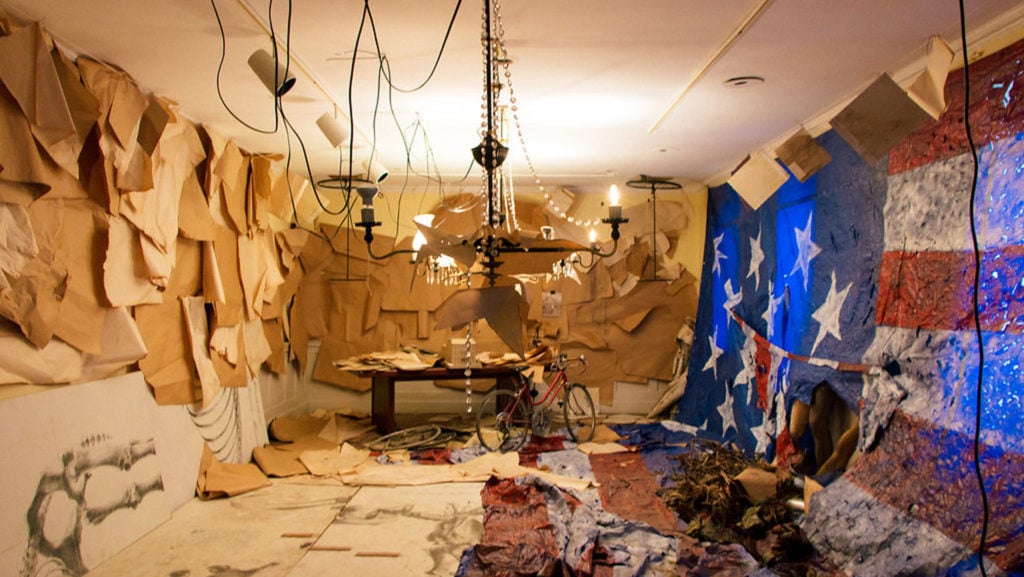
Abigail DeVille, Only When Its Dark
Enough at the Contemporary, Baltimore. Courtesy of the
Contemporary and the artist.
A Model of Success
As the director of another black
Harlem-based institution, the Sugar Hill Children’s Museum of Art,
Lauren Haynes understands how many interests a person like Thelma
Golden, and the Studio Museum as a whole, must balance.
“When I was just the artist in
Texas, with my nose pressed up against the glass, I couldn’t
understand why I got that rejection letter [from the residency],”
Haynes says. “I can’t go into all of what the mystery [of the
museum’s selections] is about, but I know it’s a lot more
complicated than just, ‘they don’t like me.’”
In some ways, Golden’s role is
so inscrutable because she is defining it as she goes along. In
addition to managing stakeholders with different priorities,
Patricia Banks explains, Golden has built enough symbolic capital,
by strategically positioning the museum as the main arbiter of good
black art, to establish the Studio Museum as a dominant institution
within the African-American art world and beyond. As a result, she
has been able to shore up significant financial resources. “Success
begets more success,” Banks says. “Influence begets more influence.
Donations begets more donations.”
By being the most prominent
program of its kind, the museum must carry an outsize burden to
decide what reflections or representations make the cut. Perhaps
that’s why, symbolically, the Studio Museum in Harlem has become
such a huge place, when in fact, the organization is rather
small—its operating budget is just $6 million (for comparison, the
New Museum’s is $13 million and MoMA’s is $147
million).
Looking ahead, the museum is
also working to cultivate artists and curators who go on to build
their own institutions. Two residency alumni, Kehinde Wiley and
Titus Kaphar, have established their own residency programs in
Dakar and New Haven, respectively. With any luck, an ecosystem is
developing in which the Studio Museum is no longer the only
institution that artists and the broader art community look to for
guidance on the future of black art.
“I personally know lots of
people who have blown up, that are basically canonized artists,
that did not get into the Studio Museum,” Abigail DeVille says. “At
the end of the day, there really are only three
spots.”
The post The Studio Museum Residency Has Shaped the World’s
Understanding of Black Contemporary Art. That’s a Lot of
Responsibility appeared first on artnet News.
Read more https://news.artnet.com/market/studio-museum-residency-analysis-1638781
Further reading


Leave a comment