
‘We Don’t Need to Demonize Wealthy People’: Ford Foundation President Darren Walker on the Unnerving Aftermath of the Warren Kanders Protests
This summer, something that once seemed impossible
happened before our eyes: a constellation of protestors managed to
topple the powerful vice-chair of a museum board. The trustee in
question, Warren Kanders, had served on the board of the Whitney
Museum of American Art for 13 years and had donated a total of $10
million to the institution. He is also the owner of a defense
company, Safariland, that produces munitions for police and
military forces and has supplied tear gas used against migrants on
the US/Mexico border.
Over eight months, the Whitney saw a wave of
demonstrations, led first by the group Decolonize
This Place and then by eight artists who
withdrew from the Whitney Biennial in protest of Kanders’s
presence on the board. And then, on July 25th, Kanders—who Whitney
director Adam Weinberg had tried to shield, arguing the museum’s
reliance on patronage meant it “cannot right all the ills of an
unjust world”—resigned in fury, declaring
that he refused to play a role in the museum’s “demise.”
Kanders’s downfall did not happen in a void.
Throughout the year, we had watched as museum after museum cut
financial ties with the Sackler family, the eminent art patrons
whose generous donations were funded by the fortune they made by
addicting huge swaths of the country to Oxycontin—a crime that has
now given rise to hundreds of lawsuits. Meanwhile, in London,
activist groups staged mass
demonstrations at the British Museum and other institutions to
protest their financial ties to petroleum companies. And the Guggenheim and
the New Museum became
embroiled in ugly confrontations with their staffs, who formed
unions to confront what they deemed unfair management
practices.
Still, Kanders’s resignation sent the museum world
reeling, posing questions that—for institutions reliant on private
patronage—bordered on the existential. Is there such a thing as
immaculate money? What litmus test would be extensive enough to
placate critics? And how can you convince wealthy donors to fund a
museum if they know their names can be stripped off the walls the
moment the source of their money falls afoul of popular
sentiment?
At a time when most leaders in the museum field have
made themselves scarce, fearing the slightest defensive peep would
draw the ire of an energized protest community now actively seeking
its next target, one of the few people to publicly address this
moment has been Ford Foundation president Darren Walker. A
near-universally respected figure who directs his organization’s
financial firepower—$600 million a year in grants, nourished by a
$13 billion endowment—toward socially progressive cultural causes,
Walker wrote an op-ed in the
New York Times the day after Kanders resigned titled
“Museums Need to Step Into the Future.” In it, he argued that our
institutions should seize this moment of social foment as an
opportunity to address issues of inequality, remaking their boards,
staffs, and programming to better reflect America’s growing
diversity.
Yet the rhetoric of populist anger toward wealthy
donors is something that makes Walker profoundly uneasy—in large
part because he, better than most, understands how reliant culture
is upon private philanthropy, and how vulnerable our institutions
would be if the source of this philanthropy were to diminish.
To better understand Walker’s reservations, artnet
News’s Andrew Goldstein spoke to the voluble head of the Ford
Foundation about his views on where things are headed.
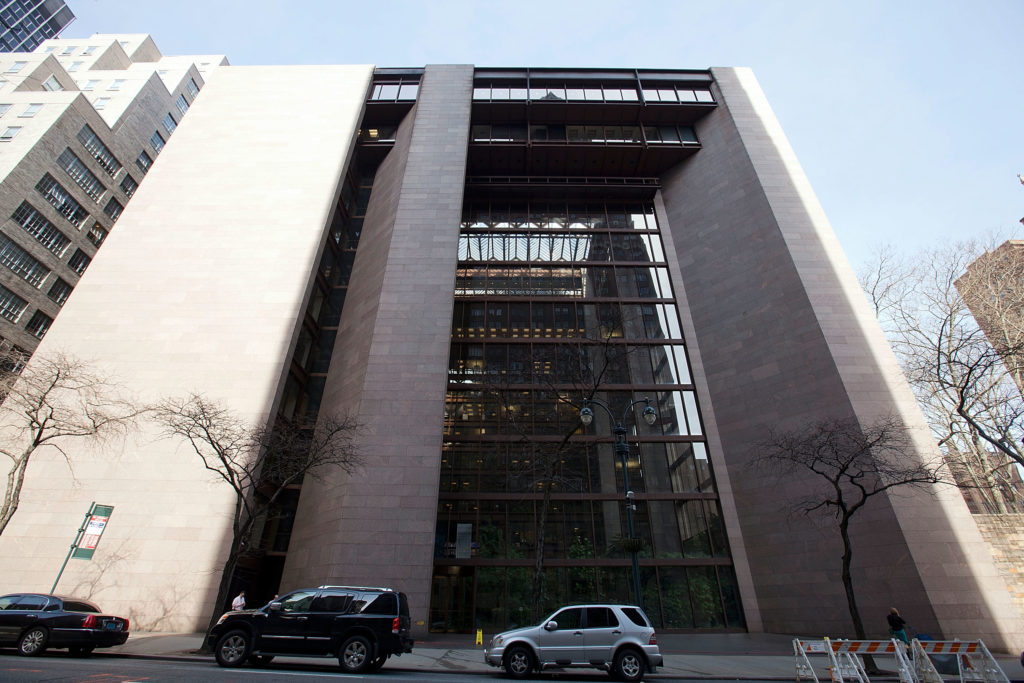
The Ford Foundation Building. Photo:
Dario Cantatore/Getty Images.
In your Times op-ed, you wrote that
the Kanders episode “reveals the extent to which museums have
become contested spaces in a rapidly-changing country,” finding
themselves “in the same struggle tearing society apart—a struggle
fueled by worsening inequality of every kind.” How does his ouster
make you feel?
Let me talk about the Whitney, and then let’s talk
about the larger issue. I think what was really unfortunate about
this is that, among museums in America, the Whitney stands out for
its diversity. This is the irony here—there is probably no museum
in America that has done more to transform itself in terms of its
programming, its curatorial staff, its identity, than the Whitney.
I think under Adam [Weinberg]’s leadership, the organization has
been an exemplar.
Now, having said that, I think one of the challenges
is that in this time of growing inequality, boards that are not
more diverse are more vulnerable to attacks. I don’t see diversity
as a defensive strategy. As I wrote in that piece, diversity is
additive to a board’s effectiveness and success. At the same time,
it would be really unfortunate if the result of this would be to
discourage generous donors from joining museum boards.
Museums need wealthy patrons on their boards. These
museums won’t stay open without the generous support of patrons. To
me, those are incontrovertible facts. What I also believe is that
their trusteeship should not be defined through a single criterion.
Because every board needs a mix of assets to be effective. Some of
those assets are financial, and some are more qualitative, more
relationship-oriented, more politically sensitive. They need to
recognize that museums have stakeholders, and those stakeholders
can be political stakeholders, community stakeholders, and other
people who care about the institution and who are influential.
You want to have a board that’s diverse enough that
these different stakeholders feel they have representation in the
institution. Unfortunately, some people have framed having a
diverse board as oppositional to having a wealthy board. These are
one-dimensional ideas. I’m simply saying that you can have both,
and you should have both. It would be a grave error to demonize
wealthy people. That is something that I find regrettable about the
discourse around the Whitney board, around this whole
controversy.
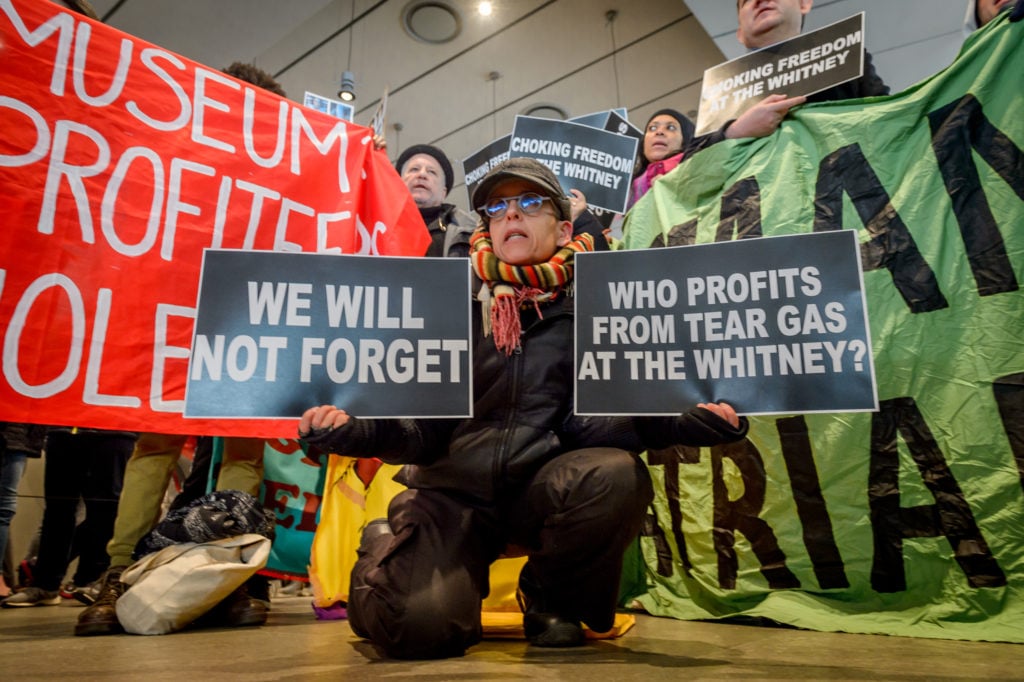
Activists took over the lobby at the
Whitney to protest Warren B. Kanders. (Photo by Erik
McGregor/Pacific Press/LightRocket via Getty Images)
While Kanders’s ownership of weapons companies
linked to politically repressive causes was the main rallying cry
in the push against him, it’s interesting that you pinpoint
diversity as one of the factors that led to the protests. One of
the prime movers in ejecting Kanders was Hannah Black, who co-wrote
the Artforum essay
“The Tear-Gas Biennial,” calling on artists to withdraw from
the exhibition. Two years earlier, she had also been a major figure in the outcry over Dana Schutz’s
Emmett Till painting Open Casket, which led to
a widespread referendum
on the politics of representation and diversity—which then, in
turn, led to this year’s Whitney Biennial being one of the most diverse on record.
The push for diversity and the demand for the ethical purity of the
board of trustees seem like very different things. How do you
reconcile them?
We have here a situation of the perfect being the
enemy of the good. I think what is disturbing is the rhetoric of
some of the protestors, who are in favor of destroying the system.
I think that would do irreparable harm. The protestors who want to
destroy the system, want to destroy museums, don’t have a solution
or a reasonable alternative to offer. It’s relatively easy to talk
about destroying a system. It’s harder to build and sustain one.
While I appreciate protests, those of us who are focused on
solutions can’t be distracted by extreme perspectives.
I wonder if the protestors might argue that it’s
not their job to be the solution—it’s their job to highlight and
intensify the problem. It seems that progressive forces are divided
between incrementalists who want to nurture slow, systemic changes
and accelerationists who are specifically trying to blow things up
so they can rebuild something more equitable from the rubble.
You’ve been involved in progressive causes for years. Which of
these do you find more useful and compelling as a strategy?
As a strategy, you have to be solutions-focused. One
of the things I worry about these days is that we have lost our
ability to understand nuance, and our awareness that context and
nuance still matter. While I am a believer in the need to dismantle
some of the systems and structures that represent a kind of a white
hegemony, I think it would be a grave mistake to destroy a cultural
ecosystem that needs reform, not destruction.
Our focus must be on reforming the system, not
destroying the system. I can’t speak for all of us in philanthropy,
but at Ford, we are system-reformers, not system-destroyers. I
think the system of board governance needs to be modified and
improved upon. It does not need to be destroyed, and we don’t need
to demonize wealthy people. There are some people who deserve
criticism. It’s an error to label broad swaths of people
negatively.
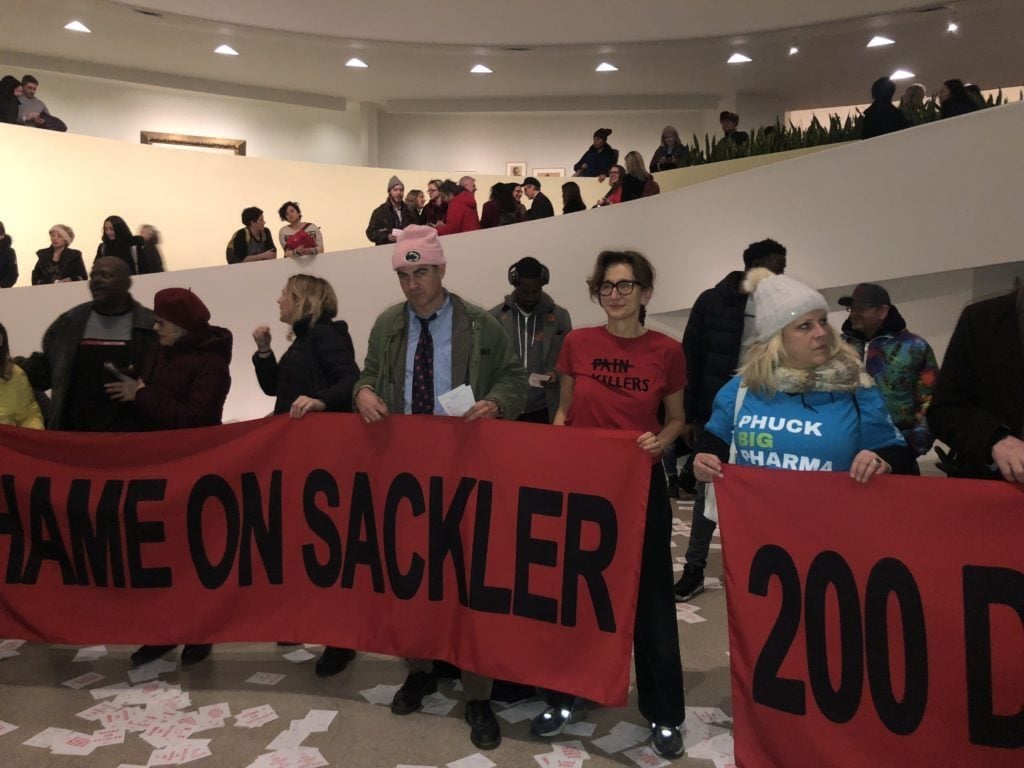
The protestors at the Guggenheim Museum.
Photo: Caroline Goldstein.
It seems to me that there is a lot of popular
outrage driven by the heat of the moment. While many museums have
severed ties with the Sacklers, refusing to take new money, there
have been some calls for them to also expunge previous gifts—even
though when institutions began taking money from family members
tied to Purdue Pharma, OxyContin was seen as a miracle painkiller,
not a glorified form of heroin.
This is a point I am familiar with. I lead a
foundation named for a man who, while he was a great
industrialist—and he was the first industrialist to name inequality
as a social problem—was a known anti-Semite and racist. John D.
Rockefeller’s company literally killed people in the pursuit of
extracting oil from the ground. These men were reviled in their
day. I say all of that to remind us that context matters. As you
say, there was a period of time when we did not understand the full
impact this drug. It had a different public identity, if you will.
That’s why I come back to context and nuance.
It might be hard to persuade donors to give money
to your museum if you can’t assure them that five years later,
you’re not going to vilify them and take their name off of the wall
when public sentiment around their industry changes. Consider
someone like Mark Zuckerberg, or even someone less currently
polarizing, like Sergei Brin. Would their money be a form of
acceptable museum patronage, or would that draw protests? How would
their gifts today be seen five years from now?
Part of the dilemma is that there is greater
transparency today than ever before. We live in a more democratic
time and a more participatory time. People hold institutions and
wealthy people more accountable. I think it’s a good thing to hold
us more accountable to be ethical, to be more conscious of the harm
that can be done from our investments and our businesses. I think
that’s fair. What’s not fair is to demonize people. Ultimately, it
could do more harm than good.
As you suggested in your op-ed, the cultural field
is starting to resemble the political field, with all of the
battles that are raging right now. The difference is that art
doesn’t have the same kind of organs that we have in the political
field—like Congress, or other legislative assemblies—to have
debates, resolve disputes, and create solutions-oriented policy.
There’s no place where all the various stakeholders can have
accountable representation and hash out differences. Do you think
it would be possible to create some kind of organization like that
that would have credibility?
Absolutely. First of all, I think this [moment] is
going to demand that the AAMD [Association of Art Museum Directors]
and the other trade organizations really up their games, because
more is going to be demanded of them. This is also going to mean
that museums will need to make sure that they have strong
community-relations programs, and that there are staff who are
dedicated to strengthening those relationships with key
stakeholders in order to build a sense of shared purpose and
vision. That’s going to be critical. We definitely need something
stronger than what we have.
The post ‘We Don’t Need to Demonize Wealthy People’: Ford
Foundation President Darren Walker on the Unnerving Aftermath of
the Warren Kanders Protests appeared first on artnet
News.
Further reading


Leave a comment