
Fistfights! Gallery Defections! Artist Lawsuits! Kenny Schachter on the Chaos of an Art Market Addicted to Easy Credit
On the first day back to school last
week, I had lunch with dealer Harry Blain at Sant Ambroeus on
Madison Avenue, New York’s uptown art canteen—just my luck I move
to LUES (Lower Upper East Side) when the art world is in the midst of a shift
to Tribeca. Within minutes I bumped into the Nahmad and
Acquavella families dining at separate tables. Near the end of our
meal, as Harry and I were talking shop, I noticed the notorious
Aaron Richard Golub, lawyer to the Nahmads and George Condo, being
led to a table with his young son in tow. As they wended their way
towards our perch I furtively tried to waive the maître d’
away, but it was too late.
You see, I have a bit of a history
with Golub, dating from when he once cursed me out at the top of
his lungs in Simon Lee’s Art Basel Miami Beach booth. The animus
relates to the fact Golub had introduced me gratis to Simon Lee,
who I did business with (and curated a show for) over the years,
while I asked dealer Rod Steinkamp for a commission fee when he and
Richard co-invested in some Chinese art after I acquainted
them.

Kenny’s LUES (Lower Upper East Side)
living space, decorated in his wife’s absence. Photo courtesy of
Kenny Schachter.
This week, as Yogi Berra aptly put it,
it was déjà vu all over again. When Golub spotted me at Sant
Ambroeus, he made his way to our table and told Harry (who doesn’t
even know him), “I’d talk to you but you are seated next to that
asshole. That’s right, he is a real fucking asshole.” Which may be
partly true, but is the bustling room of a restaurant the best
place to convey such sentiments at full volume? He didn’t stop
there. When I mentioned the fact that he might benefit from some
anger management—as I had helpfully pointed out in Miami, too—steam
practically erupted from the enraged 76-year-old attorney’s flared
nostrils, who shouted, in front of his bewildered child, that we
should step outside for a fight. (I’m a writer not a fighter.) If
ever there was a signal that the art season was officially
underway, that was it.
My very public altercation with
Richard reminded me of a trend in art economics, where an old
guard—white, male, and, occasionally, ahem, problematic (just watch
Golub’s absurd, funny-by-default music
video “Dancing for Justice”)—is fast becoming outmoded, and
starting to look a bit ridiculous. When it comes to lawyers, this
is happening at Sant Ambroeus. When it comes to artists, this is
happening on the secondary market.
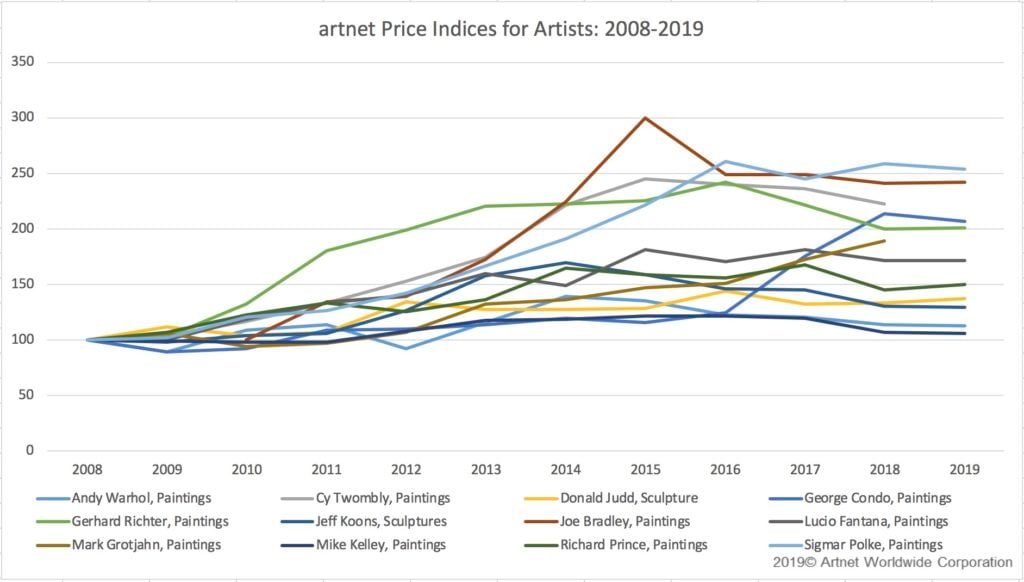
Notice a trend in these auction results?
Graph courtesy of the artnet Price Database.
Classic contemporary stalwarts of the
latest boom, which seem to have lasted forever (and a day or two)
have flatlined, including Andy Warhol, Gerhard Richter, Sigmar
Polke, Cy Twombly, Jeff Koons, Rudolf Stingel, Christopher Wool,
Mike Kelley, Donald Judd, George Condo, Lucio Fontana, Richard
Prince, and Mark Grotjahn. This in no way refers to the burgeoning
primary market of all the above, who are still firmly with
us—except for Koons, whose pornographically priced, lawsuit-attracting
baubles have slowed on that market too. One friend is being asked
to resell Condos that his clients only just bought, and they are
auctioning at prices approaching 20 to 40 percent less.
A similar situation has befallen the
classic car market, as Bloomberg reports in an article whose
headline copy could just as easily apply to today’s art market:
‘The Classic-Car Feeding Frenzy Is Over for Skittish Collectors –
Years of growth have left market over-saturated and pricey –
Lower-cost cars are booming as younger collectors pile in.” In art,
this translates to lower-priced works by woman and artists of color
soaring at auction as the art world plays catchup for past
marginalization—while causing some anxiety by spec-u-lectors up to
their eyeballs in trophies by previously lionized Caucasian male
artists.

A photo-collage portrait of Richard
Prince by Kenny Schachter from “Summer Rental” at Rental Gallery,
on view through September. Courtesy of Kenny Schachter.
If there was any more obvious a sign
of froth, the age-old sign of a top just as surely in a market as a
mug of beer, you can turn to the flamboyant gallery
expansions by the likes of Gagosian, Pace, Zwirner, and Hauser
& Wirth as they encroach more and more of Manhattan’s (and the
world’s) choicest real estate with imperially scaled galleries. You
can also see it in the about-to-be-effectuated
privatization of Sotheby’s. In all of this tumult, with news
traveling at ever-accelerated speeds, the up and down cycles of
artists’ price fluctuations are shorter than at any time
previously. From waiting-list-hot to impossible-to-offload
toxicity, artists are being churned, burned, and spurned as never
before.
When you look at previous auction
stars, there are fewer works on offer because people stop selling
when they realize stellar prices no longer exist the way they used
to. For the first in a long while, we’ve seen the market for
high-flyers behaving in lockstep, whereas normally there would be
individual artists moving up as others trended down. The
counterargument is that the slack has been picked up by the
previously mentioned women and black artists heading skyward—but,
then again, as a word of caution, Sam Gilliam and Mark Bradford are
both falling back along with Stingel, etc., after stratospheric
rises. There are exceptions to this rule, often courtesy
of the Saudi ruling
family, which has become among the most active buyers propping
up the likes of Condo and Prince, and even paying a fortune to
access Gerhard Richter’s studio. Funny how the art world turns a
blind eye to the regime that made sushi of Washington Post
journalist Jamal Khashoggi. (Hope I’m not next.)
All of this relentless price pressure
will surely effect small and mid-level dealers who are continuing
to fall prey to poachers and, worse, facing lawsuits for nonpayment
to artists. This is now said to be the situation with Michele
Maccarone, once a Midas of the mid-tier who didn’t respond to
queries about potential legal actions that might soon be initiated
by Ryan Sullivan (who had no comment) and Nate Lowman (who has yet
to respond at the time of this writing). Another sign of the hard
times that abound for many (other than the biggies… for now,
anyway)? I bumped into an artist and complimented her on the work I
purchased a year and half ago, which took her by surprise—she was
neither aware of that fact nor paid. A convenient oversight by her
struggling but well-regarded gallerist.

Nicole Eisenman’s Procession
(2019) in the Whitney Biennial. Courtesy of the artist, Vielmetter
Los Angeles, and Anton Kern Gallery, New York. Photograph by Object
Studies.
Nicole Eisenman has departed Anton
Kern, defecting to Hauser (that gallery seems to be swallowing the
art world whole); and, as previously reported, Avery Singer has
left Gavin Brown, but is still fence-sitting between Hauser and
Zwirner (after ruling out Gagosian for other reasons). Flux also
abounds in the still-mushrooming market for graffiti and street
artists, or those influenced by them, such as Eddie Martinez,
rumored to be heading to Gagosian from Mitchel-Innes & Nash, though
they claimed not to have knowledge of the defection, while Gagosian
never responded to queries. Eddie himself had this to say: “Nobody
has told me this but people keep telling me they hear I’m doing
shows at all these galleries that I don’t know about.” Hmm, I
still wouldn’t discount it. JR is headed to Pace, which will
inevitably impact on the extent of his commitment to
Perrotin—there are only so many ginormous photos you can glue on a
wall. Though maybe I’m mistaken on that front. In the small to
mid-sector, Walter Price has bolted Karma for Greene Naftali.
Also part of the continually changing
landscape, Zwirner has rescheduled his first show with Nate
Lowman—who recently fled to the gallery from arch-enemy Gagosian…
you need a flowchart to keep track of these moves—and shifted the
venue from London to Paris, since the art scene in London is
moribund for reasons too numerous to address here. (I got out in
the nick of time.) It’s become a currency arbitrage to pay
galleries by installments in pounds, with one gallery going as far
as advertising that the pound is down to its lowest level since
2017, thereby presenting an unprecedented opportunity for dollar
and euro buyers. Speaking of political instability, is Art Basel
Hong Kong toast? I’m not going, at least. (I don’t need to be beat
up twice.) If ever there was a more topsy-turvy time in the
world—socially, politically, economically, and environmentally—I
can’t remember it.

A protester in Hong Kong throws back a
tear-gas round at police during an unauthorized demonstration on
the fifth anniversary of the denial of universal suffrage to Hong
Kongers by the Chinese state. (Photo by Aidan Marzo/SOPA
Images/LightRocket via Getty Images)
Another factor fueling market mayhem
and unbridled speculation is debt, one of the three Ds that
traditionally bring art to market (divorce and death being the
other two). The difference now is that debt is arising from
leveraged art, which has become more of a force behind resales
these days. With a trillion or so worth of art filling the plethora
of freeports worldwide (and some actually hanging on walls), it has
never been easier to borrow off the back of artworks—until, that
is, the inevitable need to pay the piper (back) pops up.
Auction houses are like big pharma,
profiting from feeding addicts with easy access to opioids, then
making even more money when they become hooked (if they survive),
providing a cure by way of additional costly meds. The art-world
version the widespread availability of credit collateralizing art
at fifty cents to the dollar, then swooping in to re-auction those
works (and more) when investors can’t pay. This is an increasingly
common trajectory now that art-lending spigots have flooded the
market with ready cash, fueling art-flation. Watch for more such
deaccessioning in the fall.
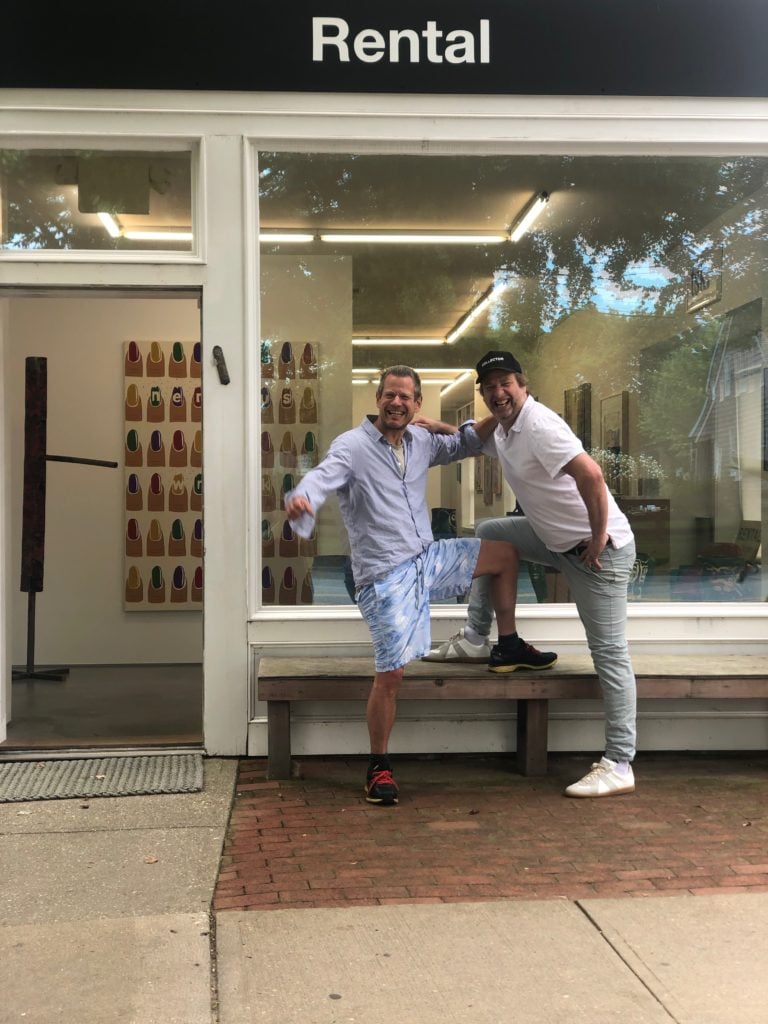
Kenny and Rental Gallery’s Joel Mesler:
like a Catskills Vaudeville show, but worse. Photo courtesy of
Kenny Schachter.
Things to look forward to in the
nearer future? There is the Bridge car-and-mini-art fair on a golf
course in Bridgehampton next week, starring my 1977 Volkswagen
Golf, fittingly enough. And, the “Summer Rental” group show I
curated at Joel Mesler’s Rental Gallery in East Hampton, featuring
work by Mark Grotjahn (forget what I said before), Jacquline
Humphries, Roy Lichtenstein, and Loie Hollowell, who is about to
premier at Chelsea’s new Pace palace. Oh, the show also has work by
Joel and various members of my family, and it’s up through
September. (Consider this self-promotion, nepotism, and
self-dealing all rolled into one. You’re welcome.) After that, it’s
back on the hamster wheel en route to Frieze and FIAC—if I survive
another encounter with Richard Golub, that is. Any of you guys
moonlight as boxing coaches?
Oh, and this just in via direct
message on Instagram:
“Kenny there is an Israeli guy in
Barcelona looking to buy valuable assets in cash. Euros. Everything
must be presented to him – provenance, valuation etc. He will pay
travel fees plus a 50k fee if he agrees to buy and then changes his
mind on the day. Would you be interested in selling some expensive
pieces of art to him? I can arrange if so. Payment will be cash in
euros. Or 150k in wire transfer or the full amount in cripto. It
needs to be below market value from his point of view.
Interested?”
For your information, I replied
negatively. We have seemingly entered a period of post-art-dealing
anarchy, where anything goes (other than buying art to hang in your
home). How much more unhinged can things get? I fear we are about
to find out.
The post Fistfights! Gallery Defections! Artist Lawsuits!
Kenny Schachter on the Chaos of an Art Market Addicted to Easy
Credit appeared first on artnet News.
Read more https://news.artnet.com/opinion/kenny-schachter-back-to-school-september-2019-1646179
Further reading


Leave a comment