
The Curators of the Bergen Assembly Open an Exhibition With a Never-Say-Die Attitude
Norway has hosted a staggering
number of biennials and other big art events this year. From the
inaugural Oslo Biennial, and an architecture triennial in the
capital, to Momentum, LIAF, and Screen City in the more remote
locations of Moss, Lofoten, and Stavanger respectively, there is no
shortage of international exhibitions in the sparsely populated
country. The Nordic country’s most critically lauded, and best
established event, is the Bergen Assembly, a triennial exhibition
that returned to the small Norwegian city last
week.
Appointing curatorial teams to
helm major biennials and triennials is a growing trend. The
Bergen Assembly was an early adopter of a collective approach. But
the jury is out as to whether a multi-headed approach really makes
for more inclusive exhibitions that are better suited to these
politically fraught times.
The Bergen Assembly’s curatorial
team is once again the size of a soccer team. The main “conveners”
of the 2019 edition are the German curators Iris Dressler and Hans
D. Christ. The co-directors of the Württembergischer Kunstverein in
Stuttgart invited 11 collaborators to collectively organize the
exhibition “Actually, the Dead Are Not Dead.”
The international team includes
Simon Sheikh, a curator who teaches at London’s Goldsmiths College,
the human rights lawyer Murat Deha Boduroğlu, the Spanish
philosopher Paul B. Preciado, and artists Emma Wolukau-Wanambwa,
Hiwa K, and Banu Cennetoğlu, among others.
As its title suggests, the
exhibition aims to give voice to the voiceless, make space for
dissident opinions, and celebrates the rebellious spirits that find
little representation in the mainstream.
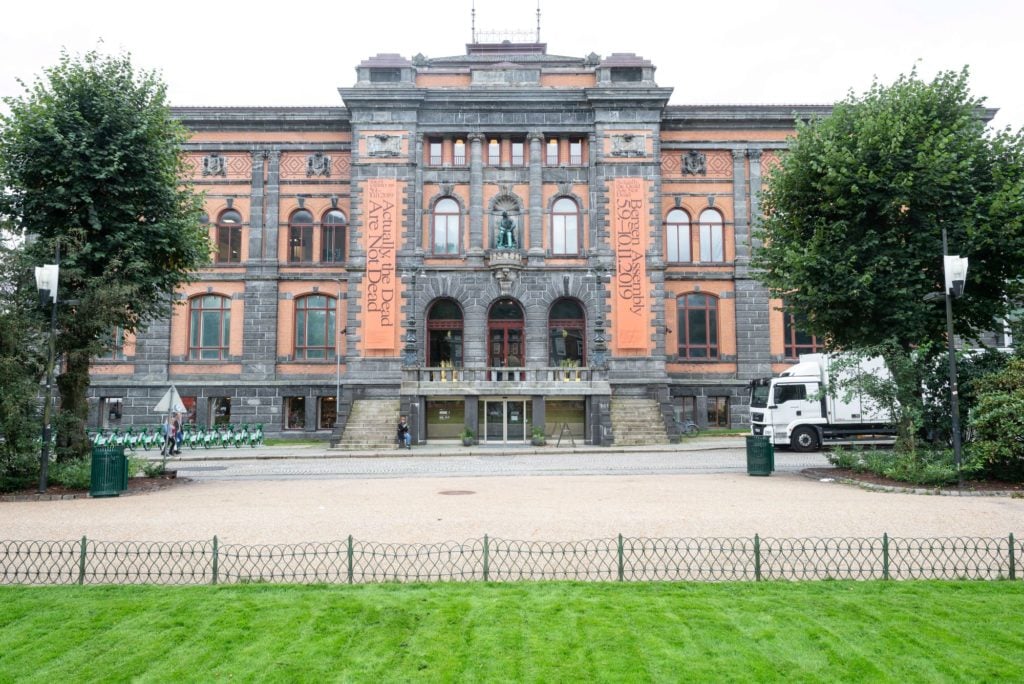
One of the main venues of Bergen
Assembly, KODE 1. Photo Thor Brødreskift.
Several of the Bergen
exhibition’s main concerns continue where the socially-engaged
documenta 14 in Kassel and Athens left off. This is perhaps
inevitable given that some of the artists on the curatorial team
participated in the 2017 edition of the prestigious,
quinquennial exhibition. Preciado was documenta 14’s curator
of public programs.
Visitors to Kassel two years ago
may remember the moving, life-affirming paintings, drawings, and
photographs by the late Lorenza
Böttner, which are
on show in Bergen as well. A transsexual artist born to German
parents in Chile, she was raised in Germany after an accident that
left her with no arms. She painted with her feet and mouth, and was
a formidable dancer.
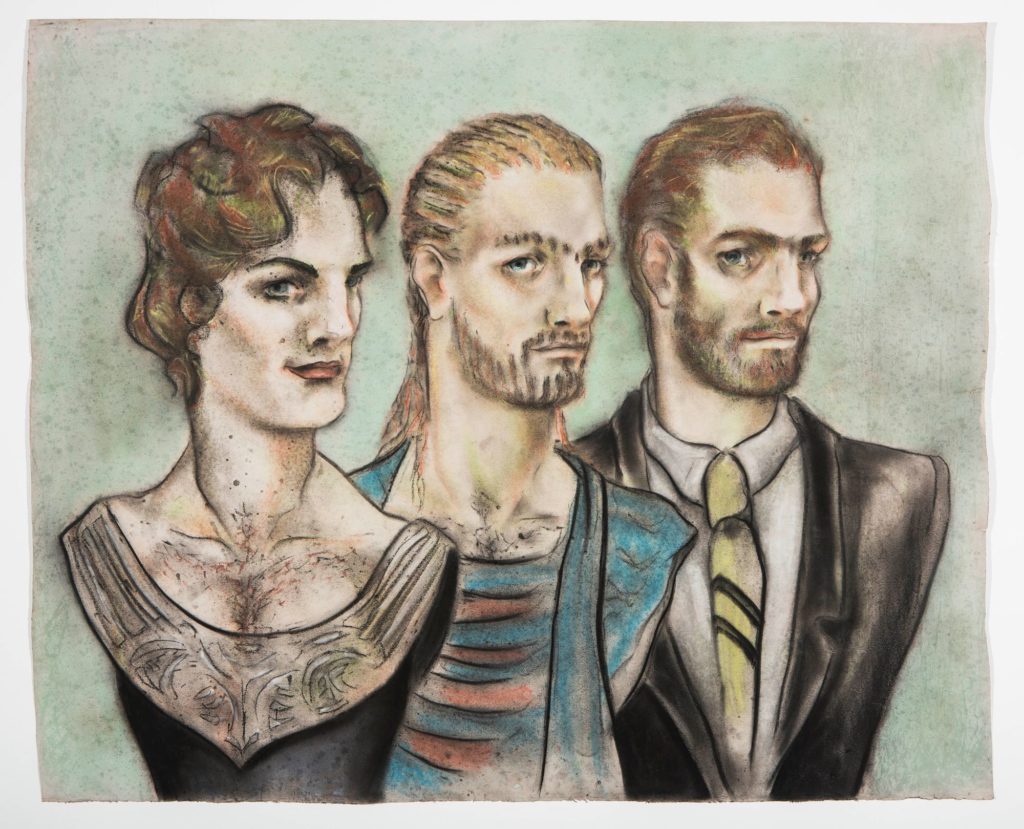
Lorenza Böttner, untitled
(no date). Courtesy private collection.
Having brought the series of
gatherings and performances called “The Parliament of Bodies” from
documenta to Bergen, Preciado called to life the Society of Friends
of Lorenza Böttner in a gathering programmed around differently
abled bodies. (Böttner’s mother is one of the Society’s founding
members.) Preciado declared to an elated audience that the Society
will work to counter the authority of the hand (as opposed to other
body parts) in the history of art.
By coincidence, there was a
political gathering of different local groups working to improve
the rights and conditions of the disabled held in a nearby park.
One group had a banner that said: “I want to be your colleague, not
your inspiration.” That the two events took place within a few
hundred meters of each other and did not connect speaks to the
insularity of the art world.
From Above a Bar to the Gallery Wall
The happening, Gypsy
Girl (2019), was organized by triennial conveners
Pedro Romero and Maria Garcia. In the performance an erotic,
semi-nude portrait of a Roma woman by the Hungarian-Roma artist
Charles Roka was removed from a local bar, where it has hung for
years, and taken in a celebratory procession to the Kode 1 art
museum. There the curators hung it alongside politically charged
works.
Roka, who lived in Norway, was a
serious painter but could only find commercial success with his
pinup-style paintings of olive-skinned temptresses. The curators
draw a parallel between his work and an action in 1964 when pin-up
photographs were hijacked by anonymous Situationist artists to
challenge General Franco’s dictatorship in
Spain.
The happening was criticized in
a talk by local Roma-rights activist Tore-Jarl Bielenberg about
Norway’s treatment of its Sinti and Roma in World War II. He argued
that it was unfair to Roka to place his painting in the museum
among works by artists, such as the Austrian-Roma Ceija Stojka. An
Auschwitz survivor and activist for Roma rights, she painted
haunting images of women prisoners’ starved bodies in the Nazi
concentration camps.
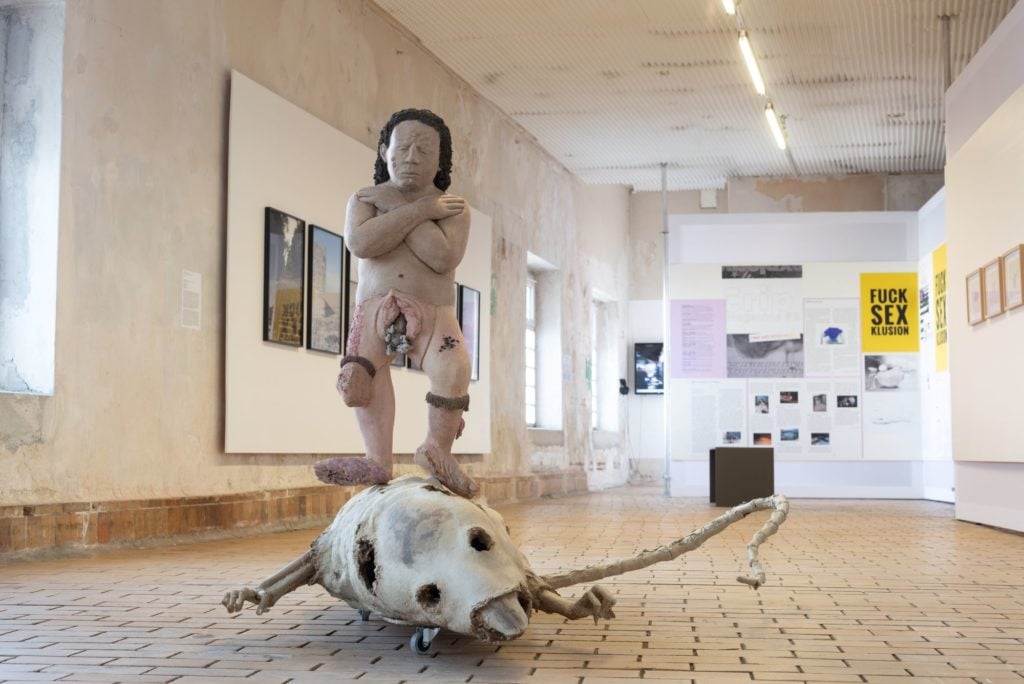
Ines Doujak
Sing Along! (2019). Co-produced by Bergen Assembly
2019.
Of the many artists showing
engrossing, thought-provoking works, those by the Austrian feminist
artist Ines Doujak stand out. Her sculpture, drawings, and a
collaborative info-chart with John Barker were shown across three
venues. Visually enthralling, Doujak’s works are populated
by mythical beings, part-human, part-animal, and part-plant, that
embody histories of inequality, cruelty, and disregard of human
life.
Trolling in Norway
Ample weight was given to time-based formats in the triennial’s
opening weekend’s program, including interactive role-playing board
games, a medium that is gaining visibility in the art world. One of
the games, Troll Swamp (2019) by artists Anne de Boer and
Eloïse Bonneviot, focuses on acting out the players’ online
behavior, tackling the dangerous disconnects in our daily
interactions, on- and offline.
The exhibition is not without its artistic highlights and
discoveries, but at the same time it is riddled with contradictions
and gestures that fell flat. So what went wrong?
When the proposal to host an art
event in the Norwegian city was first put forward by its
municipality a decade ago, art world intellectuals responded with a
heady gathering in the Bergen Kunsthall that questioned how to
meaningfully influence the booming trend for what was, essentially,
art events backed by tourism bureaus around the world. The
resulting Biennial
Reader (2010) is still a
definitive publication on the matter; it also provided the
theoretical blueprint for launching the Bergen Assembly
triennial.
But ten years on, the question
that lingers after the Assembly’s opening weekend is not whether
we’ve reached saturation point, or Peak Biennial, (we have, but
that’s ok—there’s enough art to show and enough audiences for it)
but rather, have we arrived at Peak Biennial
Navel-Gazing?
“Actually, The Dead Are Not Dead,” Bergen Assemby 2019,
September 5 through November 10, various venues, Bergen,
Norway.
The post The Curators of the Bergen Assembly Open an Exhibition
With a Never-Say-Die Attitude appeared first on artnet
News.
Read more https://news.artnet.com/exhibitions/bergen-1646437
Further reading


Leave a comment