
Pace’s New Chelsea Flagship Is a Strange, Stunning Gamble on a New Direction for the Mega-Gallery. Can It Pay Off?
“People always ask me, ‘Did you
ever imagine?’”
This was how Pace founder Arne
Glimcher opened his remarks at the unveiling of his gallery’s
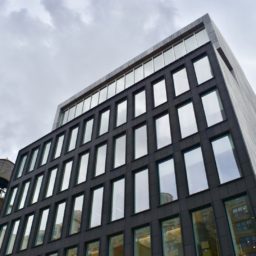
gleaming new eight-story, roughly 75,000-square-foot
headquarters in Chelsea Tuesday morning. The unnamed object of
his question was not just the building clad in 900 panels of
volcanic stone that is now Pace’s central nervous system. It was
also an allusion to the organization at large and the
globe-spanning, cross-disciplinary program the building was
designed to serve, at a cost of tens of millions of
dollars.
Glimcher has an answer for that
question: “No, but it’s not about imagining,” he told the assembled
crowd of artists, staffers, and journalists. “It’s about seizing
the moment and knowing what’s relevant to the time.”
Judging from the structure now
sited at 540 West 25th Street, what Pace’s leadership believes to
be relevant to 2019 and beyond is a counterintuitive redefinition
of the gallery model. What remains to be seen, however, is whether
their bold vision can overcome the considerable practical
challenges Pace has accepted to chase it.
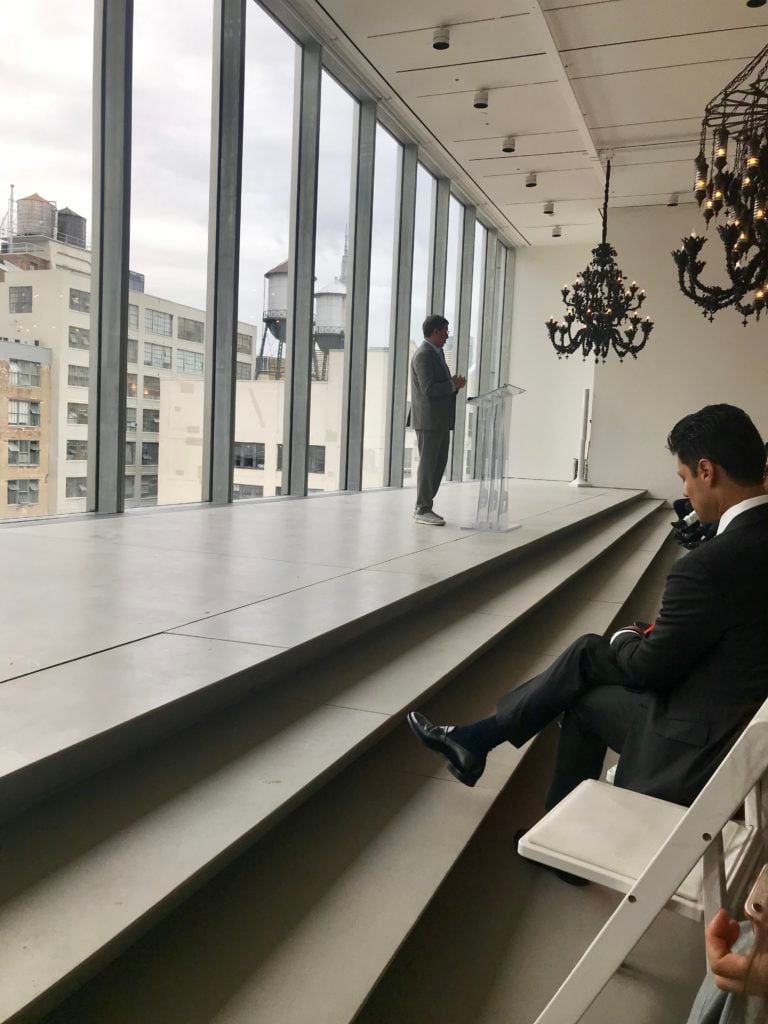
Pace Gallery president and CEO Marc
Glimcher during his opening remarks during the unveiling of the
gallery’s new headquarters. Photography by Tim Schneider.
Pace Past, Present, and Future
No one is more responsible for
this vision than Marc Glimcher, who has been the gallery’s public
face and driving force for change since being named its president
and CEO in 2011. During a public talk at the
92nd Street Y with
author and Vanity
Fair editor Michael
Shnayerson the night before, Arne credited his son with convincing
him that Pace should think bigger—and specifically, higher—during
their early conversations about the gallery’s need for more New
York real estate roughly four years ago.
Arne said that, at the time, he
thought they should just take “two or three floors” of a new
building. But in Arne’s telling, Marc argued that the organization
should “consolidate” by building “a vertical Pace gallery instead
of a horizontal one.”
Marc prevailed. Pace’s new
headquarters is quite literally stacked with potential: three
levels of versatile, column-free indoor galleries; two levels of
office space; one open-air level for outdoor sculpture; one
interior level for Pace Live, the
gallery’s fledgling performance, new-media, and event program; and
an uppermost level of private viewing space, including a rooftop
sculpture garden.
Also included in the stack: an
over-10,000-volume research library, an outdoor terrace gallery, a
dining room for private events, and, according to Marc, enough open
storage space to house 500 to 600 sculptures. The gallery even
acquired a food truck for the outdoor sculpture area.
All of the above is intended to
push Pace out of a retail-gallery mindset and into a new life as a
“communal space for thinking, transcendence, and contemplation,” as
the younger Glimcher put it in his portion of the opening remarks
Tuesday morning. “The idea is that art is for everybody,” he said,
not just “intellectuals.” Following this vision would allow
Glimcher and his team to “build a new kind of inclusive
organization.”
Notably, this sense of
inclusiveness is as crucial to Pace’s inner workings as to its
relationship with the public. Glimcher told artnet News during the
preview that he also sees his gallery’s new flagship location as an
adaptation of the campus model favored by Silicon Valley tech
giants like Facebook, Apple, and Google: a nucleus of talented
personnel, top-flight business resources, and copious amenities
condensed into a single all-purpose location so that collaboration
and cohesion can flourish.
“Everybody gets so siloed in the
art world because you’re always on the move,” says Glimcher.
Whether caused by scurrying between multiple locations across
Manhattan or between international art fairs and biennials, such
nomadic isolation only exacerbates the dangers that many, if not
most, successful galleries face by operating as what he calls
“personality cults” wholly attuned to the vision of their namesake
founder(s) alone. “If
we don’t transform that, you put all this effort into a building,
and it’s over when the founder croaks,” says Glimcher.
He maintains that the only way
to avoid this fate is to “institutionalize” a gallery’s knowledge,
skills, and perspective. “You’re going to create leadership teams and
all these things they talk about in Silicon Valley, and you’re
going to create a way a vision can continue beyond a person. That’s
what we’re trying to do.” Concentrating as much of your best
personnel as possible in one headquarters juices this process—and
Glimcher contends that it is already paying dividends for
Pace.
Which would be a major positive
for the gallery in light of some of the new building’s frankly
stunning risks and realities.
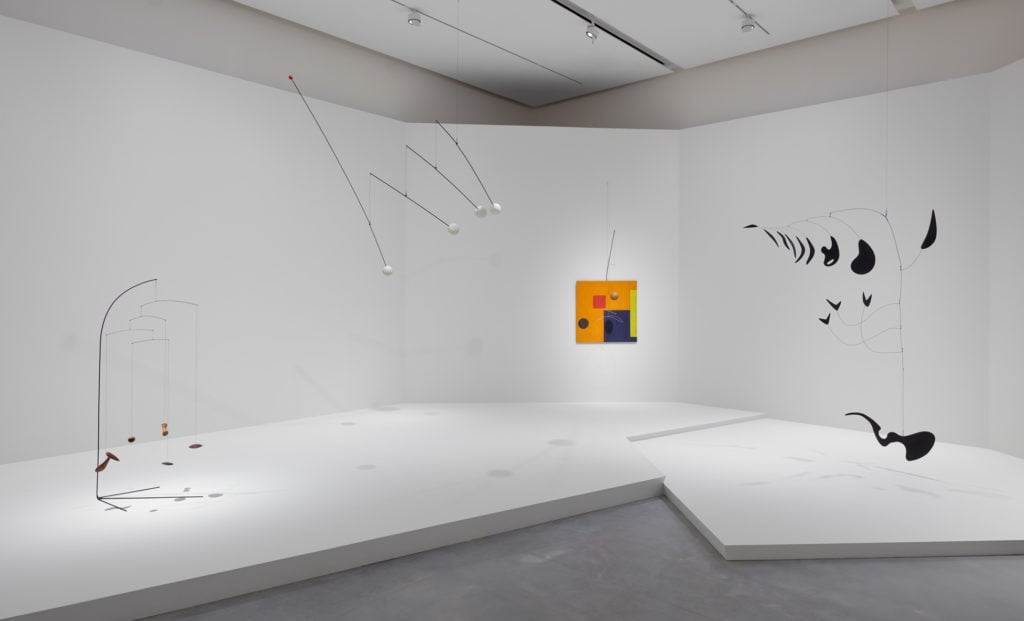
Installation view of Alexander Calder,
“Small Sphere and Heavy Sphere,” at Pace Gallery, 540 West 25th
Street. September 14–October 26, 2019. Photo: Tom Powel Imaging. ©
2019 Calder Foundation, New York / Artists Rights
Society (ARS), New York
A New Lease on Life
Since getting my first art job
14 years ago, I have analyzed a lot of statements by a lot of
gallery leaders about a lot of major new endeavors. But it wasn’t
until yesterday’s Pace preview that I heard one that included a
thank-you to “our fearless landlords, who took this journey along
with us.”
That was Marc Glimcher’s
reference in his opening remarks to Weinberg Properties, the
developer and owner of 540 West 25th Street. It was a bracing
reminder that, while Pace worked with Bonetti / Kozerski
Architecture to design the structure and pumped a reported $18.2
million into its interior build-out, the gallery does not hold the
deed to the property.
Instead, Pace has agreed to a
20-year lease that locks in a rate of roughly $112.66 per square
foot, according to the Art
Newspaper. Based on
Pace’s description of the building as “approximately” 75,000 square
feet, that rate would commit the gallery to paying in the
neighborhood of $35,200 per month, or about $8.45 million in rent
over the lease’s lifetime.
Combined with the aforementioned
$18.2 million budget to customize the interior and the reported $80
million cost of the building’s shell, Pace’s new headquarters could
force the gallery to cough up close to $125 million by 2038. (An
inquiry to a gallery spokesperson regarding whether Weinberg
Properties paid any portion of the construction costs was not
returned by publication time.) Assuming all goes well, the
gallery’s reward in another 18 years will be… to either negotiate a
new lease, or move out.
Asked about the financial
demands of the new flagship, Marc Glimcher told artnet News, “It’s
super expensive. Super expensive. Because you’re gambling that all
those good things”—the vertical integration, the collaborative
approach, the pristine and versatile new exhibition spaces—”are
going to add up to enough revenue to keep the thing
rolling.”
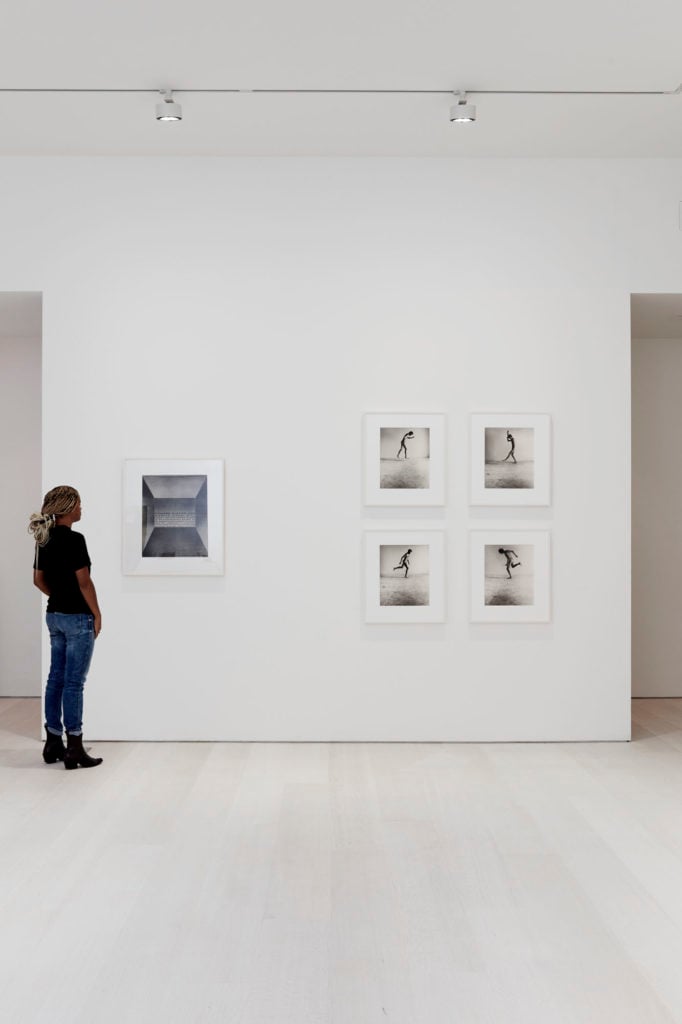
Installation view of
“Peter Hujar: Master Class” at Pace, 540 West 25th Street, New
York. September 14–October 19, 2019. Photographed by Jonathan
Nesteruk, courtesy Pace Gallery.
The Amazing Shrinking Mega-Gallery
About those new exhibition
spaces….
Touring the open levels of
Pace’s new headquarters led me to another jarring experience on
preview day. One way to describe it would be to say that the
galleries felt far more intimate and approachable than I
anticipated from an approximately 75,000-square-foot behemoth.
Another would be to say that they felt… kind of small? Even a bit
cramped at times?
I know, it sounds ludicrous!
Part of the effect is undoubtedly a result of the curation and
exhibition design of the current shows. The ground-floor gallery
hosts Alexander Calder’s “Small Sphere and Heavy Sphere,” a capsule
history of the mobile that carves the space into a series of curved
corridors and smaller galleries more amenable to the domestic scale
of the works on view. Pace also decided to mount three shows—David
Hockney’s “La Grande Cour, Normandy,” Peter Hujar’s “Master Class,”
and an ensemble of African and Oceanic antiquities from
Pace/MacGill—on the third floor, which, at only 1,900 square feet,
is already the most compact in terms of exhibition space. (The
second-floor galleries allowed Loie Hollowell’s saturated,
low-relief abstractions to breathe perfectly easily.)
Circumstance didn’t help the
gallery’s cause, either. No sculptures were installed on the
open-air sixth floor in time for the preview, and the only presence
on the impressively wide Pace Live stage was a lucite podium, a
wireless mic, and the Pace speakers who came up to use them one
after the other. This program also gave the series of Fred Wilson
chandeliers hanging overhead the feel of artworks hastily installed
by tenants right after moving into a new apartment in a bid make
the place look at least a
little alive.
But the surprisingly miniature
affect of the supposedly maximal new Pace isn’t entirely
situational, either. In fact, it is baked into the structure to a
startling degree. Using the square-footage numbers in the press
kit’s fact sheet, below is a chart I created to illustrate how the
approximately 75,000 square feet of 540 West 25th Street was
custom-built to be used.
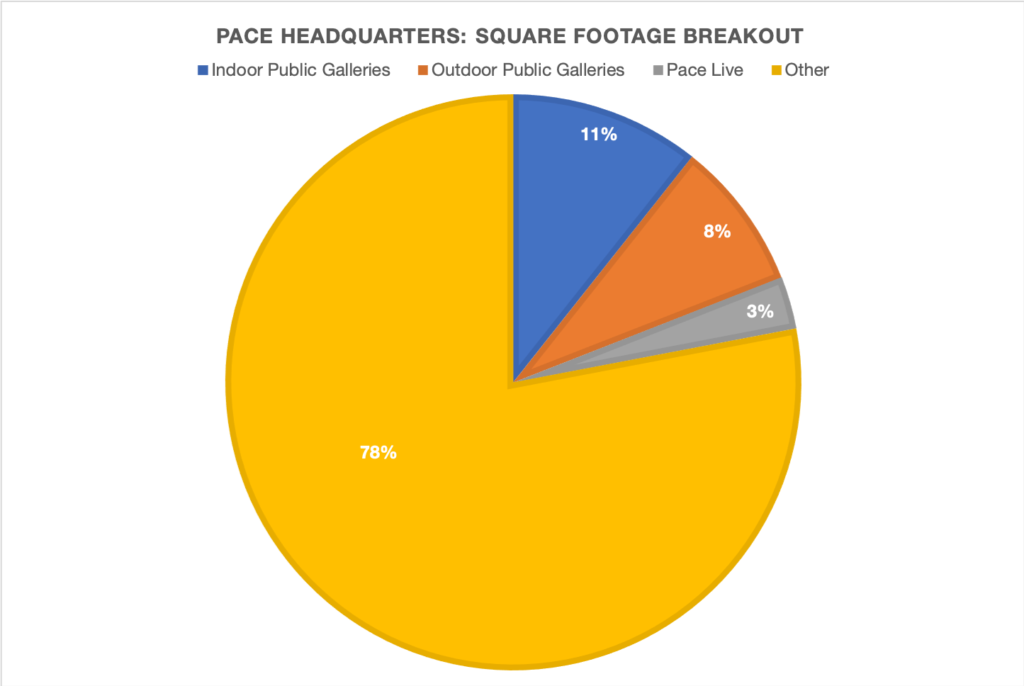
Breakout of space usage in Pace’s new
approximately 75,000 square foot Chelsea headquarters. ©Tim
Schneider.
In fairness, this chart is a
little deceptive. The “other” space includes the private viewing
rooms, storage for inventory, and the research library, where small
exhibitions will be held. (The space currently hosts a show of Yto
Barrada’s wallpaper and works on paper.) The offices, too, double
as viewing rooms, as any dealer will tell you. So it’s not as if
that entire sprawling wedge of gold on the chart above offers Pace
zero opportunities to actually sell artwork.
Still, it is remarkable to me
that leadership chose to reserve only 16,500 square feet of public
exhibition space across five floors—just over 10,000 square feet of
that space being indoors—in a roughly 75,000 square foot
mega-gallery that may cost them as much as $125 million to occupy
temporarily.
For comparison, that’s only
about 50 percent more space than Lehmann Maupin bought (emphasis on
“bought”) in a Chelsea tower for $27 million,
according to Brook
Mason, and less than half the square footage gained by Gagosian
when it recently agreed to rent the spaces
vacated by Mary Boone and Pace on West 24th Street.
(It is not known how much of the
Lehmann Maupin and Gagosian expansions will be exhibition space
versus other functional space.)
Granted, artists in 2019 need
much more than just public gallery space to thrive, as Marc Glimcher
has emphasized again and again. But the flagship’s composition looks like a
high-resolution, Jumbotron freeze-frame of Pace’s hard break from
the traditional, salable-object-based gallery model—proof that its
brain trust is not just spewing empty rhetoric about adopting an
unprecedented approach to contemporary art in the commercial
realm.
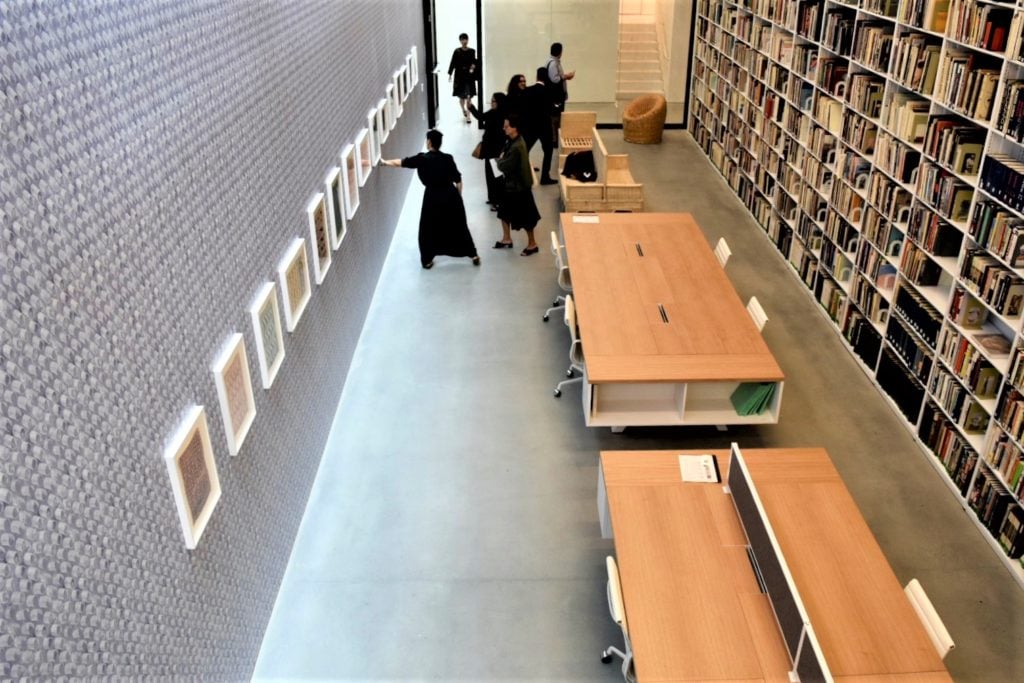
The research library at the new Pace
gallery, with works by Yto Barrada (at left). Photo by Ben
Davis.
Rolling With the Punches
Even with all these caveats, the
element of Pace’s expansion that most makes me squirm like a
stomachful of tainted ceviche is how much of it stemmed from
Weinberg Properties’ negotiating leverage. Asked whether the
gallery would have made such an Olympic leap of faith if his
landlords hadn’t already decided they would develop 540 West 25th
Street as an arts hub with or without him, Glimcher told artnet
News, “You want the real answer? Yes, the Weinbergs made it
happen,” adding that “a strategy is something that happened in the
past and it worked. Then you call it a strategy.”
Yet this instance of apparently
forced adaptation chimes with the gallery’s early beginnings to an
almost eerie degree. In BOOM, his book about the contemporary art market’s
explosive growth since the postwar years, Michael Shnayerson
recounts how, after moving Pace to New York from Boston in 1963, a
young Arne Glimcher had to assemble a roster of artists after the
city’s heavyweight dealers had already absorbed entire avant-gardes
whole. Leo Castelli had a monopoly on the Pop artists. André
Emmerich had a monopoly on the color-field painters. Who was
left?
Glimcher termed them “highly
individualistic” artists, meaning ones who could not be easily
assembled under the banner of a single dominant aesthetic or
working philosophy. A few years in, the headliners
included Louise
Nevelson, Robert Irwin, Agnes Martin, and Lucas Samaras, all of
whom stayed with the gallery for decades. The elder Glimcher
name-checked all four of these artists near the close of his
remarks on Tuesday morning as “key people I owe everything to,”
adding that the only reason he had access to Samaras was because
“Castelli didn’t want him, and [Sidney] Janis was afraid of the
work.”
In other words, being pressured
by circumstance to zig when everyone else had zagged worked
extraordinarily well for Pace before. The situation led Arne, his
gallery, and eventually his son, to adopt what Arne described at
the 92nd Street Y as “a particular point of view” based on the
notion of art as “a tool by which society extends its perception.”
(He then went on to explain how this approach differentiated Pace
from its mega-gallery competitors, saying, “We do not have a
perfume. We are not trying to make a lifestyle
gallery.”)
It is a generational symbol of
the art market that real-estate pressure—combined with Silicon
Valley management philosophy—is now shaping the way Marc Glimcher
to trying to match the bold moves that artistic pressure drove his
father to make roughly 55 years ago. But that doesn’t mean his own counterintuitive
vision can’t succeed just as spectacularly.
Arne Glimcher closed his remarks
about the new space (and the new Pace) by musing, “As old as I am,
I’m still subject to wonder.” Perhaps his coda should serve as a
reminder that everything seems impossible until someone actually
does it. Either way, I don’t think we’ll need to wait until 2038 to
find out whether Pace’s greatest gamble yet pays off.
The post Pace’s New Chelsea Flagship Is a Strange, Stunning
Gamble on a New Direction for the Mega-Gallery. Can It Pay Off?
appeared first on artnet News.
Read more https://news.artnet.com/art-world/pace-flagship-stunning-gamble-1647556
Further reading


Leave a comment