
‘There’s Nothing More Satisfying Than Making Art Accessible’: Art Production Fund Director Casey Fremont on the Power of Public Sculpture
With so many gallery and
exhibition openings this month, the fall art calendar can feel a
little overwhelming. But there’s also great art to see while you’re
out and about in public spaces that don’t require
ticketing.
Casey Fremont, executive
director of the Art Production Fund, a non-profit arts organization
that presents large-scale, cutting-edge contemporary works around
the world, should know. Fremont—who is responsible for selecting
artists and commissioning new works—has been with APF 15 years,
where she has overseen projects such as Ugo Rondinone’s
Seven Magic Mountains
in Las Vegas and Elmgreen and
Dragset’s Prada
Marfa in
Texas.
artnet News caught up with
Fremont to discuss the projects she’s working on this season, her
can’t-miss list of fall exhibitions, and her thoughts on the role
social media plays in the promotion of art.
How did you come to work for the Art Production Fund?
I started out as an intern when
I was 16 years old, in high school—so 20 years ago, which is
insane. I interned there for two summers, and then I graduated
college and started working for [founders] Doreen Remen and Yvonne
Force Villareal. It was just the three of us for many years; I
joined in 2004, only four years after APF’s founding. And then in
2016, Doreen and Yvonne stepped away from the day-to-day
operations, and I took over as director. So, including my
internship years, I’ve been with the organization since it sort of
began, which is amazing and quite rare in the art
world.
What do you enjoy most about working for a non-profit art
organization?
I think what’s obviously the
most rewarding thing about presenting art in the public realm is
that you get feedback from everyone. So, it’s always interesting
when you launch a project and you think it may be received one way,
but it impacts people in ways you hadn’t really considered. It’s
exciting and it’s always different given that we generally program
in spaces where we haven’t worked before. That can be challenging,
but once we make it work, it’s always satisfying, at the end of the
day.
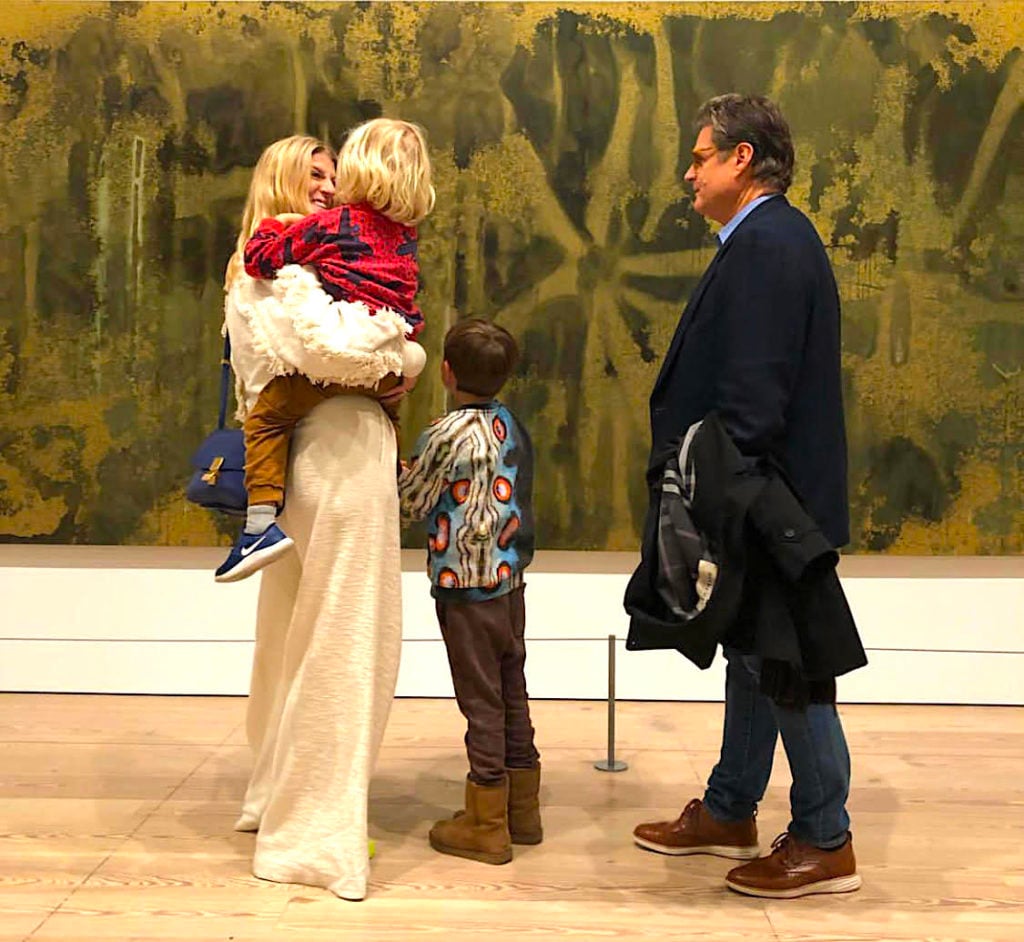
Casey Fremont with her kids and father
at the Whitney Museum. Photo courtesy Casey Fremont.
Did you ever consider making a switch to work for a museum or
private gallery?
The only other “job” I’ve had
was interning at Kasmin Gallery, when I was in college. I enjoyed
being in the gallery setting, but working at APF was still my
absolute dream job. Even 15 years later, every project is
ultimately a new experience, and brings new challenges along with
it. It’s never boring, and there’s nothing more satisfying than
making art accessible to people from all walks of life, and giving
artists the opportunity to realize an installation in a public
forum.
What was the first major public project that you worked
on?
Prada Marfa
in 2005. We dealt with so many
challenges—from fundraising to fabrication and vandalism, after the
opening. There was an immediate, overwhelming response to it—even
without social media back then—and it was clear a very important
artwork had just been realized.
Why do you think Prada Marfa became such
a lightning rod?
A Prada store set in the desert
is surreal and intriguing, as well as photogenic. It was perfect
for Instagram before Instagram existed! Although the goods have
never changed from the fall 2005 collection, the concepts of desire
and consumerism—especially with luxury brands—continue to be as
relevant and polarizing as they were 14 years ago.
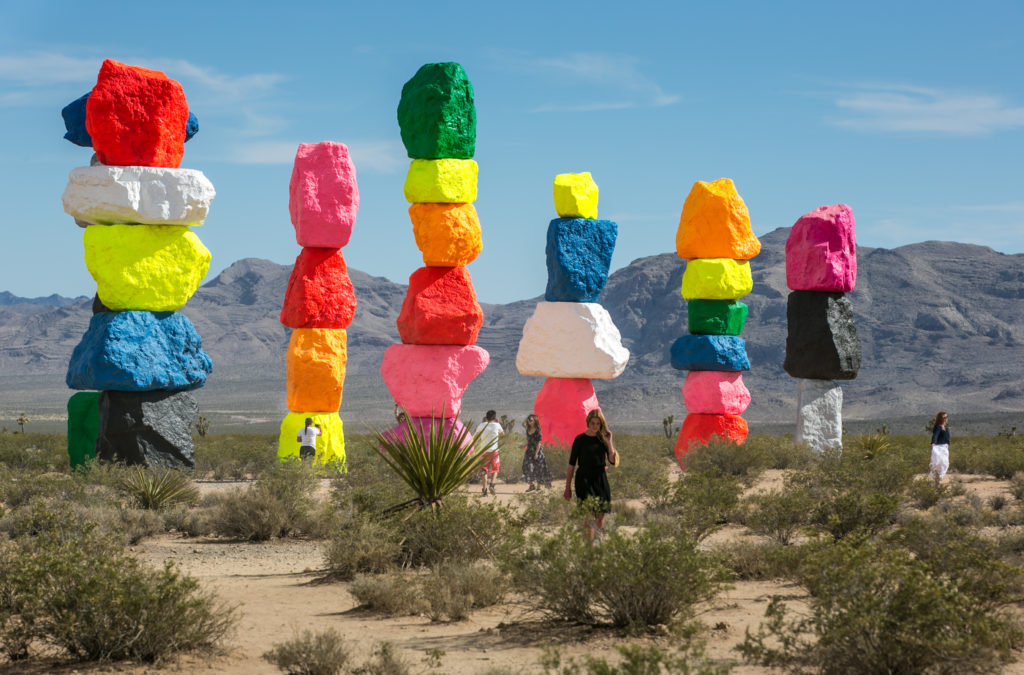
Ugo Rondinone, Seven Magic
Mountains. Photo by George Rose/Getty Images.
I’d imagine the rise of social media has contributed
significantly to the reach of public artworks, Prada
Marfa being one example. It’s maintained its
“destination” status and relevance years later, largely, I would
say, because of Instagram’s lifeline. How do you feel about social
media’s role in the promotion of public art?
I think social media has
dramatically changed how people experience art and how they find
out about art. Ultimately, it’s a good thing because it encourages
people to get up and go check things out for themselves. Something
like Prada
Marfa is an example of a
project that began before widespread social media use, and then
once people started seeing posts about it, it became a destination
in a way that it wouldn’t have otherwise. That’s
true.
What we never want for any of
our projects, though, is that someone would choose not to go and
see an artwork in person because they feel they’ve experienced it
adequately enough through their screens. There’s nothing that can
take away from that actual, physical experience of being in the
presence of an artwork—there’s nothing that can replace the
experience of standing in the desert in front of
Seven Magic
Mountains, or taking the
drive from El Paso down to Prada Marfa. I think the in-person factor continues to be
the most important part of art appreciation, and it can’t be
replicated online.
Tell me about the public art projects you’re working on this
season.
In October, we’re going to be
working with Lucy Sparrow, a British artist who creates felt
bodegas in different cities. She’s been working in New York for a
few years now. It’s part of our ongoing partnership with
Rockefeller Center. We’re taking over an empty storefront there,
and she’s creating a high-end, Eataly-esque felt store. A New York
“upscale deli” is what she’s calling it, and it’ll be a totally
immersive installation where people can come and experience it,
and, if they want, they can shop, too.
She’ll not only interact with
visitors at the storefront, but she’ll also take over the spaces
where we’ve been doing our ongoing programming throughout the
concourse and lobbies in and around Rockefeller Center. It’ll be a
total Lucy Sparrow takeover which is really exciting and something
we haven’t done before. It opens on October 1.
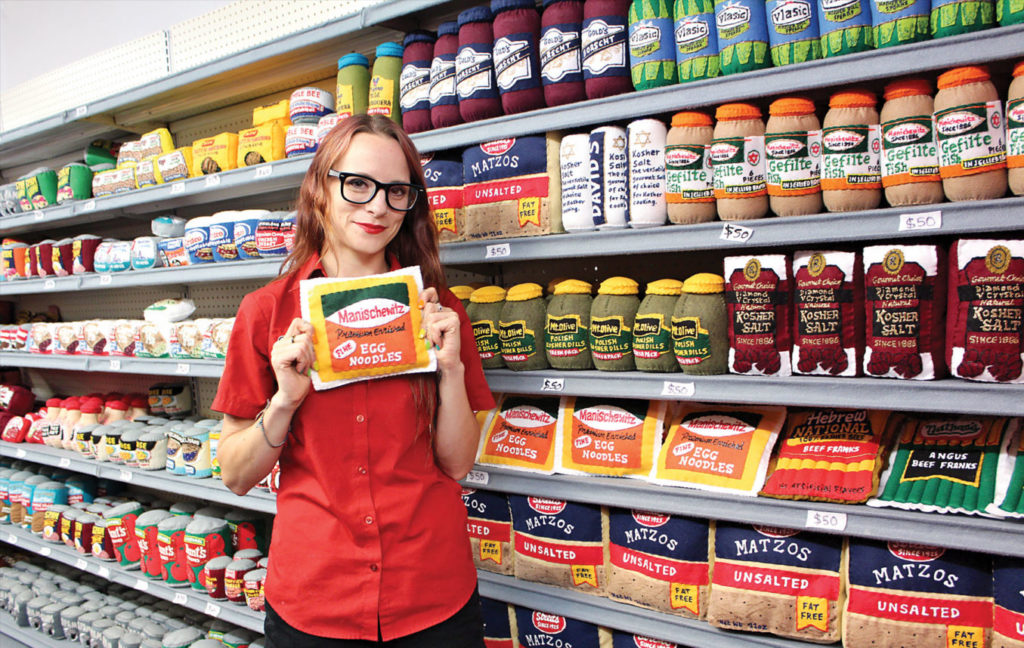
Lucy Sparrow at her “Sparrow Mart”
pop-up in Los Angeles, California. Photo courtesy Getty Images.
Then in LA, we’re doing a
project with Mika Tajima. Her work is sculpture, but it’s highly
conceptual, really interesting abstract work that incorporates
video and digital media. The project will be presented on the
digital billboards of Sunset Boulevard in West Hollywood. We’re
partnering with the city’s public art division to present this new,
site-specific video work that we’ve commissioned called
Psycho
Graphics. Mika worked
with the ballet dancer Alexandra Jacob to conceive it. The idea is
that she’s responding to politics, intelligence, military, and
marketing—all structures and tools that we have and use in the
world that create a tension between freedom and control. The piece
examines all of the things that are watching us.
Jacob is going to use her body
in sort of bondage-esque, alien ways to act out [the influence] of
technology in our lives. It’s obviously very relevant. I think
it’ll be especially impactful in LA, on Sunset Boulevard, where
people don’t really stop to see artwork. It’s a cool, unexpected
venue. It’ll play for one minute—which is actually quite long for a
video in a public space—every ten minutes within the hour, in two
locations. That will also debut in October.
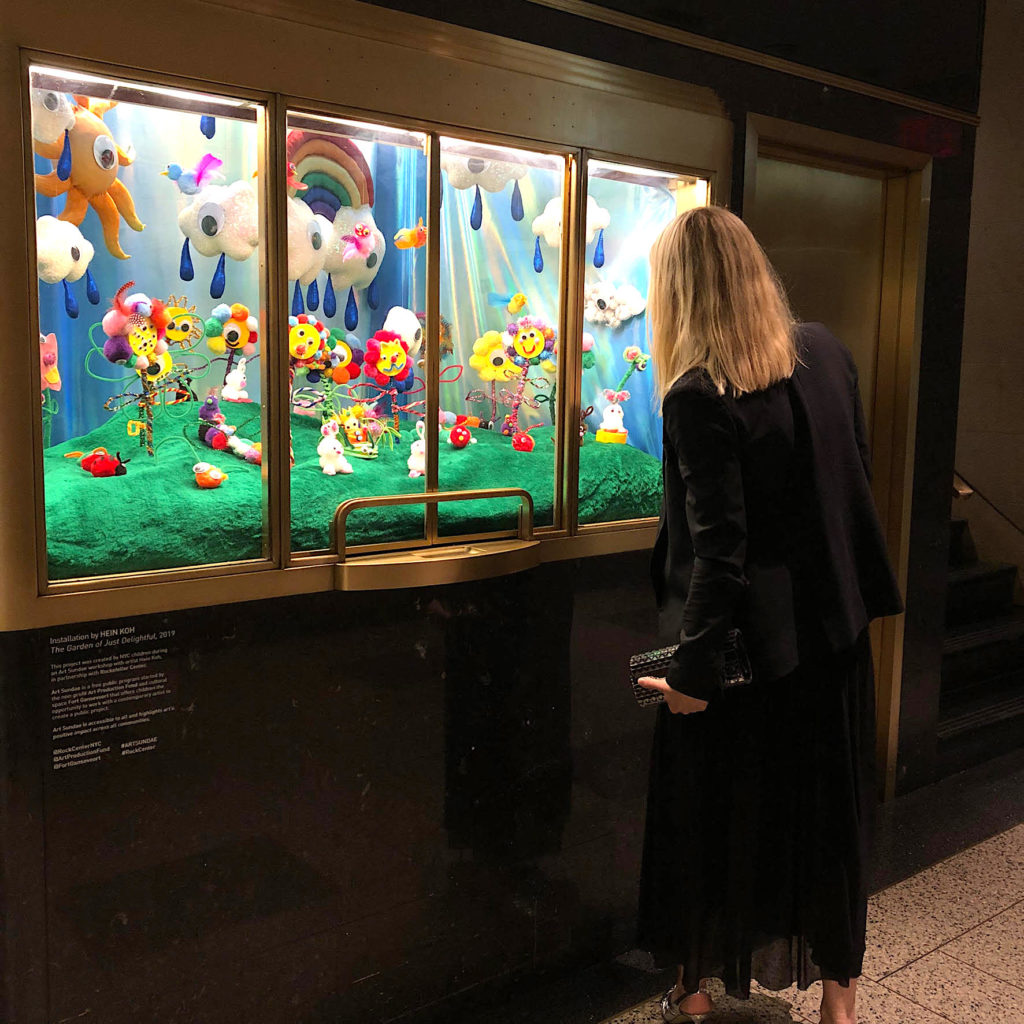
Casey Fremont in front of Hein Koh’s Art
Sundae installation at Rockefeller Center. Photo courtesy Casey
Fremont.
I’m also excited about our fall
editions of Art Sundae, which is a series that we’ve developed over
the last couple of years in partnership with Fort Gansevoort, a
gallery in New York. We bring in an artist to work with a group of
kids for a one-day workshop, and together they create a public art
project. It’s a public program, everyone can sign up and go. It’s
really about highlighting the importance of art and expression, but
also the sense of pride kids feel when they bring home an artwork
and you hang it up. The series allows kids to display their work in
a public way, and feel that pride of having created something that
exists for the world to see and having people appreciate it. It’s
merging the idea of kids working with art and our mission statement
of bringing art to the public and promoting public art in
general.
Art Sundae will kick off for the
season this weekend with Christopher Myers, who’s this amazing
artist and illustrator. He’s going to have kids tracing their
bodies and creating a kind of re-imagined map that weaves their
stories together. It’ll live on Gansevoort Plaza, in chalk, and
eventually it’ll wash away.
What other art exhibitions or projects are you looking
forward to seeing this season?
Definitely Wangechi
Mutu’s The NewOnes, will
free us, the
installation of four bronze sculptures in the niches of the
facade of the Met. I think
it’s brilliant to showcase contemporary art in these historically
empty public spaces.
Then there’s Shirin Neshat at
The Broad. Her exhibition
will feature monumental photographs and immersive video, including
the debut of a new video work. This will be the largest
exhibition—and first major exhibition—of Neshat’s incredible work
in the Western United States.
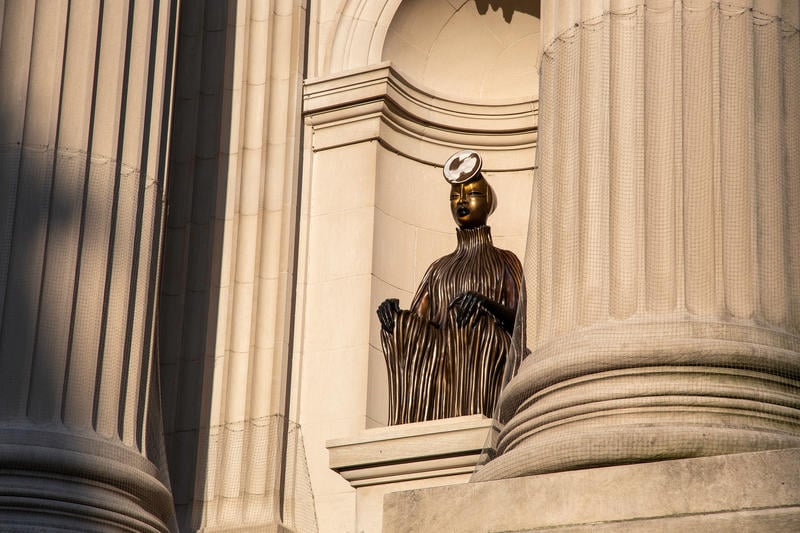
An installation view of Wangechi Mutu’s
“The NewOnes, will free Us” at the Metropolitan Museum of Art.
Photo courtesy the Metropolitan Museum of Art, by Bruce
Schwarz.
Finally, I’m looking forward to
Vanessa German at Fort Gansevoort gallery. Fort Gansevoort shows
some of the most interesting artists from around the country, and
I’m so looking forward to seeing this Pittsburgh-based artist’s
unique embellished sculptural work that uses found objects in
completely new and unexpected ways.
The post ‘There’s Nothing More Satisfying Than Making Art
Accessible’: Art Production Fund Director Casey Fremont on the
Power of Public Sculpture appeared first on artnet
News.
Read more https://news.artnet.com/art-world/casey-fremont-1648348
Further reading


Leave a comment