
The Amsterdam Museum Drops the Term ‘Golden Age,’ Arguing That It Whitewashes the Inequity of the Period
As museums around the globe
wrestle with how best to capture complex histories, the Amsterdam
Museum has taken a decisive step: The
institution announced today
that it would no longer use the
term “Golden Age” to refer to the 17th century.
For decades, the term has been
widely employed throughout the Netherlands to describe the era in
which the country was a leading economic and military power.
(During that time, it also produced some of the world’s most
renowned art by such figures as Rembrandt, Vermeer, and Frans
Hals.) However, the museum now contends that this phrase wrongly
glosses over the more negative realities of the
time.
“The Western Golden Age occupies
an important place in Western historiography that is strongly
linked to national pride, but positive associations with the term
such as prosperity, peace, opulence, and innocence do not cover the
charge of historical reality in this period,” says the museum’s
17th-century curator Tom van der Molen in a statement. “The term
ignores the many negative sides of the 17th century such as
poverty, war, forced labor, and human trafficking.”
“Every generation and every
person must be able to form his or her own story about history,”
Van der Molen continues. “The dialogue about that needs space, the
name ‘Golden Age’ limits that space.”
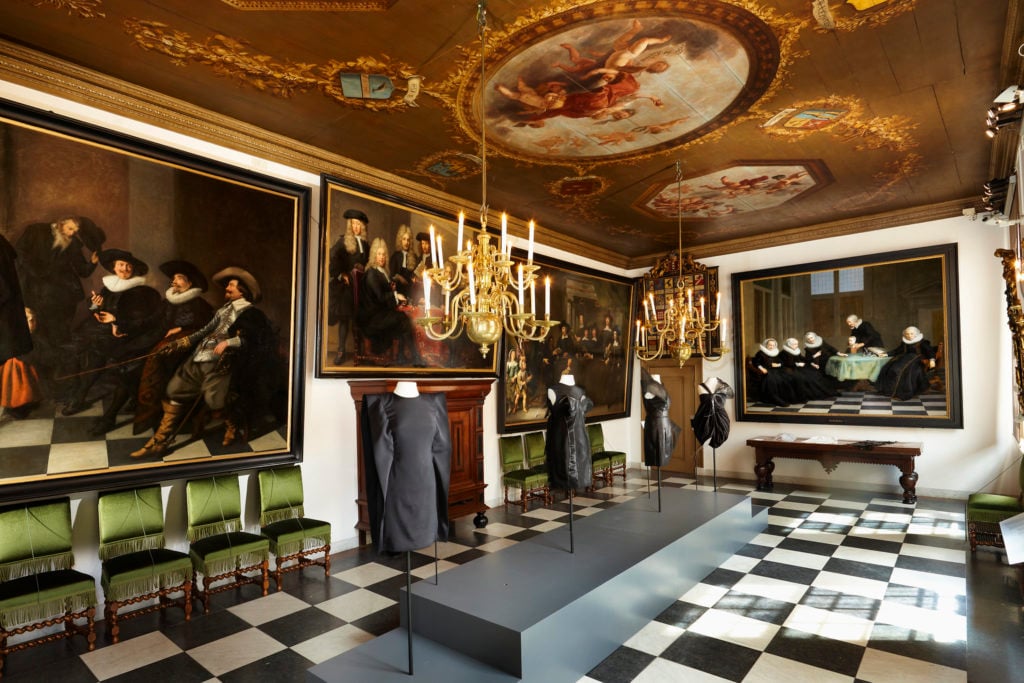
A gallery in the Amsterdam Museum.
Courtesy of the Amsterdam Museum.
In the coming months, the museum
will remove all appearances of the term in its galleries. It will
also change the name of its permanent “Dutchmen of the Golden Age”
exhibition at the
Hermitage Museum—an
Amsterdam-based branch
of the Hermitage in
St. Petersburg,
Russia—to “Group Portraits From the 17th
Century.”
The renaming effort is part of a
larger campaign at the Amsterdam museum to become more inclusive.
Later this month, the institution will host a symposium for museum
professionals and community members about the way it represents the
nation’s history in the 17th century. That same day, the museum
will open a new photography
exhibition positioned as a response to “Group
Portraits From the 17th Century,” in which Dutch people of color
are shown in historical settings.
These moves are part of a wave of museums reconsidering the way
they have presented their collections for decades. Last year, for
example, the Art Gallery of Ontario in Toronto renamed the Canadian artist
Emily Carr’s 1929 painting Indian Church
as Church at Yuquot Village to acknowledge
the Indigenous community that lived where the church was
located.
“These are important steps in a
long process,” Judikje Kiers, the Amsterdam Museum’s director, said
in the statement. “But we are not there yet.”
The post The Amsterdam Museum Drops the Term ‘Golden Age,’
Arguing That It Whitewashes the Inequity of the Period appeared
first on artnet News.
Read more https://news.artnet.com/art-world/amsterdam-museum-drops-term-golden-age-decolonize-1650112
Further reading


Leave a comment