
How Newly Minted Art Market Star Loie Hollowell’s Prices Rose More Than 1,200 Percent in Just Three Years
In October 2016, Loie Hollowell
had her first solo show at Feuer Mesler, a gallery
on the Lower East Side. The paintings were intriguingly untrendy.
In contrast to the brawny figurative painting and dystopian
installation art in vogue at the time, Hollowell painted
voluptuously abstracted female bodies in bright-colored geometric
shapes, awash in psychedelic glow, nodding to the obscured sex
organs in the flowers of Georgia O’Keeffe.
After the opening, a celebratory
dinner was held at a Mexican restaurant on Orchard Street, and
spirits were high, with her father giving an extended toast to the
beginning of his daughter’s career. It was already off to an
auspicious, if somewhat modest, start: The gallery had sold several
works in the show, some for $8,000, and larger ones for
$15,000.
Those prices have since
increased more than 1,200 percent, and Loie Hollowell has become
one of the most fiercely sought-after artists in New York. Smaller
works are now commanding $200,000 at auction. Art advisors told me
that, in private transactions on the secondary market, paintings
are being offered for almost $300,000.
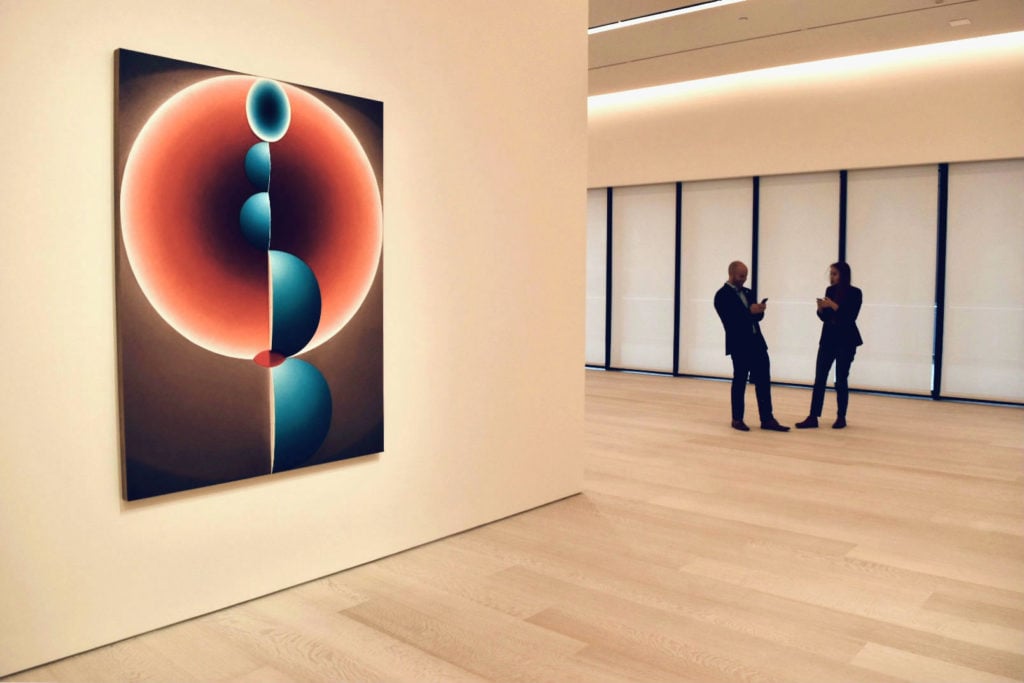
The Loie Hollowell show at the new Pace
gallery.
On Saturday, Hollowell had her
most high-profile outing yet. She opened “Plumb Line,” her first
New York exhibition with the global juggernaut Pace, as part of a
slate of shows inaugurating the gallery’s new 75,000-square-foot,
eight-story building in Chelsea. All around the neighborhood,
there are signs that list the name Loie Hollowell right between
such titans of Pace’s roster as David Hockney and Alexander
Calder.
“I feel so honored to be in the
company of these people,” Hollowell, who is just 36, told artnet
News last week, a few days before the public opening. “It’s
exciting that Hockney’s still alive and there might be a chance of
meeting him. I mean, he’s like a god among
painters.”
She could have been a bit wiped
from the hours of early previews that morning, but still seemed
endlessly peppy as she showed off her latest nine paintings, which
chronicle her recent pregnancy and the birth of her child. Even
with canonical Calders downstairs and buzzed-about new Hockney
drawings a few floors up, Hollowell’s show stays with you when you
leave the steel-and-glass Pace citadel. She’s left behind
art-historical references in favor of her now fully developed
sex-forward idiom, making a leap to six-foot-tall canvases, her
biggest ever. Each one pops off the white walls, the groovy
constellations on canvas enhanced by round, foam sculptural
implements that protrude from the surface like balls floating in
water. All were sold well before the opening and the waiting list
for the work is quite long. Each painting cost $100,000, netting
Hollowell a cool $450,000 after the gallery’s 50 percent
commission.
But while she gushed about the
new space and her inclusion in Pace’s storied roster, she was
feeling a twinge of anxiety about the new attention she’d get from
the exposure, and how it would affect her already skyrocketing
auction prices. As any in-demand young artist knows, secondary
market sales that jump too high, too fast often tempt other
collectors to sell, potentially flooding the market and
overexposing the artist before she’s gotten the chance to develop a
solid foundation for her work.
“I almost never talk about money
but, well, the market determines that,” she said. “These stupid
auctions, it totally fucks with your price.”
“Just Trust Me.”
After graduating from Virginia
Commonwealth University in 2012, Minnesota-born Hollowell moved to
New York and showed at small galleries like one in Ridgewood,
Queens, where she presented paintings of unabashedly sexual flora
that one local blog described as “labial cacti.” A chance encounter
with the painter Ridley Howard, who was an artist in residence at
VCU while Hollowell was there, led to a show at Howard’s project
space, 106 Green, in Greenpoint, Brooklyn, in the fall of
2015.
Among those who bought work from
the show was Joel Mesler, a dealer who months earlier had teamed up
with Zach Feuer to open a two-space gallery on the Lower East Side.
He paid $2,400 for each. After visiting her studio, Mesler offered
Hollowell representation, and brought her work to NADA Miami Beach
in December 2015.
“As soon as I went to the
studio, I knew she was one of them—it’s like, once every two years,
you find that artist,” Mesler told artnet News. “The historical
references are there, they’re sexy, they’re colorful, they have
great wallpower.”
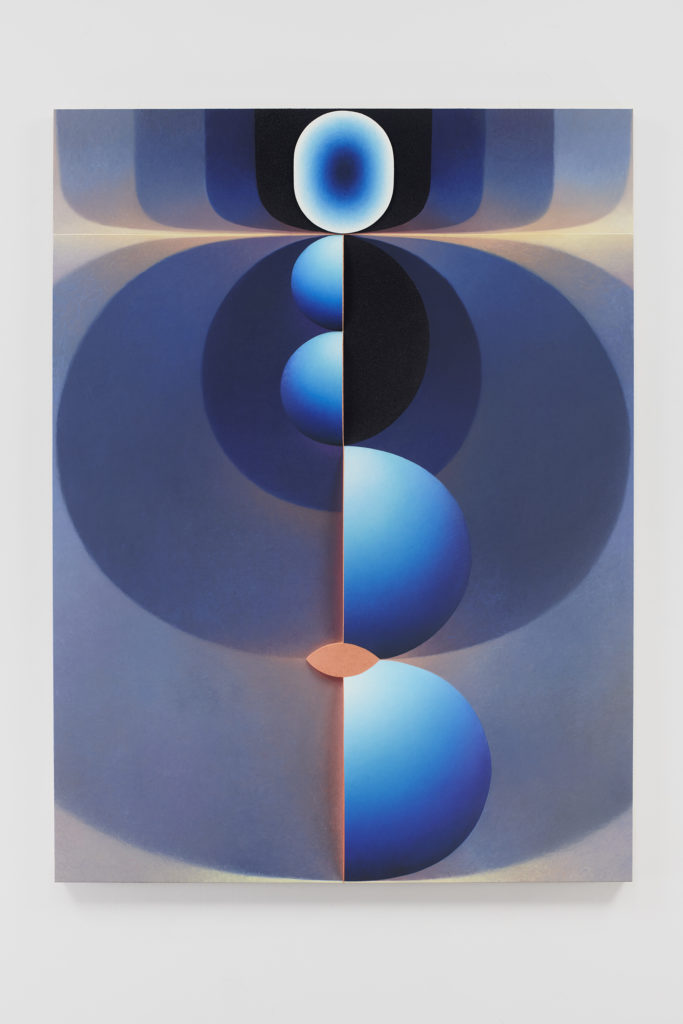
Loie Hollowell, Standing in
Blue (2018). © Loie Hollowell, courtesy Pace Gallery
But in the run up to the show at
Feuer Mesler, advisors who were approached to buy on behalf of
clients were skeptical. Some, speaking on background, said the
O’Keeffe connection was too obvious, and that, at 33, Hollowell was
too young to take a bet on. “He had to, kind of, convince me,” one
advisor who is still very active in the artist’s market told me.
Mesler admitted many sales took a bit of elbow grease to
finalize.
“Everyone who I sold work to, I
was like, ‘Just trust me,’” he said. “Even the ones who weren’t in
100 percent, I said, ‘Just trust me.’”
One early admirer was Fairfax
Dorn, the scion of a big Texas philanthropist family and the
founder of Ballroom Marfa, an art center that has helped transform
the tiny desert town into a global destination on the art hajj.
Dorn worked with Mesler to secure loans of Hollowell’s work for a
group show at Ballroom Marfa in 2016, and by the time Hollowell
opened her first show with the New York gallery that fall, many of
the buyers included not just Mesler’s bread-and-butter crew, but
the powerful Lone Star State machers who back the Marfa
machine.
“The foie gras collectors came
running,” Mesler said. “It was like a different tier of collectors
started reaching out about available work. I pretty much knew that
she was jumping ship.”
Indeed, Hollowell at the time
was just a year removed from her first solo show at a small
neighborhood project space, but she was about to head to a
mega-gallery. Dorn is married to Pace president Marc Glimcher, who
was in Marfa to see the show and found her work to be simpatico to
that of Pace artists like Agnes Martin, whose work also embodies
the aesthetic of the Southwest, and Elizabeth Murray, who, like
Hollowell, plays riotously with color and form.
And after Hollowell’s show at
Feuer Mesler ended in December 2016, Glimcher offered her
representation with his global stable of galleries that stretches
across three continents. In a press release announcing the move
sent not a month after the Feuer Mesler show closed, Glimcher said,
“She is truly a rare talent. Despite her age, the importance of her
work is evident.”
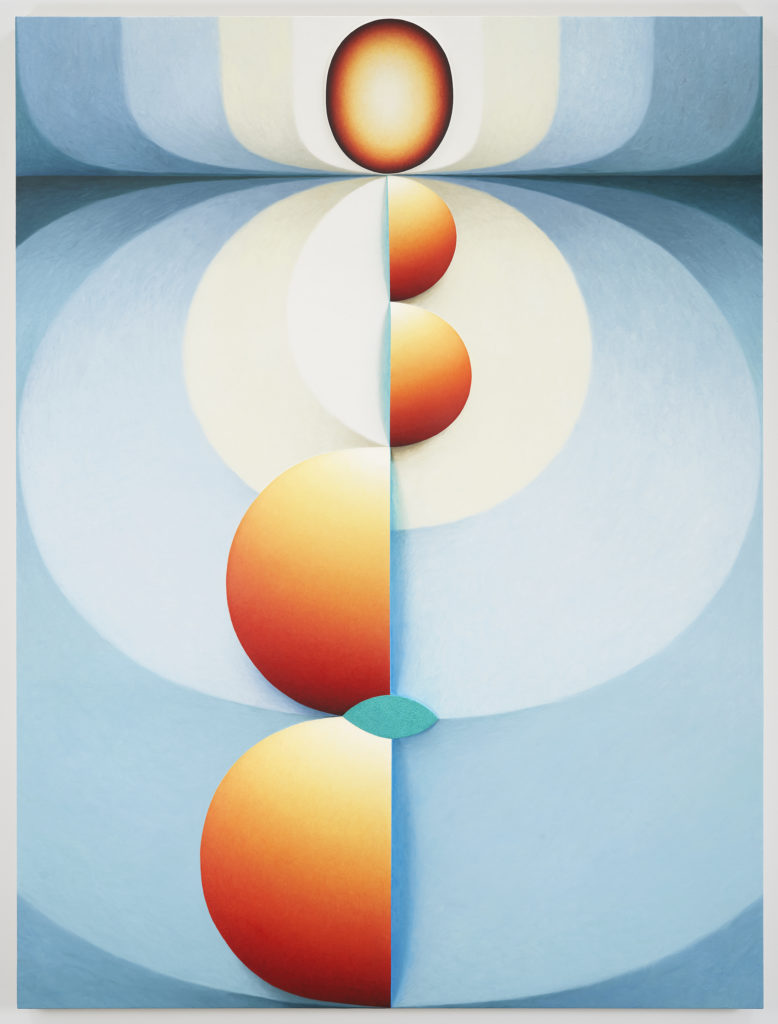
Loie Hollowell, Standing in
Light, (2018). © Loie Hollowell, courtesy Pace Gallery
Smashing Estimates
It didn’t take long for the
market to share that excitement. Her first Pace show opened at the
gallery’s Palo Alto outpost in September 2017 and immediately sold
out, with the prices now at $30,000 for a painting, or $45,000 for
a triptych. In October, Pace brought 16 small pastel works priced
at $6,500 to Frieze London. They sold them to 16 different
collectors in less than an hour and added 40 other prospective
buyers to a waiting list.
Her streak continued in 2018,
when she showed at Pace’s gallery in Hong Kong, and then in London,
at which point prices for her work had risen to $50,000. Anton Kern
Gallery director Brigitte Mulholland secured a painting on loan for
a group show at the start of that year, and by then, the market was
already in a full-blown tizzy over
Hollowell. A new painting donated by the
artist to benefit the Global Wildlife Fund was offered as the
highly visible first lot in Christie’s Postwar to Present Sale in
September. Estimated to sell for $20,000 to $30,000, it went for
$110,000.
And this past March, the
painting HUNG (UP) (2016) sold at Sotheby’s Contemporary
Curated auction, consigned by a collector who bought it at the
Feuer Mesler show for $15,000. It was estimated to fetch $50,000 to
$70,000. Instead, bidding spiraled up until the cost, with fees,
was $200,000.
Asked about that result, and
whether she had expected the work to more quintuple its low
estimate, Charlotte van Dercook, the head of the sale, said that
such things happen when there are so few works coming to market and
the artist takes three months to make each
painting. “There is a lot of demand for the work—when
that happens, coupled with an artist who’s not really producing a
lot of work, that doesn’t surprise me,” van Dercook said.
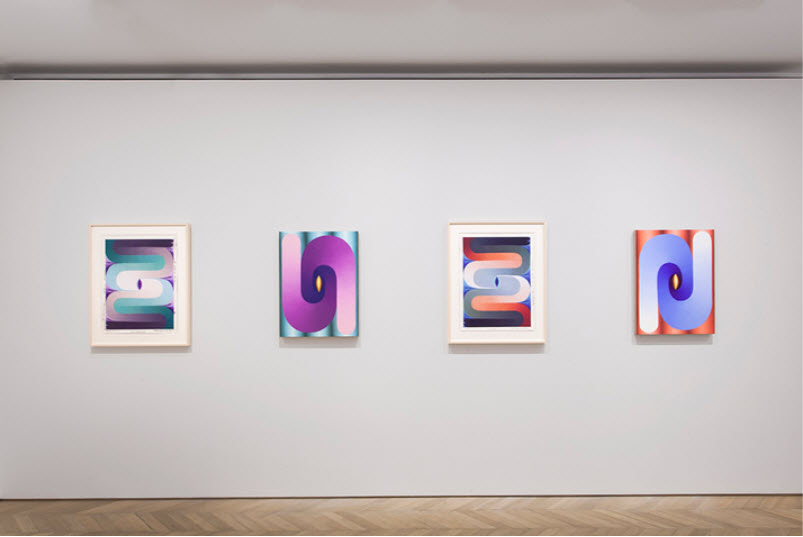
“Loie Hollowell: Switchback”
installation view. Courtesy of Pace gallery.
How High Can It Go?
Arne Glimcher, the founder of
Pace, is aware that the inflation rate for the youngest artist in
his legendary stable is getting a bit out of hand. Speaking about
Hollowell in a talk last week at the 92nd Street Y, he said that
you “introduce an artist at the lowest price you possibly can” but
that with Hollowell, the numbers were “growing like
crazy.”
More than one advisor indicated
that the elder Glimcher was among the buyers of the nine works in
her new Pace show, while another said that one was acquired by a
secretive Chinese collector who is “spending a shit ton on art
right now and getting access to things because of it.” There’s
every indication that more work will surface on the secondary
market—simply because, as one advisor put it, “if you buy something
for 7 [thousand] and all of a sudden its worth 150 [thousand], it’s
hard to resist selling it, or at least putting feelers out
there.”
A new auction record would
invariably push those prices up even more, especially given the
growing demand for fresh work by exciting new female artists. While
Hollowell’s approach was once unfashionable, all of a sudden the
mystic-looking work of woman such as Hilma af Klint and
Agnes Pelton were being fêted with blockbuster museum
shows.
The buzz also “mirrors a lot of
market demand for women artists in the highest echelons of the art
market, artists like Cecily Brown, Njideka Akunyili Crosby, Joan
Mitchell, and one of her most salient references, Georgia
O’Keeffe,” van Dercook said. “Those artists keep going higher and
higher and that causes galleries and other collectors to look at
other artists who are pulling from a similar visual
vocabulary.”
So how high could her prices go?
“It could go to $1 million,” Mesler said. “Should it? Probably
not.”
Auction results aside, Hollowell
herself is fairly unconcerned about the market, saying that she
joined a large gallery like Pace so a crew of competent dealers can
deal with the financial machinations and leave the art-making to
her. “That’s why as an
artist like me, who has no knowledge of the market, I work with
Pace,” she said.
And perhaps it’s healthy to be
able to put things into perspective. When I saw Hollowell two days
after my tour of the show, it was at the VIP party for the new
gallery, which promised not the same old canapés but “culinary
experiences” and a surprise performance that turned out to be by no
lesser rock eminences than The Who, present due to a large
charitable donation from the gallery.
They played four songs, and
after “Pinball Wizard,” frontman Roger Daltrey thanked Marc
Glimcher, who then started hopping up and down with a childlike
glee, basking in whoops and pats on the back. Collectors J.
Tomilson Hill, Len Riggio, and Dasha Zhukova, Met director Max
Hollein and LACMA director Michael Govan, tennis star Maria
Sharapova, and artists including Julian Schnabel and Henry
Taylor all slinked through a big throng on the top floor. Women in
pearls snagged tiny hot dogs and sauced them liberally with truffle
aioli from Pace-branded squeeze bottles. It was the kind of blowout
that we’ll think back upon with awe in the midst of the next
recession.
When I saw her, Hollowell was
trying to find the few friends she had put on the list for the
bash, and as The Who ripped into “The Kids Are Alright,” I thought
about something she had told me earlier that week. After talking
about how high her prices had climbed, she pulled back for a second
and put her $100,000 works in the context of Pace as a whole—in the
context of the roof garden we were standing in, on top of an $80
million, museum-sized commercial enterprise that’s set to kick off
a new golden age of
behemoth mega-galleries in Chelsea.
“Compared to the other price
points in the gallery right now,” Hollowell said, “mine would
definitely be the most affordable.”
The post How Newly Minted Art Market Star Loie Hollowell’s
Prices Rose More Than 1,200 Percent in Just Three Years
appeared first on artnet News.
Read more https://news.artnet.com/market/how-loie-hollowells-prices-rose-1200-percent-in-three-years-1649155
Further reading


Leave a comment