
Who Are This Year’s Turner Prize Nominees? Meet the 4 Provocative Artists Shortlisted for the UK’s Most Prestigious Art Award
The Turner Prize exhibition officially opens to the public
tomorrow, showcasing the output of this year’s crop of four
nominees: Lawrence Abu Hamdan, Helen Cammock, Oscar Murillo, and
Tai Shani.
The annual exhibition was established in 1984 to stimulate
public conversation around contemporary art, and it seldom fails to
meet the task. Last year’s five-hour video
extravaganza raised the hackles of
several members of the public, while the works of the YBAs
in the 1990s, several of whom have been nominated for the prize,
were notoriously provocative.
The annual prize exhibition is held at a venue outside of the
capital city every other year, and this year it has decamped from
London to Margate, the seaside hometown of one of the prize’s most
famous nominees, Tracey Emin. The current exhibition will run
through January 12, 2020, at Turner Contemporary—an apt setting
given that the gallery is located on the site of a former lodging
house where JMW Turner lived, in the town that inspired his deep
fascination with the sky.
The prestigious award is given to an artist for an outstanding
exhibition or other presentation of their work in the preceding
year, with the winner receiving £25,000 ($31,000), and the three
other shortlisted artists receiving £5,000 each
($6,000). This year’s prize
will be judged by Alessio Antoniolli, director of Gasworks &
Triangle Network; Elvira Dyangani Ose, director of The Showroom
Gallery and lecturer in visual cultures at Goldsmiths; Victoria
Pomery, director of Turner Contemporary, Margate, and Charlie
Porter, a writer. The jury is chaired by Tate Britain director Alex
Farquharson.
Before the winner is announced on December 3, at an
award ceremony broadcast live on the BBC, get to know the four
nominees with our breakdown, below.
HELEN CAMMOCK
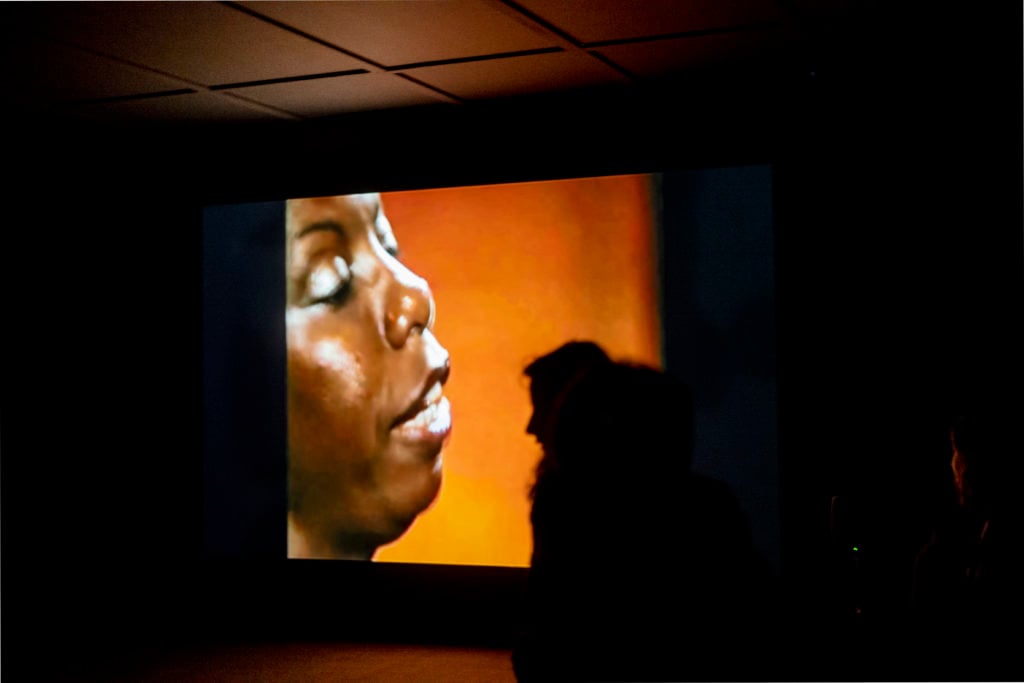
Helen Cammock, video still from The
Long Note (2018). Commissioned by VOID, Derry/Londonderry,
Turner Prize 2019 at Turner Contemporary Margate. Photo by David
Levene. Courtesy of the artist.
Born: 1970,
Staffordshire,
UK; based in
London
Age: 48
Nominated for: Her solo exhibition “The Long Note” at
Void, Derry/Londonderry and IMMA, Dublin
Best known for: Film work exploring social histories,
based on deep research processes that uncover and raise up
marginalized voices. Cammock also works in photography, print,
text, and performance.
Work in the Turner show: A film installation
of The Long Note (2018), a collage of
archival footage, new film, and interviews conducted by Cammock.
The work excavates the overshadowed role of women in the civil
rights movement in Derry/Londonderry in 1968, the beginning of the
Troubles in Northern Ireland. Cammock challenges the purportedly
“objective” way histories are told and draws attention to her own
subjectivity as an author by inserting herself into the film,
appearing at times to clean rain off the camera lens or respond to
an interviewee.
Interwoven with musical interludes, from traditional Irish songs
to Nina Simone’s spellbinding 1976 performance of How It Feels
to Be Free, the film, which runs an hour and 39 minutes, is on
the face of it tightly focused, but the long note reverberating
through it connects the struggles of women in Ireland to the black
feminists fighting during the civil rights movement in the US to
contemporary struggles involving gender, class, and race.
Five of Cammock’s hand-pulled screen prints from her 2017 series
“Shouting in Whispers” are also on display, bearing texts that
are important to her from the words of Trinidad-born activist
Claudia Jones to her own poetry to a dictionary definition of the
word “punctum.” Finally, Cammock provides a space for visitors to
discuss and learn about the various different struggles for civil
rights.
In their own words: “I want to disrupt the smooth,
often linear understanding and reception of histories, to make us
think about their construction. I am interested in exploring the
interconnectedness of time periods and geographies, and the
structural and personal intersectionality that is the cement of all
experiences, and is for me the continuum of histories, which are
both cyclical in form but also living and ever-evolving
entities.”
Gallery affiliation: None
Notable detail: Cammock was a social worker for 10
years before she became an artist.
On view elsewhere: Cammock recently closed
a show at the Whitechapel Gallery, and is preparing to embark on an
artist residency at Wysing Arts Center in Cambridgeshire this
fall.
Up next: “Che Si Può
Fare (What Can be Done)”
at Maramotti Collection, Reggio Emilia, Italy, October 13, 2019 –
February 16, 2020; “Radio
Ballads” a Serpentine
Galleries project, November 20, 2019 – April 20, 2020; solo show at Wysing Arts Center,
Cambridgeshire, February 20 – April 20, 2020; “Concrete Feathers and Porcelain Tacks,”
Photographers Gallery, London,
and Touchstones,
Rochdale, June 20 – October
20, 2020
TAI SHANI
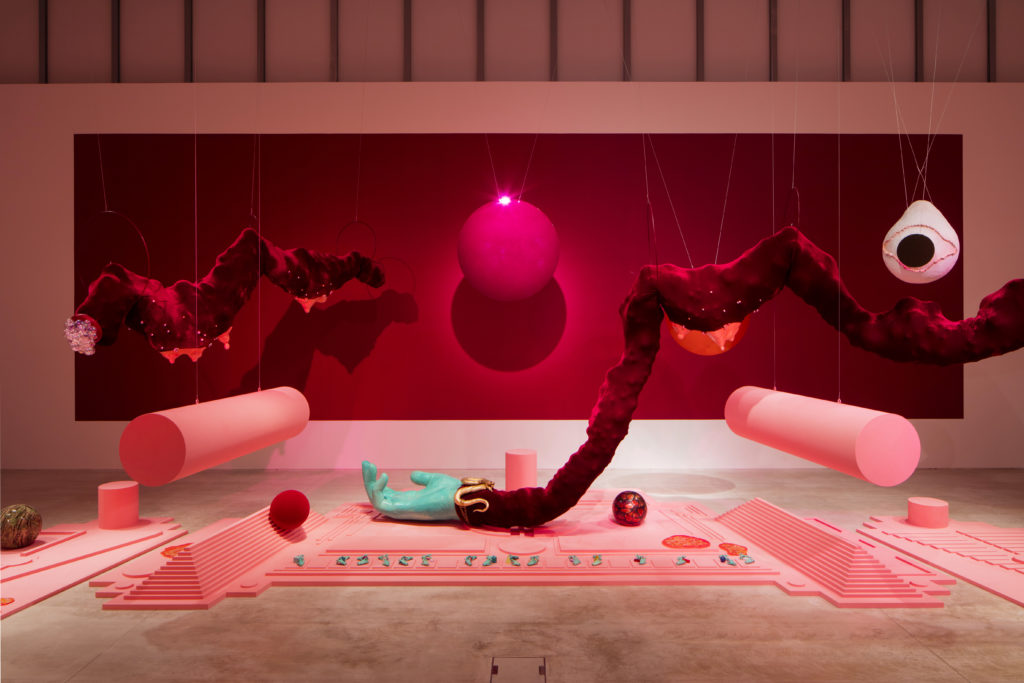
Tai Shani, DC: Semiramis (2019).
Installation view of Turner Prize 2019 at Turner Contemporary.
Photo by David Levene. Courtesy the artist and Turner
Contemporary.
Born: 1976, London; based
in London
Age: 43
Nominated for: Her
participation in Glasgow International 2018, the solo exhibition
“DC: Semiramis” at The
Tetley, Leeds, and her participation in “Still I Rise: Feminisms,
Gender, Resistance” at Nottingham Contemporary and the De Le Warr
Pavilion, Bexhill-on-Sea
Best known for: The ongoing project Dark Continent, of which the Turner show is a
part, inspired by a
15th-century protofeminist text, The Book of the City of Ladies
by Christine de Pizan. Shani is
creating her own city of women, through theatrical installations,
performances, and films, featuring fantastical
characters.
Work in the show: A bright pink architectural model
of Shani’s “womxn’s city,” an imagined place that exists outside of
patriarchy, complete with strange moons and udder-like appendages
oozing resinous goo, and anchored around the large green hand of
Semiramis, the legendary Assyrian queen.
The highly Instagrammable piece is scored by the British pop duo
Let’s Eat Grandma and is accompanied by a narrator embodying the
characters who populate a 12-episode epic through which Shani
conveys her deeply detailed universe. Indebted to feminist science
fiction as much as écriture féminine, gender theory,
myths, and fantasies, Shani has created a surreal world that is at
once an imaginary future and an alternate history. The narrator’s
words are heard via wireless headphones, access to which is
age-restricted due to the disturbing nature of some of the
episodes, which deal with issues of trauma, abuse, and erotic
taboos, although they are all available to read in an accompanying
book. The theatrical installation will be further activated by
performers on occasions throughout the run of the exhibition.
In their own words: “I wanted to create both a
physical and a conceptual space to critique contemporary gender
constructs, but also to imagine an alternative history which
privileges sensation, experience, and interiority, undermining
hegemonic conceptions of narrative history to propose these
possible visions of post-patriarchal futures. It is world-making
within which patriarchal ideology is replaced with marginalised
ideologies, such as intersectional and queer feminism, to propose
polyphonic, non-hierarchical perspectives on history, science and
nature.”
Gallery affiliation: None
Notable detail: Shani grew up on a commune
in Goa, and although she never received a university qualification
in art, it has been omnipresent in her life, as she was raised by a
progressive artistic family, her father a writer, her mother an
actor and photographer.
On view elsewhere: “Tai Shani: Tragodía” at
Moravská Galerie, Czech Republic, September 27 – December
8
Next up: DC: Semiramis (2019) will be
part of a group show, “ALIAS” organized by
Netwerk Aalst, Belgium, September 28 – December 1.
OSCAR MURILLO
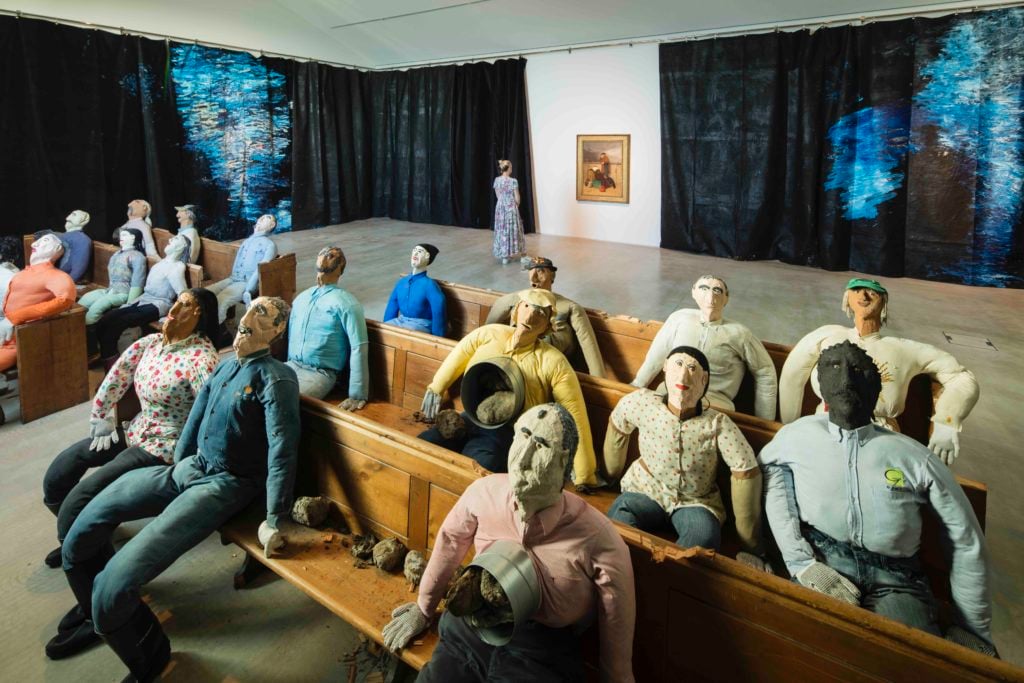
Oscar Murillo, installation in Turner
Prize 2019 at Turner Contemporary, including surge (social
cataracts) (2019), Collective Conscience (2019), The
Institute of Reconciliation (2019), and John Watson
Nicol’s Lochaber No More (1883). Photo by David Levene.
Courtesy of the artist and Turner Contemporary.
Born: 1986,
La Paila,
Colombia; based in London
and elsewhere
Age: 33
Nominated for: His participation in the 10th Berlin
Biennale, his solo exhibition “Violent Amnesia” at Kettle’s Yard,
Cambridge, and “Oscar Murillo/Zhang Enli” at the chi K11 art
museum, Shanghai
Best known for: His restless and relentless
production of paintings, through which he experiments with mark
making on unstretched canvases, sometimes collaged together with
recycled material. Murillo also makes drawing, performance,
sculpture, and sound works, reflecting on his own experience
of displacement (he moved to London from Colombia at age 11), and
the social fallout of globalization.
Work in the show: In the gallery with Turner
Contemporary’s best view out to the North Sea, a series of
hacked-up pews house papier-maché effigies inspired by a Colombian
New Year tradition. The fragile bodies from Murillo’s ongoing
“collective conscience” series represent the global mobile
workforce, pipes ripped into their stomachs reflecting the
insidious violence of capitalism. The figures were accompanied
on the train and wheeled along the seafront to the gallery in a
performative action. They sit waiting, facing the window, which is
mostly obscured by swaths of black canvas, part of his series “The
Institute of Reconciliation.” The black canvas extends to
walls around the room, where it is flooded in patches with blue
paint, part of the artist’s “surge (social cataracts)” series, a
reference to Monet’s eye problems, and the social blindness of the
current moment. Over the course of the exhibition, a performer
will also read from the Brazilian author Patricia Galvão’s 1933
novel Industrial Park: A Proletarian Novel.
In the back of the gallery hangs a 19th-century painting by John
Watson Nichol, Lochaber No More (1883). The
painting of Scottish migrants shipping off to America during the
Highland Clearances serves as a poignant reminder that migration is
a part of the history of the UK, and more broadly of humanity.
Not visible in the exhibition, but a part of it all the same, is
a new extension of Murillo’s collaboration between his family and
political scientist Clara Dublanc, the “Frequencies” project.
Schools around Kent are receiving canvases to be fixed to school
desks for six months, with students invited to make whatever marks
they want, offering up a sort of analogue record of a particular
time.
In their own words: “I am seeing my participation in
Turner Prize 2019 as an opportunity, particularly given that the
exhibition is in Margate this year, to think about my practice in
relation to the UK, its culture, its history and where society
finds itself currently, from a social, geographical and economic
point of view, and this is what draws me to this space. The
beautiful view was the most attractive thing, but it can also be an
opportunity to negate such a view, almost to make clear the
darkness or ignorance of the moment.”
Gallery affiliation: David Zwirner, Carlos/Ishikawa,
Isabelle Bortolozzi Galerie
Notable detail: Oscar Murillo is the only bona
fide market star included in this year’s crop of Turner Nominees.
At his most recent exhibition with David Zwirner, “Manifestation”
works were on sale for $320,000-$400,000. His work has come to
auction 133 times, and his auction record is $401,000 (with
premium) achieved at Phillips New York in 2013 for an untitled
canvas from 2011 from his “drawings off the wall” series.
On view elsewhere: “trades
hall & institute” at Carlos/Ishikawa London through October 19;
“Oscar Murillo:
Frequencies” at Yorkshire Sculpture Park, through November 3;
“Grand Hotel Abyss” at
Steirischer Herbst Festival, Graz and Styria, Austria through
October 13; “HERE AND NOW:
Transcorporealities” at Museum Ludwig, Cologne, Germany through
January 19, 2020
Up Next: “Oscar Murillo: Horizontal
Darkness In Search of Solidarity” at the Kunstverein in
Hamburg, Germany, November 8, 2019 – January 26, 2020. “Oscar Murillo: Social
Altitude” at the Aspen Art Museum, November 23, 2019 – May 17,
2020
LAWRENCE ABU
HAMDAN
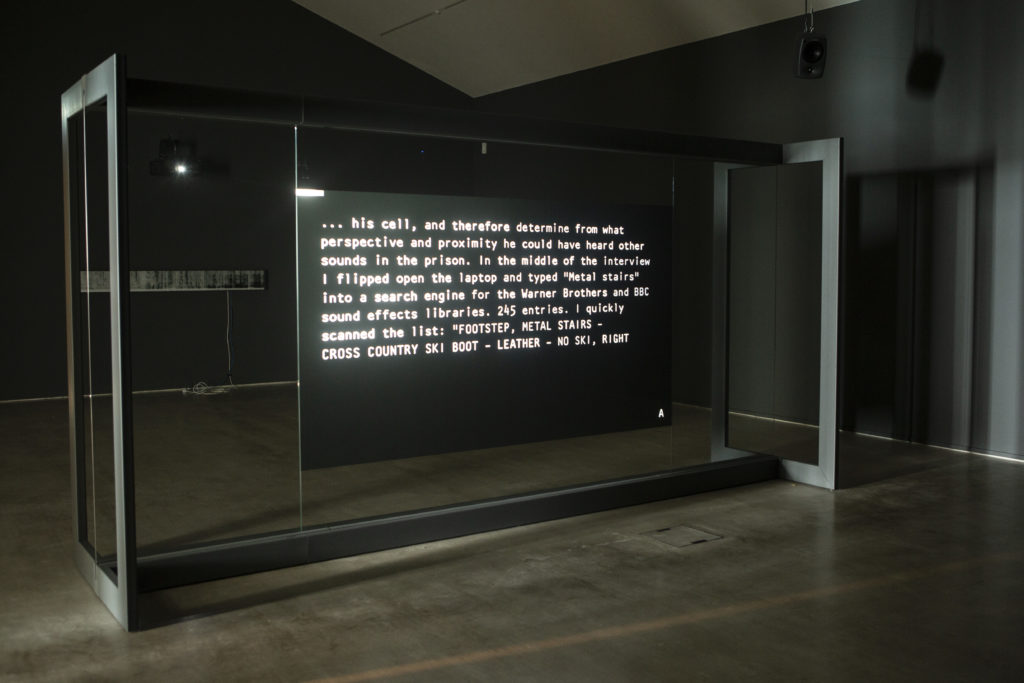
Lawrence Abu Hamdan, After SFX
(2018). Turner Prize 2019 at Turner Contemporary, Margate 2019.
Photo by Stuart Leech. Courtesy the artist.
Born: 1985 in
Amman, Jordan; based in
Beirut.
Age: 34
Nominated for: His solo
exhibition “Earwitness
Theatre“
at Chisenhale Gallery, London, and
for the video installation Walled Unwalled and performance After SFX at Tate Modern, London. Both projects came from
ear-witness interviews with six former detainees of the Syrian Regime
prison Saydnaya, who were subjected to total sensory deprivation
during their incarceration, as part of an audio investigation by
Amnesty International and Forensic Architecture to map the unknown
architecture of the prison and to understand what happened
there.
Best known for: Abu Hamdan calls himself a “private ear” because he
investigates crimes that have been heard and not seen. Abu Hamdan
reconstructs contested situations and events through sound,
creating audiovisual
installations, lecture performances, audio archives, photography,
and text.
Work in the show: Three works are installed in the
space and shown on a loop: Saydnaya (the missing 19db)
(2017), a light-box visualization of the decrease in volume of the
inmates’ voices after the Syrian revolution, when the prison became
a death camp where speaking was a capital
offense. Walled/Unwalled, recorded in an East
Berlin recording studio, a spoken-word interlacing of different
court cases that relied on ear-witness testimony, from the trial of
Oscar Pistorius to that of OJ Simpson, anchored around the Saydnaya
prisoners’ relation of the walls of their cells as solid and yet
sound-permeable structures. After SFX, a text
animation accompanied by sound effects from 95 custom-designed
sound objects meant to correspond to the sounds the prisoners
described hearing from their cells, as well as other cases that
relied on contested sonic testimony.
In their own words: “The works are intended to serve
a double purpose: both to reflect and transmit the stories of that
prison in the way I believe more adequately suits the entanglements
of place and sensory experience, and to argue for art as a mode of
truth production that is distinct from the way science and the law
derive their truths. I believe it is just as valid a strategy for
producing claims and documenting events as the fields which we
conventionally task to do this.”
Gallery affiliation: Maureen Paley, Mor-Charpentier, Sfeir-Semler.
Notable detail: Abu Hamdan is also affiliated with Forensic Architecture,
the collective shortlisted for the Turner Prize last
year.
On view elsewhere: “May You Live in Interesting
Times,” the 58th Venice Biennale, Italy through November 24;
“Crack Up – Crack Down,”
the Ljubljana Biennial of Graphic Arts, Slovenia, through September
29; “Lawrence Abu Hamdan” at
Sfeir-Semler Gallery, through January 4, 2020; “Eavesdropping” at City Gallery
Wellington, New Zealand, through November 17.
Up next: The Shouting Valley:
Interrogating the Borders Between Us” at Gus Fischer Gallery,
Auckland, New Zealand, September 28 – December 14; “Nirin” Biennale of Sydney, Australia, March
14 – June 18, 2020
The Turner Prize Exhibition
is on view September 28, 2019, to January 12, 2020, at Turner
Contemporary in Margate.
The post Who Are This Year’s Turner Prize Nominees? Meet the
4 Provocative Artists Shortlisted for the UK’s Most Prestigious Art
Award appeared first on artnet News.
Read more https://news.artnet.com/exhibitions/turner-prize-2019-meet-the-artists-1661080
Further reading


Leave a comment