
The 100 Works of Art That Defined the Decade, Ranked: Part 1
“Best of” lists are always at least
half frauds. After all, no one can really see all the movies or
read all the books in a year, let alone a decade—but at least film
critics or literature critics are debating things that offer the
same experience no matter where you are. The nature of art means
that the exercise is extra arbitrary. A really successful work of
art might travel to different museums, but it also might not. So
you are left either taking someone else’s word for what was good or
leaving out important touchstones.
If you were to map out the geography of the works I mention
below, it would look like a target, with most of the darts falling
right around where I live, New York. The distribution of hits
would then scatter out from the bullseye, landing at more and more
random points the farther they get. You really feel your own
limitations when you try to put together a list like this.
Nevertheless, I think there’s some interest in picking out not
just artists or general trends, but specific artworks. I
find it’s hard to do that, which is exactly why it’s worth doing—to
take note of specific images or ideas that appeared this decade and
that particularly stuck, even if not everyone is going to agree on
how exactly to value them.
Still, I’m left facing my own limitations. Just picking personal
favorites leaves out a lot that was objectively influential, but
pretending it’s some kind of objective “Greatest Hits” leaves you
just measuring raw popularity (in which case, Wall
Street’s Fearless Girl would be #1).
So I thought of five measures by which I might estimate
artworks’ importance: by originality/invention (the degree to which
they introduced something new to the conversation); form/style (how
memorable they were as a specific image or idea); depth/nuance
(whether coming back to them was rewarding, or revealed new
layers); symbolic power (the degree to which they seemed to stand
as symbol of some bigger conversation, moment, or emergent cultural
sensibility); and popularity/influence (how big a deal they were,
either to other artists or to the wider public).
Combing back through a decade’s worth of seeing, reading about,
and writing about art, and squinting at it through the lenses of
these five categories, I came up with a list of artworks that
balance between these values, converging toward works that fire on
most cylinders at the top. (I didn’t want to repeat artists,
because that made the list more boring.)
Starting at the end, then, here is one way to look at the 2010s
in art.
100.
Jamian Juliano-Villani, Stick Drawing for Help
(2016)
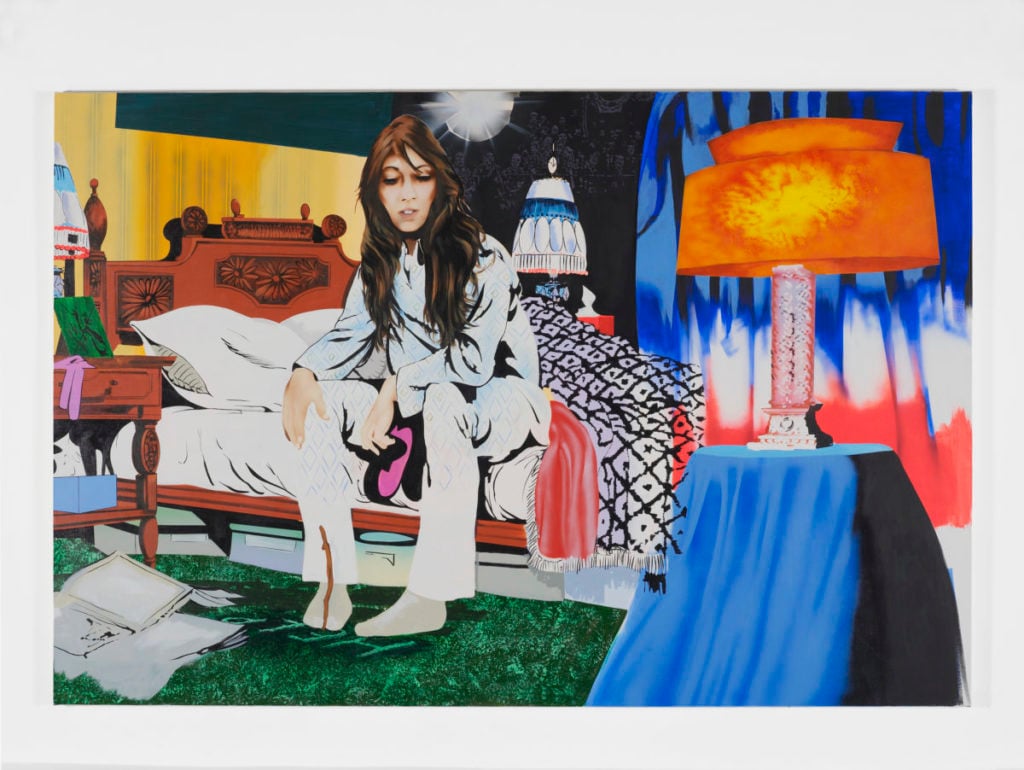
Jamian Juliano-Villani, Stick
Drawing for Help (2016). Image courtesy of the artist.
A self-portrait by one of the premier painters of present-day
internet-fried figuration nicely captures the affect of being cut
adrift in an everyday world transformed into a simulation of
itself.
99.
The Propeller Group, Television Commercial for
Communism (2011-12)
A fun riff on the strange fix of geopolitics: the Ho Chi Minh
City-based art collective works with an actual advertising company,
filming their attempt to come up with a new “public image” for the
notion of state Communism. The resulting brainstorming sessions are
shown as an installation, plus this final, cheerful spot, which
shows the thin line between corporate treacle and totalitarian
propaganda.
98.
Daniel Lind-Ramos, Maria-Maria
(2019)
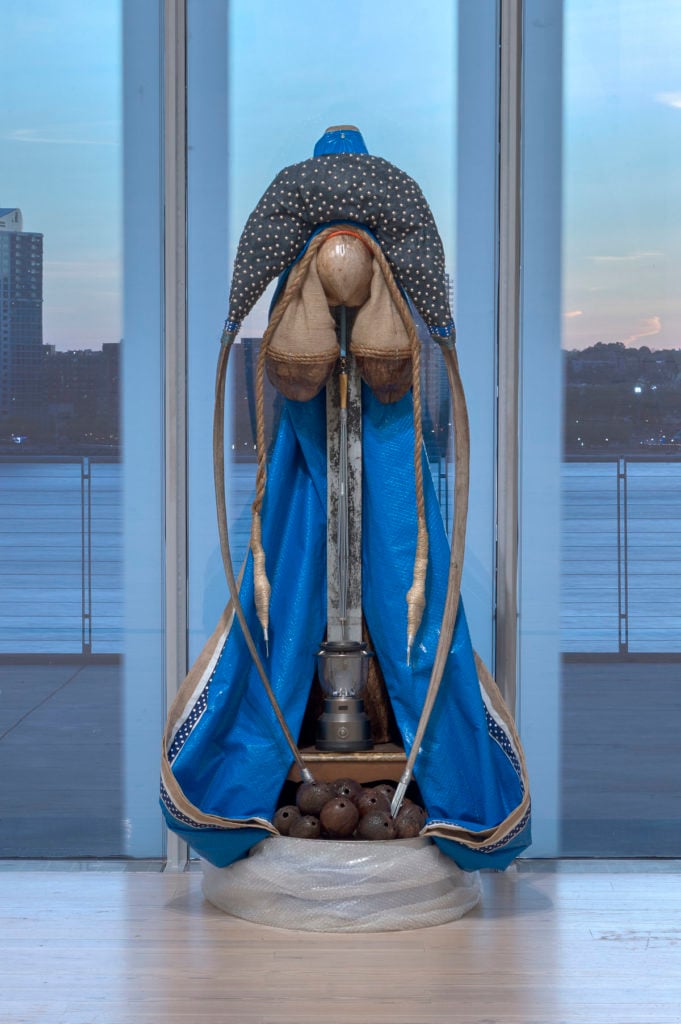
Daniel Lind-Ramos, Maria-Maria
(2019). Image courtesy of Whitney Museum of American Art.
Puerto Rican sculptor Lind-Ramos’s assemblage for the Whitney
Biennial 2019 incorporated blue disaster relief tarps from the wake
of the devastating Hurricane Maria, drawing the comparison with the
blue vestments of the Virgin Mary to build this ambiguous but
expressive altarpiece. For me, Maria-Maria also represents
a kind of healing, totemic use of materials that has become more
general.
97.
David Best, Temple (2018)
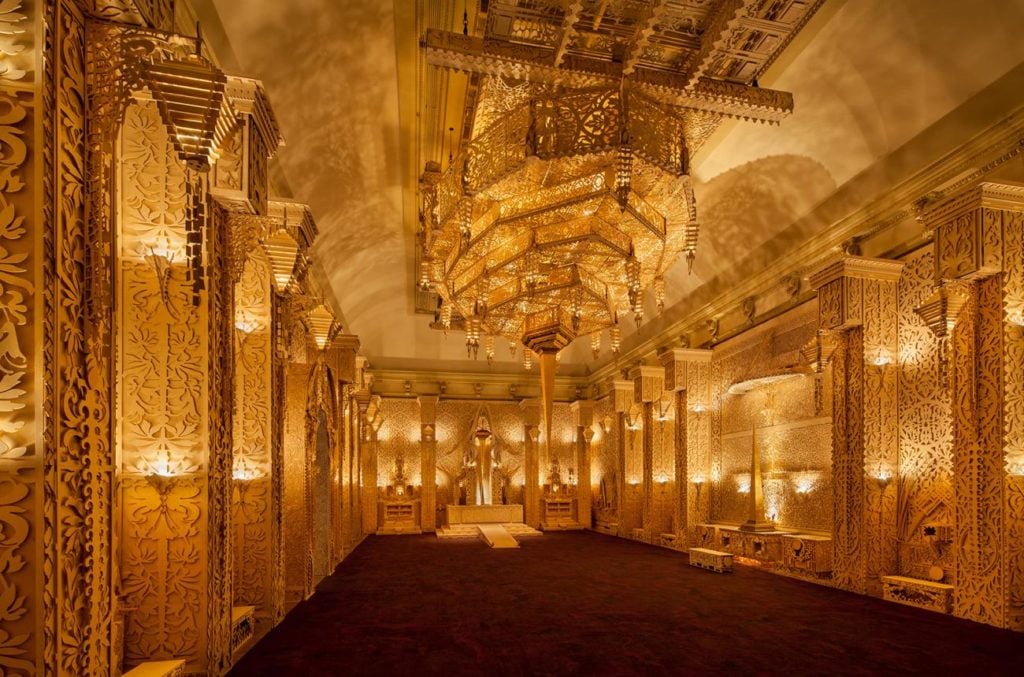
David Best, Temple (2018).
Photo by Ron Blunt, courtesy Smithsonian American Art Museum.
Burning Man, the desert alt-culture
bacchanalia, moved unstoppably into the mainstream this decade
(and also, in its way, became just as associated with rich-guy
ostentation as the mainstream art fair circuit). The Renwick’s “No
Spectators” marked the apotheosis of the trend, and David
Best’s intricate and ephemeral temple, a recreation of a shrine
staged each year where people bring notes representing their
sorrows to be burned at festival’s end, stands for the best of
it.
96.
Ana Teresa Fernández, Borrando la Frontera
(Erasing the Border) (2011)
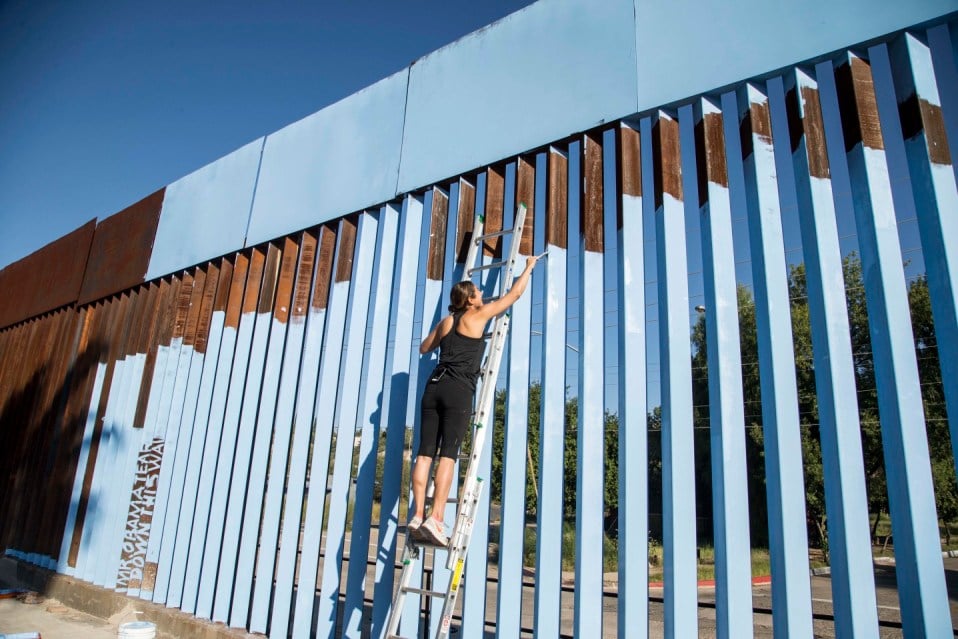
Ana Teresa Fernández performing
Borrando la Frontera. Image courtesy of the artist.
On October 13, 2011, Fernández and a group of volunteers teamed
up to paint a 50-foot stretch of the US/Mexico border fence blue,
highlighting the barrier by erasing it. A ambitious, poetically
simple gesture—but given the enormous weight the border has taken
on in the public discourse since, one whose weight has only grown
with time.
95.
John Gerrard, Western Flag (Spindletop,
Texas) (2017)
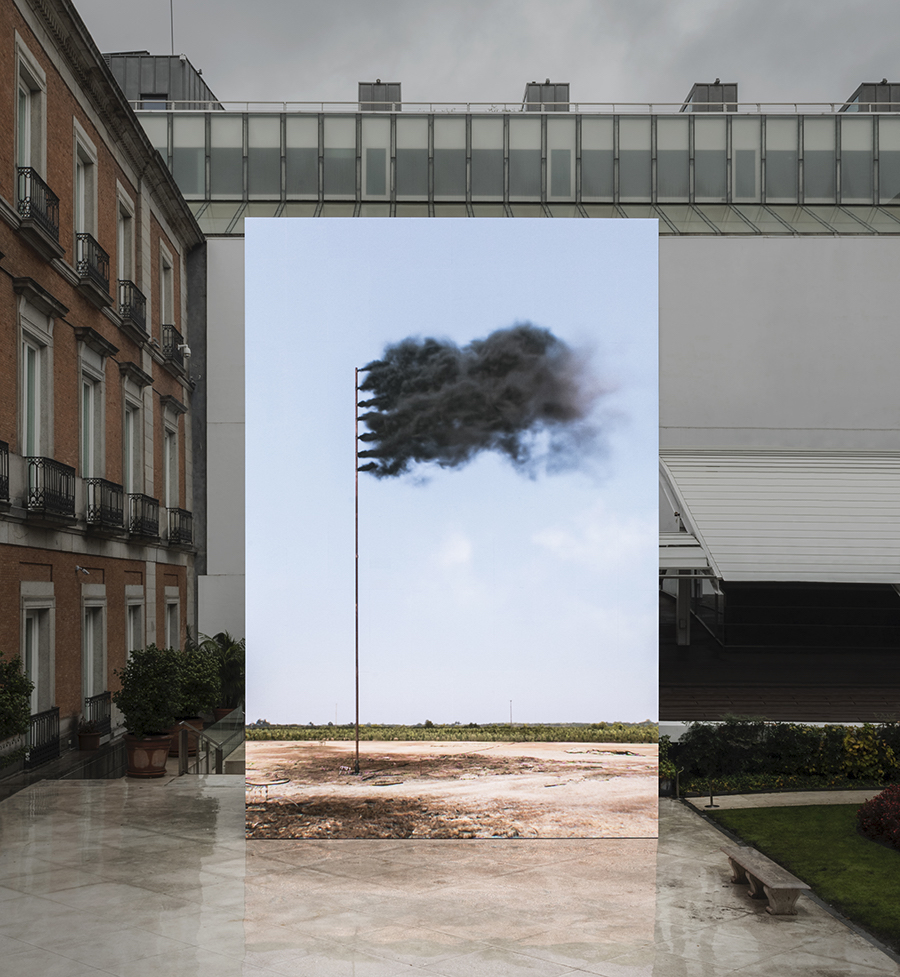
John Gerrard, Western Flag
(Spindletop, Texas) (2017). Photo: Roberto Ruiz. Image
courtesy Museo Nacional Thyssen-Bornemisza.
Originally commissioned for Earth Day (and seen recently at
the Museo Nacional Thyssen-Bornemisza during the failed COP25
in Madrid), Gerrard’s animation presents an
image of an impossible flag of oily black smoke, planted into the
moonlit ground of Spindletop, Texas, site of the first major
oil gusher.
94.
Irena Haiduk, Nine Hour Delay (2012)
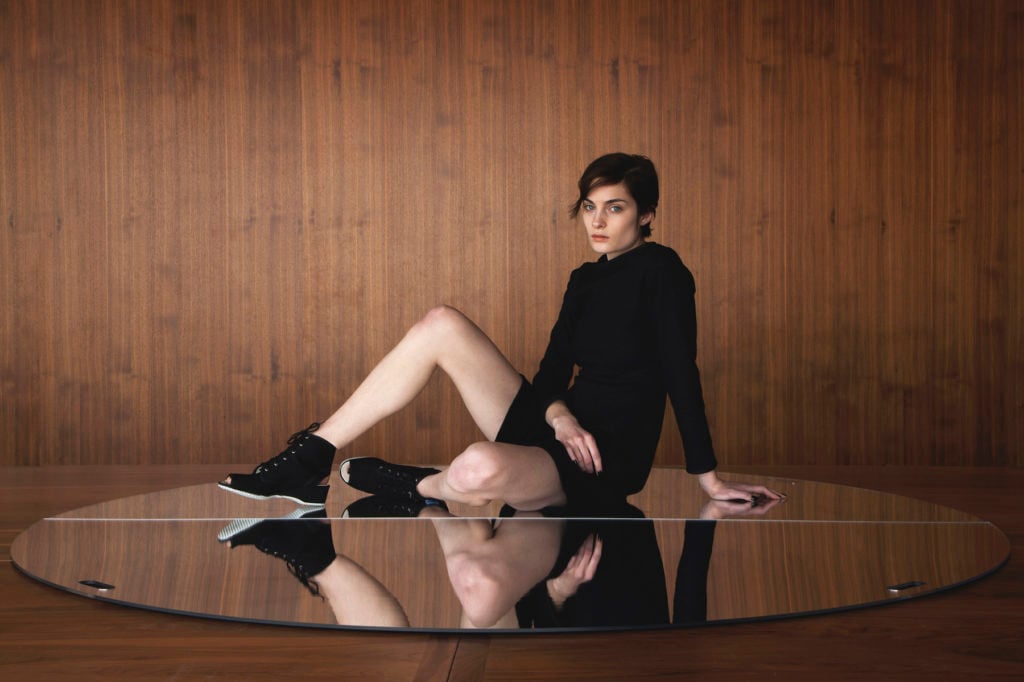
Irena Haiduk, Nina House Delay:
Amelia Pool Working, desktop background. (2013). Image
courtesy documenta 14.
This is a complex one, but stands for a way that the
disorienting expansion of conceptual art mirrors the disorienting
rewiring of economies and ideologies: In 2015, the Belgrade-born
Irena Haiduk created Yugoexport, a conceptual-art
company, and she has actually revived the “Borosana Labor Shoe,” an
ergonomically designed shoe manufactured in the former Yugoslavia
designed to be comfortable for working women who had to be on their
feet all day. For each iteration of this work, the “Borosana Labor
Shoe” is made available to the workers at any art institution
where the work is shown. (You can also buy them online.)
93.
Elías García Martínez/Cecilia Giménez, Ecce Homo (aka
Beast Jesus) (2012)

Elías García Martínez, restored by
Cecilia Giménez, Ecce Homo (c.1930/2012).
Laugh if you want, but no tale of art in the 2010s is complete
without the beloved masterpiece of unintentional surrealism. When
then 81-year-old retiree Cecilia Giménez sought to pitch in on
restoration work for a relatively minor depiction of Jesus at her
village chapel by Elías García Martínez (1858–1934), she created
something much bigger than herself, probably much bigger than
almost any conventional artwork. “Beast Jesus” or “Monkey
Christ” spawned endless delight and brought visitors from faraway
lands to see the reborn Ecce Homo. Call it a
miracle.
92.
Wendy Red Star, Apsáalooke Feminist (2016)
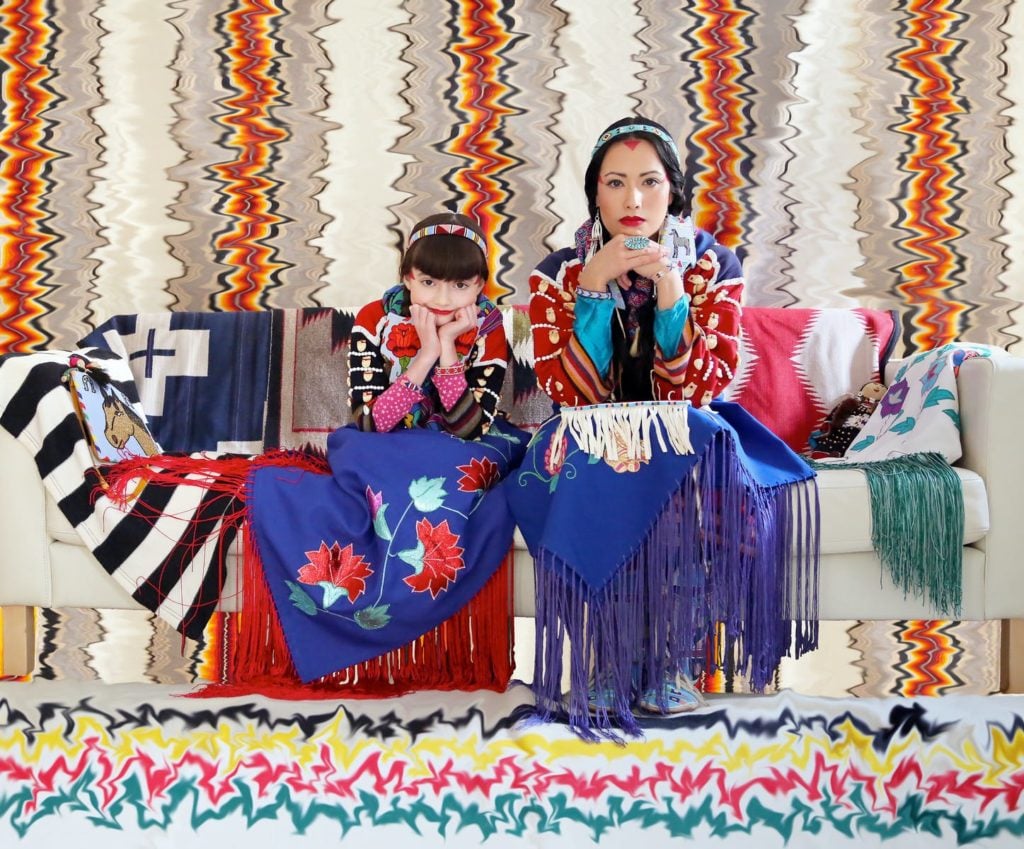
Wendy Red Star, Apsáalooke Feminist
#2, featuring Wendy Red Star with daughter Beatrice Red
Star Fletcher (2016).
Red Star’s “Apsáalooke Feminist” series features herself and her
nine-year-old daughter, Beatrice Red Star Fletcher. It’s both
loaded up with traditional signifiers and vivid Photoshop
abstractions, a vibrant declaration of holding onto indigenous
identity and freeing it from stereotypes with creative verve all at
once—and teaching that spirit.
91.
Jeremy Shaw, Liminals (2017)
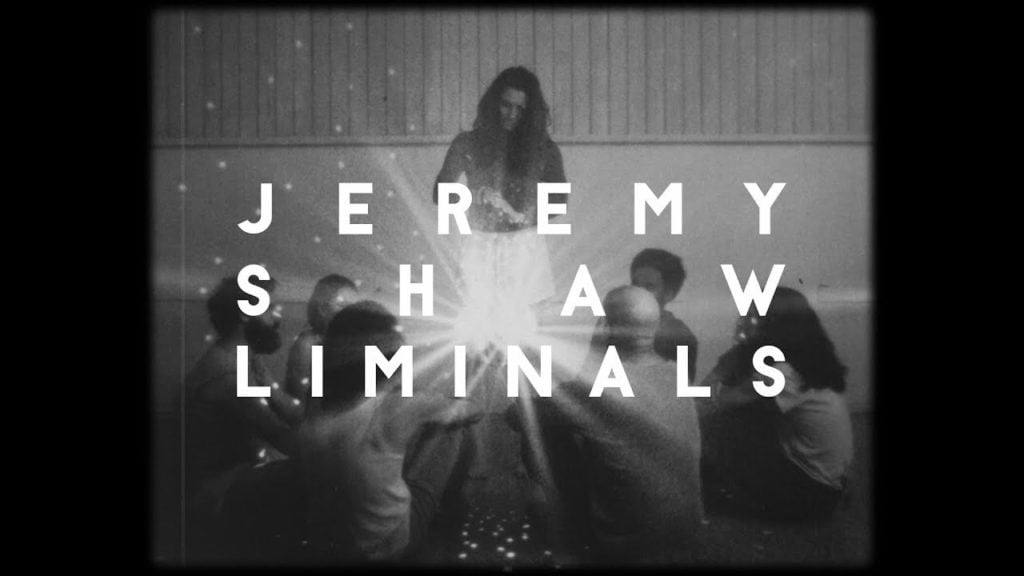
Title image from Jeremy Shaw’s
Liminals.
Seen at Christine Macel’s “Arte Viva Arte” Venice Biennale in
2017, Canadian artist Jeremy Shaw’s fake
documentary Liminals was my highlight from that
show. It presents a future where people turn increasingly to
irrationalism and cult rituals in the face of societal collapse. I
think of it a lot actually.
90.
Superflex, Power Toilets / JPMorgan Chase
(2011)
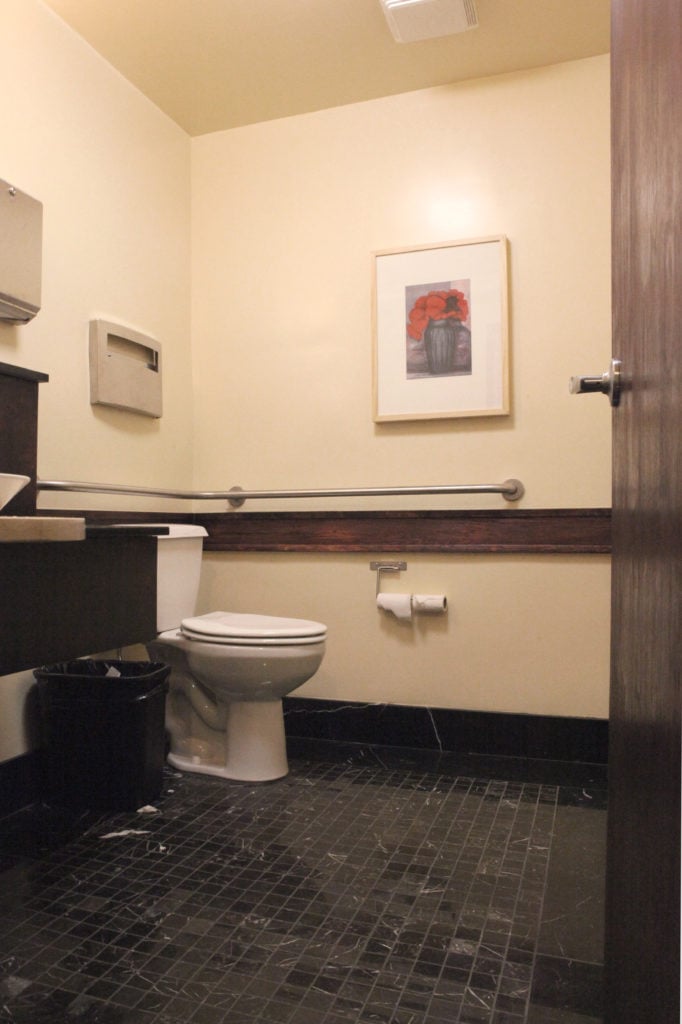
Superflex, Power Toilets
(2011). Image courtesy Superflex.
Installed at a diner on Delancey Street in New York, and
billed as a fully functional re-creation of the executive loo at
JPMorgan Chase, the installation nailed a certain enflamed
awareness of inequality in a decade defined by the fallout from the
Great Recession (and appeared on the cusp of the
conversation-shifting explosion of Occupy Wall Street).
89.
Cally Spooner, And You Were Wonderful, On Stage
(2013)
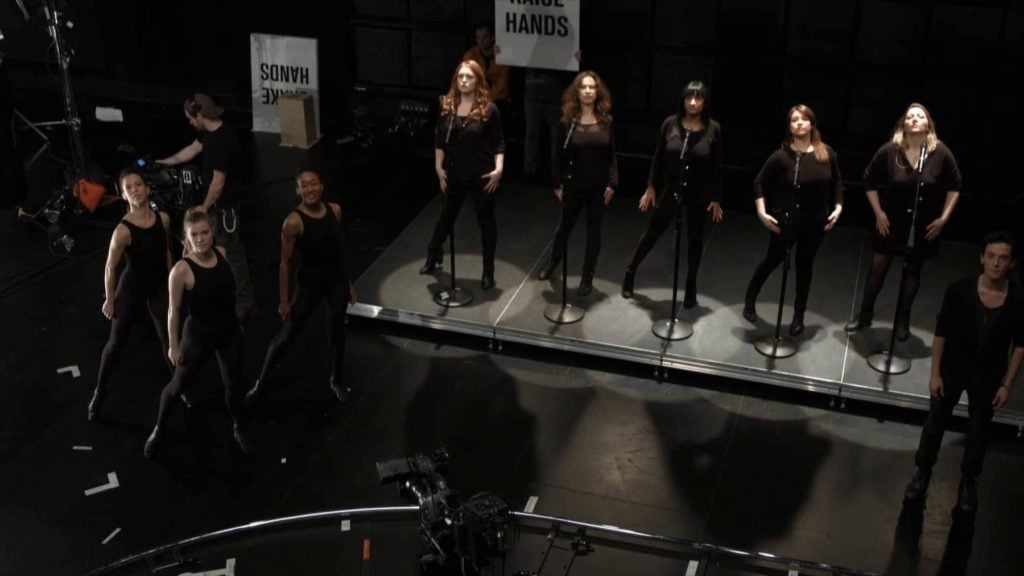
Performers staging And You Were
Wonderful, On Stage at EMPAC. Image courtesy EMPAC.
Spooner’s opus, a choral musical about the changing nature of
celebrity and the increasing displacement of in-person experience
by various kinds of mediation, had many lives, touring and becoming a video installation of
the same name. All of which shows how it nails the sense of a
present-day, mutating consciousness.
88.
Leo Villareal, The Bay Lights (2013)

Leo Villareal, The Bay Lights
on January 24, 2013. Image via Wikimedia Commons.
Claiming to be the largest light-based artwork around,
Villareal’s animated collection of 25,000 twinkling LED lights on
the Bay Bridge in San Francisco started as a temporary installation
in 2013, but was popular enough that it returned as a permanent
feature in 2016.
87.
Diana Al-Hadid, Nolli’s Orders (2012)
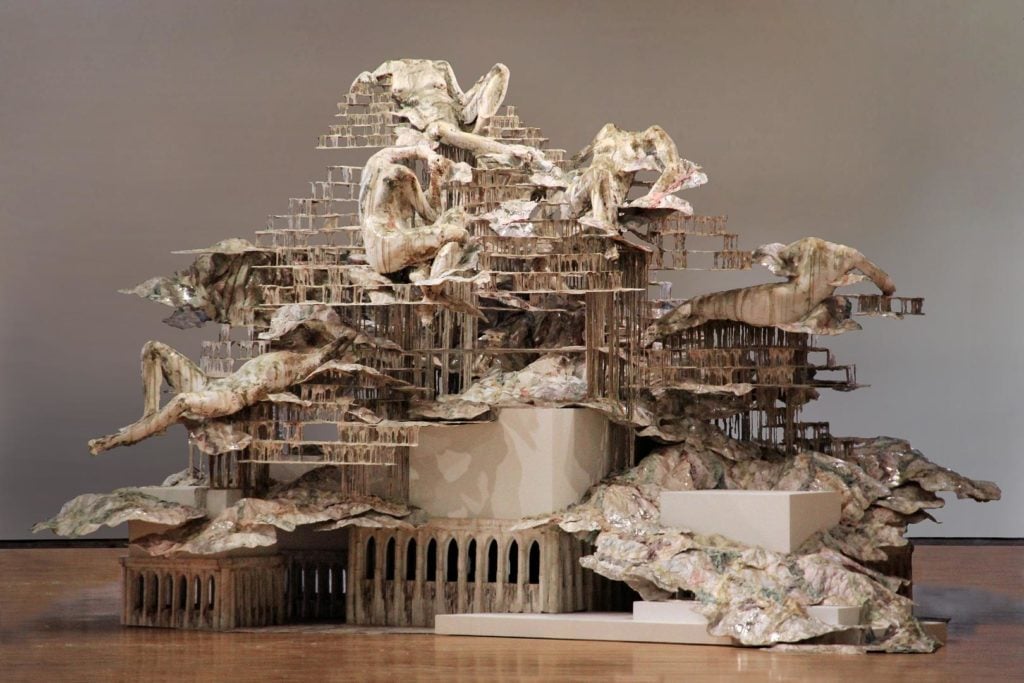
Diana Al-Hadid, Nolli’s Ordesr
(2012). Photo by Dennis Harvey, courtesy of the artist and Marianne
Boesky Gallery.
First seen at Mass MOCA in 2012, Al-Hadid’s room-sized
sculptural folly is an anthological, scale-shifting mass of
references to antique architecture and Mannerist painting.
86.
Julia Weist, Reach (2015)
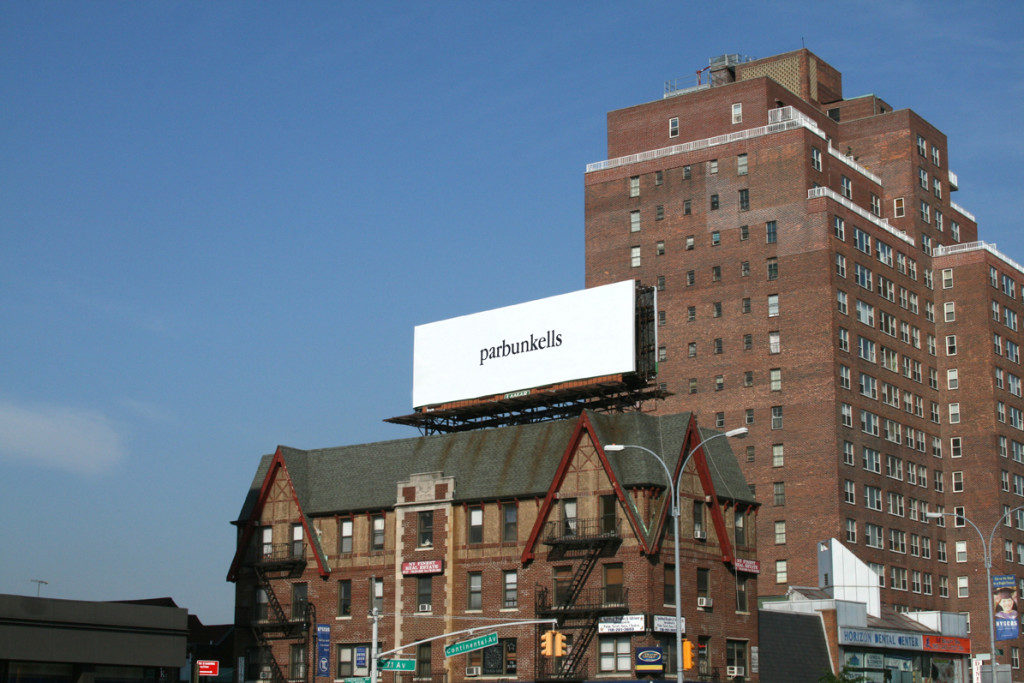
Julia Weist, Reach
(2015). Image courtesy the artist.
In premise, Weist’s work is simple enough: a billboard in Queens
featuring an arcane word, “parbunkells,” that had exactly zero
Google search results before, plus a lamp in her apartment that was
rigged to light up whenever the word was searched. The resulting
viral explosion shows
that Reach distilled a certain feature of the attention
economy down to its fundamentals.
85.
KAWS, Holiday (2019)
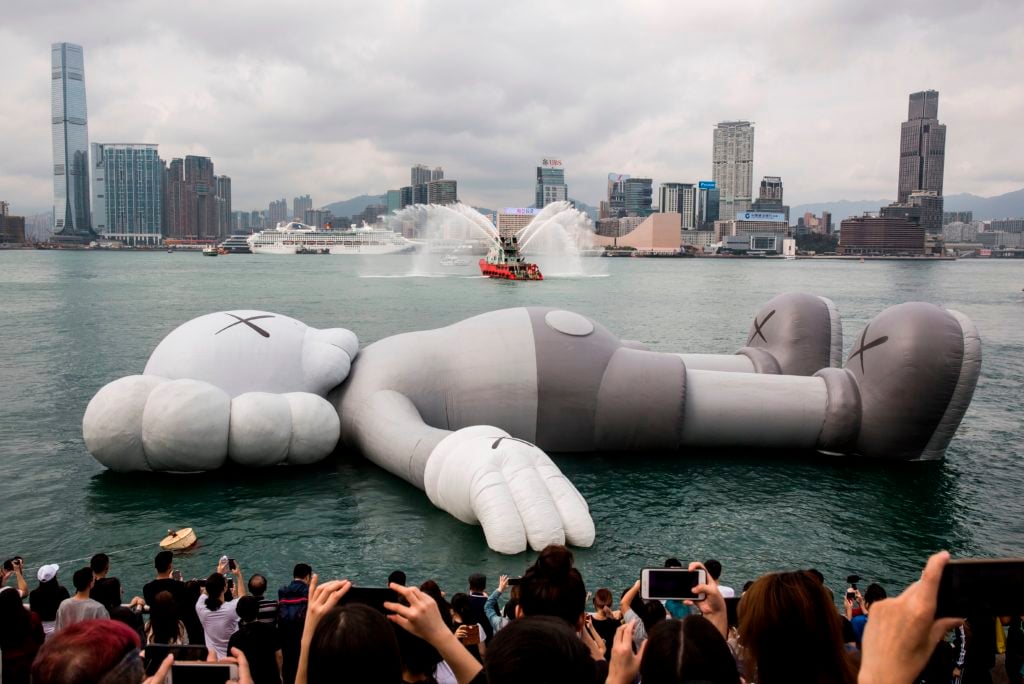
KAWS’s Companion at Victoria
Harbor, Hong Kong. Photo: Isaac Lawrence//AFP/Getty Images.
You may have tried to ignore the KAWS
phenomenon, but the former street artist and vinyl-figure
entrepreneur was one of the unstoppable success stories of the
decade. He just got bigger and bigger until it was impossible to
ignore him, and his signature “Companion” character was literally
115 feet long, 40 tons, and floating in Hong Kong harbor.
84.
Julian Rosefeldt, Manifesto (2015)
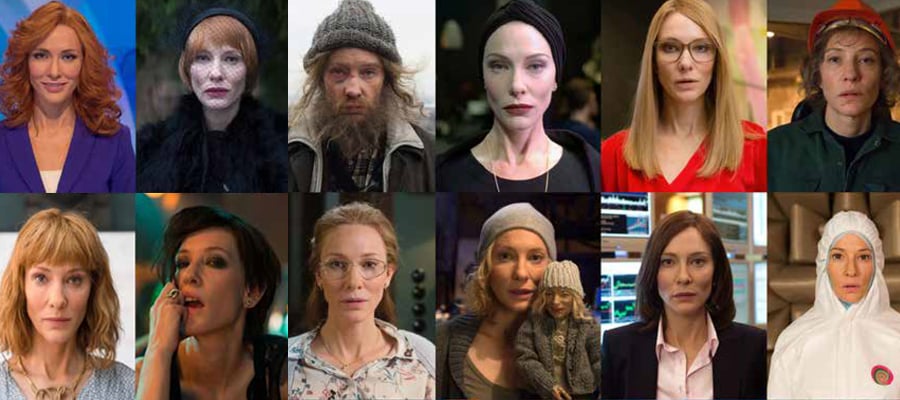
Julian Rosefeldt, Manifesto
(2015), film stills featuring Cate Blanchett. Courtesy Julian
Rosefeldt and VG Bild-Kunst, Bonn.
Rosefeldt’s ambitious, multi-screen installation restaging the
cardinal modernist manifestos as campy bits of present-day drama is
funny and strange, both distancing you from their original meaning
and reconnecting you with it. Plus, every single one is read by
actress Cate Blanchett, who’s having a lot of fun. The celebrity
presence was organic to the meaning of the work in that it
suggested that all the different, life-altering possibilities
offered by modern art, to a contemporary audience, are accessible
mainly as theatrical gestures.
83.
Wolfgang Laib, Wax Room (Where Have You Gone-Where Are You
Going?) (2013)
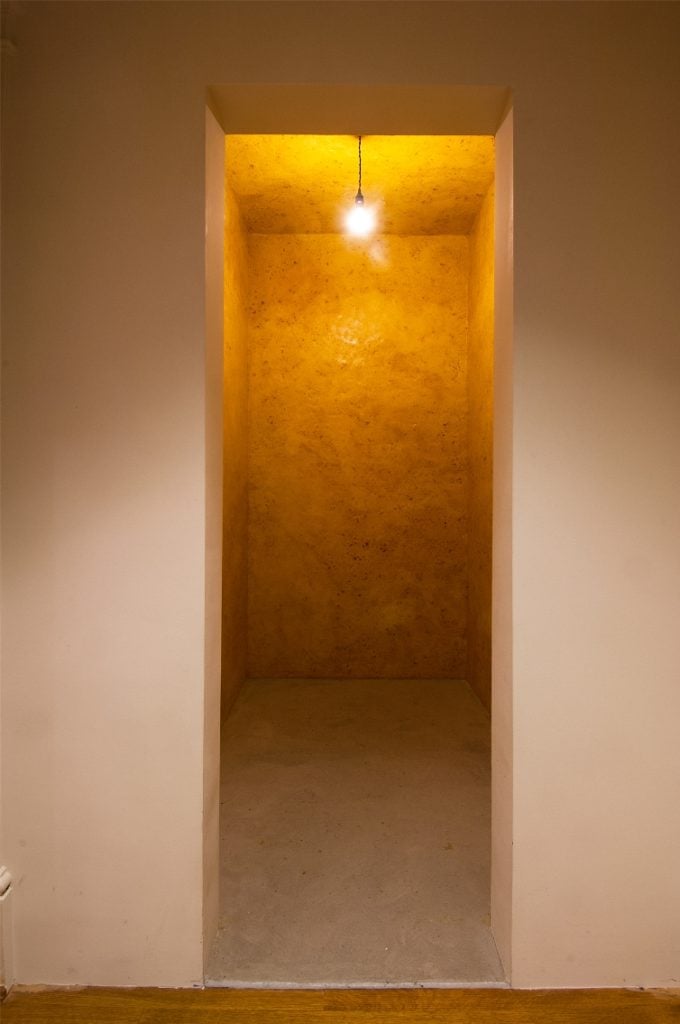
Wolfgang Laib, Wax Room (Where have
you gone–where are you going?) (2013). Photo: Lee Stalsworth.
Image courtesy the Phillips Collection.
Promoting an intense sense of place and focus on materials
within its intimate confines, this, the German artist’s first
permanent wax room installed in a museum and the Phillips’s first
new permanent installation since its Rothko Room, is worth the
pilgrimage.
82.
Sondra Perry, IT’S IN THE GAME ’17 or Mirror Gag for Vitrine
and Projection (2017)
The new realities of digital life and how they interact with
labor, racism, aesthetics, and sense of self were major themes of
the 2010s. For me, Perry’s disorienting, disoriented IT’S IN
THE GAME, which was commissioned by Oslo’s Henie Onstad
Kunstesenter and the Institute of Contemporary Art at the
University of Pennsylvania, is a go-to reference drawing together
all of that, partly because it is such a personal take on the
subject, dealing with how her brother’s image was hijacked for a
basketball video game.
81.
Anti-Eviction Mapping Project, Narratives of Displacement and
Resistance (2016)
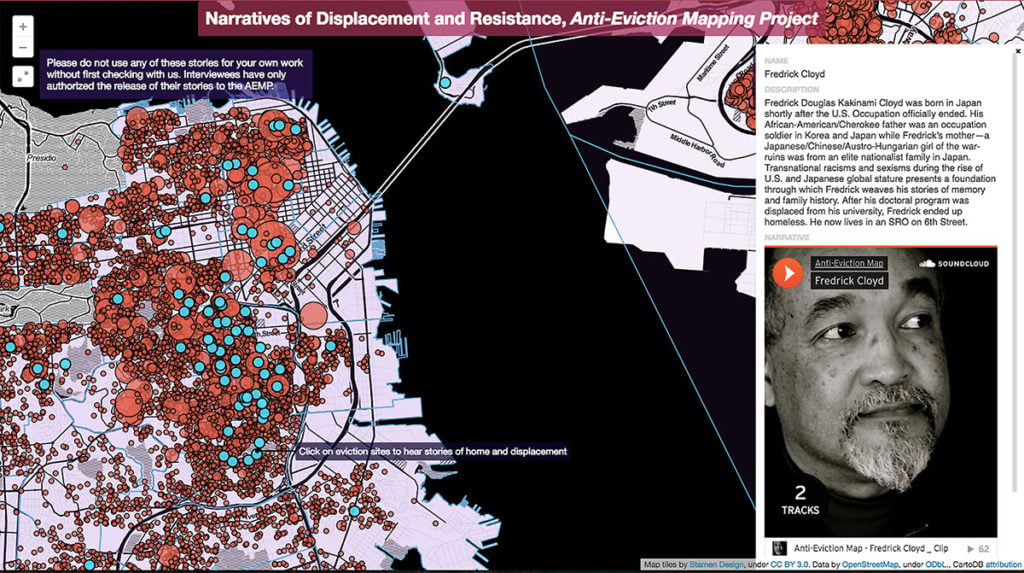
Screenshot from Anti-Eviction Mapping
Project’s Narratives of Displacement and Resistance
initiative.
Since 2012, the Bay Area’s AEMP has doggedly
used data-visualization, storytelling, and
“countercartography” to record the impact of predatory landlords,
police violence, and displacement in San Francisco and beyond. This
2016 initiative gives a literal overview of the breadth of
evictions in the hyper-gentrified city—while also creating an
archive of the human stories behind them so that the stakes don’t
get lost in the data.
80.
Paul Mpagi Sepuya, “Darkroom Mirror” series
(2017)
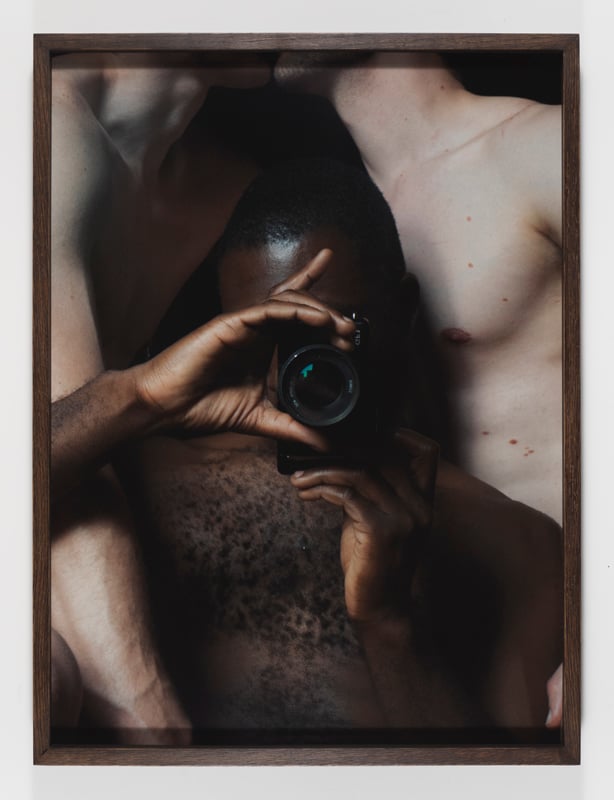
Paul Mpagi Sepuya, Darkroom Mirror
Portrait (_2060194), 2017. Courtesy of the artist and Team
Gallery.
Sepuya’s “Darkroom Mirror” series offers photographic portraits
was made collaboratively in the studio with friends and intimates,
as if to both present a sense of queer intimacy and to queer ideas
of authorship at the same time, letting it blur into something
slightly less fixed and conventional.
79.
Critical Art Ensemble, A Temporary Monument to North American
Energy Security (2014)
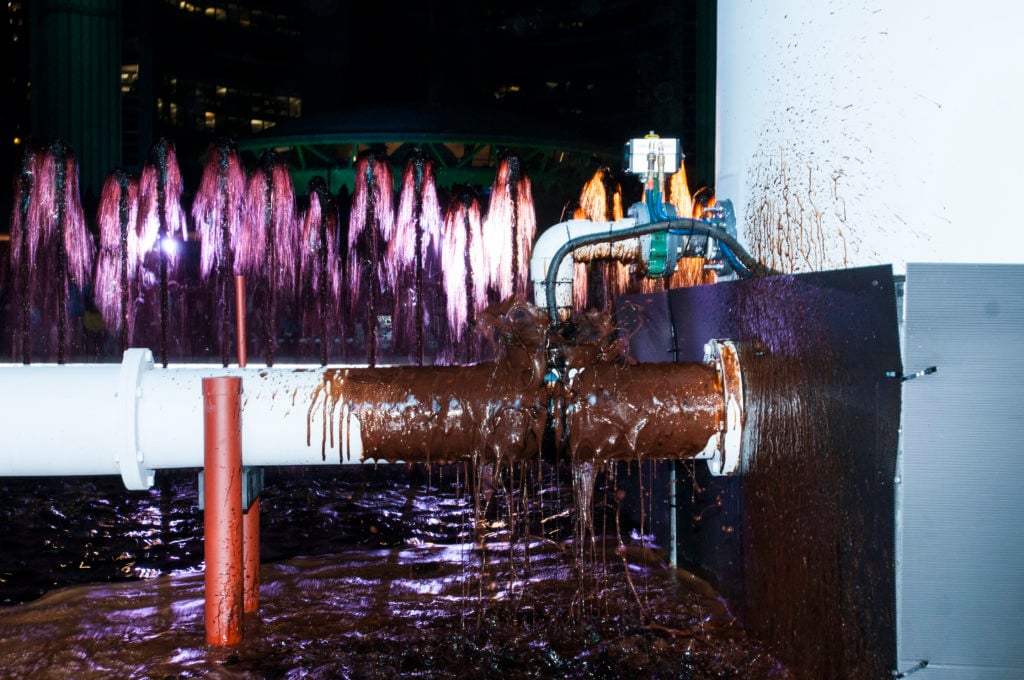
Image of Critical Art Ensemble’s A
Temporary Monument to North American Energy Security (2014)
during Nuit Blanche. Image courtesy Critical Art Ensemble.
It begins as an anodyne piece of corporate PR for “CanAmerican
Energy,” beaming out over the fountain at Toronto’s City Hall. It
evolves into something else as a pipeline set up as part of the
show bursts, flooding into the water. It ends with a Hazmat team
arriving to investigate. The message is pretty
clear.
78.
Amalia Ulman, Excellences & Perfections
(2014)
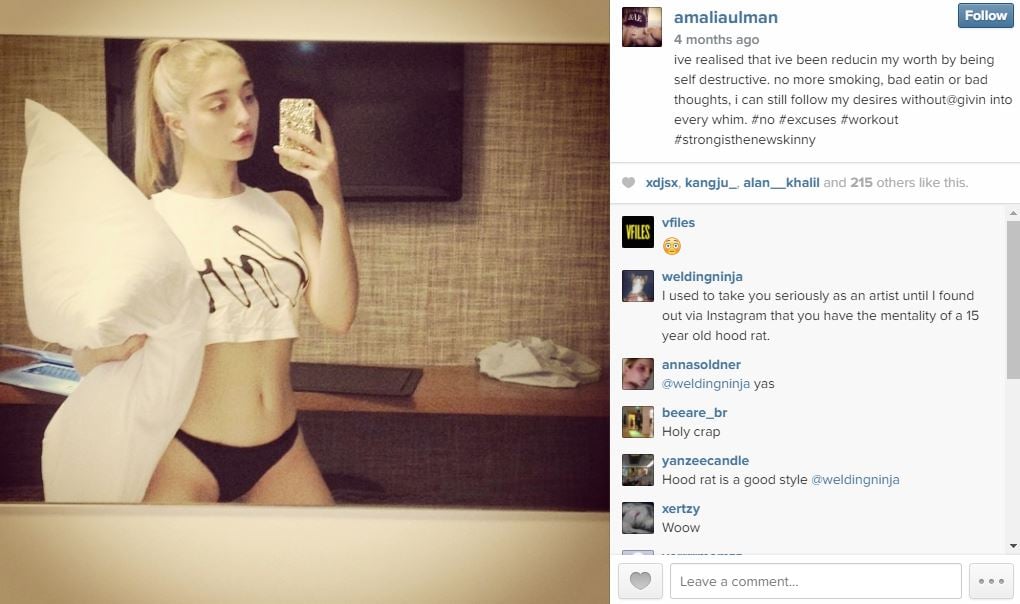
Still from Amalia Ulman’s “Excellences &
Perfections” via Instagram.
Ulman’s fabulated social-media parable, described as “an
extreme, semi-fictionalized makeover” but really more of a plumbing
of the depths of aspirational basic-ness and the Instagram
audience’s hunger for drama, has become the go-to reference for
“Instagram art” as a genre of performance.
77.
Anila Quayyum Agha, Intersections (2014)
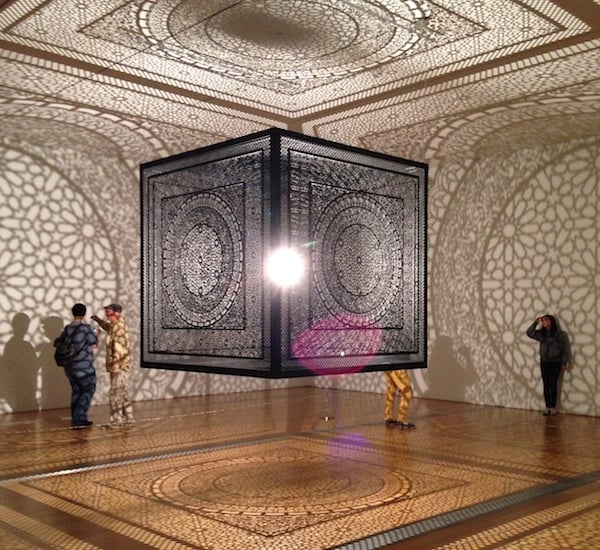
Anila Quayyum Agha,
Intersections (2014) at ArtPrize. Photo: Cait Munro.
Emerging from the Grand Rapids-based ArtPrize in 2014, where it
both won a popular vote for best in show and split the critic’s
vote—a convergence that’s as rare as a solar eclipse—Agha’s
intricate lantern sculpture was inspired by the majesty of
the Alhambra in Granada. It also emerged from her reflection
on how women were excluded from the inspirational spaces of the
mosque during her childhood in Lahore—giving its particularly
accessible beauty a kind of mission as representing a sense of the
wondrous that is meant to be shared widely.
76.
Phyllida Barlow, dock (2014)
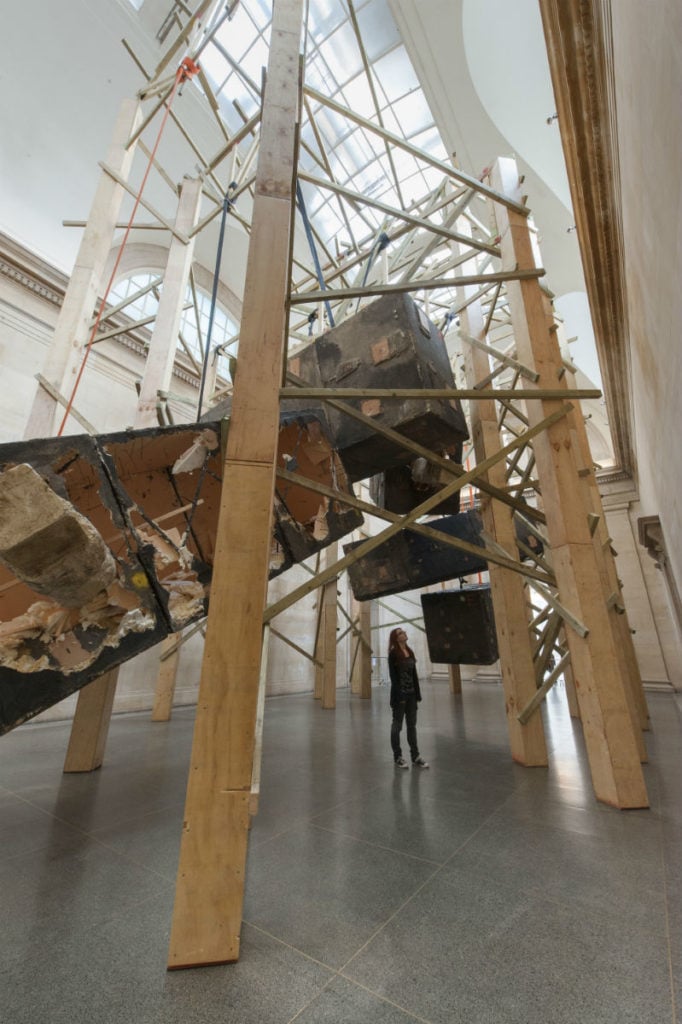
Installation view of Phyllida Barlow,
dock at Tate Britain 2014
. Photo by J Fernandes, Tate Photography.
Barlow’s ambitious, explosive, joyous sculpture-mess-environment
responding to the Tate Britain’s austere Duveen Hall was a symphony
of anti-monumentality that gave her decades of formal
experimentation room to coalesce into something memorable
(she was named CBE the next
year).
The post The 100 Works of Art That Defined the Decade,
Ranked: Part 1 appeared first on artnet News.
Read more https://news.artnet.com/opinion/100-works-that-defined-the-decade-part-1-1729962
Further reading


Leave a comment