
Here Are 5 of the Most Notorious Art Thieves, Swindlers, and Forgers of the 21st Century—and How They Were Finally Caught
“It seemed like a nice
neighborhood to have bad habits in,” wrote Raymond Chandler in the classic detective
novel The Big
Sleep.
Chandler wasn’t talking about the
art world specifically, but the sentiment captures some of its
well-heeled, occasionally unscrupulous dealings.
Right now now, there’s the
mounting world-wide search
for art dealer Inigo Philbrick, whose
laundry list of alleged crimes include selling a work he didn’t own
to multiple collectors, holding $14 million dollars of art hostage,
and then seeming to disappear. But that’s nothing new under the
crooked sun of art scamming. As we kick off the roaring 2020s we
thought we’d round up the other leading stories of shady dealers,
forgers, and thieves from the past two decades.
Stéphane
Breitwieser

Stéphane Breitwieser in 2006. Photo by
Jef-Infojef via Wikimedia Commons.
The Scam: This notorious
Frenchman stole at least 239 works from 172 museums throughout
Europe between 1995 to 2001. Consistency was his skill: Supposedly
he robbed an artwork every 15 days or so, often with the help of
his former girlfriend Anne-Catherine Kleinklauss, who would stand
as lookout as he removed paintings from their frames. What makes
Breitwieser so intriguing is that his thieving lacked any financial
necessity. Instead, he saw himself as something of a connoisseur,
with a taste especially for 16th- and 17th-century works. His most
expensive pinched painting was Lucas Cranach the Elder’s
Sybille, Princess of Cleves, which was estimated to be
valued at £5-£5.6 million.
How He Got Caught: He
couldn’t quit while he was ahead. In November of 2001, Breitwieser filched a 16th-century bugle, of which
only three are known to exist, from the Richard Wagner Museum in
Lucerne, but a guard spotted him before he escaped. Seemingly
insatiable, Breitwieser
returned to the museum just two days later. A journalist
named Erich Eisner
happened to be walking his dog by the museum and, when he noticed a
man who seemed out of place, surveying the museum, he alerted the
very same guard who had spied Breitwieser a few days before. He was
arrested in Switzerland, but it took authorities several weeks to
get a search warrant for his home in France and in that time the
thief’s spooked mother apparently destroyed a number of works, for
which she was ultimately served just over 2 years in
prison.
Where He Is Now: Breitweiser would wind up spending two years in
prison Switzerland before being extradited to France, where in 2005
he would be sentenced to an additional three years by a court in
Strasbourg. After he was released he wrote an autobiography of his
exploits called Confessions of an Art Thief. But even
that publishing success couldn’t satisfy his thirst for theft and
in 2011, police discovered 30 stolen works in his home, landing him
in prison for three more years. And just this past February he was
arrested once again, this time in relation to a 19th-century
paperweight he tried to sell on eBay.
Anna Delvey

Anna Sorokin, aka Anna Delvey, in a
courtroom during her trial in New York. Photo by Timothy A.
Clary/AFP/Getty Images.
The Scam: Here’s the
takeaway: the ethos of “fake it till you make it” can go
desperately wrong. The
Russian-born Anna Sorokin decided she wanted a taste of the good
life and arrived in New York a few years back a new woman—really.
She adopted the persona of Anna Delvey, an imaginary German heiress
with a fortune of €60 million, and set about splurging on luxury
hotels, lavish meals, and whirlwind vacations to the tune of
$200,000. But like any good make-believe trust-funder, she also had
her pulse on the cultural scene and her agenda included setting up
the so-called Anna
Delvey Foundation, a “members-only” arts club on Park Avenue, for
which she was in the ill-fated process of securing loans when she
was arrested.
How She Got Caught: Delvey
made a number of
missteps that eventually
caught up with her, including changing her place of birth on
official documents, spending too flagrantly, and crossing a former
friend who ultimately participated in an NYPD sting. After a
dramatic 22-day court trial—in which Delvey’s lawyer likened his
“moxie”-filled client to Frank Sinatra—an unrepentant Delvey, who
seemed almost concerned about her wardrobe, was
convicted on a total of
eight counts, including grand larceny in the first, second, and
third degrees, and theft of services. She
was sentenced to four
to 12 years in prison by the New York State Supreme Court—a
comparatively harsh punishment compared to some other swindlers.
She was also ordered to pay $198,956 in restitution and $24,000 in
fines.
Where She Is Now: Delvey
is serving time on Rikers Island and will eventually be moved to a
prison in upstate New York. Her story will soon be coming to a
television near you in the form of Inventing Anna, a forthcoming Netflix series about the infamous Soho grifter,
played by Julia Garner. And maybe life in prison isn’t all
bad—Page 6
reports she’s found love behind
bars.
Glafira
Rosales

Glafira Rosales (center) leaves
Manhattan Federal Court in 2013. Photo by: Jefferson Siegel/NY
Daily News via Getty Images.
The Scam: It was thepièce
de résistance of art scams. In the mid-1990s, Long Island art
dealer Glafira Rosales approached New York City’s Knoedler Gallery
with a trove of “masterpieces” by the likes of Jackson Pollock
and Mark Rothko, which she claimed were consigned by a secret
collector called, ahem, “Mr. X.” Somehow, these dubious works wound up being
sold for tens of millions of dollars and into a number of
prestigious collections between 1994 and 2009. A phony Rothko
painting was even purchased by Domenico De Sole, a Sotheby’s board
member who said he’d had no reason to doubt “the most trusted,
oldest, most important gallery” at the time. Ann Freedman, the former director of Knoedler
Gallery, has long maintained her innocence in the scam, despite
overlooking even the most egregious of cautionary measures—which
many of Knoedler’s victims say they find unlikely.
How She Got Caught: The
mystery collection seemed to keep growing in scope. In 2011, amid
financial troubles, the gallery, which had opened in 1846,
shuttered its doors and the house of cards began to tumble. In late
2011, the New York
Times published a story
about a lawsuit filed against the gallery by collector Pierre
Lagrange who believed he’d been duped into purchasing a fake
Pollock. As the story unfolded it was eventually discovered that
Rosales’s boyfriend Jose Carlos Bergantiños Diaz and his brother
had hired Queens-based
Chinese painter Pei-Shen Qia to create the myriad “mid-century”
works, and in a very public trial In 2013, Rosales ultimately plead guilty to
wire fraud, tax evasion, and money laundering.
Where She Is Now: Only
Rosales received any punishment, serving three months in prison,
and house arrest in 2017. She was also ordered to pay $81 million
dollars to the victims. The Diaz brothers fled to Spain, where
their extradition has not been granted. Qia, who was paid
comparatively meagerly for his forgeries, fled to China where he
claims not to know his works were being sold as originals. Freedman
remains a free woman.
Mark Landis

From left: Registrar Mathew Leininger,
directors Jennifer Grausman and Sam Cullman, forger Mark Landis and
co-director and editor Mark Becker from “Art and Craft” at the
Tribeca Film Festival. Photo by Larry Busacca/Getty Images.
The Scam:
A priest, a philanthropist, and an
art forger walk into a museum and… well, they’re all the same
person. This oddball case tells the story of a man who just wanted
to see his art in museums and didn’t care whose name was on it. For
decades, Mark Landis went about donating his fakes to museums under
various names, and sometimes disguised himself as a faux Jesuit
priest named Father Arthur
Scott. Landis had trained at
the Art Institute of Chicago, then attempted to open a gallery, but
meeting with financial woes, and on the verge of moving back to
Mississippi, he wanted to try to do one remarkable thing. His
thinking? He painted a version of a Maynard Dixon work and donated
it to a California museum as an original. Meeting with success, he
continued to donate his own paintings to many smaller museums for
30 years, posing as artists as famed as René Magritte to many
smaller, more obscure artists. His most remarkable skill as a
forger was not his meticulousness, so much as his ability to work
very quickly and in a number of styles.
How He Got Caught: A
museum registrar by the name Mathew Leininger ultimately began
to unravel the ruse in 2007, when he double checked documentation
on a Paul Signac painting that had been donated to the Oklahoma
City Museum of Art, only to find that identical works had been
donated to several other museums by Landis (under his various
aliases). In 2010, exposes followed in
the Art
Newspaper and the
Financial
Times and the jig
was up (except not really!).
Where He Is Now: Donating
works, even phony ones, to museums without any financial incentive,
it turns out, is not against the law—so Landis never actually saw
any consequences for his deceptions — though the costs of his
donations to museums cost something to the tune of $5 million. In
2014, Art and
Craft, a documentary
about his life, came out, and museums have made an effort to expose
his works. That said, Landis seems undeterred and has attempted to
donate dozens more forgeries even after his story was
exposed.
Larry
Salander
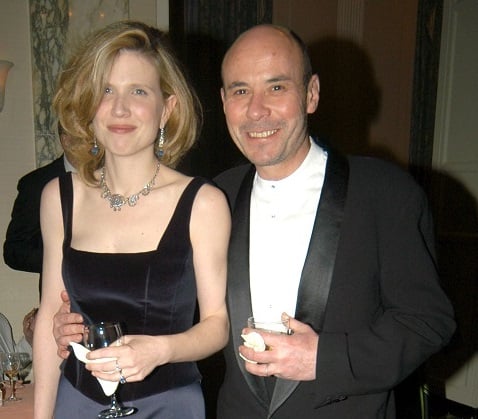
Larry Salander and his ex-wife Julie.
Photo: Patrick McMullan.
The Scam: Call this
a case of how the mighty have fallen. In 2003, Salander-O’Reilly Galleries was named the best
gallery in the world by the Robb Report. By 2007, Earl Davis, son of the artist Stuart
Davis and a friend of Salander, made the heartbreaking discovery
that his friend had stolen and covertly sold 90 works by his
father, leaving the younger Davis financially destroyed. Davis
wasn’t the only one swindled by Salander, who had a taste for
bigwig victims and bilked the like of tennis champion John McEnroe
and Rober De Niro, Jr.
How He Got Caught: Salander’s Ponzi schemes began to
collapse on each other. In the
spring of 2009, he was charged with 13 counts of first-degree grand
larceny, 10 counts of second-degree grand larceny, among a slew of
other charges. A year later, in March 2010, he pleaded guilty to 29
felony counts of grand larceny and admitted to selling numerous
artworks without permission after falling behind on the
$154,000-a-month rent of the gallery’s 71 Street Space.
Where He Is Now: Salander
was sentenced to six to 18 years in prison and is currently serving
that sentence on Rikers Island.
The post Here Are 5 of the Most Notorious Art Thieves,
Swindlers, and Forgers of the 21st Century—and How They Were
Finally Caught appeared first on artnet News.
Read more https://news.artnet.com/art-world/5-notorious-art-swindlers-1734696
Further reading


Leave a comment