
The Gray Market: Why the Coronavirus May Finally Force the Art Market to Evolve Beyond Its Old-School Ways (and Other Insights)
Every Monday morning, Artnet
News brings you The Gray Market. The column decodes important stories from the
previous week—and offers unparalleled insight into the inner
workings of the art industry in the process.
For this edition, wading back
into the biggest health scare in the (art) world…
PANIC ROOM
This week, fears of the novel
2019 strain of coronavirus—now shorthanded as COVID-19—wreaked a new
level of havoc on the global art industry, with a slew of players
across sectors postponing or nixing major events in response to the
disease. Taken together, the frantic rescheduling now makes it
appear as if a mixture of reasonable precaution and borderline
paranoia could endanger every event in the foreseeable
future.
For perspective, here’s a
rundown of how the worldwide art calendar has been reshaped since
the cancelation of Art
Basel Hong Kong:
In the fair sector, Hong Kong’s
Art Central fair, which runs concurrent to Art Basel Hong Kong, was
called off the day after the larger fair bowed out. Event
organizers canceled Beijing’s Jingart fair on February 21, and
Milan’s Salon del Mobile, one of the world’s premier trade fairs
for design, was recently pushed back from April to mid-June. The
MCH Group, Art Basel’s parent company, also announced on Friday
that the next edition of its Baselworld watch fair, the company’s
most lucrative trade fair, will be moved
from April 30 to late January
2021—a precaution motivated by a Swiss ordinance banning all
gatherings of more than 1,000 people until
mid-March.
In the auction realm,
Sotheby’s
geographically and temporally split the raft of sales it had planned for its Hong
Kong venue in the first week of April. The Modern and contemporary
art auctions will now take place in New York in the middle of the
same month, while their once-accompanying sales of jewelry,
watches, wine, and Asian art will be held in Hong Kong the week of
July 6. Christie’s pushed back its own Hong Kong sales from March
to May, and Bonhams postponed its March auctions in the city
without confirming when exactly they will be rescheduled. Multiple
houses participating in New York’s Asian Art Week (March 12–19)
have also delayed their respective sales until
June.
Finally, about a month after
state officials first closed
museums and other public
institutions in mainland China and Hong Kong, arts nonprofits
outside the region began ducking and covering, too. Last
Monday, officials shut down
all museums in northern Italy, where 650 cases of COVID-19 had been
confirmed by Friday. The same day, the Japanese ministry of culture
shuttered museums nationwide for the next two weeks, delaying the
opening of a major
traveling exhibition of works from London’s National Gallery at
Tokyo’s National Museum of Western Art.
In short, the industry is
accelerating toward panic mode across all sectors. And the more I
look into material on the coronavirus and the world’s reaction to
it, I’m increasingly convinced of two things: this episode is
not—repeat, not—going to blow over in the next couple of
months, and we’re going to learn an awful lot about the art
economy’s flexibility (or lack thereof) by the time the state of
emergency passes.
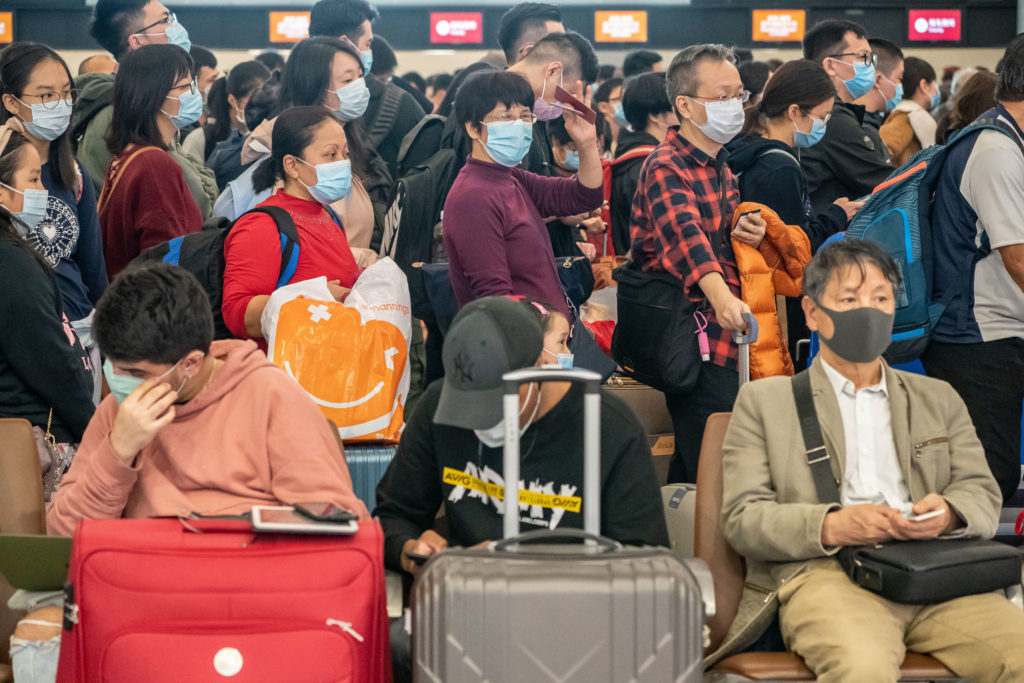
Travelers wearing face masks at the
departure hall of West Kowloon Station on January 23, 2020 in Hong
Kong. Photo by Anthony Kwan/Getty Images.
REALITY CHECK
Before I go further, let me
state this loud and clear: what matters most is that people around
the world are getting sick and, in some cases, dying from COVID-19.
Just as grave is the fact that many more people are being thrust
into positions of harrowing uncertainty about how, where, and
whether they and/or their loved ones will be able to get medical
care at all, and what the quality of that care will
be. This, not the economy
(art or otherwise), is where our minds should go first.
And one of the reasons it’s
crucial to keep this perspective is that, according to some experts
in the medical and public-health communities, most of the global
population may not be able to avoid the coronavirus regardless of
the measures taken.
I found no better expression of
this than in a piece by doctor and journalist James Hamblin,
matter-of-factly titled “You’re Likely to
Get the Coronavirus.”
The good news is the bad news, and vice versa. COVID-19 has a very
low mortality rate; the virus has been terminal in less than two
percent of confirmed cases to date, with the overwhelming majority
of fatalities being elderly patients. Compare that to the avian
flu, which emerged in 1997 and killed a terrifying 60 percent of
the people it infected, and you get a sense of how much worse this
outbreak could be.
On the other hand, it’s
precisely because the coronavirus is so mild that it’s already
been spread so far, so fast, so covertly. Hamblin describes it this
way:
[COVID-19] is deadly, but not
too deadly. It makes people sick, but not in predictable, uniquely
identifiable ways. Last week, 14 Americans tested positive on a
cruise ship in Japan despite feeling
fine—the new
virus may be most dangerous because, it seems, it may sometimes
cause no symptoms at all.
These traits lead us back to
Hamblin’s provocative-but-medically-grounded headline. One of his
sources, epidemiologist Mark Lipsitch, estimates that 40 to 70
percent of humankind will contract the coronavirus in the next
year—but that many of the people who do will weather it without
medical care, if they suffer any ill effects whatsoever. And since
those people will still be walking around, getting on public
transportation, going into the office, etc., the bug will keep
getting passed around.
In fact, Lipsitch is part of
what Hamblin calls an “emerging consensus among epidemiologists”
that COVID-19 will likely live on forever as a “new seasonal disease” that joins the
other four commonly contracted coronaviruses, one (or more) of
which may already have knocked you out of the office for a few days
in the recent past.
Oh, and if you’re banking on a
vaccine, don’t hold your breath. Even by the most bullish
projections, it would take between 12 and 18 months for a COVID-19
vaccine even to be properly vetted for safety and effectiveness. It
would then have to be mass-produced and distributed around the
globe, which will take even more time. According to
infectious-disease specialist Laurie
Garrett, COVID-19
survivors in China haven’t even seemed to develop an immune
response to the virus, calling into question whether a vaccine is
even viable.
All of which means that the
world at large, including the art world, should move past
short-term emergency measures like canceling events and onto
big-picture questions about how to move forward in a world where we
can’t just wait out COVID-19. And companies in other sectors of the
economy are already demonstrating the promise of doing so—and the
peril of refusing to.
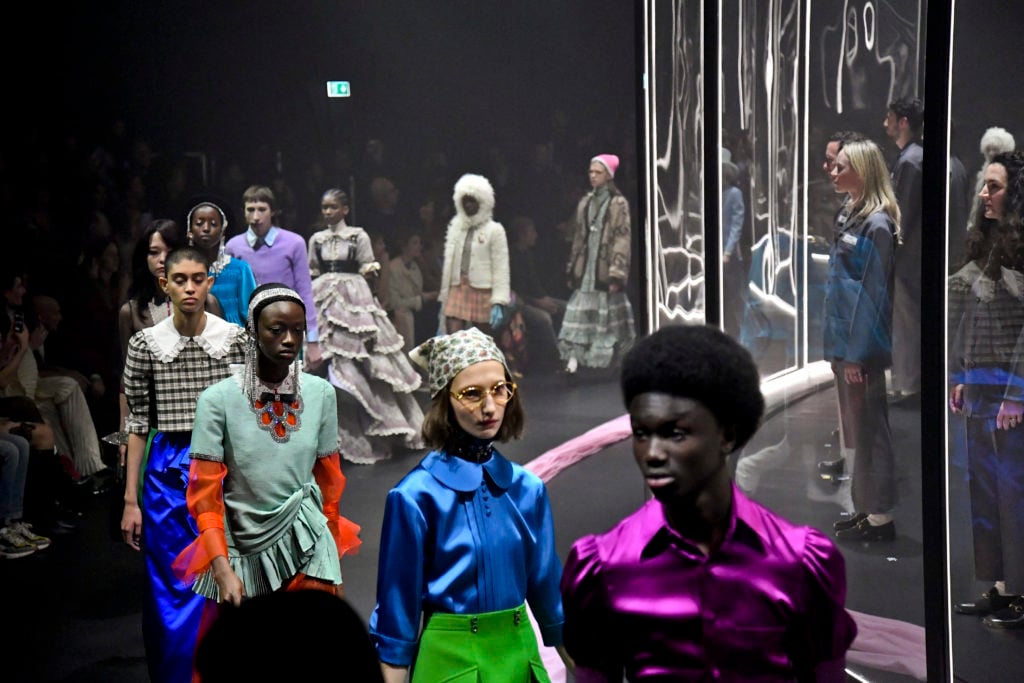
Gucci’s Ready to Wear Fall/Winter
2020-2021 runway show was one of dozens live-streamed during
February’s Milan Fashion Week in response to coronavirus-related
obstacles. Photo by Victor VIRGILE/Gamma-Rapho via Getty
Images.
DIGITAL DASH
Thanks to quarantine measures
and other ironclad state edicts aimed at slowing the
coronavirus, China is
still in the midst of what Bloomberg analysts called “the world’s largest
work-from-home experiment.” And this scenario is just as
consequential for what it does to consumer behavior as for what it
does to the supply side.
Alibaba, the so-called “Amazon
of China,” has lost about $28 billion in value in the past six
weeks under the threat of COVID-19. Why? First, because buyers have
cut back on more expensive purchases in the face of the health
scare. Instead, “a lot of the millions of [Alibaba] packages that
get delivered every day are cheap items such as groceries and face
masks,” according to Zheping Huang and Claire Che in
Bloomberg.
But beyond this losing trade-off
in customers’ shopping carts, the company’s core competency is the
delivery of physical objects through a physical shipping network—a
major vulnerability given that millions of manufacturing employees,
warehouse staffers, and delivery personnel are still confined to
their homes by law, disrupting the
supply chain at home
and, increasingly, abroad, too.
It doesn’t take visionary
imagination to draw parallels between Alibaba’s predicament and the
one now facing galleries, auction houses, and art fairs. In both
cases, suppliers need customers to continue buying high-value
physical objects, and any restrictions on human contact severely
hamper that ability. The art market has it even worse than Alibaba,
of course, because so much of the trade revolves around mass
gatherings of industry players in designated destinations around
the world. If buyers and sellers can’t physically congregate at
scale, the market’s gears start to grind. In this way, the
coronavirus—and the cancelations it’s already caused—once again
illustrate just how old-school the art trade still is.
In contrast to Alibaba’s
struggles, however, two of China’s other most important companies
have actually been buoyed by COVID-19. ByteDance, the owners of
TikTok, and Tencent, the company behind WeChat and a host of
popular mobile games, “are benefiting from a vastly increased
audience as millions are confined to their homes, with mobile
gaming and livestreaming their only recourse to entertainment,”
report Huang and Che of Bloomberg.
Tencent is even working to
bridge the gap between China’s newly captive audience and the world
of high fashion. On short notice, the company managed to coordinate
with the organizers of Milan Fashion Week to livestream every
runway show in the program, resulting in 16 million views for 30 brands
on Tencent Video. After the cancelation of both Shanghai’s and Seoul’s fashion weeks in the past few days,
designers and event organizers may begin to seek out even more
digital solutions to compensate for the crucial industry gatherings
lost to COVID-19.
Can the art market develop
similar immune responses? Art Basel is already drafting off the
tailwinds produced by galleries (from the price
apex to the
lower
levels) by
launching online viewing
rooms for exhibitors who
were admitted to the now-canceled 2020 edition of Art Basel Hong
Kong. But what other tech opportunities might be found? Similar to
the gains made by ByteDance and Tencent’s core products, could the
coronavirus boost the fortunes of software-based artworks and
initiatives created expressly for digital consumption? Or, as
others have speculated already, might collectors go the opposite
direction by demonstrating resurgent interest in local or regional
galleries, fairs, and other events?
I don’t have the answers. But no
matter how much of the upcoming art-market calendar is warped by
panic over COVID-19, it will be noteworthy to see whether the trade
emerges having evolved in lasting ways—or whether it simply reverts
to the same patterns it had fallen into before the outbreak. The
answer won’t just tell us what lessons the market learned from this
anomalous disruption. It will also tell us a great deal about how
much change to expect once we settle into a new normal.
That’s all for this week. ‘Til
next time, remember what Emerson said about obstacles: every wall
is a door.
The post The Gray Market: Why the Coronavirus May Finally
Force the Art Market to Evolve Beyond Its Old-School Ways (and
Other Insights) appeared first on artnet News.
Read more https://news.artnet.com/opinion/gray-market-coronavirus-calendar-1790631
Further reading


Leave a comment