
Did Ancient Hebrews Get High During Temple? A New Archaeological Discovery Suggests They Did
Frankincense, myrrh, and… cannabis? Archaeologists have
discovered traces of weed on an ancient Israelite altar, suggesting
that getting high was a religious ritual for the Hebrew people.
The discovery was made using gas chromatography and mass
spectrometry testing on an Iron Age Judahite shrine at Tel Arad, in
Israel’s Negev desert. The cannabis altar was in the inner sanctum
of the temple, known as the cella, or holy of holies.
“We know from all around the Ancient Near East and around the
world that many cultures used hallucinogenic materials and
ingredients in order to get into some kind of religious ecstasy,”
Eran Arie, curator of Iron Age and Persian Periods archaeology in
the Israel Museum in Jerusalem told CNN. “We never thought
about Judah taking part in these cultic practices. The fact that we
found cannabis in an official cult place of Judah says something
new.”
Arie published a report on his
findings in the Journal of the Institute of
Archaeology of Tel Aviv University with independent
researcher Baruch
Rosen and Dvory Namdar, a
chemist and archaeologist from the Volcani agricultural research
center.
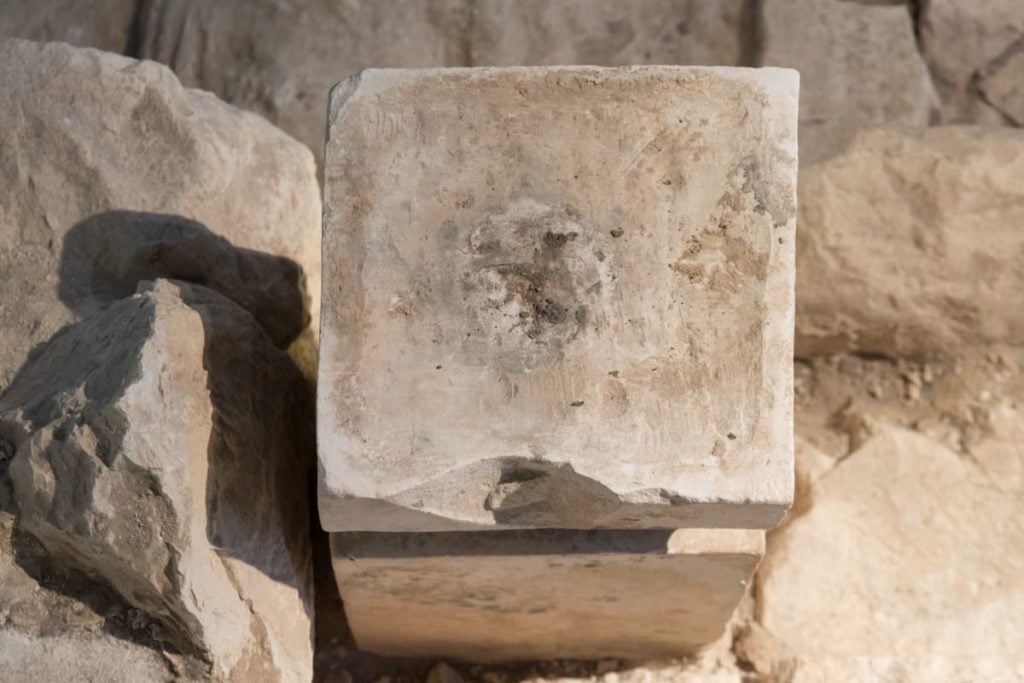
The burnt residue on the top of this
altar contains compounds found in cannabis. It was excavated from
the shrine at Arad and rebuilt in the Israel Museum from the
original archaeological finds. Photo courtesy of the Israel
Antiquities Authority, ©the Israel Museum, by Laura Lachman.
Experts believe the site, first discovered in the 1960s, was
active from the ninth century BC to the beginning of the sixth
century BC. At some point while the temple was still in use,
worshippers buried the two limestone altars on either side of the
stairs leading up to the stella.
In the dry desert climate, the burnt remains on either side were
preserved over the millennia. Testing conducted by the original
archaeologists who unearthed the altars proved inconclusive, so it
was assumed that they were used to burn animal sacrifices.
Now, modern scientific testing suggests otherwise: One altar was
for cannabis, the other, larger one for frankincense, an aromatic
incense made from resin of the Boswellia tree. (The
frankincense was significant, since it had never been found at an
dig site before, but given its appearances in the bible, its
presence came as no great surprise.)
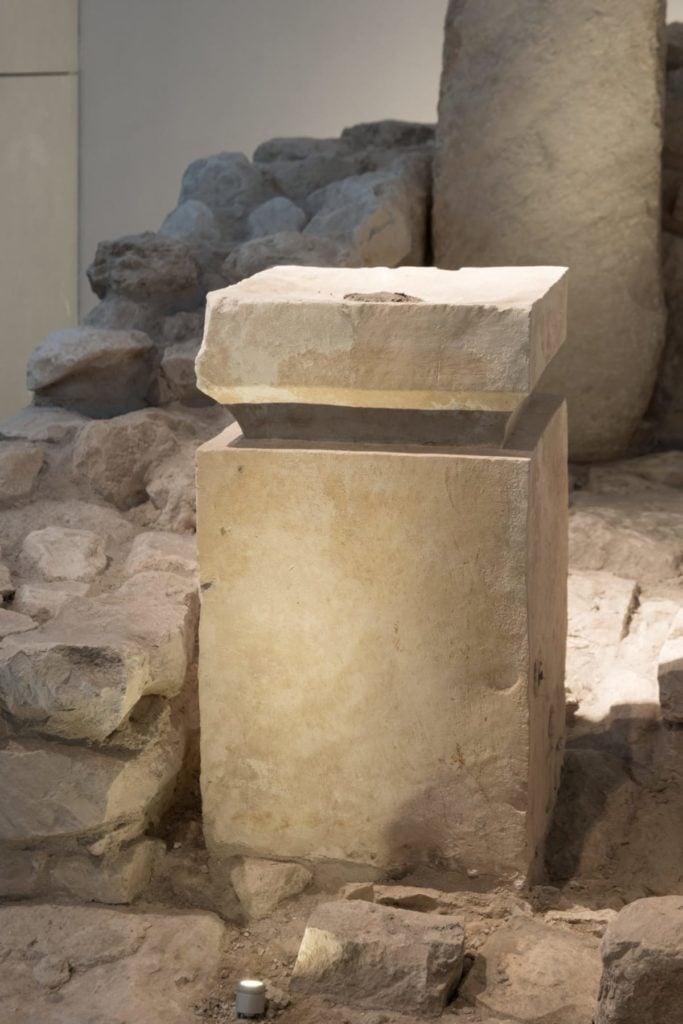
The larger altar from Arad’s holy of
holies was used for frankincense offerings. Photo courtesy of the
Israel Antiquities Authority, ©the Israel Museum, by Laura
Lachman.
The traces of teterahydrocannabinol, cannabidiol, and
cannabinol—substances that are found in cannabis—were far more
surprising. Initially, the team wondered if Namdar, who had just
started a job at lab researching weed’s use in medicine, had
accidentally contaminated a sample. Then an independent lab
confirmed the result.
The leading theory is that worshippers were using the cannabis
to get high. The residue showed that the drug had been mixed with
animal dung, which would have made the cannabis burn at a lower
temperature, allowing for the activation of the drug’s psychoactive
compounds. The frankincense likely was at a separate altar
because it releases its aroma best when burned at high
temperatures—the residue there included animal fat, which would
raised the temperature to the desired level.
Both the frankincense and cannabis were likely quite
expensive, as they would have been brought to Israel by traders
from afar.
“Importing cannabis and frankincense was a big investment that
could not be made by some isolated group of nomads, it required
backing from a powerful state entity,” Arie told Haaretz. “If they just wanted
to make the temple smell nice, they could have burned some sage,
which grows in the area of Jerusalem.”
The cannabis may have been imported to the Middle East from
southeastern Russia, or China, where the burnt remains of
2,500-year-old plants were discovered in an ancient
cemetery last year. It likely would have been in resin form,
known as hashish.
The report suggests that the ritual use of cannabis was likely
widespread throughout Israel at the time, as the shrine where they
found the drug would have been run by a local garrison of Judahite
soldiers sent from Jerusalem. If that’s true, it’s possible that
biblical scholars don’t know the word the ancient texts used for
the plants—or the custom may have died out before the scripture was
written down.
The post Did Ancient Hebrews Get High During Temple? A New
Archaeological Discovery Suggests They Did appeared first on
artnet News.
Read more https://news.artnet.com/art-world/archaeologists-discover-cannabis-biblical-site-1874790
Further reading


Leave a comment