
The Gray Market: Why New National Security Laws May Be the End of the Hong Kong Art Market as We Know It (and Other Insights)
Every Monday morning, Artnet
News brings you The Gray Market. The column decodes important stories from the
previous week—and offers unparalleled insight into the inner
workings of the art industry in the process.
This week, examining yet another
calamity for the “global art world”…
END OF AN ERA?
On Thursday, China’s parliament
overwhelmingly approved a new national security law to be imposed
on Hong Kong as soon as September. Although the final text of the
regulations will not arrive for weeks, the Washington
Post reported that
the overarching thrust will “criminalize ‘foreign interference,’ terrorism,
secessionist activities, and subversion of state power” throughout
the semi-autonomous region. The action likely marks both a turning point in
the development of the Asian art market and another instance where
politics impacts art much more powerfully than the
inverse.
The legislation comes in
response to the large-scale pro-democracy
protests that dominated
Hong Kong from spring 2019 until its public-health shutdown early
this year. Chinese Communist Party officials, as well as Hong Kong
chief executive Carrie Lam, have routinely portrayed the protesters
as “terrorists” and foreign agents, even before their actions
sometimes turned violent (often in response to aggression from the
authorities).
If you feel like a huge number
of specific activities could fall under the broad designations laid
out by the new law, you’re right… and that’s the point. Antony Dapiran, a Hong Kong-based attorney
and political analyst, summed up the vague language this
way: “This law will mean
whatever Beijing wants it to mean, and that has serious
implications” for civil liberties in the city, including
the rights to free speech, free
assembly, free trade, and popular elections for the local
legislature—an entity Chinese officials bypassed
entirely with Thursday’s
parliamentary vote.
The main question now facing a
variety of different markets is what will become of the special
international trade relationships that have enabled Hong Kong to
flourish for decades as a global hub for finance and
commerce. The US, for
instance, places no restrictions on currency exchanges between the
US dollar and the Hong Kong dollar, slaps few (if any) tariffs or
other added costs onto goods traded with Hong Kong, and requires no
visas to travel between the two destinations. None of these
benefits is enjoyed by businesses and high-net-worth individuals on
the mainland.
Yet their days in Hong Kong now
also appear to be numbered. President Trump can incinerate the
privileges with a single executive order, and he already
signaled his
intentions to do so on
Friday. Other nations including Australia, Great Britain, and
Canada have gestured toward their economic holsters as well, hoping
to pressure Beijing into curtailing the final bill’s encroachment
on the semi-autonomous region.
If the tactic fails, though, it
likely means the premature end of the “one country, two systems”
arrangement implemented after the UK handed Hong Kong back to China
in 1997—and with it, the end of the city’s internationally vital
art scene, at least as we’ve come to know it this
century.
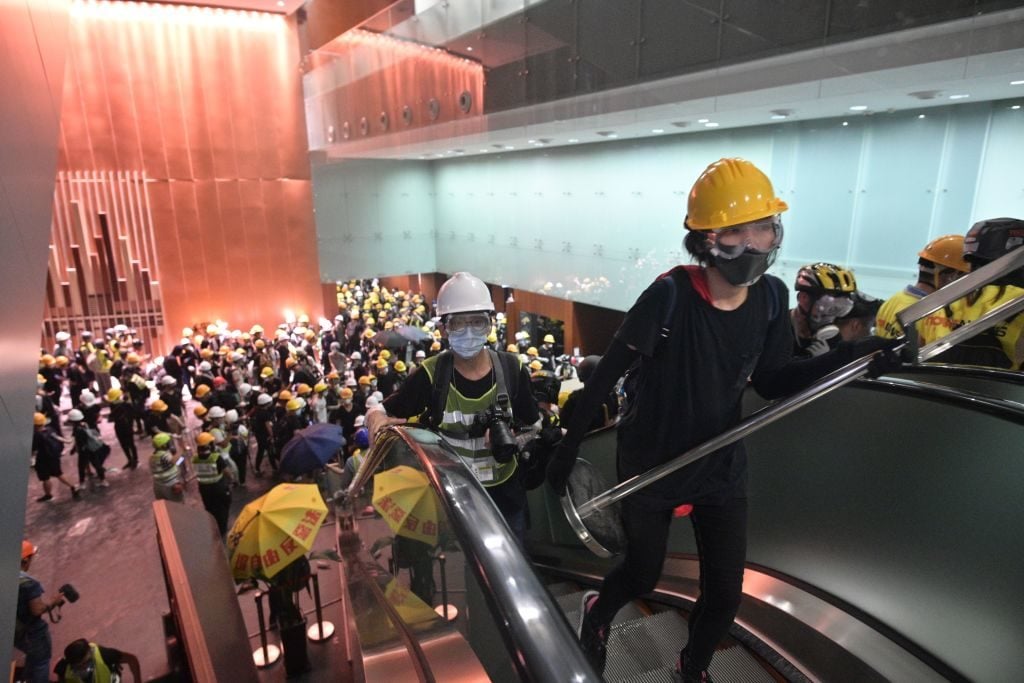
Protesters break into the government
headquarters in Hong Kong on July 1, 2019, on the 22nd anniversary
of the city’s handover from Britain to China after successfully
smashing their way through reinforced glass windows and prizing
open metal shutters that were blocking their way. Photo: ANTHONY
WALLACE/AFP/Getty Images
ONE-TWO PUNCH
In the worst-case scenario, the
forthcoming national security law would deal a double blow to the
arts in Hong Kong. The loss of free-speech rights would obviously
hold dire implications for the artworks that can be created and the
types of messages that can be delivered across creative
disciplines. As Jiayang Fan of the New
Yorker put it after
talking with Hong Kong-based playwright Candice Chong and theater
director Chan Chu Hei, “With
the latest proposed security legislation, if you dare to question
Beijing’s version, you are liable to be accused of subversion.” But
for many in the arts, “the real fear is not knowing where the line
might lie, and the danger, as a result, is policing one’s own
imagination.”
It’s no surprise, then, that
1,500 members of Hong Kong’s art community signed a petition
last week proclaiming that the
regulation’s “consequent
damage to the image of Hong Kong as a cultural metropolis and to
the economy will be incalculable.”
The consequences for the art
market could be no less severe. An end to economic openness and
special trade relationships could almost immediately transform Hong
Kong from a global hub to a regional also-ran in the eyes of the
international art market—an outcome that would prove especially
damaging for sellers hoping that Chinese consumers
will be their salvation during the West’s continued struggles during
the ongoing shutdown.
For a sense of scale, between
1991 and 2018, total sales of fine art in the district’s auction
houses swelled
from approximately $11 million to
nearly $1.4 billion. While we (as usual) have comparatively few
data points to quantify the degree of growth in Hong Kong’s private
market over that span, it’s safe to say that such powerhouse
Western dealers as Gagosian, David Zwirner, Hauser & Wirth, Pace,
and Lévy Gorvy didn’t decide to establish serious
permanent operations in the city out of reckless adventurism. Nor
is it a coincidence that Art Basel chose Hong Kong as the base for
its only East Asian art fair, which rapidly became the region’s
premier event for the industry’s elite every
March.
How apocalyptic would it be for
the art market if Hong Kong became financially indistinguishable
from the mainland? Few, if any, dealers have spoken on the national
security law’s impact by publication time, but we have some clues
from a newsworthy art-specific move last summer.
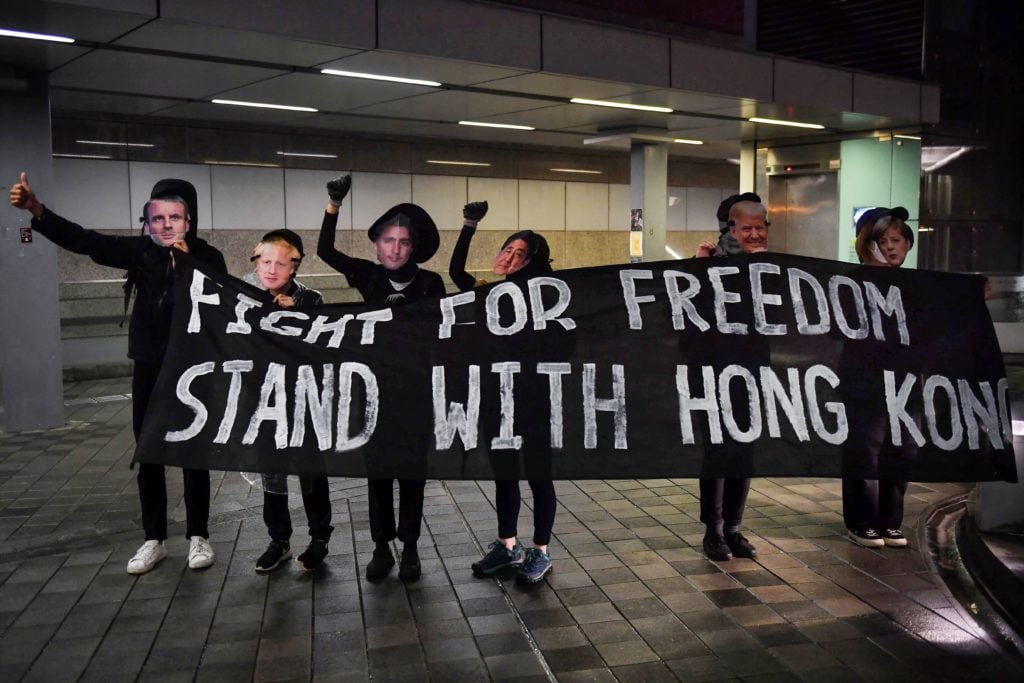
Protesters wearing masks of (left to
right) French President Emmanuel Macron, British Prime Minister
Boris Johnson, Canadian Prime Minister Justin Trudeau, Japan’s
Prime Minister Shinzo Abe, US President Donald Trump and German
Chancellor Angela Merkel during a rally at Tamar Park in Hong Kong
on September 2, 2019. Photo: Lillian Suwanrumpha/AFP/Getty
Images.
ACROSS THE SPECTRUM
When Pace announced in July 2019
that it would sunset the Beijing
space it had maintained
for more than a decade, gallery co-founder Arne Glimcher declared
that it was “impossible to do business in mainland China right now,
and it has been for a while.” He based his judgment on the state of
the US-China trade war (for reference, the Trump administration was
then threatening a 25 percent tariff on importations of Chinese
art); a Chinese luxury tax of 38 percent; and reluctance on the
part of mainland Chinese citizens to “conspicuously show their
wealth” by making major purchases for their residences or offices,
presumably for fear of being targeted by Xi Jinping’s fierce (and
often politically motivated) anti-corruption
campaign.
But Greg Hilty, curatorial
director of Lisson, which opened a space in Shanghai in 2019,
was considerably more
optimistic in comments
to my colleague Eileen Kinsella at the time. Hilty downplayed the
mainland’s tax obstacles, citing only a one percent import tax and
13 percent sales tax that he considered “workable.” He also
indicated somewhat cryptically that “there are other ways of doing
business with the Chinese,” and that the gallery
“believe[s] the Chinese and
Western art worlds and markets will draw ever
closer.”
You may be wondering, as I did,
what accounts for the dramatically different tax pictures described
by Glimcher and Hilty. It turns out that the “Chinese luxury tax”
is actually shorthand for a combination of import duties, VAT, and
consumption tax, each of which depends on the product trading
hands, its nation of origin, and a variety of other factors too
labyrinthine for me to sort through on this particular deadline. So
while rates can be lower than Glimcher’s estimate in some cases,
they can also be even higher in others. In fact, imported luxury
goods have sometimes been burdened by taxes of up to 60
percent.
Still, quibbling over specific
tax rates and terminology within China would miss the point. What
matters most to Hong Kong’s art-market future is the significant
financial difference between selling art there versus
elsewhere.
Shortly after news broke about
Pace’s exit from Beijing, Shana Wu at Art Market
Journal provided a
chart comparing the respective after-tax income for a dealer
selling the same hypothetical $100,000 artwork in three different
markets. In Hong Kong, the profit came in at just over 25 percent
of the sale price; in the US, it landed somewhere between 15.6 and
19.5 percent; and in mainland China, it crashed into a ditch
between zero(!) and 9.3 percent. (Wu’s figures also excluded
tariffs, meaning the actual earnings from a US dealer could be even
lower right now thanks to Trump’s current 7.5 percent tariff on
Chinese artwork.)
If that sobering
mainland-Chinese profit range begins to apply to Hong Kong, too,
it’s not hard to imagine international dealers and buyers thinking
twice about the city based on the financial picture alone. Add in
the possible restrictions on free expression for artists and
galleries, mainland-style fear of flexing on the buy side, and new
hurdles to the flows of traffic and money for everyone involved,
and Hong Kong’s “global hub” status could be crippled in a fraction
of the time it took to power up.
Again, I’m presenting the
worst-case scenario here. It’s possible that international pressure
convinces Beijing to soften the final form of the forthcoming
national security laws. Personally, though, I’m pessimistic about
the outcome for both the city’s art scene and its civil liberties.
Believing otherwise requires believing in a world where the
decision-makers involved prioritize cosmopolitan globalism, free
and fair exchange between cultures, and a shared goal of reaching
common ground at all, let alone through the specific
avenue of artworks and exhibitions. That vision is the founding
myth and the driving force behind the construct we’ve come to know
as the “global art world.”
But with Communist party
officials poised to scrap Hong Kong’s semi-autonomy, with yet
another murder of a black American citizen by a white American cop
setting off justifiably furious protests in cities across
the US, and with a historic public-health crisis too often
showing just how little people in and out of power care about
anyone beyond their own direct interest groups—both at home and abroad—I think it’s
past time for many of us in the arts to recognize that the
seemingly enlightened assumptions we held about human progress at
the start of this century may have been much more naive than we
realized. What’s happening in Hong Kong is a microcosm; the
consequences for all of us, in the arts and a whole variety of
issues, are far, far bigger.
That’s all for this week. ‘Til
next time, remember what Lenin said: there are decades where
nothing happens, and there are weeks where decades
happen.
The post The Gray Market: Why New National Security Laws May
Be the End of the Hong Kong Art Market as We Know It (and Other
Insights) appeared first on artnet News.
Read more https://news.artnet.com/opinion/national-security-law-hong-kong-1875219
Further reading


Leave a comment