
See You at the Fair? Nope! Why the Art World Is Embracing ‘JOMO’—the Joy of Missing Out—in a Big Way
It seems like only yesterday that FOMO, the pressure-packed
acronym denoting a “fear of missing out,” was inescapable in the
global art world. No matter how active you were, every time you
opened Instagram or checked your email, there were multiple
transmissions from peers, friends, and rivals about new exhibitions
and events happening somewhere else in the world where you were
not… but felt like you should be for the sake of your
career, your personal network, your social-media following, or all
of the above.
But every day, FOMO is being overtaken further and further by
the yin to its yang, the day to its night, the chaser to its shot:
JOMO, the joy of missing out. The phenomenon represents the next
natural step forward from “fairtigue,” “auction
exhaustion,” and all the other new phrases invented to put a cute,
manageable face on the art world’s increasingly body-wracking
treadmill of events.
“The ‘See you in Miami?’ email sign-off will begin to pervade my
inbox likely starting next month, but already, three people—two
gallerists and one collector—have expressed to me their delight in
sitting it out this year,” says art advisor Liz Parks. And the
sentiment extends far beyond her network.
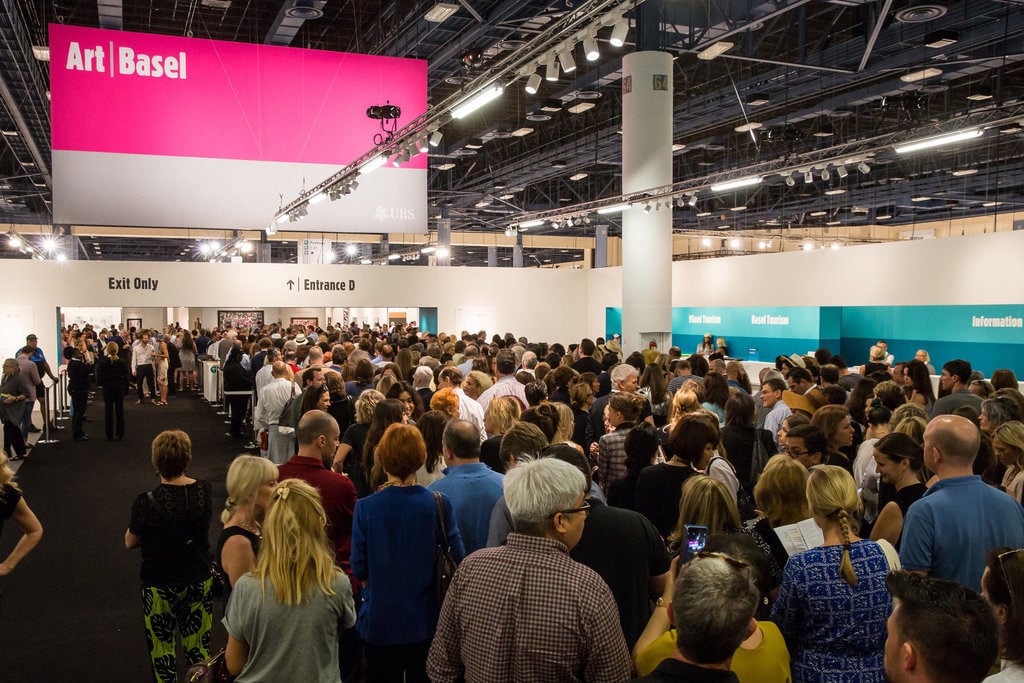
The lines to get into Art Basel in
Miami. Courtesy of Art Basel.
A Brief History of JOMO
It doesn’t take a forensics team to figure out how we got here.
The explanation is clear based on even a cursory look back at what
art critic Martin Herbert—whose recent book Tell Them I Said
No examines artists like David Hammons and Cady
Noland, who opted out of the art scene midway through their
careers—calls the “scalar expansion” of the art trade over the past
20 years. Somewhere along the way, the art world hit a tipping
point where it became impossible to even strive to see everything
and be everywhere—and with that collective resignation, FOMO
mutated into JOMO.
“I feel like my grasp of what’s
going on is only okay, but I’m also decreasingly likely to guilt
myself over that,” Hebert told artnet News. “I see that attitude in
other people too: a reflected sense that the art world has gotten
too big to process.”
A few figures help illustrate just how extreme the proliferation
of events has become in the art world. The number of worldwide art
fairs mushroomed from 68 in 2005 to somewhere between 225 and 300
by early 2015—and still floats close to the high end of that range,
according to art economist
Clare McAndrew.
The Biennial Association, meanwhile, currently lists 259
biennials, triennials, or similar art exhibitions in its directory. And while it’s
difficult to find an estimate for the number of gallery exhibitions
now mounted each year in a sector of the trade where Gagosian alone
boasts 17 permanent spaces, consider that the artnet Price Database
went from tracking auction results for about 8,300 artists in 1988
to 71,621 last year. Each of these events is also accompanied by
its own murderer’s row of dinners, cocktail parties, and breakfast
buffets to entice those who keep the art market churning.
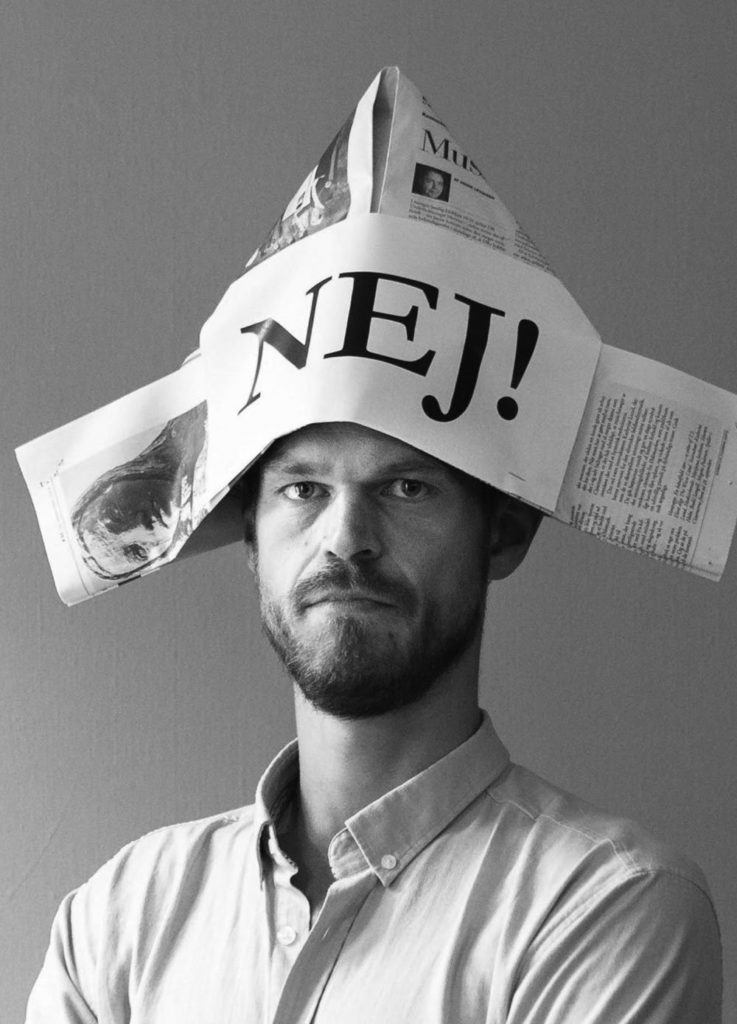
Svend Brinkmann, author of The Joy of
Missing Out. Courtesy of the author.
In this way, the art world is simply a heightened version of the
real world, where social media, smartphones, urbanization, and
other factors have combined to make life more distracting and
demanding than ever. The term FOMO, on which JOMO is based, can be
traced back to 2004, when it was coined by venture capitalist
Patrick McGinnis while he was a student at Harvard Business School.
He had arrived from a small town in Maine and found himself
overwhelmed by the activities and options available to him. (He now
has a podcast, called “Fomo Sapiens,” on which he interviews
business leaders about how they prioritize.)
As Danish psychology professor Svend Brinkmann writes in
his book The Joy of Missing Out, published in
February, saying no is a skill “we lack as both individuals and as
a society.” But, he argues, it is one we must cultivate to
counteract lives based on “overconsumption, untrammelled growth,
and whittling away at our natural resources.” (Brinkmann declined
to speak with artnet News for this story, citing his busy schedule,
which feels on brand.) This particular thread of self-help
seems to be catching on: recent best-sellers in this genre include
Chris Bailey’s Hyper Focus and Cal Newport’s Digital
Minimalism: Choosing a Focused Life in a Noisy World.
The JOMO Resistance
Some market players take heart in the notion that the most
important transactions never happen out in the open. “The most
important works that come to market never make it to a fair or an
auction. They don’t need the visibility help,” says one dealer who
requested anonymity. “When you come to that realization, going out
of one’s way to see ‘B’ material at a fair or auction becomes less
desirable.”
Still, some members of the art caravan can’t afford a deep
indulgence in JOMO. Chief among them are advisors, particularly
those focused on younger clients with small children or businesses
they are still actively in the process of building. “One of the most important aspects of the
advisor’s role is to see as much as possible and speak to as many
people as possible in order to divine some sort of signal in the
noise that is the market,” says advisor Benjamin
Godsill.
He also points out that, for more experienced collectors, any
trend toward missing out probably has less to do with embracing joy
than with recognizing necessity. He regularly meets with his
clients at the start of each season to map out which fairs qualify
as must-see—a determination increasingly informed by taking a wider
view of the destination city, including what local gallery shows, institutional exhibitions,
and other special events are accessible during a fair’s
run.
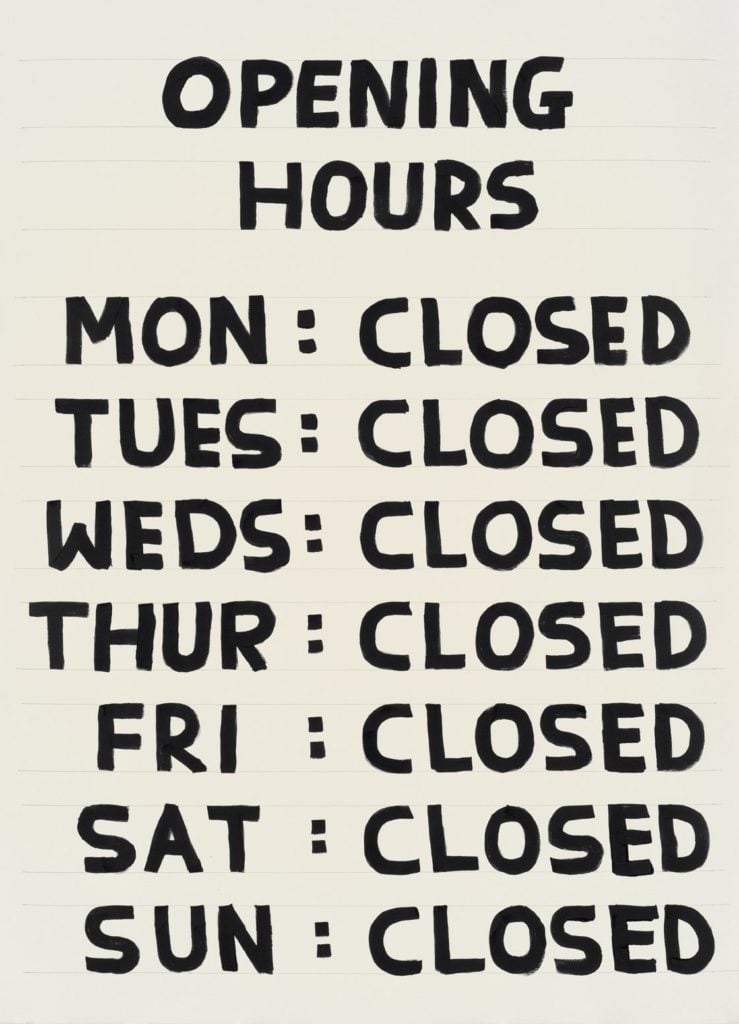
David Shrigley’s Opening Hours
(2016). Courtesy of the artist.
Dealers on the rise form another group pushing back against the
tide of JOMO. “I always make sure
to go to anything directly related to an artist I’m working with,
wherever it is in the world,” New York gallerist Meredith Rosen
says. “Everything else is secondary to that.”
Parks notes that the fact that collectors are increasingly
comfortable buying art off a JPEG makes them feel more sanguine
about missing market events when they don’t fit easily into their
schedules. (Plus, the plethora of art-fair photos on Instagram
means you can pretend you saw that installation everyone was
talking about regardless.)
“I go to Frieze this week as their proxy,” Parks says ahead of
the art-fair bonanza in London. “If they experience JOMO as a
result of not being there, good for them. And I suppose as I walk
through Regent’s Park on Wednesday, I can simultaneously rack up
some anti-FOMO points. Everyone wins.”
When applied to the art world, JOMO is above all about
prioritization. “I don’t think skipping the occasional art fair has
any effect on how well I do my job,” says Eric Gleason, a director
at Kasmin. “But it definitely makes me a better father.”
With such a proliferation of activities, the joy comes from
picking the ones you really want or need to attend, and leaving the
rest behind—without guilt. “If
I read a report about an art fair I wasn’t at—which is most of
them—I’m usually glad I wasn’t there, but a part of me rehearses a
scenario in which I alight upon something great,” Herbert says.
“And then the next fair rolls around and, quite probably, I still
don’t go.”
The post See You at the Fair? Nope! Why the Art World Is
Embracing ‘JOMO’—the Joy of Missing Out—in a Big Way appeared
first on artnet News.
Read more https://news.artnet.com/art-world/jomo-joy-missing-out-1665580
Further reading

Leave a comment