
5 Outstanding Works at Frieze London, From a Gripping Painting by Thornton Dial to Some Unsettling Photos by Cindy Sherman
Protests are raging in Hong Kong, fake blood is being sprayed
around London by Extinction Rebellion, and Donald Trump
keeps asking foreign governments to investigate his political
rivals, even as Congress impeachment dangles above him.
In other words, all is normal on planet Earth in the year
2019—or at least as normal as we have come to expect it to be, with
chaos being the only constant.
That paradoxical sense of unperturbed calm pervaded Frieze
London, where, despite some freaked-out signage around the VIP
entryway that nodded at the havoc raging outside the tent, the fair
was absolutely business as usual.
Why not enjoy it while it lasts? Here are a few of the most
intriguing art experiences to be found in the aisles.
Joseph
Kosuth
Booth curation
Lia Rumma, Naples
Price: €7,500 to €600,000
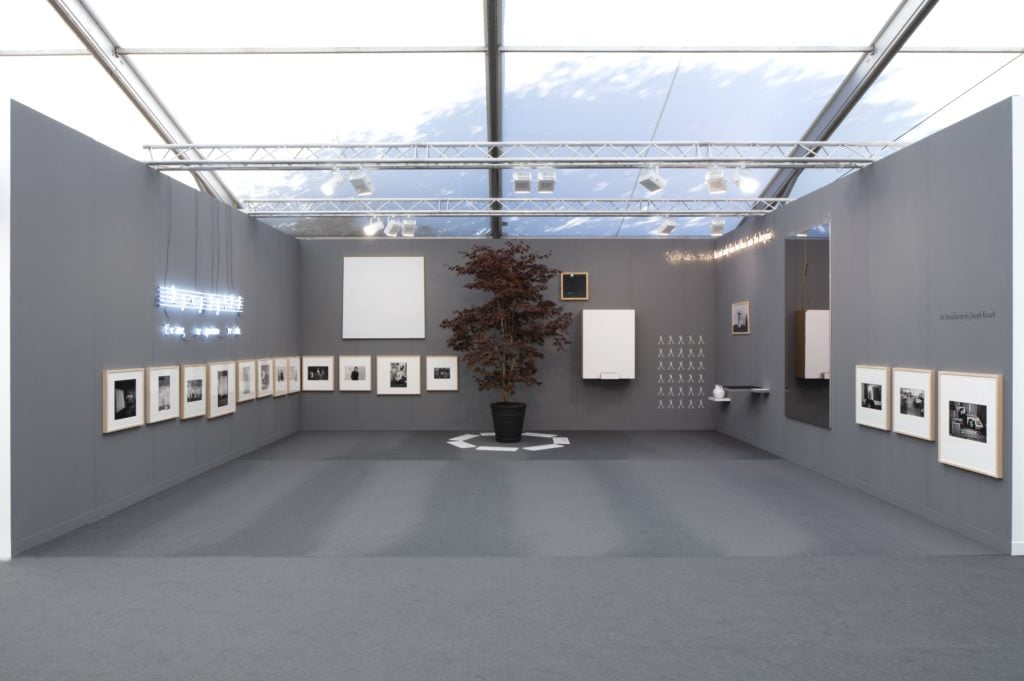
Lia Rumma’s booth at Frieze London,
curated by Joseph Kosuth. Courtesy of Lia Rumma.
The Frieze Art Fair’s brand rests upon its
presentation of art commerce in a thoughtfully curated framework,
and that not-always-easy-to-pull-off combination may have reached a
pinnacle this year at the booth of Naples’s Lia Rumma Gallery,
which assigned the job of assembling its wares to one of its
artists, Joseph Kosuth.
Putting one’s business in the hands of an artist
dedicated to interrogating the very nature and meaning of art may
seem like a risky move, but the revered 74-year-old, Ohio-born
Conceptualist evidently jumped in with both feet, producing an
elegant, meditative display that nonetheless managed to make the
artworks look very buyable.
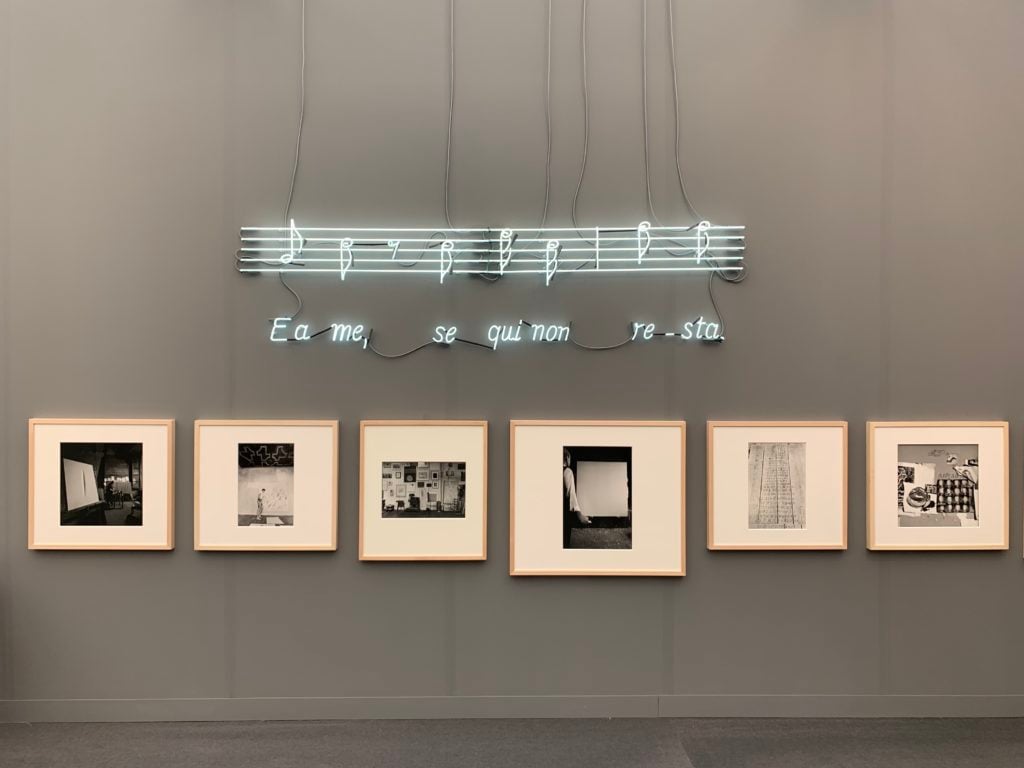
Photos by Ugo Mulas and a neon by Joseph
Kosuth.
Centered on a potted Japanese maple surrounded by white marble
plaques—a piece by David Lamelas (€60,000)—the booth featured
best-of hits by the gallery’s intellectual roster: a white wall
piece by Haim Steinbach; a light gray painting by Ettore Spalletti;
a suite of sensitive photographs of great postwar artists by Ugo
Mulas (€7,500–18,000); a Pistoletto mirror with an ominously
dangling noose (€600,000); an arrangement of medical scissors by
Marzia Migliora responding to a pregnant-looking Gio Ponti pitcher;
and art books by the Kabakovs and Giovanni Anselmo on individual
shelves. Buzzing neons by Kosuth himself—one with a quote from
Samuel Beckett, and the other from Gioachino Rossini
(€80,000–90,000)—were perched atop the display to help set the
mood.
The collaboration with Kosuth was so successful that
the gallery plans to continue the approach in coming art fairs,
handing booth-curating duties off to Alfredo Jaar for Artissima,
Steinbach for Art Basel Miami Beach, and Spolletti for a fair next
year. An even better idea? Some fair should create a whole section
for artist-arranged booths.
Mrinalini
Mukherjee
Kusum (1996)
Nature Morte, New Delhi
Price: Not for sale, but if it was, in the mid-to-high six
figures
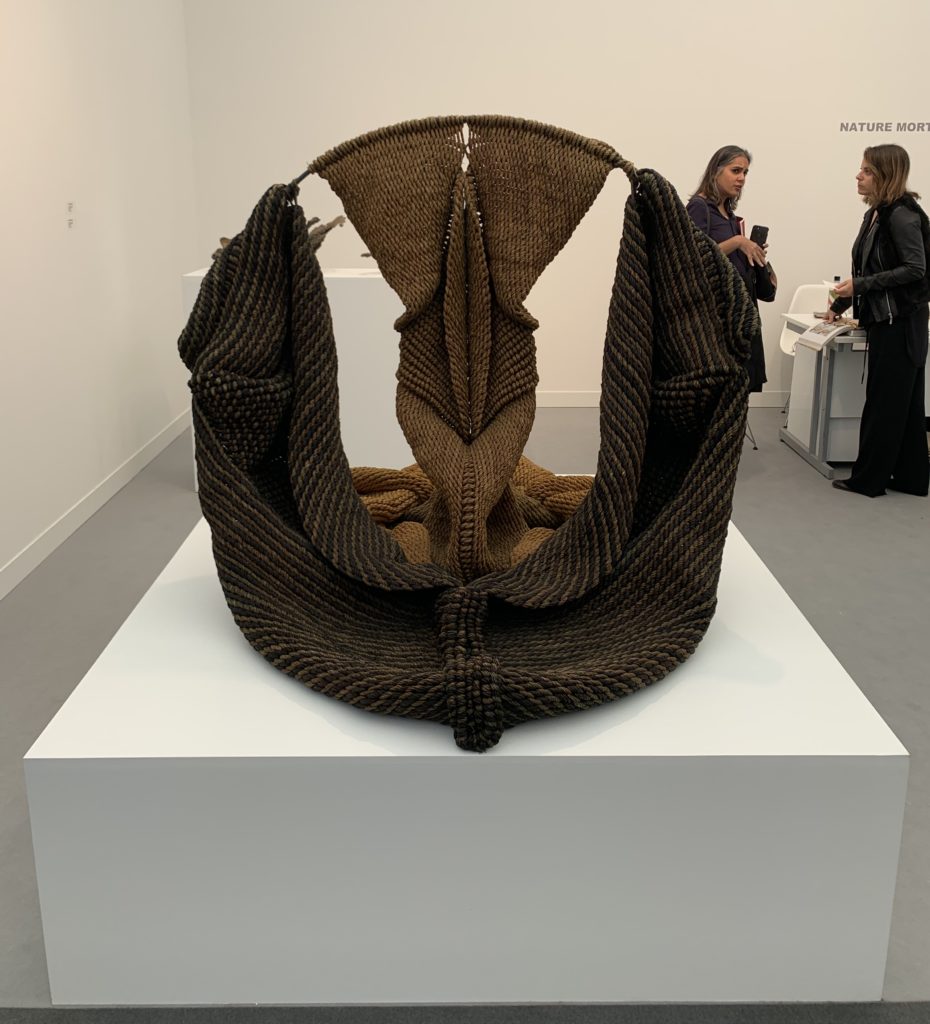
Mrinalini Mukherjee, Kusum
(1996).
An artist whose revelatory, just-closed show at the
Met Breuer in New York drew rave reviews from critics—and wonderment
that such a powerful artistic force could have remained under-known
for so long—Mrinalini Mukherjee could be a case study in how
marginalization can thwart a magnificent career.
Born in 1949 in Mumbai, Mukherjee grew up under the
tutelage of artist parents and went on to study painting and mural
design, but found herself drawn to working with woven fibers,
creating imposingly sensual sculptures from dyed, knotted ropes
that somehow manage to fuse Vedic deities with female genitalia.
(Sometimes they look more like deities, sometimes genitalia;
oftentimes, improbably, the works resemble both.)
Her peers in the predominantly male Mumbai art scene,
unfortunately, had no idea what to do with her art. They saw it as
gendered craft work, and dismissed her as a bit of an eccentric. As
a result, she was never picked up into the slipstream of artistic
discourse, which so frequently revolves around groups of artists,
and which is critical for gaining the attention of curators and
collectors.
Despite making some 200 of her woven sculptures—which
she almost magically created without preparatory studies or
drawings, relying instead on her intuitive understanding of knotted
rope—she only received a museum retrospective in 2015, when her
devoted longtime dealer Peter Nagy brought a hospital bed into the
galleries of New Delhi’s National Gallery of Modern Art so she
could oversee the installation in the weeks before she died.
Yet while that show and the Met Breuer survey have no
doubt awaked curators to her work, the marketplace—where artists’
posthumous careers can get their wings, with historical value
signaled through high prices at auction—doesn’t quite know what to
do with her either. All of her fiber works are spoken for, and the
only two that have ventured to auction fared unimpressively, one
selling for $158,309 at Sotheby’s in 2014 and the other failing to
elicit a bid in 2007. (Her less significant bronze and ceramic
works, meanwhile, have sold at auction, but always in the $10,000
range.) The value of the woven sculpture that Nature Morte brought
to Frieze can only be guesstimated, in the mid-to-high six
figures—and even so, it is on loan from a private collection and is
not for sale. In other words, it’s up to you, curators.
Thornton
Dial
A Piece of Art (2004)
David Lewis Gallery, New York
Price: $350,000
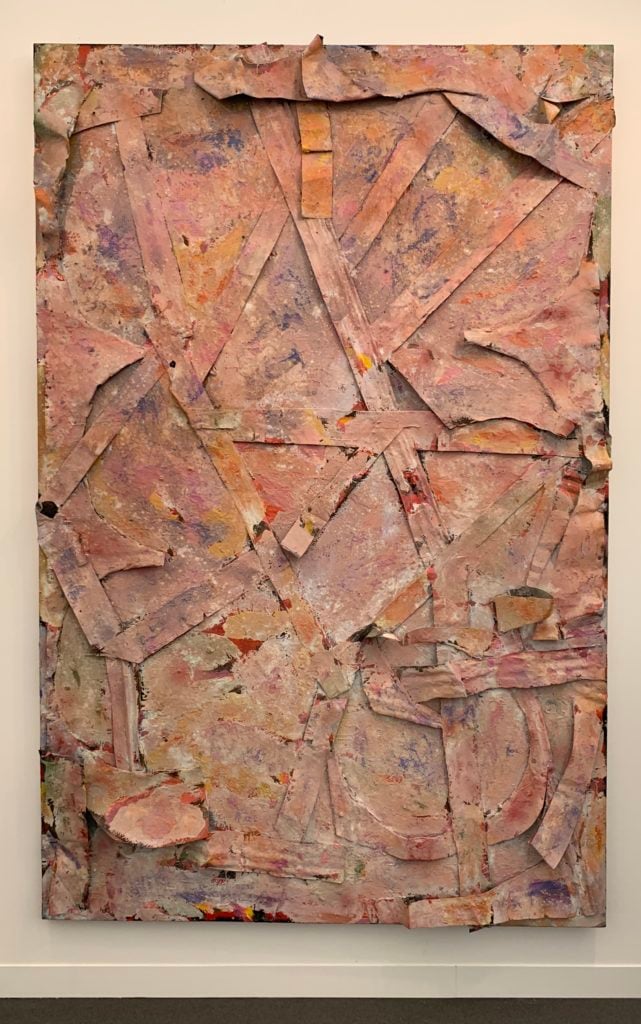
Thornton Dial, A Piece of Art
(2004).
In the art world, context is key, and moving an
artist from one context to another can be as effortful a process as
breaking down and then reconstructing a home.
Such is the process underway with the late African
American artist Thornton Dial. A towering self-taught talent who
grew up illiterate in Alabama, and whose jobs included picking
cotton and doing metalwork, he found a voice in his later years as
an “outsider artist,” and was championed and grouped alongside
artists such as Henry Darger and Adolf Wölfli, who worked in their
own worlds, divorced from society, often making their art in mental
institutions. (His New York Times obituary, when he died at
87 in 2016, labeled him an “Outsider Artist Whose Work Told of
Black Life.”)
But Dial was hardly an outsider artist, says David
Lewis, the young Lower East Side art dealer who has been working
with the artist’s family for about two years. Instead, he was
keenly aware of art history, making work that was consciously in
dialogue with other art—something that is reflected in such
paintings as the surpassingly delicate-looking painting of sculpted
tin, gypsum powder, and enamel Lewis brought to Frieze, which he
said was inspired by a Joan Mitchell painting.
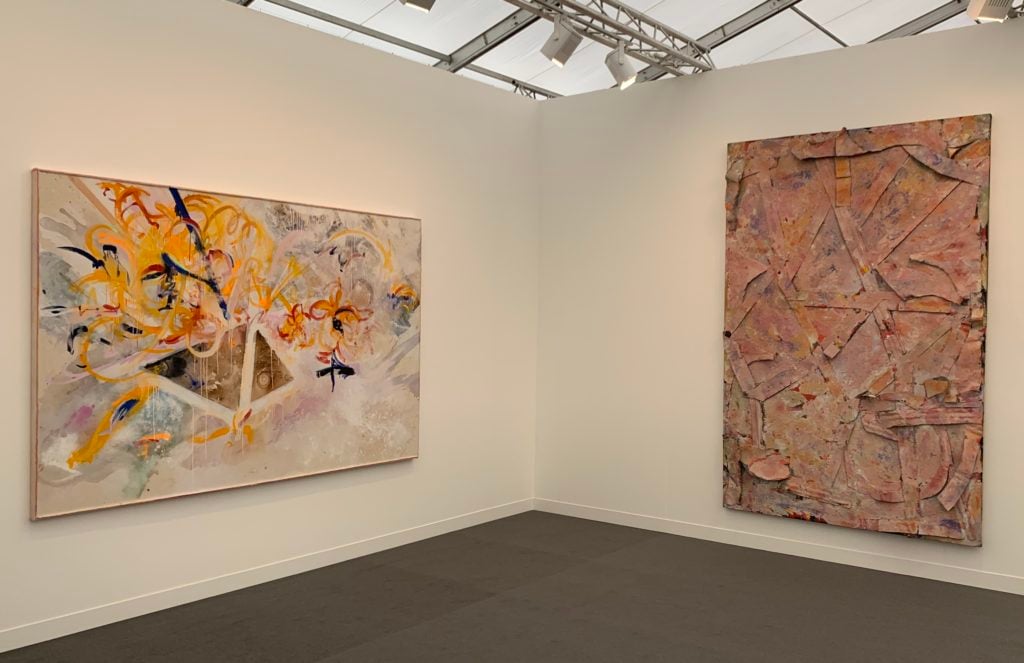
Lucy Dodd’s Sun Dial (2019)
next to the Thornton Dial painting.
Recently this view of Dial as an artist actively
involved in the art of his time has been embraced by the
Metropolitan Museum of Art, which, since receiving the gift of
dozens of his paintings from Will Arnett’s Souls Grown Deep
Foundation in 2014, has been displaying his work side-by-side with
Rauschenbergs and Jasper Johnses.
Now, however, Lewis wants to shift Dial’s context
even further, framing him as a lively contemporary artist. In the
fair, Dial’s painting is displayed together with brand-new Lucy
Dodd canvas, Sun Dial (2019), that was made deliberately in
response to the late artist’s work, and also incorporates elements
of Mitchell’s style. The dealer also notes, with approval, that a
recent buyer of a Dial work took down an Elizabeth Peyton painting
to make room for the canvas, which now hangs opposite a John
Currin.
These context changes are happening amid broader
transformations in the art landscape as large, which have led to a
restructuring of art history to make its past and future more
inclusive. “The first step was to get his work into the canon,”
Lewis says of Dial. “Now a new generation is saying that, not only
is Dial in the canon, but he’s the bedrock of what the canon will
become.”
Cindy
Sherman
“Broken Dolls” series
Sprüth Magers, Berlin, London and Los Angeles
Price: Under $50,000 apiece
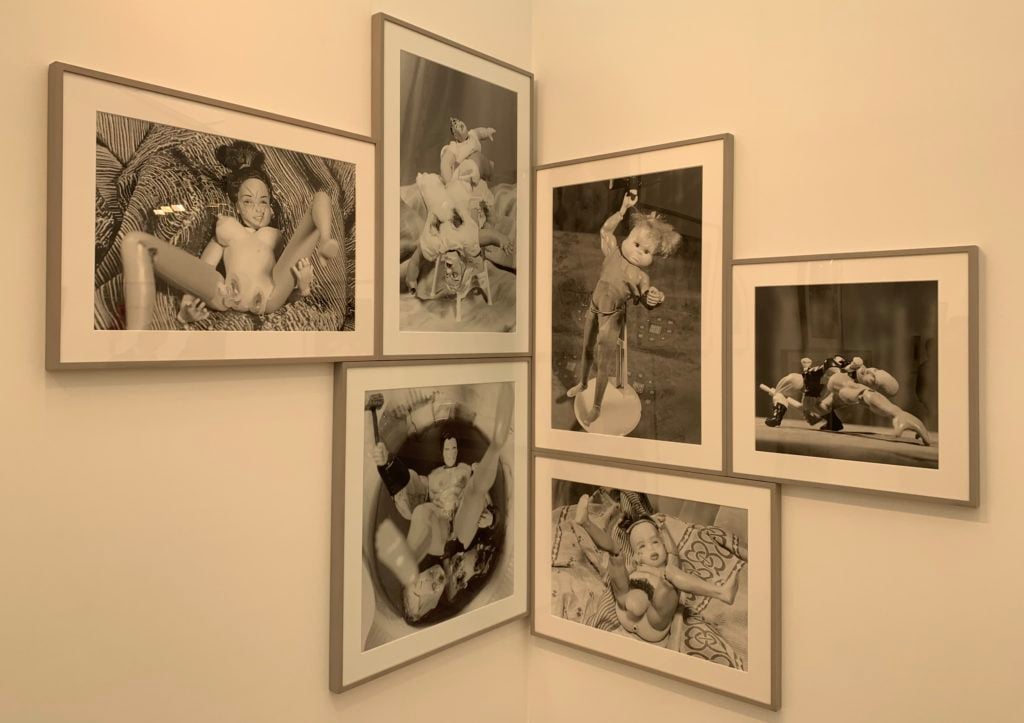
Works from Cindy Sherman’s “Broken
Dolls” series.
No, these are not unrated outtakes from the latest
Toy Story movie, but rather photographs from Cindy Sherman’s
“Broken Dolls” series, an important chapter of the artist’s
ever-evolving career.
Where do these fit into her overall oeuvre? A quick
recap: Sherman came to prominence in the 1970s with her
black-and-white “Film Still” self-portraits, then transitioned to
her market-dominating full-color “Centerfolds” series, and then, in
the late 1980s, she entered her uncanny period—a decade-long
chapter when she took herself out of the frame and instead made
series after series of raw, disturbing photographs of dolls, masks,
and prosthetics that seemed plucked from Dr. Freud’s
nightmares.
This period, which fascinates her most devoted
admirers and repels those who prize her earlier cinematic
portraits, culminates in the “Broken Dolls” works, in which naked
girls’ toys have been tortured, mutilated, and otherwise abused and
photographed in black and white, evoking the Surrealist work of
Hans Bellmer while also possibly signifying Sherman’s anger at the
conservative, repressive climate of America at the time. With this
series, Sherman got something out of her system, because in 2000
she returned to featuring herself in her photographs and has been
doing so ever since.
Twenty years later, the doll images still shock. Will
they ever be treated as masterpieces by the art market (which even
goes gaga for Sherman’s terrifying clown self-portraits)? Or will
they linger on as a restive provocation, haunting the more
collectible, more pleasurable facets of her career?
Martine
Syms
Capricorn (2019)
Sadie Coles HQ, London
Price: €20,000 (edition of 5)
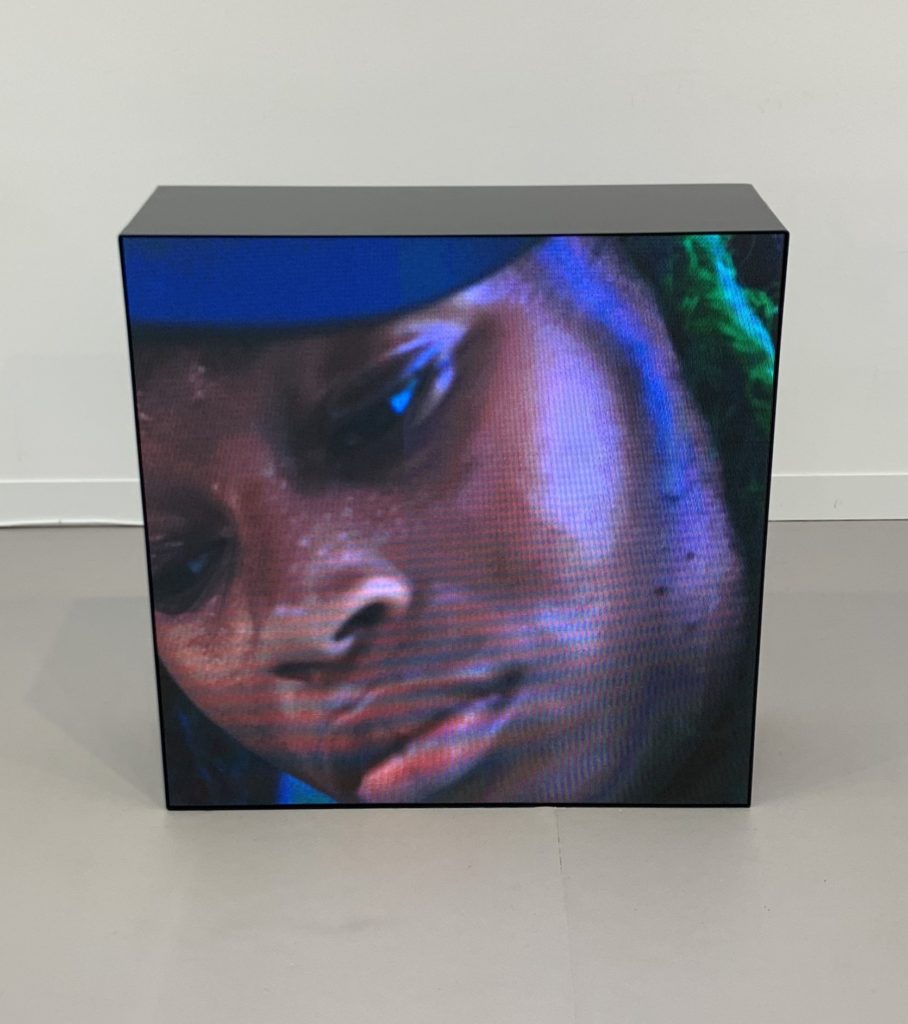
Martine Syms, Capricorn
(2019).
Martine Syms, the 31-year-old, self-described
“conceptual entrepreneur,” whose complex and often biting video
installations about identity and race have graced the Whitney
Biennial and other major shows, may have made her most commercial
work yet with her new video at Frieze. And that’s “commercial” in
both senses of the word.
The artwork, a loop of 100-second-long (i.e.,
TV-commercial-long) videos, plays like an Impressionist,
amalgamated remix of Nike ads featuring black athletes. The
protagonist—or avatar—is played by a young black dancer who
approaches the artificial green of a driving range on which she
proceeds to jerkily dance, using it like a prop in a music video.
She occasionally stops dancing and hacks at the golf ball, and
sometimes hits extraordinarily good shots.
Every so often, the camera zooms in for a closeup of
her sweaty, intense, pensive face—an image that looks readymade for
a billboard if you just add a little swoosh in the corner.
According to the gallery, the video is an homage (of sorts) to
Venus Williams, Florence Griffith Joyner, and other black female
athletes, and how they are represented in popular culture.
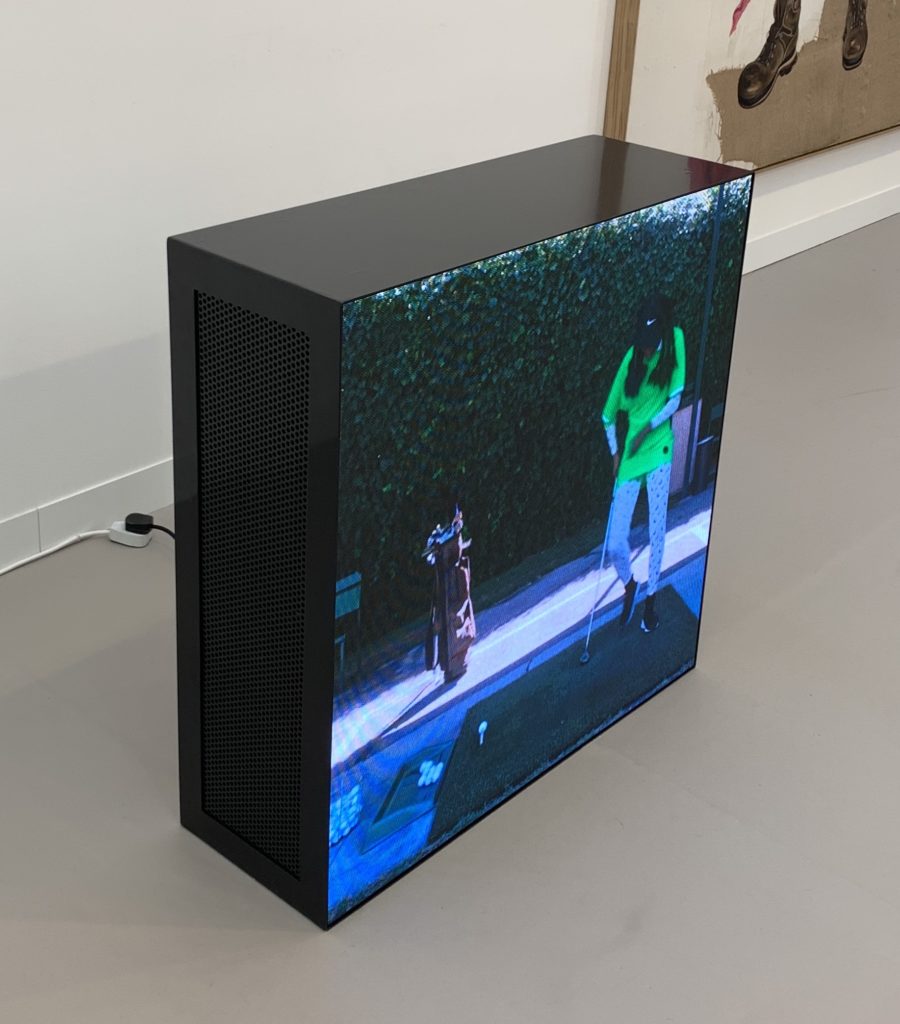
Martine Syms, Capricorn
(2019).
As for that other sense of commercial, the work is
just beautifully packaged.
Syms had a custom TV created specifically for the
video, and it’s a perfectly sleek black box that is almost as
absorbing to look at as the video itself. In fact, it might be the
nicest-looking video-art-playing device I’ve ever seen—it makes you
just kind of want it.
Considering that Syms’s career is continuing to rise,
with the artist having now received the second Future Fields
Commission in Time-Based Media from the Fondazione Sandretto Re
Rebaudengo and the Philadelphia Museum of Art, the combination of
her timely art and her stylish presentation might actually make
video art pay off financially, as well as reputationally.
The post 5 Outstanding Works at Frieze London, From a
Gripping Painting by Thornton Dial to Some Unsettling Photos by
Cindy Sherman appeared first on artnet News.
Read more https://news.artnet.com/market/best-artworks-frieze-london-2019-1668766
Further reading


Leave a comment