
Artist Kehinde Wiley’s First Public Sculpture in Times Square Is a Powerful a Rejoinder to Confederate-Era Monuments
When Kehinde Wiley visited
Richmond’s Virginia Museum of Fine Arts for his retrospective there in the
summer of 2016, he was struck by a monument a few blocks away
that depicted Confederate general James Ewell Brown Stuart poised
atop a horse, torso cocked back, a steely look in his
eye.
The statue, just one of many
Confederate monuments immortalized in bronze on Richmond’s Monument
Avenue, stuck with Wiley. In the meantime, public discourse around
the fate of such statuary grew fiery as the country reckoned with
hard questions about its past. Do we remove or destroy these
monuments in an effort to rewrite history? Or do we live with them
as a reminder of past mistakes?
That question was the
inspiration for Wiley’s newest work, an eight-ton,
29-foot-high-tall bronze equestrian monument titled
Rumors of
War. The statue, Wiley’s
largest work to date and his first public sculpture, was unveiled
last Friday in Time Square—a site classified by the artist as the
“crossroads of human movement on a global scale.” The work is
funded by Times Square Arts, the Virginia Museum of Fine Arts, and
Wiley’s gallery, Sean Kelly.
At first glance, it looks a lot
like Stuart’s statue. A figure rears atop a horse, chest out,
looking slightly backward. But saddled atop the horse is not a
Confederate general in a war uniform, but a young black man wearing
Nikes and a hoodie.
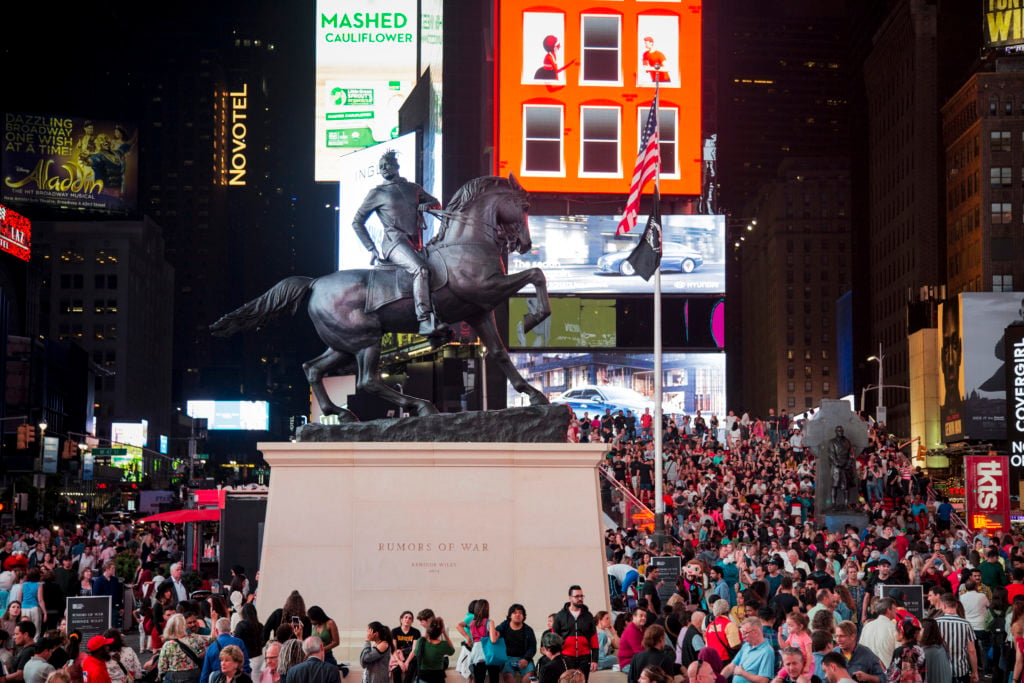
Kehinde Wiley, Rumors of War
(2019). Courtesy of the Virginia Museum of Fine Arts, Times Square
Arts, and Sean Kelly. Photo: Ka Man Tse for Times Square Arts.
“Art and violence have for an
eternity held a strong narrative grip with each other,” Wiley said
in a statement. “Rumors
of War attempts to use
the language of equestrian portraiture to both embrace and subsume
the fetishization of state violence.”
This isn’t unfamiliar territory
for the 42-year-old artist, who has made a career of adapting the
language of classical portraiture to accommodate depictions of
proud black men and women.
Wiley has appropriated equestrian portraiture before too, such as
in his paintings Napoleon
Leading the Army over the Alps and Equestrian Portrait of Prince Tommaso of
Savoy-Carignan.
But working in a different
medium, on a very different scale, was a new challenge. Most of his
paintings, including his presidential portrait of Barack Obama,
position his subjects in front of ornate wallpaper—backdrops dense
with symbolism. Working in sculpture offered a new contextual
opportunity for the artist.
“What I do in my own work here
with regards to sculpture is to allow the city to be the backdrop,
to allow a moving and constantly changing America to be the context
in which we see this young man riding a massive horse,” he told
the Associated
Press this
week.
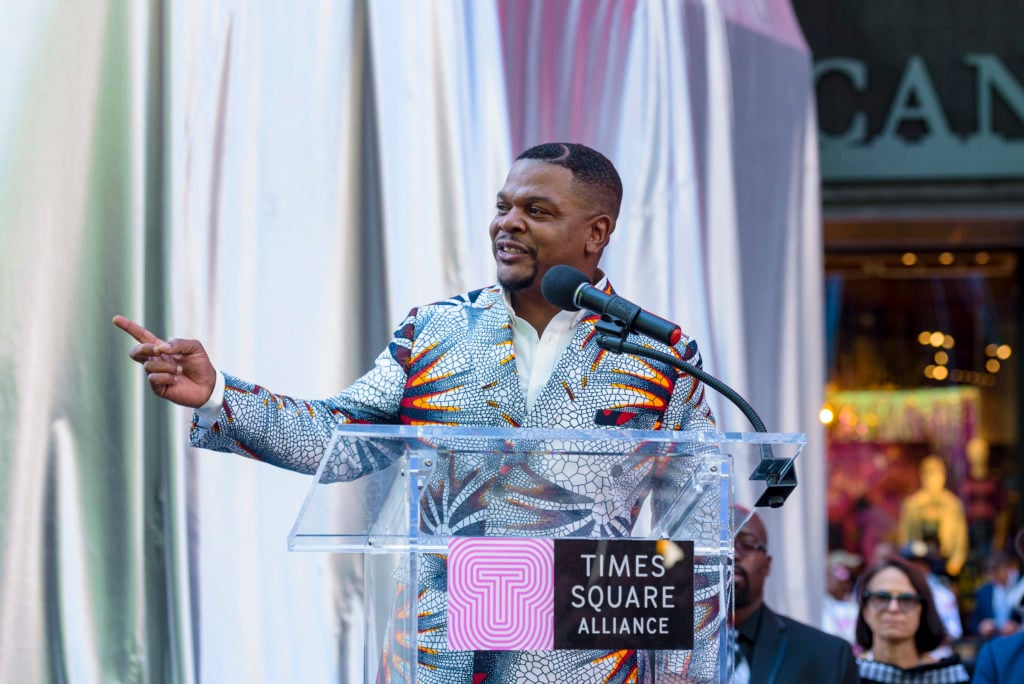
Kehinde Wiley at the opening ceremony
for Rumors of War (2019). Photo: Ian Douglas for Times
Square Arts.
That context will change
dramatically in December when Wiley’s monument is moved from Times
Square to the grounds of the Virginia Museum of Fine Arts, where it
will live in perpetuity, just down the road from the Confederate
statues that inspired it.
“I believe that when dealing
with a troubled past and arguably a beautiful future, artists
should use every tool in their wheelhouse,” the artist said. “What
I try to do is say yes to certain aspects of history. And I say no
to others.”
“What we’re saying yes to here,”
he continues, “is monumentality, Romanticism, the love of
sculpture, the love affair with the body. This is something that I
think is beautiful, but I don’t want to necessarily use the
negative aspects of America’s history as a means through which you
view this work. I think promise is the leading edge of this
work.”
The post Artist Kehinde Wiley’s First Public Sculpture in
Times Square Is a Powerful a Rejoinder to Confederate-Era
Monuments appeared first on artnet News.
Read more https://news.artnet.com/exhibitions/kehinde-wiley-times-square-2-1669708
Further reading


Leave a comment