
The Philadelphia DA’s Office Has Just Hired Its First Artist in Residence. He Previously Spent 27 Years in Prison for Murder
Artists-in-residence programs have become popular at
institutions ranging from Google to CERN, the European
Organization for Nuclear Research. Now, they are coming to
government agencies, too. Next month, the Philadelphia District
Attorney’s office will become the first agency associated with law
enforcement to launch an artist-in-residence program. James “Yaya” Hough, the artist chosen
for the job, will be tasked with
introducing a fresh dose of creative thinking to the 600-member
staff—with a side of empathy.
Hough, a Pittsburgh resident in
the process of relocating to Philadelphia, might seem an unlikely
candidate at first. He was released from a state prison in
Graterford, Pennsylvania just last August after serving 27 years
for a murder that he committed at age 17.
It was in prison that he was
introduced to Mural Arts Philadelphia, a non-profit organization
that works with at-risk teens, as well as current and former
inmates, “to create art that transforms public spaces and
individual lives,” according to its mission statement. It was Mural
Arts Philadelphia, in concert with the Los Angeles-based
organization Fair and Just Prosecution, that developed the concept
of establishing an artist-in-residence program at the Philadelphia
District Attorney’s office: a six- to nine-month project, with its
initial $25,000 budget funded by the Agnes Gund-sponsored
group Art for Justice.
Hough, in his role as
artist-in-residence, won’t be creating paintings or sculptures. The
goal of the program is more in line with social practice art: to
initiate conversations about the need for criminal justice reform,
with an artist as moderator and interlocutor. “My presence in the
prosecutor’s office sends a message to district attorneys, a
powerful symbol of hope and redemption,” Hough said in an interview
with Artnet News.
Through the program,
prosecutors, victims and survivors of crime, and former convicted
criminals will all take part in workshops, seminars, and other
initiatives. The program is the latest in a string of initiatives
across the local, state, and federal government that aim to spark
new thinking by inviting an artist in to shake things
up.
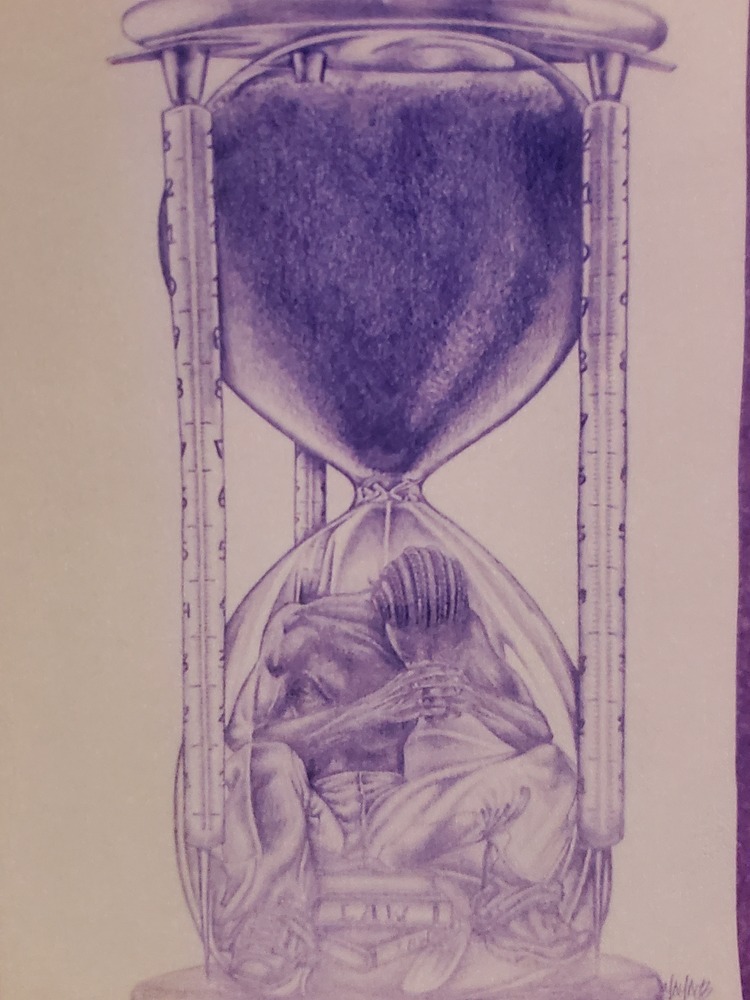
An untitled drawing by James “Yaya”
Hough.
“I came up with the idea because
few vehicles are as impactful as art in changing hearts and minds,”
said Miriam Aroni Krinsky, founder and executive director of Fair
and Just Prosecution. “Through an artist-in-residence program, we
can use the clout of art to point up the damage that the criminal
justice system has done.”
She proposed the idea of setting
this first-in-the-country program in the Philadelphia District
Attorney’s office because Larry Krasner, who became the district
attorney there in 2018, has been an advocate for “shrinking the
criminal justice system, ending the death penalty, [and]
reexamining previous convictions and decades-long
sentences.”
Mural Arts Philadelphia proposed
Hough for the program, having worked with him as part of its prison
arts program over a 20-year period. “James was interested in
drawing but, through us, he learned how to draw,” said Jane Golden,
founder and executive director of Mural Arts. She finds him
uniquely qualified for the artist-in-residency gig due not only to
his artistic skill, but because “he is deeply empathic… he
understands the criminal justice system, and he articulates what he
went through so well.”
A Fortuitous Series of Events
Two unrelated, monumental events
helped create the possibility for this radical artist-in-residence
program in Philadelphia. The first was a ruling by the United
States Supreme Court in 2012 that found that sentences of life
without the possibility of parole are unconstitutional for juvenile
offenders, a judgment that was expanded by the high court in a
similar case four years later. Those rulings helped lead to an
early release for Hough, who had himself been sentenced to life
without parole.
The second was art
collector Agnes Gund’s private sale,
in early 2017, of Roy Lichtenstein’s Masterpiece (1962) for $165 million (the buyer reportedly
was billionaire hedge-fund manager and art collector Steve Cohen.)
Gund used $100 million from that sale to start up the Art for
Justice Fund, which provides grants to organizations seeking to
make visible the human dimension of mass incarceration—informing
the public about mass incarceration and its links to racial bias
and increasing educational and employment options for those leaving
prison.
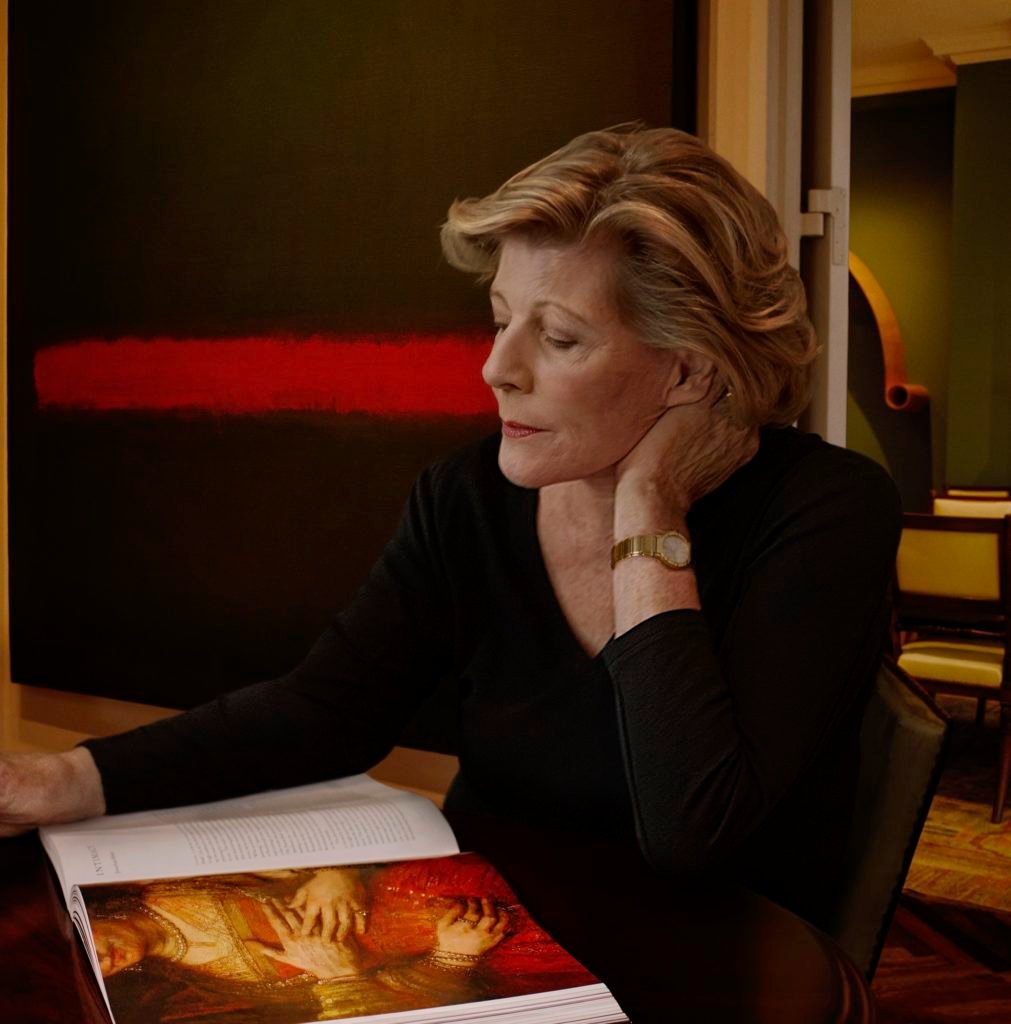
The art patron Agnes Gund. Photo by
Annie Leibovitz.
“When a prosecutor charges a
defendant, when a judge sentences a defendant, they never see the
transformation of that individual taking place while incarcerated,”
Hough said. “They don’t see that someone can become a creating,
contributing member of society. Prosecutors have the ability to
crush offenders, but they can use those same powers to encourage
offenders to do right and be redeemed.”
Hough’s work at the district
attorney’s office will involve more than just conversations and
workshops. He plans to create a series of three-minute
videos—“like a long-form
commercial”—based
on feedback from participants in the workshops and seminars,
incorporating drawings he’ll make of those who took part. These
videos will be shown at the district attorney’s office, on social
media, and at the African American Museum in
Philadelphia.
Since news of the program began circulating, Krinsky said she
has “heard from other DA
offices”—one in California and one in
Texas—“who want to work on this
model.”
Artists in Government?
DA offices aren’t the only ones pursuing the artist-in-residence
model. Others have been going on for years, with success for both
the host and the artist. The National Park Service brings in one
artist at a time for a period of between two and five weeks.
Residents are required to
donate a piece of art that represents their stay to the Park
Service’s collection, and they also may be asked to present a talk
for park visitors.
“I just loved it,” said Kim
Henkel, a metal sculptor in Denver, Colorado, who had been a
resident at Mt. Rushmore, the Grand Canyon (“I was in a beautiful
apartment overlooking the south rim”), and the Petrified Forest
between 2007 and 2009, spending one or two months at each
site.
All five branches of the US
Military also bring in artists—known
as “combat” artists—for
short-term (usually, a week or two at most) residencies on military
bases or other locations where soldiers are stationed. The work
they make on site is donated by the artists to the collections
maintained by the respective branches.
The military doesn’t commission
artists or pay them for their work, only offering them round-trip
transportation, officers’ quarters, and food. Artists do receive a
temporary rank as captain or colonel or major, depending on the
particular service (the artists aren’t able to give orders to
anybody, but they can get first in line at mess
time). Military
artists-in-residence are not told what or how to paint; they are
not asked to be propagandists. Some of the artworks made in the
past have focused on scenes that aren’t heroic or dramatic,
including bored soldiers drifting off to sleep.
Many artists take part in these
military programs just for the thrill of it. William Phillips, an
artist in Ashland, Oregon whose specialty is aviation art, lights
up when he talks about visiting an Air Force base, especially when
describing taking a ride in a fighter jet: “Every time you get into
a high-performance aircraft, you face danger. It’s not like sitting
in my studio. And, when you put on that flight suit…”
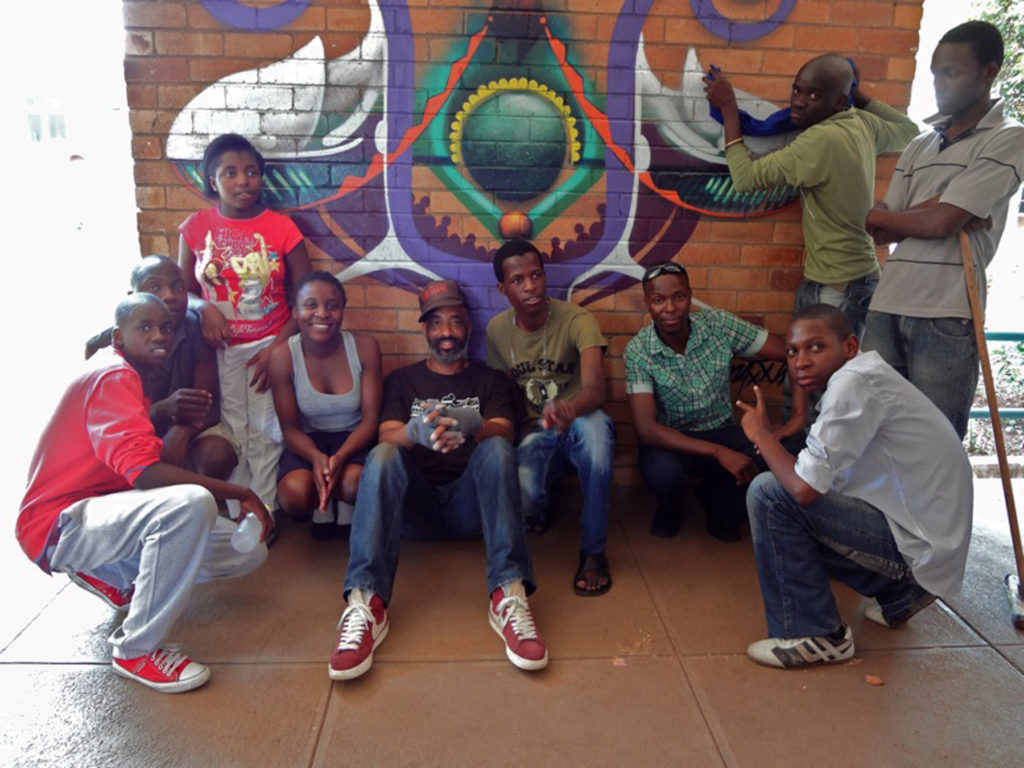
Maxx Moses with his mural-painting team
in Zimbabwe.
The US Department of State has
its own residency program for artists too, called Arts Envoy. It
brings performers, writers, and visual artists to countries all
over the world, where they may work with local groups for between
five days and six weeks. Maxx Moses, a 57-year-old muralist and
street artist living in San Diego, worked for a week in the city of
Bulawayo, Zimbabwe, in 2011. His expenses, from transportation and
accommodations to food and materials, were paid for by the State
Department. Moses led a team of 10 local artists in creating a
series of murals on the theme of combating the AIDS epidemic. “Most
of the artists had never worked with spray paint before or created
in front of a live audience,” he said.
And of course, perhaps the
longest-running and most fabled artist-in-residence is Mierle
Laderman Ukeles, who creates what she calls “maintenance art.”
Since 1977, Ukeles has been the
unsalaried artist-in-residence of the New York City Department
of Sanitation. Among her artworks are a choreographed ballet of
backhoes titled Romeo and
Juliet and
Touch Sanitation,
an endurance performance that
involved shaking hands with all 8,500 workers in the sanitation
department while saying, simply, “thank you.”
The post The Philadelphia DA’s Office Has Just Hired Its
First Artist in Residence. He Previously Spent 27 Years in Prison
for Murder appeared first on artnet News.
Read more https://news.artnet.com/art-world/artist-in-residence-district-attorney-1726251
Further reading


Leave a comment