
11 of the Most Groundbreaking Discoveries of 2019, From the Priceless Painting in Grandma’s Kitchen to the Secret of Stonehenge
As 2019 draws to a close, it’s time to once again revisit the
year’s most exciting discoveries in art history and archaeology,
from long-lost paintings to buried treasures and everything in
between.
As always, some discoveries are the result of years, if not
decades, of concerted research on the part of experts. Others are
made by happenstance, such as a set of solid gold bands found by
an amateur metal
detectorist in the UK or an eagle-eyed 12-year-old who spotted an
ancient mammoth tooth during a family gathering in the woods of
Ohio.
Not all discoveries, of course, hold up to scrutiny. Some invite
skepticism: The theory about
Leonardo da Vinci’s only surviving sculpture has been floated for
years; and claims to have decoded the mysterious Voynich
manuscript have been floated for the second straight
year—this time using an extinct language
called proto-Romance—but were once again quickly called into
question, leading the University of Bristol to retract its announcement
about the paper.
But in many cases, the finds astonish and provide a greater
understanding of human history and the world around us. So, without
further ado, here are the biggest discoveries of 2019.
A High School
Student’s Lunch Money Fetched $204,000
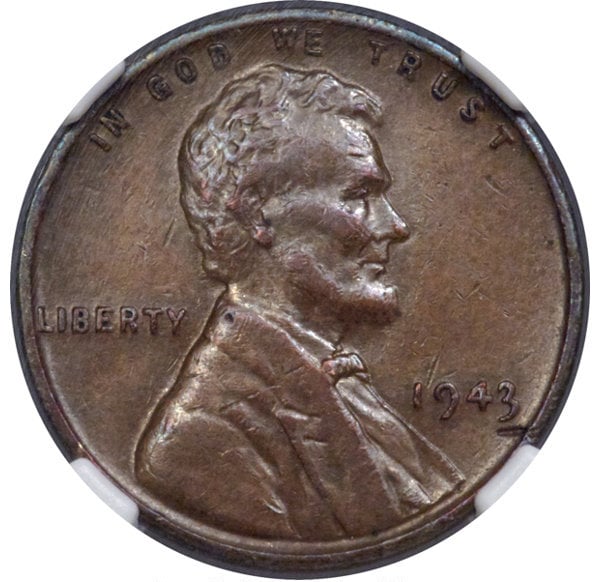
The penny! It’s worth a bundle. Photo:
Heritage Auctions.
Even though he was just 16 at the time, Don Lutes Jr. knew
there was something strange about the copper penny he received in a
handful of change at the school cafeteria back in 1943. Turns out,
it was one of just 20 copper pennies produced that year, the US
Mint having switched to zinc-plated steel coins during
wartime. Lutes died in 2018, but he’d had the coin authenticated in
the 1950s. The world became aware of his amazing discovery in
January, after his descendants sold it at auction for
the impressive sum of $204,000.
Stonehenge Was Built Using
Stones From Faraway Quarries—and Lard!
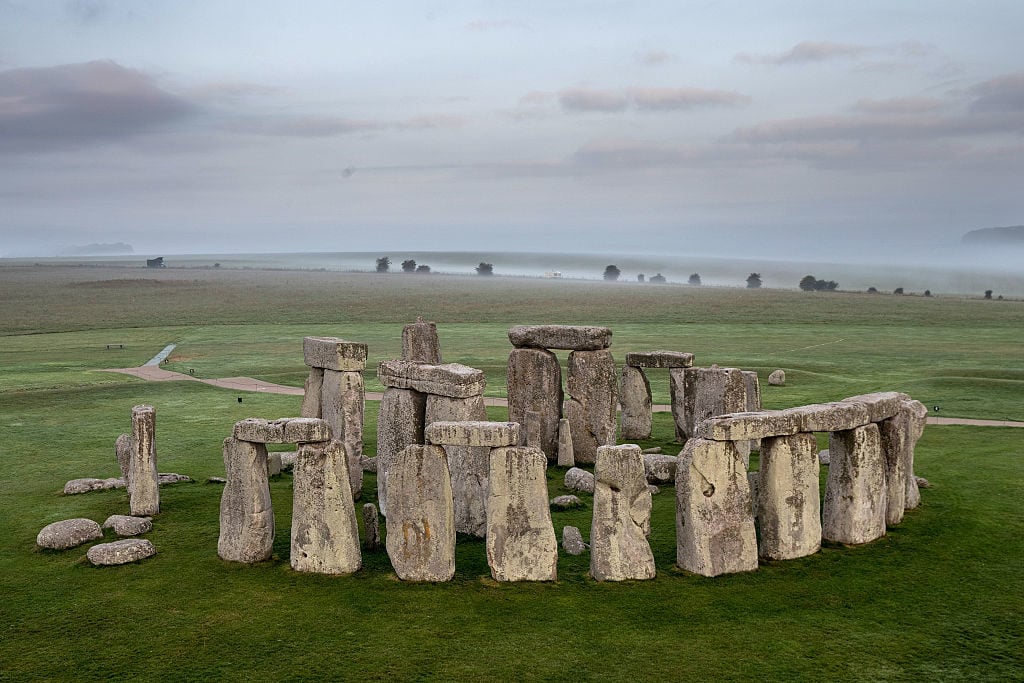
The inner rocks of Stonehenge may have
been dragged nearly 150 miles from where they were quarried to
their current site. Photo: Matt Cardy/Getty Images.
In February, a team of archaeologists claimed to have identified
the exact quarries in
the Preseli Hills in Wales that the
“bluestone” dolerite rocks used to build Stonehenge came from.
It’s still unclear why the ancient builders would have moved the
massive monoliths some 143 miles to erect the mysterious structure,
but we do have a new hint as to how they achieved such a monumental
task: using lard.
Archaeologists now believe that antique jars with traces of lard
found nearby suggest that animal fat was being used not just for
cooking, but for construction purposes.
A Family Realized Their
Mother’s Portrait Was by One of Africa’s Most Famous
Artists
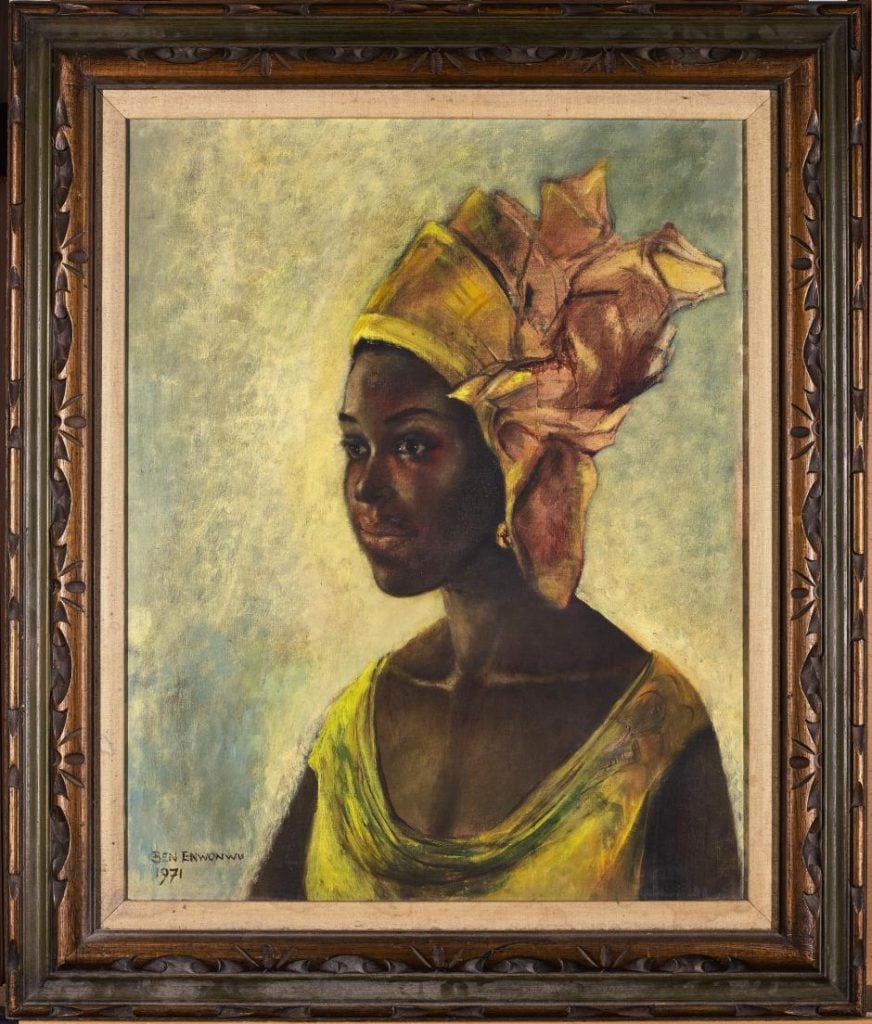
Ben Enwonwu, Christine (1971).
Courtesy of Sotheby’s.
A Texas family never gave much thought to the portrait of the
family matriarch that had decorated their home for decades. Then
they Googled the artist, Ben Enwonwu, and discovered that he was a
Nigerian Modernist art star who had recently made headlines for
his rediscovered
masterpiece of the Nigerian royal princess Adetutu
Ademiluyi. When the family auctioned the painting at Sotheby’s
London, it sold for £1.1 million ($1.4
million) despite a pre-sale estimate topping out at just
£150,000 ($192,000).
A Japanese
University Research Team Found a Giant Peruvian Earthwork Using
A.I.
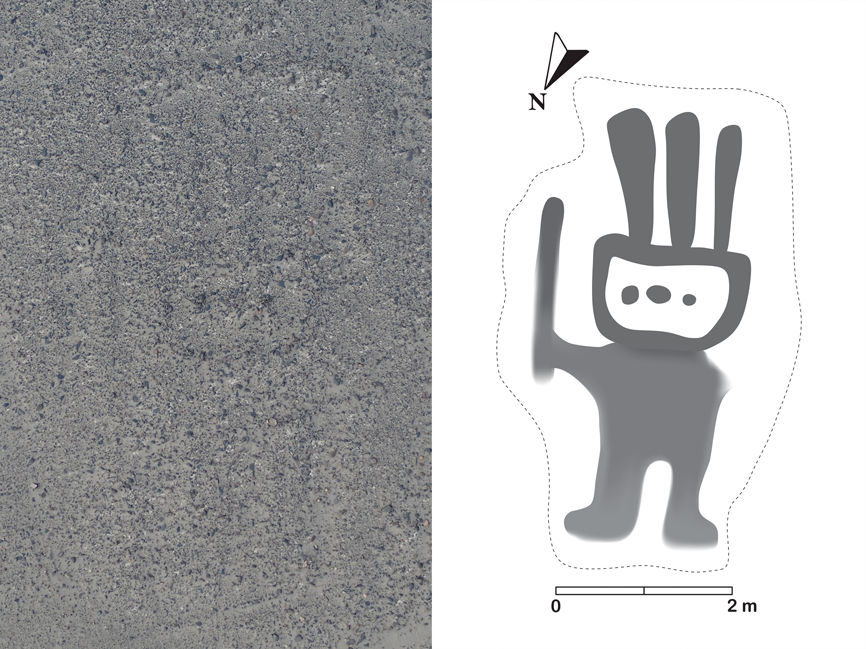
The original (left) and an A.I.
rendering of a newly uncovered Nazca Line drawing in Peru.
Japan’s Yamagata University has been able to find 142 previously unknown
Nasca Lines, giant earthwork drawings created in prehistoric
Peru. To help find the faint lines, carved between 100 BC and 300
AD, the research group teamed up with IBM Japan to develop an A.I.
model using the deep learning platform IBM Watson Machine Learning
Community Edition. After analyzing the high-resolution aerial
photos, A.I. added one new geoglyph to the project’s discoveries,
for 143 examples of ancient Land art in total.
Female Scribes May
Have Made Medieval Manuscripts
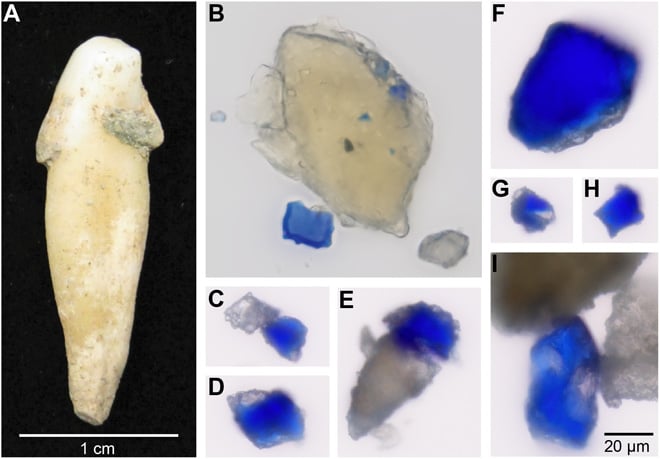
Traces of lapis lazuli were found in the
dental tartar of a woman who lived at a 12th-century German
monastery, leading researchers to believe she was a highly skilled
artist who worked on illuminated manuscripts. Courtesy of
Science Advances.
An investigation into monastic medieval diets sent researchers
in an entirely unexpected direction when an archaeologist
discovered visible traces of lapis lazuli in the dental
tartar of a 10th- or 11th-century German nun. The working
theory is that she was working with the expensive blue pigment to
create a religious manuscript. Creating those colorful
illuminations was a skill previously thought to be the exclusive
purview of monks, but who knows how many of those anonymous
medieval artists were actually women?
A Stolen Klimt Was
Found at the Scene of the Crime—23 Years Later

Gustav Klimt, Portrait of a Lady
(c. 1916-17). Image courtesy Wikimedia Commons.
A gardener at the Ricci Oddi modern art gallery was stunned when
he opened a metal panel on the back of the museum building,
obscured by ivy vines, to discover a Gustav Klimt painting hidden
inside. The work, Portrait of a Lady, was
stolen back in 1997, its mysterious disappearance giving rise to
all manner of conspiracy theories. Currently valued at €60 million
($66 million), the canvas may or may not have been on the premises
the whole time.
LiDAR Continues to
Transform the Field of Mayan Archaeology
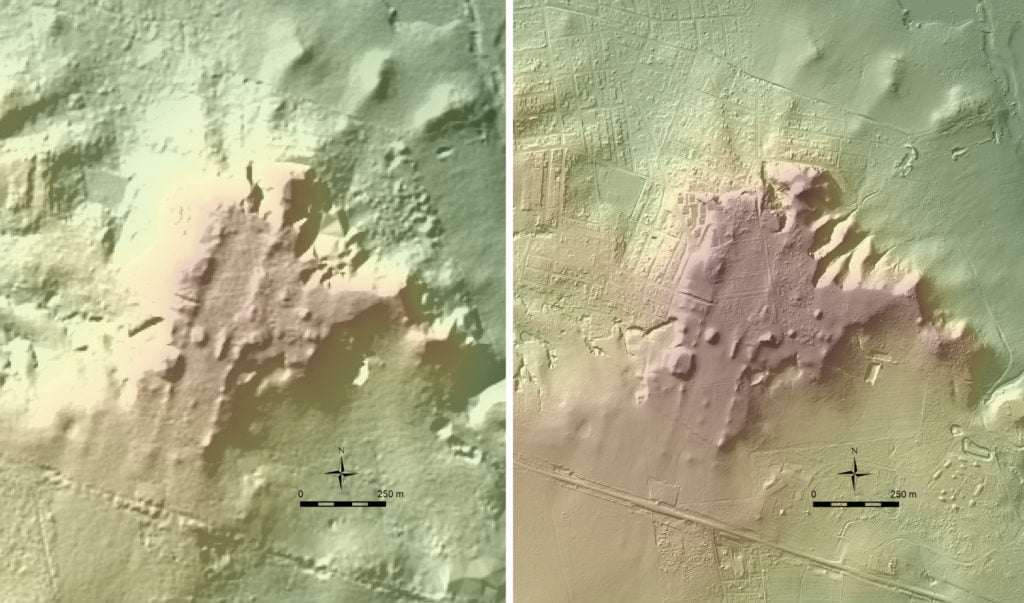
Takeshi Inomata identified this ancient
Maya site, dubbed La Carmelita, using LiDAR maps, seen here in both
low and high resolution. Image courtesy of the Instituto Nacional
de Estadística y Geografía/Nacional Center for Airborne Laser
Mapping.
Inspired by archaeologists in
Guatemala who found thousands of Maya
ruins thanks to light detection and ranging
technology known as LiDAR—which involves airplanes equipped with
laser mapping tools that take topographical readings of the
landscape—a researcher at the University of Arizona looked at some
old LiDAR maps published by the Mexican government in 2011. What he
found were 27 unknown Mayan
sites across 4,400 square miles of land,
accomplishing decades-worth of groundtrooping remotely, without
having to take a machete to dense jungle vegetation—further
demonstrating just how revolutionary LiDAR is.
An Old Lady Had a
$26.8 Million Masterpiece in Her Kitchen
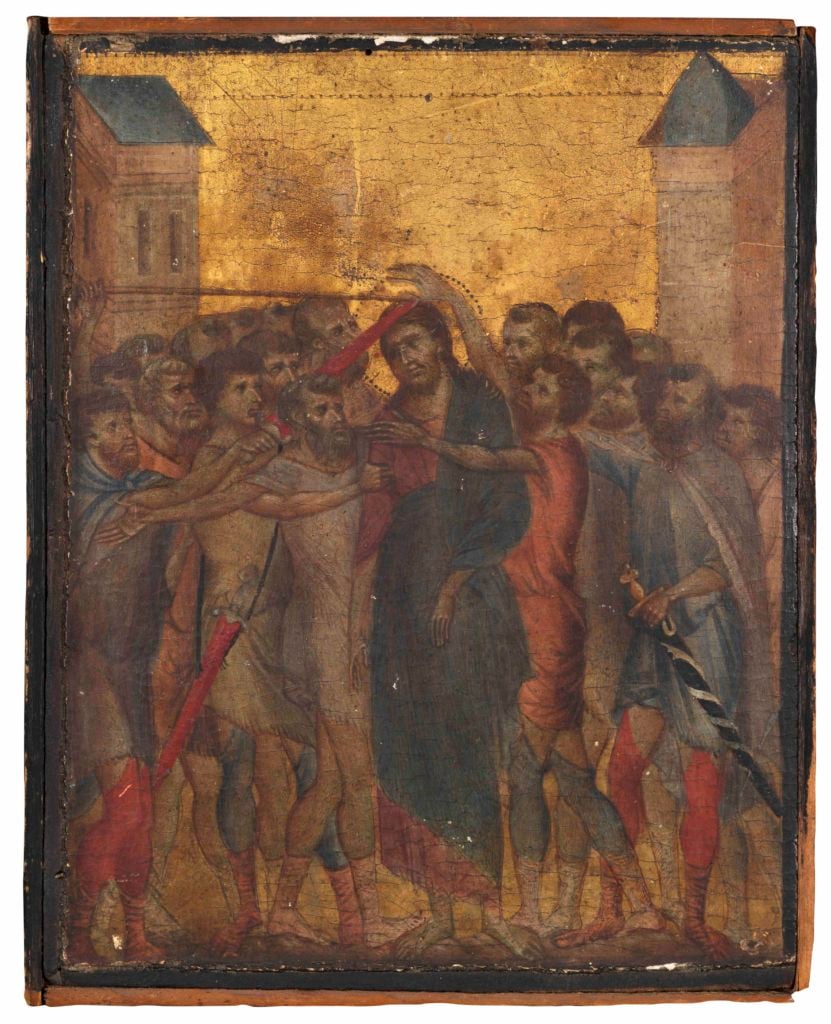
Cimabue, The Mocking of Christ.
Photo courtesy ACTEON Senlis.
The owner, a little old lady in France, kept the small religious
painting hanging above the hot plate
in her kitchen. It was only when she called in an auction house
to help sell some of her belongings that she discovered the piece
was actually a missing panel from a well-known altarpiece by
Cimabue—and worth many
millions. Considered Italy’s first proto-Renaissance painter,
Cimabue represents an important stepping stone between the
Byzantine style of Italy’s medieval period and the greater realism
of the 14th century. But the painting smashed expectations when
it sold at auction in Paris
for a record €24.2 million ($26.8 million).
The Oldest
Figurative Cave Painting in the World Was Discovered in
Indonesia
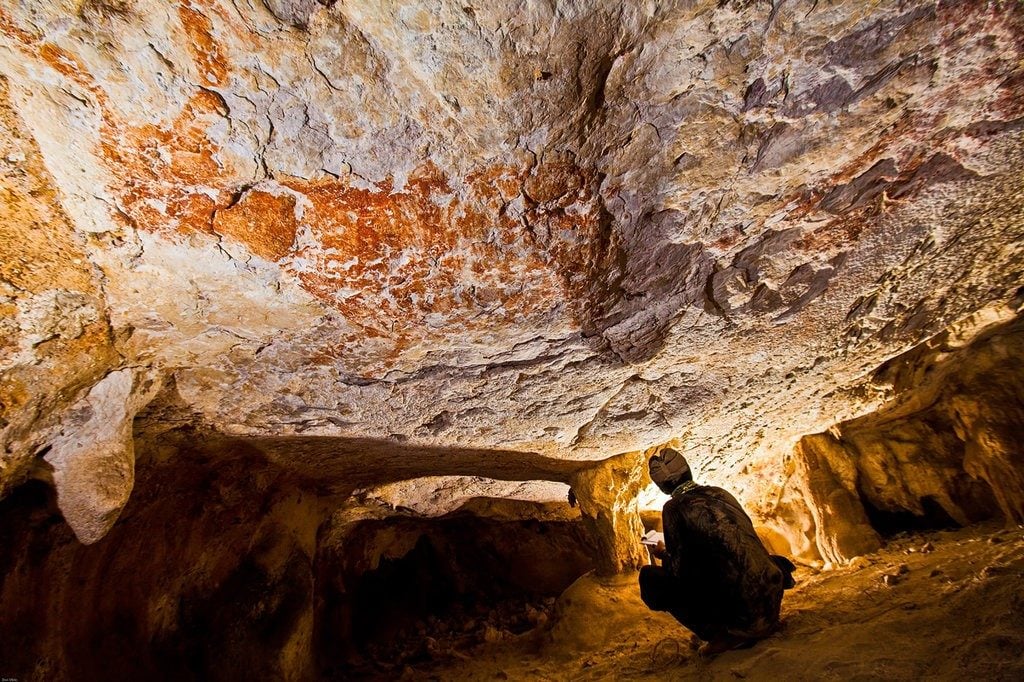
A researcher studying what was
previously believed to be the world’s oldest figurative art in a
Borneo cave. The find has been supplanted by a new discovery in
Indonesia. Photo by Pindi Setiawan.
The oldest pictorial art in the
world is now believed to be an ancient hunting scene painted on
the walls of an Indonesian cave some 43,900 years ago. The
prehistoric artwork is even more significant, however, because it
shows imaginary figures with both human and animal features. That
suggests that the concept of religious thinking originated not in
Europe, as previously thought, but much earlier, and on the
opposite side of the globe.
A 17th-Century Painting Was
Uncovered Inside an Oscar de la Renta Boutique
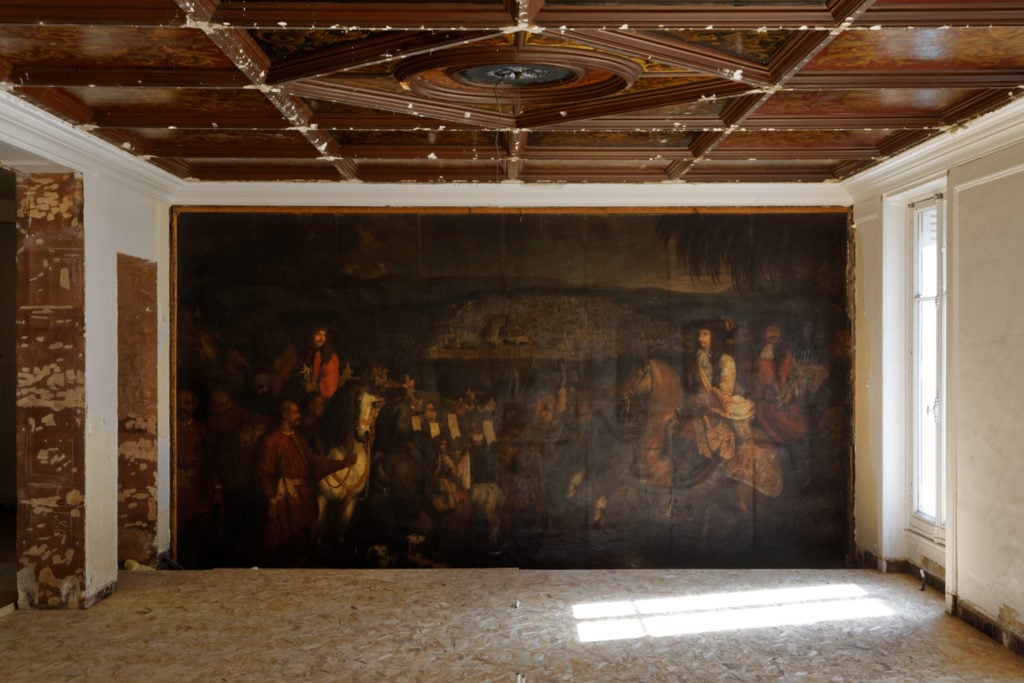
A work by Arnould de Vuez uncovered at
4, rue de Marignan, Paris. Photo courtesy of Oscar de la Renta.
Construction workers found the surprise of a lifetime when they
encountered a 1674 painting by Arnould de Vuez, an artist in the
court of Louis XIV, hidden behind a wall of
a historic Paris building. The workmen were doing renovations ahead
of the planned opening of an Oscar de la Renta fashion boutique,
but quickly stopped to call in art historians. The painting,
praised as an “inexplicable holy grail,” was carefully restored and
can now be seen at the designer’s shop.
An Ancient Roman Coin Found
in an English Field Is Said to Depict the “First
Brexiteer”
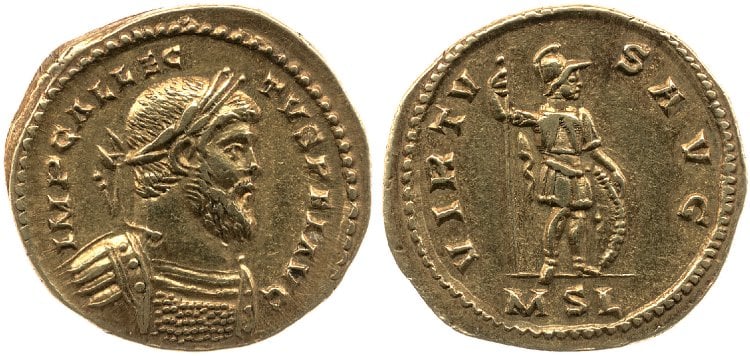
Golden aureus coin featuring a bust of
Allectus, the Roman emperor who ruled Britain as an independent
nation from 293 to 296 AD, during the time of the Roman Empire.
Photo ©The Trustees of the British Museum.
Any metal detector enthusiast would be happy to stumble across a
24-carat gold coin, but a 1,700-year-old one found in a field in
Kent, England, proved a particularly fascinating discovery. That’s
because it features the Roman Emperor Allectus, who forced the
“original” Brexit by breaking away from the Roman Empire and ruling
Britannia and northern Gaul as an independent nation between 286
and 296 AD. At London auction house Dix Noonan Webb, it was
expected to fetch no more than $127,000, but it sold for $700,000,
becoming the most expensive Roman coin minted in Britain ever sold
at auction.
Can’t get enough? Here are the other art world
discoveries covered on Artnet News this
year:
Archaeologists Were Shocked
to Find This Golden Pendant of an Ancient Egyptian Goddess—in
Greece
An Ornate Shield Found in a
Celtic Warrior’s Grave Is Challenging What We Know About Ancient
Combat
Scientists Have Found the
Rare Secret Ingredient Rembrandt Used to Make His Paintings So
Vibrant
A Long-Lost Cupid Is
Revealed Under the Surface of One of Vermeer’s Greatest
Paintings
The post 11 of the Most Groundbreaking Discoveries of 2019,
From the Priceless Painting in Grandma’s Kitchen to the Secret of
Stonehenge appeared first on artnet News.
Read more https://news.artnet.com/art-world/11-biggest-art-and-archaeology-discoveries-2019-1736265
Further reading


Leave a comment