
What the Present Owes to the Past: Why Robert Smithson and the Art of ’60s Remain So Vividly Present in Contemporary Art
A quarter-century after his
death in an airplane crash in the West Texas desert, Robert
Smithson re-emerged as a figure of contemporary sensibility.
Beginning in the ’90s, Smithson excited the sort of devotion that
certain painters and poets do after their deaths. He became a
figure of special interest to artists and scholars too young to
have seen his works when he made them, and to have read his
writings when they were first published in the pages of
Artforum.
We had missed Smithson, but not
entirely. Our acquaintance was one step removed. I met an artist
who had interviewed him for her master’s thesis, and befriended
another who shared the memory of Smithson arguing with Carl Andre
into the early morning at Max’s Kansas City, and frequenting the
bar’s back room, where a Flavin sculpture cast a whorehouse glow on
the red tablecloths and napkins and glamorous patrons—Warhol and
his Superstars. Someone else pointed out the building where
Smithson had lived with his wife Nancy Holt in Manhattan’s
meatpacking district at a time when the cobblestone streets, now
lined with designer emporia, reeked of blood and rotting organs and
garbage, and the crumbling piers on the river were places of crime
and illicit pleasure.
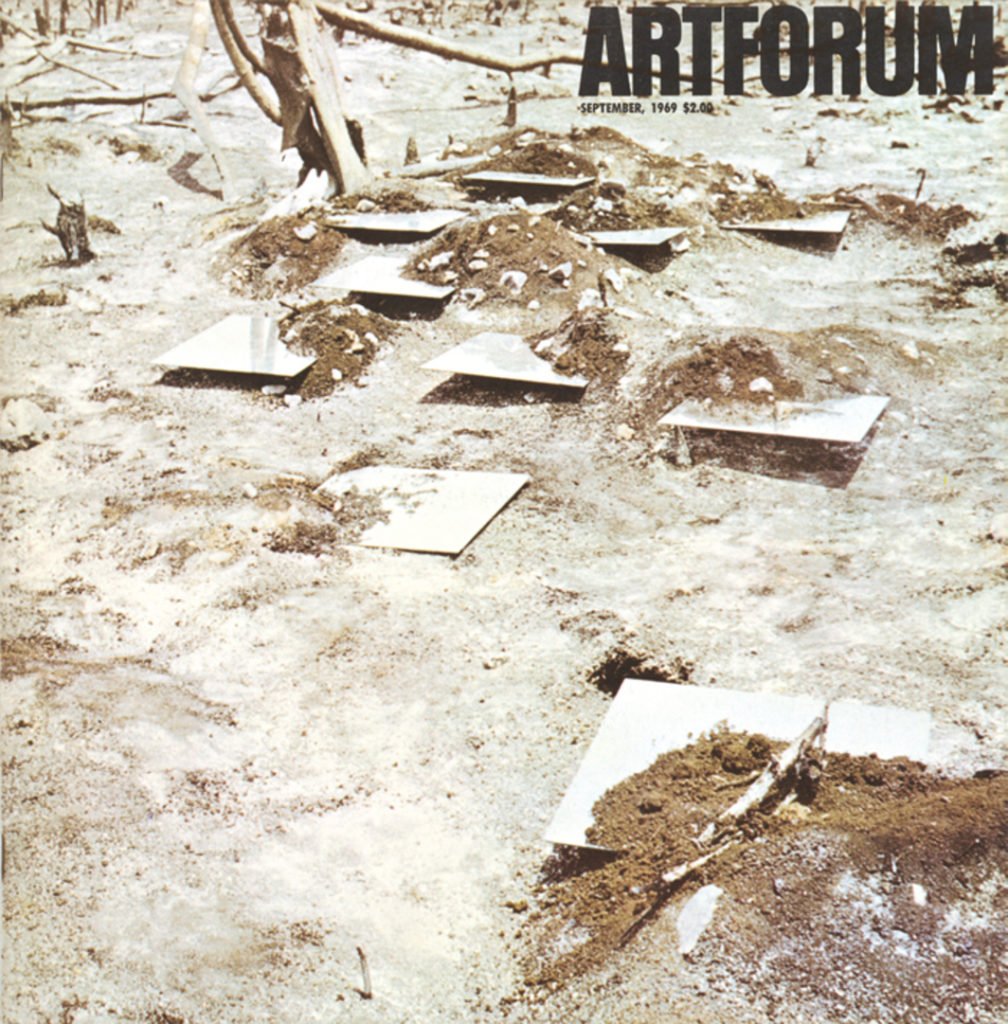
Robert Smithson’s work on the cover of
the September 1969 edition of Artforum.
These were passing glimpses,
snapshots; they did not yet make up a composite image. During this
period, when I began my doctoral dissertation, the long Sixties had
slipped into the past. The fall of Saigon and the German Autumn had
occurred just 15 years earlier; to a young person these events felt
like ancient history. Yet the more I researched that time, the
closer it seemed. The more I returned, it returned; the more I
identified with it, the more I felt part of it. Many of Smithson’s
contemporaries were still alive and working then. I wrote letters
to them, requested interviews. I visited their studios and houses,
and took meals with them. I wrote down their remarks sedulously. I
drew out their confidences.
I brought a cassette recorder
along to these visits. My index finger pressed the “On” button, and
the tiny wheels of brown magnetic tape turned silently, capturing
the patter of our conversation. I wrote down their memories, and my
memories of them, such as the recollection by an important artist
of a dismissive review of his first show (he never forgave the
critic), and the patronizing responses of the artist-writer Donald
Judd to the work of many of his peers. (It mattered little that the
individuals recalling these slights 30 years after the fact were
world famous: the put-downs we experience in our youth leave a
mental stain it is impossible to wash away.) And if the machine ran
out of tape or was turned off at the interviewee’s insistence, the
taping device in my brain was very much “on.” In my determination
to develop my expertise, I fashioned myself into a sort of
recording device, a memory machine, as if my ears were microphones
and the retinas in my eyes were delicate plates coated with
photosensitive emulsion. Those remarks and those images, those
recollections of triumphs and slights, were stamped in my mind
instantly and forever. I gathered these perceptions greedily,
stuffed them in my pockets. I hoarded them like little
stones.
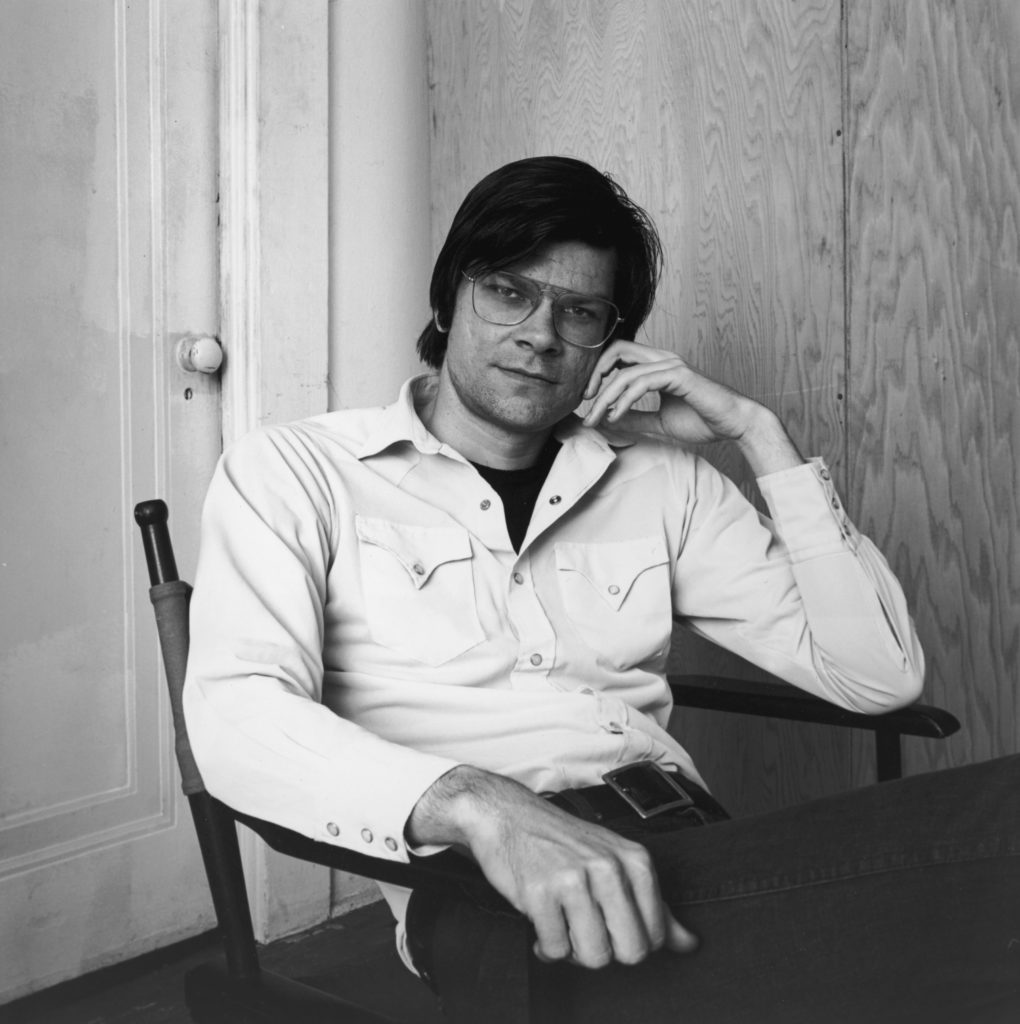
American sculptor and artist Robert
Smithson, photographed on November 7, 1969. Photo by Jack
Robinson/Hulton Archive/Getty Images.
Memories of the dead were the
most precious of all. Smithson had died young. Eva Hesse and Gordon
Matta-Clark had died young. As had so many others.
The works of these artists had
become pivotal references of a burgeoning field called
“contemporary art history.” Many of these projects were meant to
last for a short time; others had decayed beyond recognition,
become ruins of their former selves. We could reconstruct these
works from archival photos and reviews, but we would never
see them as they had been seen. We would never know
them for ourselves. And if the artist had died young, we would
never know him or her. That awareness—that we would never speak to
Smithson, Hesse, or Matta-Clark, would never hear artists like Jimi
Hendrix or Janis Joplin live—inspired a longing unique to the
scholar of the recent past, a desire to know a person one might
have known, or to experience their art new. (As Reinhart Koselleck
would say, our “historical times” overlapped, our “biological
times” did not.) As I set out to write the history of the
Minimalists and Post-Minimalists—the so-called greatest generation
of American artists—I came
to identify not a little with the narrator of Henry James’s
ravishing novella The
Aspern Papers, whose
fervent desire to “know” a dead poet of a previous era has become
the motivating force of his scholarship, and comes to dominate his
entire existence—a mnemonic longing so intense it makes it
impossible for him to live fully in his own time.
The fictional poet Jeffrey
Aspern was a leading light of literary Romanticism. When James’s
story begins, at the end of the 19th century, Aspern’s work is in
the midst of a revival; it is “a part of the light in which we
walk,” the narrator, a young enthusiast, observes.
Aspern’s death at the height of his
abilities has only enhanced his reputation. He is recalled as a
genius who died too soon; an aura surrounds his name. Aspern
remains forever young, handsome, and gifted. He did not live long
enough to lose his inspiration. He is a figure of infinite
expectation, about whom one can say: What more would he have
achieved?
James’s narrator venerates
Aspern, and the time when Aspern lived. The poet emerged “when the
century was young”; that era appears infinitely more energetic and
important than the narrator’s present moment. The age of Aspern is what Nietzsche calls
monumental history: Aspern’s talent was nourished in this fertile
soil. Like Nietzsche’s antiquarian who is always gazing backward,
the young nostalgic of James’s story pines for a period he has
missed. In his effort to “know” Aspern, the scholar attempts to
ingratiate himself with Aspern’s aging mistress and her niece in
order to procure Aspern’s papers—the letters the poet wrote to her
when she was young, now hidden in her desk. Yet his unscrupulous
actions only catalyze the destruction of these precious letters,
and the old woman’s death.
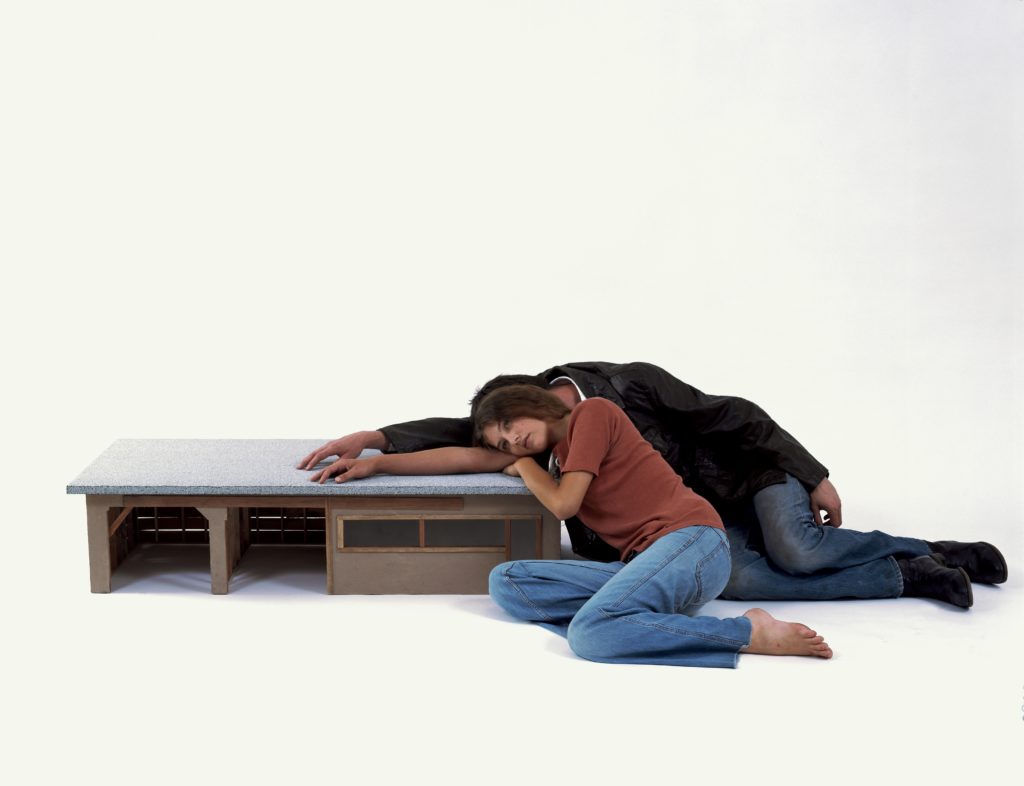
Sam Durant, What’s the Opposite
of Entropy? (1999). Like Triple Bluff Canyon, the
work revisits Robert Smithson’s Partially Buried
Woodshed (1970). Photograph courtesy of Sam Durant.
When I met them, Smithson’s
peers had reached an advanced and (for the most part) contented
middle age. They had lived long enough to develop the implications
of their early work, and in many instances they had challenged the
rigorous precepts and sober formality of their classic
styles. When I tried to
imagine Smithson (the portrait of the artist in my mind was
becoming clearer, more recognizable), I did not think of a
historical person, as James’s narrator describes Aspern, whose
portrait shows a young man in a high-collared green coat and a buff
waistcoat, the antiquated dress of the early 19th century. No:
Smithson felt insistently present during the ’90s. His death did not seem as
distant as the most famous Sixties tragedies, such as the
assassinations of the Kennedys, Patrice Lumumba, and Martin Luther
King, Jr. It was an event that his friends still mourned. In their
company, it felt as if he had died not so long ago.
On July 20, 1973, Smithson went
out with a pilot and photographer in a two-propeller Beechcraft
Baron to stake out the site of an earthwork at the edge of an
artificial lake on a ranch outside of Amarillo. The summer
afternoon was clear and bright. The desert shimmered in the heat.
The whirring sound of propellers mixed with the hot air as the
plane ascended.
We don’t know what happened
next. In my imagination one of the engines sputtered, and the
pilot’s attention was diverted. One of the wings dipped. At some
point Smithson and the others realized what was about to happen.
Then the plane rammed into a rocky hill a few hundred yards from
the location where Smithson planned to build his work, and the men
died instantly. The news reached New York that
afternoon.
Reproduced with permission from The Art of Return: The Sixties and Contemporary
Culture by James Meyer, published by the
University of Chicago Press. © 2019 by The University of Chicago.
All rights reserved.
The post What the Present Owes to the Past: Why Robert
Smithson and the Art of ’60s Remain So Vividly Present in
Contemporary Art appeared first on artnet News.
Read more https://news.artnet.com/art-world/art-of-return-james-meyer-excerpt-1740267
Further reading


Leave a comment