
‘Better Days Will Come’: Swiss Collector Uli Sigg on Why Hong Kong Remains the Best Home for His Unparalleled Chinese Art Collection
When the Swiss entrepreneur Uli Sigg first traveled to China in
1979, he hesitated to reach out to artists because he feared that
making contact might get them into
trouble with the authorities. But in the more than 40 years
since then, he has assembled perhaps the world’s most important
collection of Chinese contemporary art in close collaboration with
China’s leading creatives. Ai Weiwei has said of Sigg: “However
famous I become, he [Sigg] is the creator.”
The former Swiss ambassador to China is still working to help
foster the careers of emerging talent today as the sponsor of the
Sigg Prize, which gave its inaugural HK$500,000 ($64,000)
award to the Hong Kong artist Samson Young earlier this month. An
exhibition of the winning installation, as well as work by the five
other shortlisted artists, is on view at the recently
reopened M+ Pavilion in Hong Kong (which had been shuttered
for months during the city’s lockdown).
The show could take on a heightened significance following the
passage last week of a new national security law to suppress
subversion, secession, and terrorism in the semiautonomous city,
which local arts workers have
warned will cause “incalculable” damage to Hong Kong’s
status as an art hub. That status is particularly important to
Sigg, who in 2012 announced plans to donate more than 1,000 works
in his collection to M+, the long-delayed museum of visual culture
that is finally expected to open in the West Kowloon Cultural
District next year. So far, Sigg maintains that awarding the collection to
Hong Kong was the right move—it will keep the artwork within
China while offering the maximum freedom for display.
Following the announcement of the Sigg Prize winner, we spoke to
Sigg over the phone from his home in Switzerland about his thoughts
on the future of Chinese art, how the lockdown has hampered his
collecting process, and the unintended impact that growing
anti-Asian sentiment could have on art.
The inaugural Sigg Prize, which was awarded to Samson Young
earlier this month, is an outgrowth of the Chinese Contemporary Art
Award you founded in 1998 to honor artists born or working in
China. How does the new award, administered by M+, relate to the
original?
My intention remains the same:
to bring talented artists to the attention of the Chinese public.
At the beginning when I set it up in the 1990s, the wider audience
did not have much interest in contemporary art, and although the
concept has changed over time in terms of opening up to greater
China, the purpose remains the same, and I see the Sigg Prize as
doing that too, on a larger scale and with more resources, which of
course is to my delight.
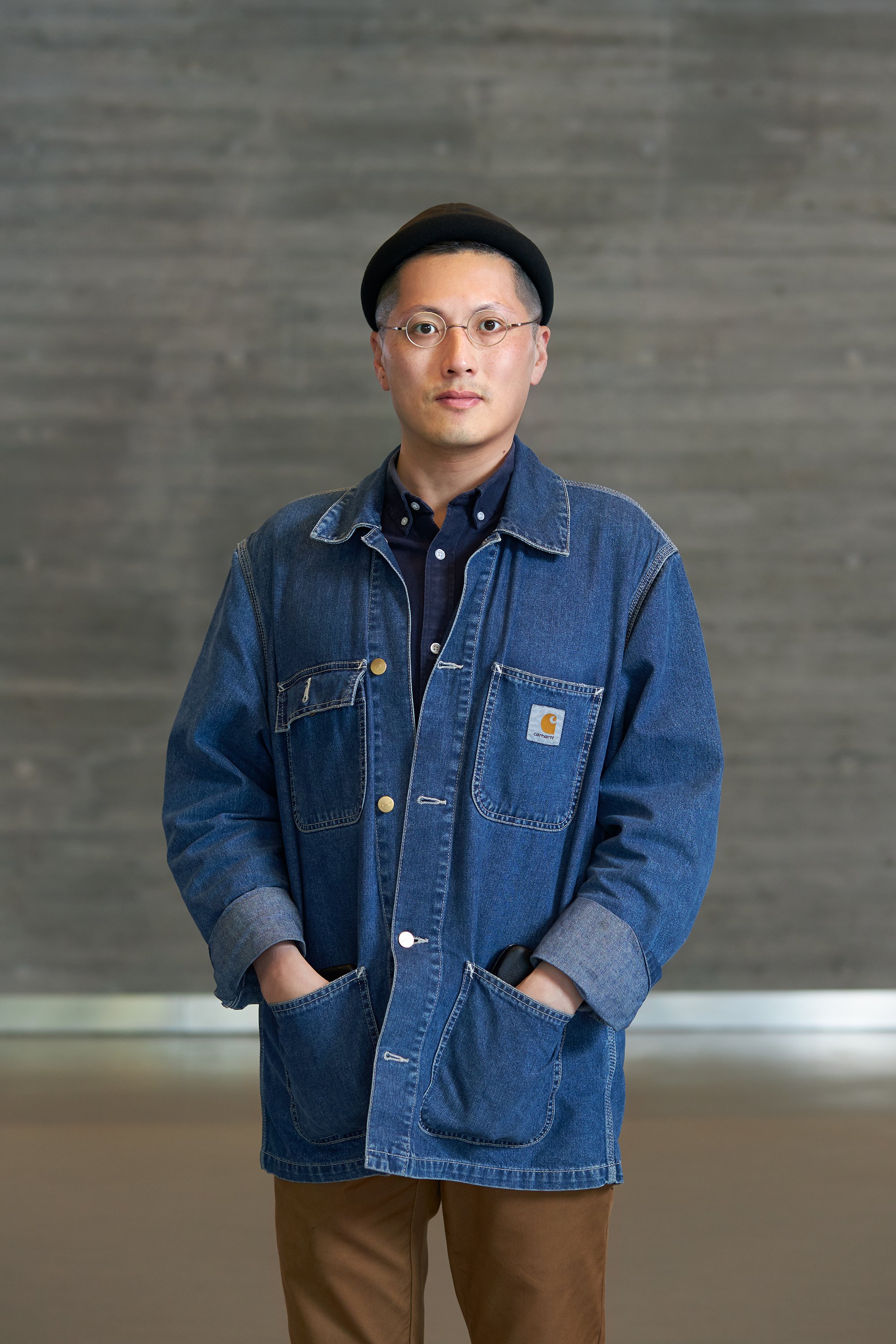
Samson Young. Photo: Winnie Yeung @
iMAGE28. Courtesy of M+, Hong Kong.
What will the future of the prize be? Will it accept entries
from other states in the region, not just greater China? Is it less
about the ethnicity or nationality but more about where they
work?
The main idea will remain the
same: it’s about work that is created either in the ambiance or in
the reality of greater China, maybe by people who are coming out of
this particular sphere. Of course, that doesn’t limit whatever they
deal with in their work. It’s not so much about borders or
nationality; it’s about cultural space, Chinese cultural
space.
Can you say a few words about why Samson was chosen? He
won for his installation Muted Situations #22: Muted
Tchaikovsky’s 5th, a 12-channel installation that captures
the Flora Sinfonie Orchestra playing Tchaikovsky with
only the sounds of performers shuffling in their seats and scraping
their bows, with no musical notes.
What I really liked was the ease
with which he crossed over all of these limitations of what
normally would be the music world, the performance world, video
art, etc. That particular approach impressed me very
much.

Samson Young, Muted Situations #22:
Muted Tchaikovsky’s 5th, (2018). Courtesy of the artist
Installation view, 2019. Image: Winnie Yeung @ iMAGE28 Courtesy of
M+, Hong Kong.
His work has broken down a lot of boundaries.
Across all mediums, yes. For me,
the worlds of music and contemporary art have very little overlap,
so to see how he merged the two was very impressive. The whole
series comes as a surprise to the people in the contemporary art
field and the music field, and can reveal new aspects of
both.
Work by the other finalists was also exhibited in
the Sigg Prize 2019 exhibition at the M+ Pavilion. In general,
what impressed you the most? What were you looking for—the
perspective of the artist, and their ability to give us a different
perspective into contemporary life?
Yes, all of the above. To become
a finalist, we looked at two to three years’ worth of work for each
artist, and then the finalist submitted a work to the exhibition,
and we chose the single work for the winner. They all have a degree
of intensity and involvement, and formally interesting results. So
that’s how they became finalists.
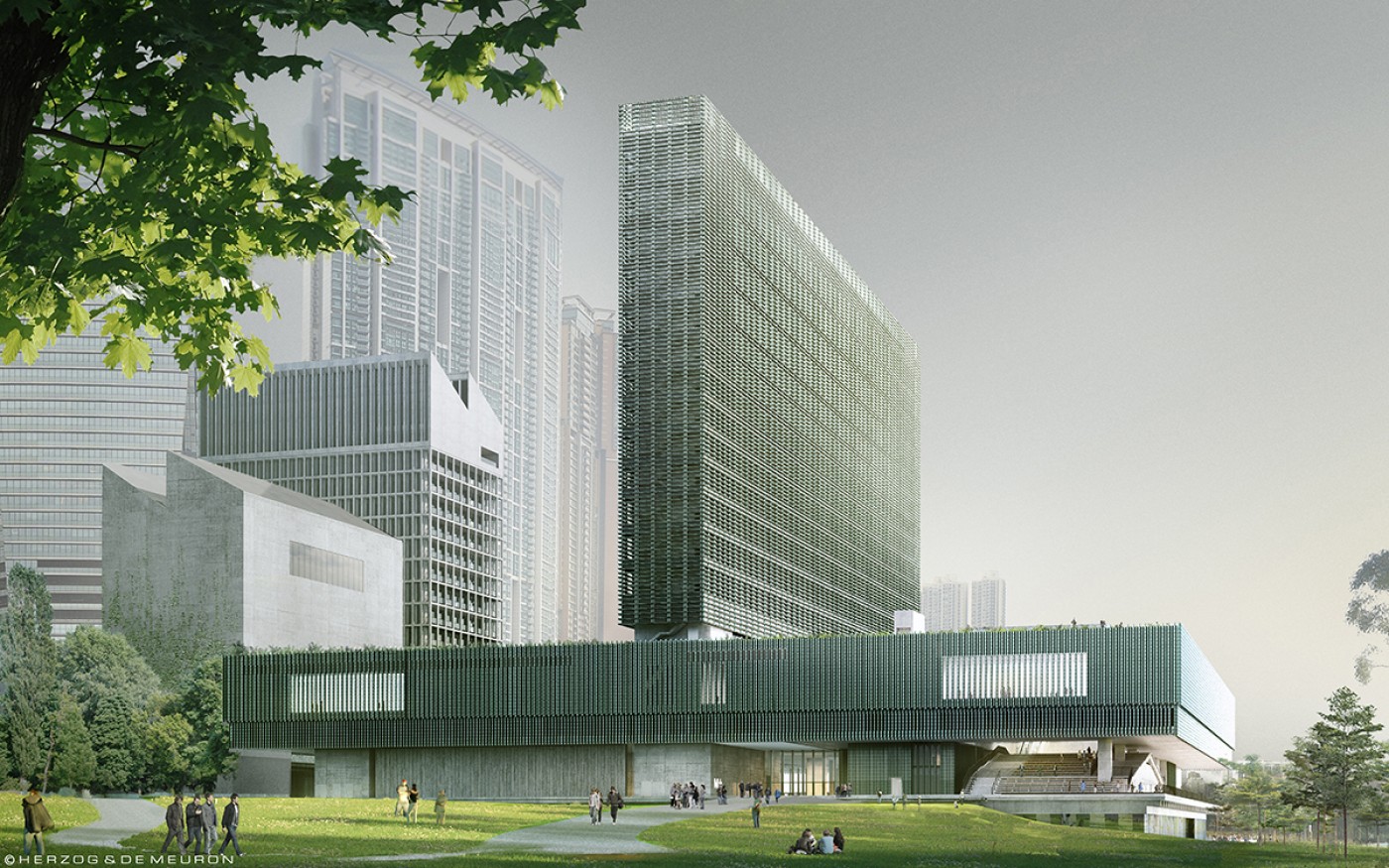
M+ Building rendering. © Herzog & de
Meuron.
Besides the prize, I’m also interested in the status of M+.
When can we visit the museum?
Well, I’m not exactly the person
to ask about that. But hopefully there will be a soft opening in
March and then the big splash should be in July. That’s the plan as
far as I know. [An M+ representative later stated that the building
will be complete by the second quarter of 2020, with a public
opening nine to 12 months later.]
And are there any things that worry you in regards to the
opening of M+? This year has been challenging for everyone because
of the coronavirus pandemic. How do you think the pandemic might
have changed the way we look at, think about art? And the way we
think about life?
I don’t know what the outcome
will be, and neither does anyone else. Of course, the consumption
of art in a public space such as a museum will be much inhibited,
and no one is happy about that, but there’s not much we can do. I see it here in
Europe currently.
I have a show of my own
collection at the Castello di Rivoli near Torino, which is a region that
has been really severely affected by the virus, and so now they are
just in the process of defining how to give access to a public
unknown in numbers at this moment. Many people are hungry to just
get out and see new things. No one knows at this stage, so a
prognosis may be much easier two months from now.

Installation view of “Facing the
Collector. The Sigg Collection of Contemporary Art from China” at
Castello di Rivoli.
What is the exhibition at Castello di
Rivoli?
The show is called “Facing the Collector,” and it came about
because two years ago, the institution received a big donation from
an industrialist [the late Francesco Federico
Cerruti] who put together a very large collection ranging from
Old Masters to some Modern and contemporary works, and [acquired]
even the house where all of this was situated, from a collector no
one knew about, had any idea about. So now, they’ve restored that
collection and the house so it can be open to the public, and that
really piqued their interest in collectors.
Carolyn Christov-Bakargiev, the director of Castello di Rivoli,
was interested in pursuing this idea of the collector, the person
behind the collection. There are many portraits of me in
the show, but it also addresses the way I built my collection, my
“typology” of collecting, and also how I commission works.
Whenever we talk about collectors or a show from the
collectors it’s usually about the work, but it’s interesting to
shift the perspective.
It’s just a pity that the exhibition didn’t take place as
planned. It was open for one week and then it had to close; it was
really caught in this virus problem.

Installation view of “Facing the
Collector. The Sigg Collection of Contemporary Art from China” at
Castello di Rivoli.
How do you see the current situation in Chinese
contemporary art right now? In speaking to artists, there seems to
be a very strong desire for them to document or record their
experiences and their observations, the emotional turmoil that they
have gone through during this period. It seems to be a more direct
and timely response to what is happening around them, and also, of
course, the most direct way to disseminate those visuals is via
social media, regardless of the platform. Do you think this
could be an important time of transition?
In times of high tension and changing circumstances, artists are
often drawn to act and make interesting art… it very much depends
on the individual. Some need long-term reflection to come up with a
very well thought-out work, and some artists’ method is to react
spontaneously. Still others will just document without much value
added. There are so many ways to respond to these extraordinary
situations, and we see all of that. Some of it is interesting, and
some is really not. Some will surely prevail beyond the virus time,
and much will disappear.
And of course there are new distribution methods with social
media. For me, that’s a big disadvantage, being unable to travel
and seeing it all from Switzerland, I don’t have access to Chinese
social media and I cannot read Chinese—I can speak it, but I cannot
read it. So for me, it’s difficult to follow in the same ways I
normally do.
Recently I saw in the Guardian that the
anti-Asian crime rate has increased by 20 percent, and statistics
like that have been emerging since the onset of the coronavirus. Do
you think that collectors and supporters of the art world in China
should take the lead in maintaining these kind of
relationships?
Of course, the art world should take the lead in combatting this
anti-Asian sentiment, but unfortunately I don’t know that it will
be able to do that. These types of prejudices right now are mainly
fuelled by the President of the United States; it’s become an
instrumental part of his re-election campaign and it spills over to
Europe as well.
I’m afraid it may have some effect on public institutions not
focusing as much on Asian art as they may have otherwise, so it may
in fact be more difficult to get sponsorship for Chinese art, for
example. How long will it last? We don’t know.
It’s very sad, because selection processes should be based on
the quality of the art, and shouldn’t be subject to these global
political swings, which in this case are particularly
irrational.
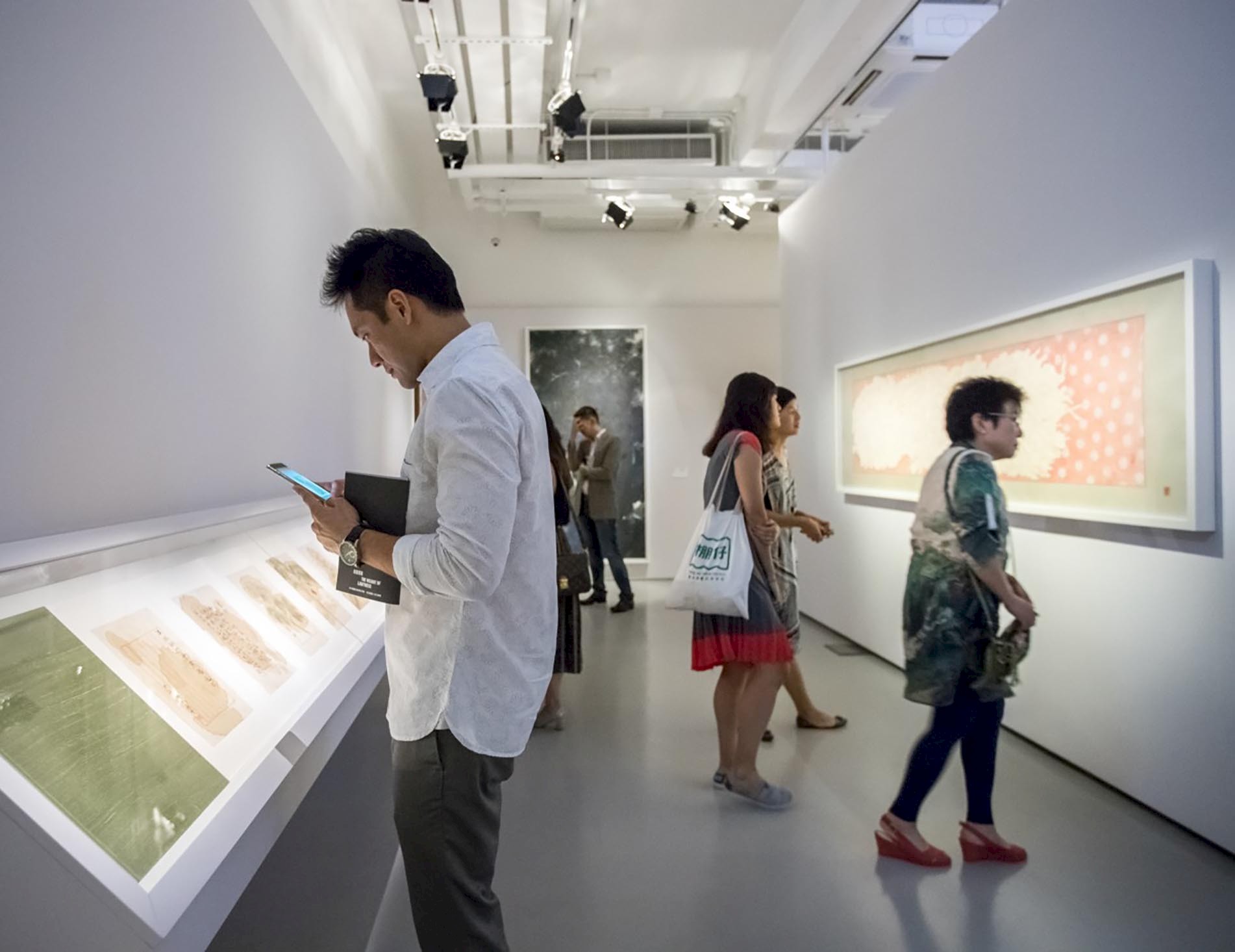
Visitors in the M+ event space. Courtesy
of M+.
That means that M+ will have an even bigger role to play
in terms of carving a different narrative.
An institution like M+ can take a fresh view, without issues of
the past weighing on it. It can build the right relationships, and
even enhance the role [for art] to play.
I want to hear what you think about Hong Kong right now.
Do you think the role of Hong Kong within the art world will change
amid the ongoing political turmoil?
I think a lot is in the hands of the people of Hong Kong and
mainland China… of course that’s easy for me to say from a distant
Switzerland, to talk about it without being able to travel and hear
it directly from those on the ground. But I do hope that all sides
involved will take a step towards each other because the future of
Hong Kong as an arts hub is at stake. People will still have
to want to travel to Hong Kong, and the
restrictions on that will really inhibit it. The free movement of
people, art, and freedom of speech are all very important. That’s
what made Hong Kong the place it is now.
Is this threatened further by the new national security
law?
It would be naive not to assume that
there is a risk, whether this risk will materialize will depend on
how the HK authorities will implement this law. And whether the
various camps are enabled and also willing to take a step towards
each other out of current deadlock. Without international and
mainland travel, the art-trading hub Hong Kong will clearly
suffer.
Yes, the value of Hong Kong has always been that it is
kind of on its own, you know—things can happen in Hong Kong.
Personally, I’m also worried about your collection. How much of it
can be or will be shown?
I must really stress that so far we have not been inhibited in
the least in preparing our exhibition, and I have very strong
commitments from the chairman [of West Kowloon Cultural District,
where M+ is located], the director of the museum, the CEO—each and
every one of them has expressed the strongest intent to preserve
the current status in this respect and not allow any restraints. Of
course, that has happened in the past, and this current situation
is momentary, but I see no reason to doubt these assurances.
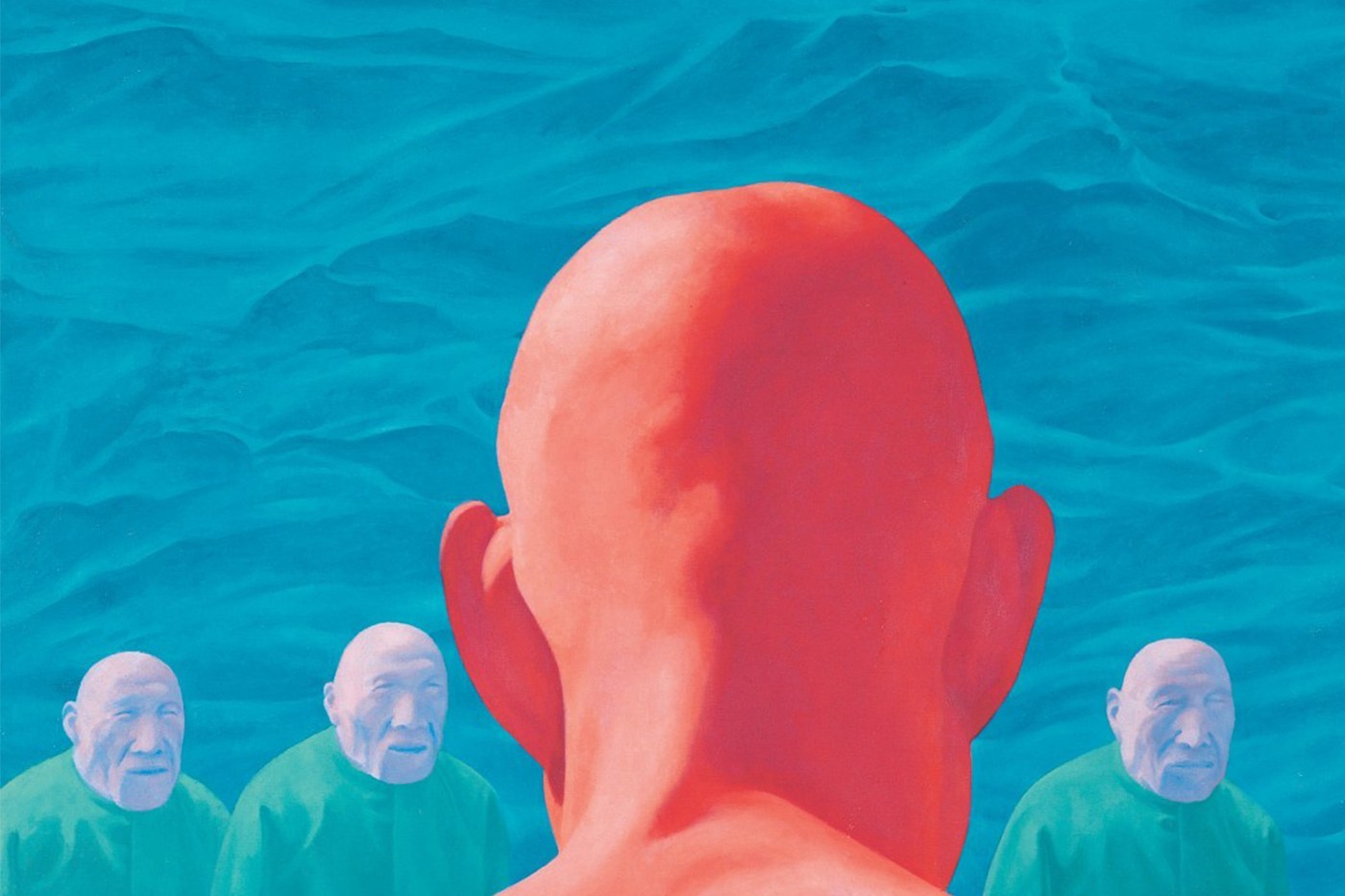
Fang Lijun, Untitled (1995).
Courtesy Uli Sigg.
And people should take note of the significance of
having your collection in Hong Kong, as opposed to anywhere else.
Despite the complicated historical backdrop and relationship
between Hong Kong and mainland China as well as their different
trajectories, the historical and cultural context of Hong Kong is
inseparable from the Chinese cultural sphere you mentioned. It is
important that these works can remain and be exhibited in Hong
Kong, which is a part of the Chinese soil, culturally
speaking.
That’s always been my ambition. It’s the only place one is able
to read the story line of Chinese contemporary art and far beyond
that, from the collection. It has an importance, and I’m still
convinced it is in the right place, even if we have to wait 20 more
years for it to be shown!
Again, this collection is not about me at all, it’s about the
Chinese artists and what they have created, and that is a value
which remains eternal. Even if conditions are worse for a limited
time, better days will come.
It’s also an important chapter of history, what the
collection embodies. I personally learned so much from just seeing
a fraction of the works, because we were not taught about that
period of history—from the 1970s onward—in school back in the day.
It is a great way to be exposed to that period of
time.
I’m convinced one can see, learn, understand, feel, grasp more
from art than from reading 100 books about it. That is the meaning
of the collection.

Zhang Xiaogang, Bloodline Series—Big
Family No. 17-1998 (1998). Courtesy of the artist and West
Kowloon Cultural District Authority.
I’m also curious about the way you collect these days.
Has anything changed from your practices in the past?
Of course it is very different from the past. There’s no need
for me to collect in an encyclopedic way now that there is M+ and
many collectors both inside and outside of China. Now, I can focus
on fewer artists and artists who I particularly like. That was not
the criteria in my collecting before, when I just wanted to mirror
the art production of a whole period. I commission works—that’s
what I enjoy, sometimes getting involved in the creative
process—and that’s my way of researching phenomena in China. Of
course, right now, it’s very difficult because that requires some
physical presence and dialogue, which is very difficult to do
online. I hope I can resume my own way of collecting soon.
How does it work exactly, the process of
commissioning?
It varies, but I’m interested in how the individual artist
works. I may have a topic in mind, take “China Dream” for instance,
so that subject I research as a China specialist. It’s an
interesting way for me to work, and if the artist is interested in
getting involved, I get to add my personal views to it and enrich
the conversation. That’s the most interesting way for me. Sometimes
artists want to go their own route, but the first way is the most
rewarding for me.
Many artists really like my involvement; they claim I’m an
artist, but I’m not! Yes, oftentimes I have better ideas than the
artists, but there is a big divide. We all talk about it, but the
artist actually does it.
The post ‘Better Days Will Come’: Swiss Collector Uli Sigg
on Why Hong Kong Remains the Best Home for His Unparalleled Chinese
Art Collection appeared first on artnet News.
Read more https://news.artnet.com/art-world/uli-sigg-interview-1872105
Further reading


Leave a comment