
‘Bodies Can Be Our Own Borders’: Artist Julia Chiang on Making Art About Invisible Forces Within Us, From Sneezes to Anger

A lot has changed in the six
years since Brooklyn-based artist Julia Chiang first showed her
work at Tokyo’s Nanzuka Gallery. After taking time to focus on
motherhood and raising her two daughters, the artist is now
returning to the space with a vibrant new solo exhibition. Called
“Pump and
Bump,” the show is a
colorful exploration of the body and the invisible forces that roil
it—from anger to tears to a simple sneeze.
“I’m constantly thinking of how
things within us can be mimicked outwardly,” Chiang explains. “The
violence we create, the love we share, the boundaries we make—it
all starts from these tiny cells, and how they move, grow, push,
explode, and come together.”
The show includes a selection of
paintings and ceramics featuring Chiang’s signature repetitious
style, in which tiny petal shapes blanket surfaces like cells. Her
color palette—reds, blues, and purples—are inspired by her interest
in contemplating the body from the inside out.
“I feel like if what you make
can even just gets someone to pause and walk away with something,
that’s a good thing,” Chiang says. “There’s this weirdness where
people don’t even pause anymore, so if they stop to look, I’m
pretty psyched.”
Chiang speaks with artnet News
about the inspiration behind her show, how becoming a mother shaped
her work, and the role art plays in her marriage to art-market superstar
KAWS.
Tell me about how the show came to be.
It’s been an ongoing
conversation since the last show I had at Nanzuka Gallery six years
ago, when I was pregnant with my first child. At that time, I was
entering the unknown of becoming a mom, and Shinji Nanzuka [the
gallery’s owner and founder] was saying, “When you feel ready to
show again, let me know.” That’s rare, right? Over the years, he
took pieces of mine to fairs and kept me in the loop. When I had
just the one kid, I could work regularly, part-time. Maintaining
the work didn’t feel as difficult, in a way. But when our [newest]
little one arrived, she really threw me off—she was really hard as
a baby. I always kept working, but the idea of committing to a show
on my own just didn’t seem like a good idea. So finally, when I got
more into the regularity of the craziness, I decided to commit to
doing this show.
Do you have any special relationship to Japan? Why did you
choose to return to Nanzuka and show in Tokyo rather than, say, New
York, where you live?
I love Japan but I haven’t shown
there from a particular relationship to the place. I met Shinji
though my husband [Brian Donnelly, also known as KAWS] when I
traveled with him there years ago. He asked to see my work, and to
visit my studio, and it started from there. I had only known of a
few Japanese artists he showed, but after time with him, and
meeting some of his artists, it felt like we were old friends. The
opportunity for my own show came about six years ago. He’s always
been supportive of me in the sense that he knew I wanted to take
time to be a mom and just make work slowly and figure things
out.
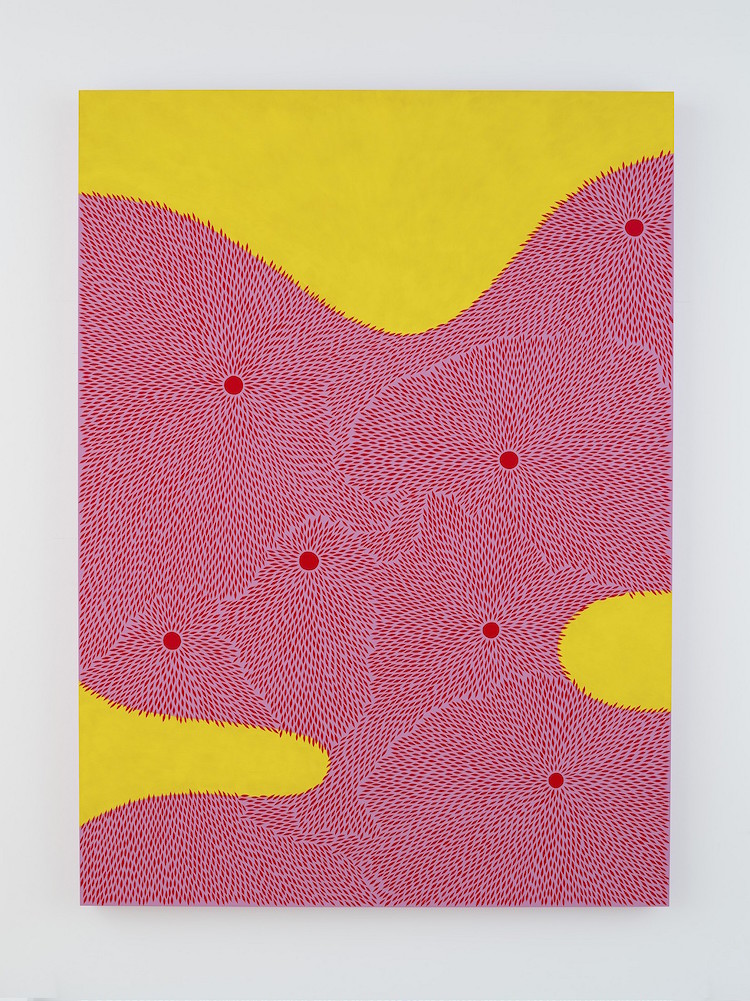
Julia Chiang, Summer Hot
(2019). Photo courtesy Nanzuka gallery.
How does the work in this show compare to your last
exhibition there?
It’s similar to what I was doing
before, just smaller scale. I painted and did a lot of ceramics and
made a lot of functional stuff, just because I wanted to keep
everything regular. If you step out of the studio for too long,
when you get back in, everything is weird and the groove is just
gone. I wound up giving a lot of gifts to people and making stuff
for my kids. It’s a total luxury that I can choose to raise my kids
and be there when I need to be or want to be and also juggle my own
studio schedule. The majority of people in this country have no
choice. Our country is not one that supports the belief in time
needed with raising families. In that way, I feel super fortunate.
Not to say it’s easy—it’s kind of [like] trying to figure out a way
to maintain two full-time jobs without the secure benefit of one
full-time job.
What was the inspiration and drive behind “Pump and
Bump”?
I don’t aim to represent
anything specific. One of the magical things about art for me is
not knowing what somebody’s intention was in what they made, and
walking away with my own understanding of it. But with everything I
do, I’m constantly thinking about our bodies internally and
externally—how everything functions within and how it’s expressed
outwardly. I’ve always connected with behavior, with the way people
interact physically in real time, how they clash and come together.
If something’s happening externally, whether it’s arguing, crying,
or war, it’s manifesting inside of us, too. If our bodies can be
our own borders for all our inside stuff, we can be each other’s
boundaries for all the physical stuff around us. Our blood can’t
just go through our skin, it’s enclosed within us. If people
explode with anger, there are physical constructs to control
it.
So does each painting within the exhibition reference an
emotion or emotional reaction?
I’m not making a painting and
thinking, “This is going to portray what happens when you get
punched in the face.” It’s not so specific. In general, I think
about cause and effect regarding forces of nature. So, if you come
at something with this much pressure, what could be a potential
result of that? If you could see a sneeze from inside and outside,
what might it look like? If you could portray what happens in your
body when you’re having sex, if you could see all the things going
on within two people, what might that look like? It’s not
necessarily a specific emotional feeling, it’s more just imagining
specific forces [more generally].
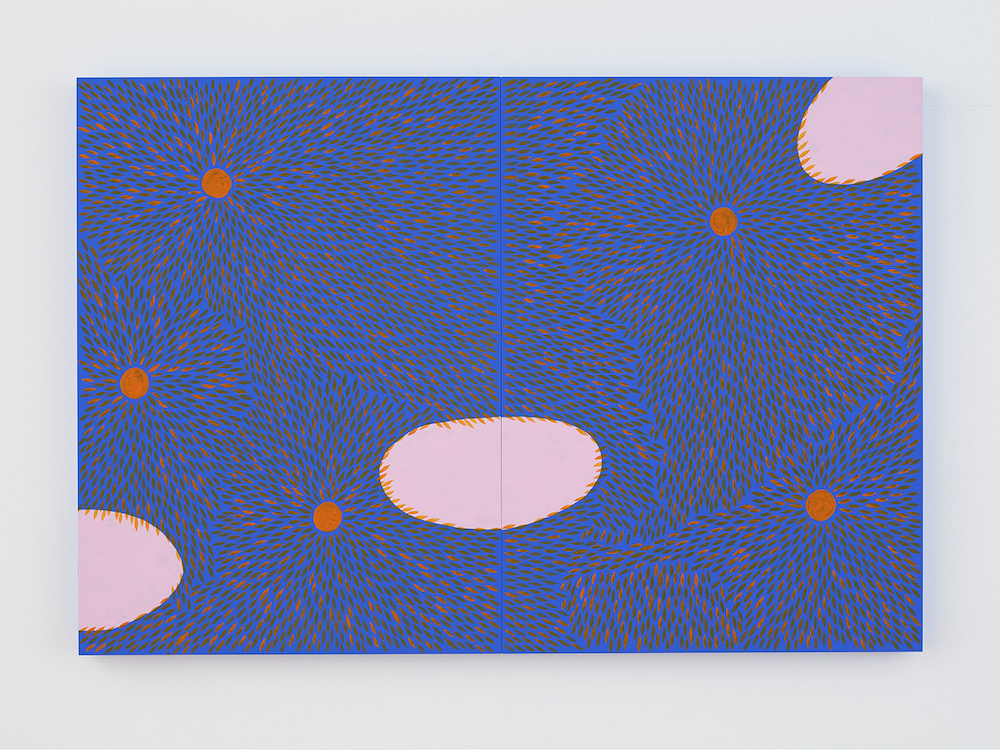
Julia Chiang, Bumpity Bump
(2019). Photo courtesy Nanzuka gallery.
Tell me a little about your color theory. It informs so much
of your work.
I’m drawn to blues and reds and
purples a lot because I feel like they are part of our internal
makings. Not that if you cut yourself open there’s all that
rainbow, but if you bleed or if you bruise, these are very common
colors. I feel like there’s kind of an extended rainbow of color
when you think of all that comes out of us, so I usually start from
that palette. Recently, I’ve been looking a lot at body scan images
and medicine and drugs and the surreal, weird vividness in all of
that. It’s really beautiful to me. They’re always strange—very
saturated, very vibrant, and not really colors that you would
normally think of when it comes to the body.
The phrase “Yes You Can” features prominently in your show.
Where did that come from?
We’re in a climate where
everything in the world seems like it’s falling apart and getting
worse. It feels like there’s an overwhelmingly negative response to
things: “No, it’s not gonna happen” or “You can’t do this, you
can’t do that.” I felt there was this need—this physical need—to
believe that things can change, that things can happen. When said
over and over, the positive feels more like a need to believe, an
attempt at convincing oneself almost. Now, more than ever, we could
all use some convincing… at least I can. I also really related to
the phrase “Yes You Can” in terms of managing work and family life
and taking on the news. I just felt like it was really reflective
of the times.
Why did you choose to display the phrase in ceramic
letters?
I’ve always loved working with
ceramics. It’s the material I’ve worked with the longest, and I’ve
always loved it for its duality of being super fragile and super
strong. I like the contrast of saying something loud and
confidently with a ceramic letter that might potentially break as
soon as you hang it on the wall, if you hit it the wrong way.
They’re just very connected for me, the material itself and the
install of the words.
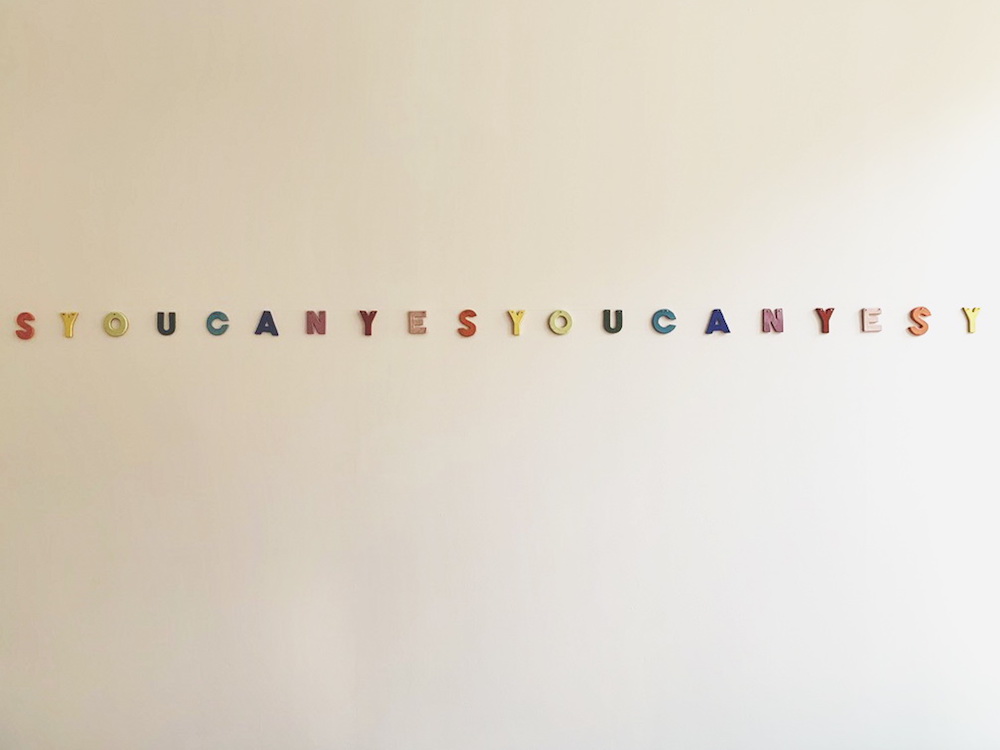
Julia Chiang, Yes You Can
(2019). Photo courtesy Nanzuka gallery.
What, to you, is the point of making art? Of looking at
art?
I’ve just always loved making
things. Itchy hands, you know? They can’t stay still. And looking
at art—I’ve always loved seeing how people make things, what they
make, and how they see. I remember as a kid going to the Met and
just being blown away. I couldn’t believe hands made the things I
saw, and I’ve always loved learning how people make the things they
do.
You’re married to an artist. How does art factor into your
relationship?
I mean we’re married, so we
share it all. We talk art as much as we talk about everything else
and we share a lot about what we’re making, though we work really
differently. But yes, art is a big part of our family.
“Pump and Bump”
is on view at Nanzuka Gallery in
Tokyo through October 5.
The post ‘Bodies Can Be Our Own Borders’: Artist Julia Chiang on
Making Art About Invisible Forces Within Us, From Sneezes to
Anger appeared first on artnet News.
Read more https://news.artnet.com/exhibitions/julia-chiang-1650325
Further reading


Leave a comment