
Doris Salcedo, Whose Haunting Work Bears Witness to Dark Histories, Is the First Winner of the World’s Largest Cash Prize for Artists
Doris Salcedo, the Colombian
artist whose haunting, elegiac work bears witness to the history of
violence, has been named the inaugural recipient of the $1 million
Nomura Art Award, the largest cash prize for art in the
world.
Sponsored by Nomura, a Japanese
financial services group, the award was founded
earlier this year and will be handed out annually to an artist
who has “created a body of work of major cultural significance.”
The cash comes with only one stipulation: that the winning artist
put the funds toward the creation of a new work. (They’re allowed
to pocket any leftovers.)
The company announced its first
winner at a gala in Shanghai on Thursday evening.
Salcedo will put the funds
toward creating a new community-based, performative artwork that,
like much of the work she has been making since 1999, transforms
domestic, quotidian materials like soil or wooden chairs into
monuments that bear witness to unspeakable trauma. But while much
of her work has focused on victims of political violence within the
Colombian capital of Bogotá, this new work will take her to remote
regions of the country, working with communities that are still
facing the effects of the country’s five-decade civil
war.
“These places that most of us
have never heard of, they deserve art,” the 61-year-old Columbian
artist tells Artnet News over the phone. “I actually think
that’s where art is most needed.”
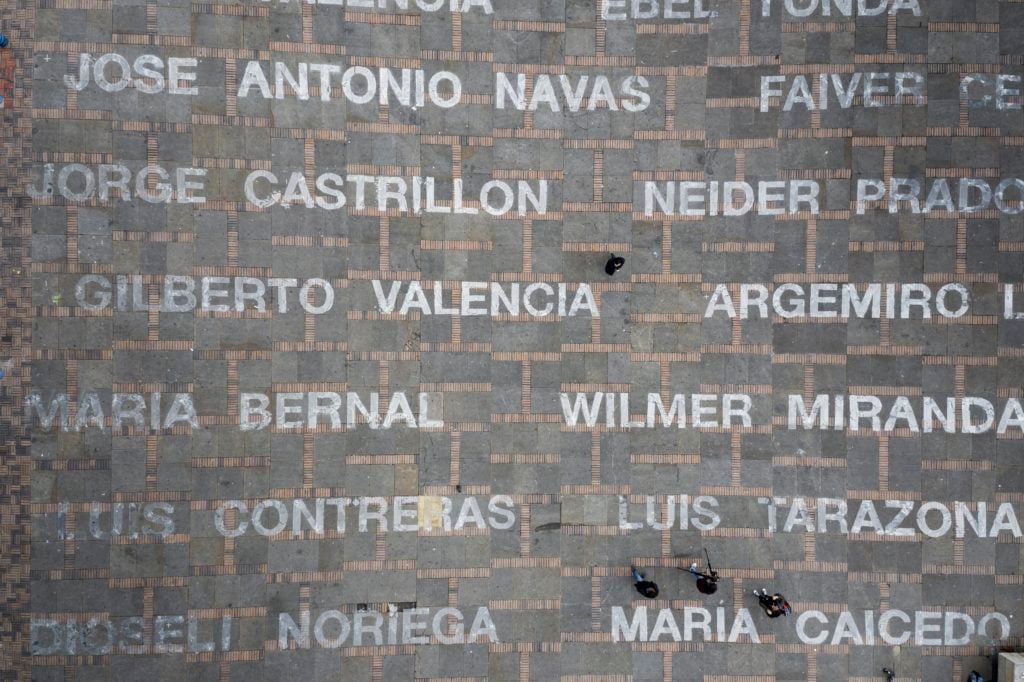
Doris Salcedo, Quebrantos(2019).
Photo: Juan Fernando Castro.
Her new work will tackle
unspeakable acts of violence waged by the state.
“In these poor areas, the
right-wing paramilitary death squad operated a crematory oven, just
like in Auschwitz,” she says. “These ovens were active from 1998 to
2004 and the community has distinct memories of the terrible events
that transpired there. I think we need to recover the dignity of
the victims and recover this terrain, be able to walk on it, and do
something that dignifies the memories of the victims and the life
experiences of the survivors. I don’t know exactly the shape it
will take; I just know that it will be like an ephemeral,
performative piece.”
Salcedo was chosen for the
Nomura award by an independent, star-studded jury of curators and
museum directors: Doryun Chong, deputy director and chief curator
of M+; Kathy Halbreich, head of the Robert Rauschenberg Foundation;
Yuko Hasegawa, artistic director for the Museum of Contemporary
Art; Tokyo; Max Hollein, director of the Metropolitan Museum of
Art, New York; Nicholas Serota, Chair of Arts Council England; and
Allan Schwartzman, the chairman of Sotheby’s Fine Arts Division and
co-founder of Art Agency, Partners. The late curator Okwui Enwezor
was also included on the jury before his death in
March.
“For more than 30 years, Doris
Salcedo has been making sculptures and installations that capture
the anguish associated with the loss of loved ones and preserve the
memory of traumatic events in the long civil war in Colombia,”
Serota said in a statement. “However, her language has an empathy
and her materials an everyday character that give her work a
universal meaning that speaks to people across the
world.”
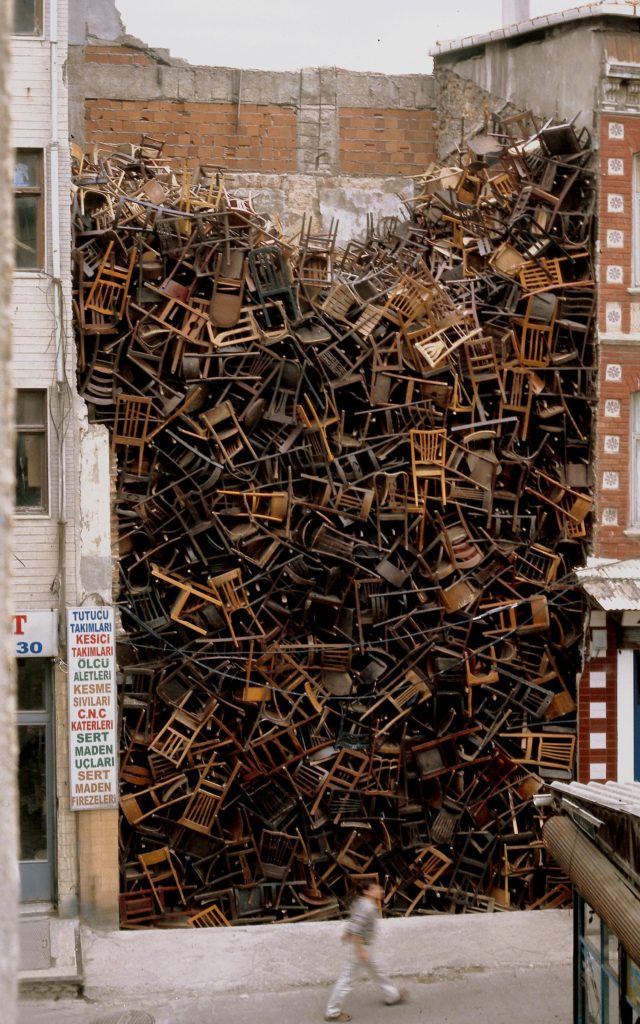
Doris Salcedo, Untitled (2003),
from the 8th Istanbul Biennial. Photo: Sergio Clavijo.
This is the latest in a long
line of major awards for Salcedo, who ranks among the most
decorated living artists. She was the recipient of a Guggenheim
Fellowship in 1995, the €100,000 Velázquez Visual Arts Prize in
2010, a Hiroshima Art Prize in 2014, and was named the inaugural
winner of the $100,000 Nasher Prize for sculpture in
2016.
For Salcedo, such prizes are to
allowing her to make works that “are completely outside of the art
market.”
“About half of my life’s work
has not been commercial,” she says. “They’re ephemeral pieces.
They’re political, site-specific, time-based. Awards like this give
me the freedom to make work like this that is unique and very
important for me.”
Such noncommercial work has ranged from filling the streets of
Bogotá with a two-mile path of red roses to commemorate the
assassination of Colombian journalist Jaime Garzon in 1999, to
cutting a 500-foot-long fault line in the floor of Tate Modern’s
Turbine Hall in 2007.
“Each one of my pieces is
completely different,” Salcedo says. “They’re all related to
political violence but they’re different. So every time I start a
piece I know nothing. I always feel like I’m at the zero point,
starting from scratch. Each new work is more difficult than the
last.”
The post Doris Salcedo, Whose Haunting Work Bears Witness to
Dark Histories, Is the First Winner of the World’s Largest Cash
Prize for Artists appeared first on artnet News.
Further reading


Leave a comment