
Ever Wonder How Experts Find Long-Lost Masterpieces? We Asked Top Sleuths in the Trade to Share Their Secrets
Every so often, an art expert will make headlines for digging up
and authenticating some long-lost masterpiece. Sometimes, their
labors forever change the fields in which they work. Other times,
the discovery makes them a lot of money.
Have you ever wondered how they do it?
We spoke to five experts who
are unusually good at
identifying and authenticating masterpieces. They offered some
vital insights into the long
and difficult process that goes into such major finds. Here, we’ve
distilled their advice down to eight key pieces of advice for
treasure hunters.
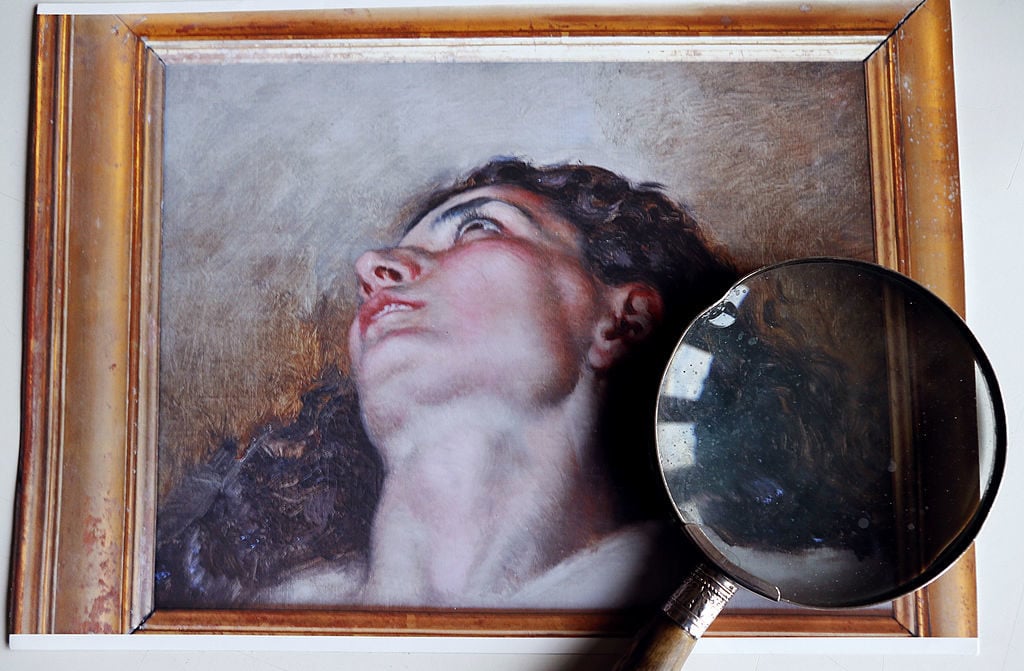
Photo by Patrick Kovarik/AFP via Getty
Images.
1. Arm
Yourself With the Appropriate Toolkit
TV art detective Bendor
Grosvenor recently uncovered
a long-lost Botticelli right under the noses of curators at a Welsh
museum. He recommends that an amateur sleuth always carries a
flashlight and a magnifying glass. You never know when such basic
tools will come in handy.
Colette Loll,
founder and director of
Art
Fraud Insights, LLC, adds that you can determine an awful lot with a
really good microscope. She does, however, advise that you
turn to an expert in the field for a thorough physical
examination.
Still, don’t underestimate your
own common sense. Use your nose. “If it smells like coffee, be
concerned,” Loll says. (Coffee is commonly used to artificially age
a work).

Detail of Jean-Marc
Nattier’s Portrait of the countess de Tillières,
acquired by Richard Seymour-Conway, 4th Marquess of Hertford,
showing craquelure. Image courtesy Wikimedia Commons.
2. Know What to Look for
Dr. Jennifer L. Mass, an expert
in material analysis and the president of Scientific Analysis
of Fine Art, LLC, says that before sending a work to the lab,
the owner can give it an initial inspection for physical
evidence. She advises people to
look for signs of oxidation. “Has the canvas or panel darkened and
has the canvas turned brittle?”
Mass also notes that it is worth
documenting the extent and type of cracks resulting from how the
paint layers have dried, aged, and interacted with their support.
This patterning, called craquelure, will vary depending on the
period of the work’s production and will be important to compare to
related works. You can also look for evidence of previous
restoration and conservation campaigns, which would be expected
from any work that is thought to be several hundred years
old.
And don’t forget to flip the
canvas over. Is there any evidence of exhibition or ownership
history on the reverse of the stretcher or panel? Gallery labels
and collector’s marks can be vital clues.
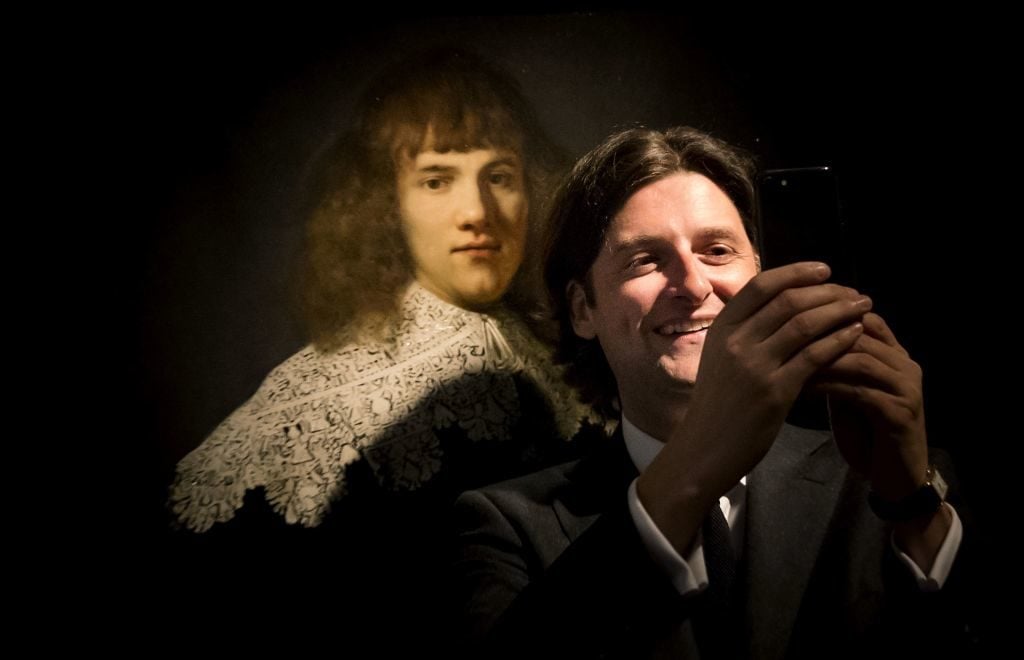
Amsterdam art dealer and historian Jan
Six. Photo: Koen van Weel/AFP/Getty Images.
3. Assemble a Great Team
Loll says that any expert worth
his or her salt will recognize that “authentication is a
collaborative process,” with each prong of research conducted by a
different professional. “There is no room for ego in art
authentication,” she says, advising anyone seeking to authenticate
their own masterpiece to build a team of experts who are prominent
in their fields.
All of the experts Artnet News
talked to agreed that conservators are a vital resource. Grosvenor
says to spend as much time with a conservator as you can, as “you
will need an intimate understanding of condition issues.” Loll adds
that conservators are often impartial third parties working for
museums, and can be keen to offer a really thorough investigation
in order to help advance the field.
Jan Six, a Dutch art dealer and
historian responsible
for uncovering not one,
but two previously undiscovered
Rembrandts, explains that
“restoration is often the
key to many discoveries.” Great works of art can be hidden under
yellowed or dirty varnishes or heavy overpainting, he
says.

An example of an FTIR spectrometer.
Photo by Keshavana via Wikimedia Commons.
4. Bring in the Big Guns
A forensic analysis by a
qualified expert is very important.
Jennifer Mass explains
that an expert in material analysis should be able to tell you
whether the palette is as expected for the period and for the
specific artist. They should also be able to confirm that no
anachronistic materials or technologies are present.
“One of my most important tools
for understanding not only the materials and techniques used to
prepare a work of art, but also its degradation mechanisms, is
Fourier-transform infrared spectroscopy,” Mass explains. The
technology, which became widely available in the 1980s, allows
experts to look at not just the pigments in paint, but also the
binders, fillers, drying agents, and other additives. “Often
forgers will work hard to get the pigments right, but the rest of
the paint composition [will be] wrong,” she explains.
More recent innovations include
multispectral and hyperspectral infrared imaging, which Mass
explains are excellent methods for examining the preparatory layers
or sketches of the work in a non-invasive manner. These are not
only helpful with attribution, but have been responsible for a
number of important art historical discoveries.
5) Be Up to Date on the Current Literature…
All the experts emphasized the
need to read widely about the artist you suspect to have authored
the work in your possession.
They encourage those who think
they are on the trail of an undiscovered artwork to look beyond the
existing monographs and biographies of the artist, and to conduct
research into the provenance, location depicted, and the people in
the work, as well as the artist’s daily life. Six advises being
prepared to answer questions about how the work fits in with the
rest of the artist’s oeuvre, and how it matches up to what other
artists were doing at the time.

Pablo Picasso with his son, Claude, on
August 21, 1955. Image courtesy Getty Images.
6) … but Don’t Trust Everything You Read!
Robert
Wittman, the founder of
the FBI’s National Art Crime Team, says that we should not always
take certificates of authenticity for granted, even if they do come
from the appropriate authorities.
“The experts who are often used
have no idea whether something is legitimate or not,” Wittman says.
“How should Jean-Michel Basquiat’s father, Gerard, know what makes
an authentic Basquiat? How does Claude Picasso know what his father
did in 1932?”
Wittman also warns that there
are always gray areas in scientific analysis. Expert copiers or
forgers have become good at passing forensic tests. And the
materials and tools of Modern artists like the Abstract
Expressionists are still available to forgers today.
Loll also emphasizes the
importance of looking beyond the physical work. “Most of the time
the deception is uncovered not in the material work, but in
falsified documentation,” she explains. “Forgers will go to extreme lengths to fool
you.”
This includes creating fake
galleries, shadow corporations, shell companies, fake
documentation, fake certificates of authenticity, fake provenance,
fake certificates of export, and more. “You name it, I’ve seen it,”
Loll says. “Never underestimate the cunning of a
fraudster.”
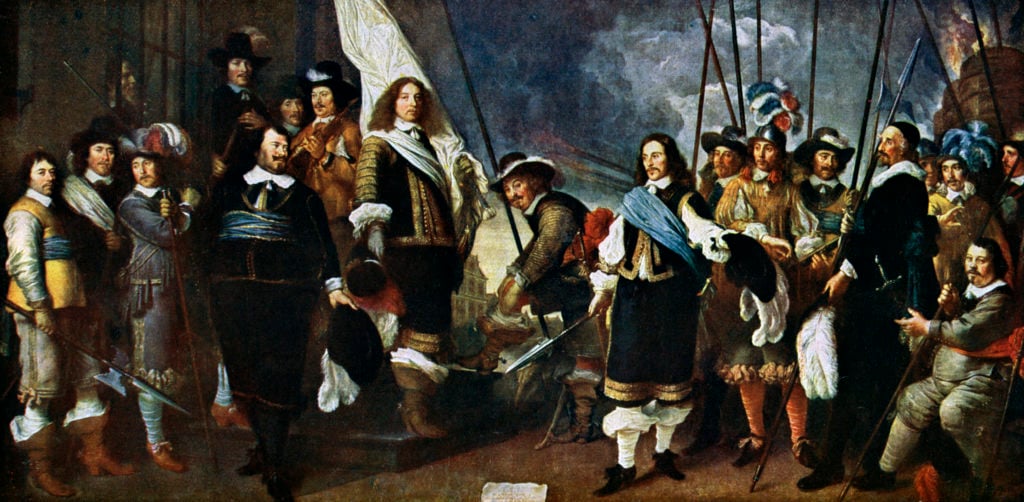
A 17th-century painting by Govaert
Flinck. Photo by The Print Collector/Print Collector/Getty
Images.
7. Abandon Your Preconceptions
If you are looking to uncover a masterpiece no one else has
spotted yet, you have to be willing to open your mind.
As Wittman points out, even
great masters have bad days.
“You can’t just look at the
existing monographs, the existing research on paintings and bodies
of work,” Six says, adding that discoveries usually come out of a
group of works that have not been researched at all. “Sometimes you
also have to dismiss your own preconceived ideas about what a great
master is. You may end up stumbling upon something that feels
wrong, but actually turns out to be right.”
Sometimes, poor scholarship lays
a bad foundation for subsequent research. “A lot of things are
attributed to Rembrandt’s students, because he had so many. But if
you look closely you might find, for example, that their
biographies don’t match up to the attribution.” One of Rembrandt’s
students, for example, Govert Flink, has been credited with
creating some works when he would have been just four or five years
old.
“It’s crazy that some people
just write and copy what they read elsewhere. Just because someone
else has done the work doesn’t mean you should stop thinking for
yourself,” Six advises. “A book will only be an ensemble of
the current ideas of that moment. You need to dare to see it
differently.”
8. Be Prepared to Wait a Long, Long Time for
Success
All the experts warned that
looking for undiscovered masterpieces is not a path to a steady
income.
“You’re not going to pay your
rent doing that,” Wittman says. “You can’t just find it in a book.
It takes a lot of time and research, into the forensics, the
provenance, everything, and even then it is just your belief. Then
you have to have it authenticated by whatever committee manages the
artist’s estate. If they are having a bad day, or if there are
commercial reasons for not wanting to authenticate too many works,
you’re out of luck.”
“You can’t expect next day delivery, or online
authentication,” Loll warns. “These projects are incredibly time
consuming. Most people don’t understand the level of expertise that
is required.”
“Don’t try this at home,”
Jan Six cautions. “The only way to
be successful at this is to turn it into your lifestyle, 24 hours a
day, seven days a week. It will be a long time before serious
discoveries are made that will really change the field.”
The post Ever Wonder How Experts Find Long-Lost
Masterpieces? We Asked Top Sleuths in the Trade to Share Their
Secrets appeared first on artnet News.
Read more https://news.artnet.com/art-world/how-to-spot-an-undiscovered-masterpiece-1714311
Further reading


Leave a comment