
Experts Discover the Secrets of a Dutch Old Master After Nearly 400 Years
When the Dutch Old Master Pieter de Hooch painted a woman weighing gold
and silver coins, he signed his canvas in an unusual place. Nearly
400 years later an eagle-eyed conservator spotted the artist’s
name slyly incorporated into the frame of an open window
within the painting.
It is one of three intriguing
discoveries made by experts working on a major survey organized by
the Museum Prinsenhof Delft in the
Netherlands. As well as
his signature, experts have discovered the artist’s fingerprint in
another canvas.
The exhibition “Pieter de Hooch
in Delft: From the Shadow of Vermeer” is the artist’s largest
survey in a generation, and the first in the Netherlands. It
features 29 works and concentrates on De Hooch’s most
prolific period in the 1650s, during which the city of Delft played
a central role.
The new findings were made as a
result of research for the exhibition. The signature in
A Woman Weighing Gold and Silver
Coins (around 1644) was
spotted by conservator Johanneke Verhave and co-curator
Katja Kleinert when they were preparing the painting for the show.
Verhave detected fragments of the signature “P.D. HOOCH” in the
window frame.
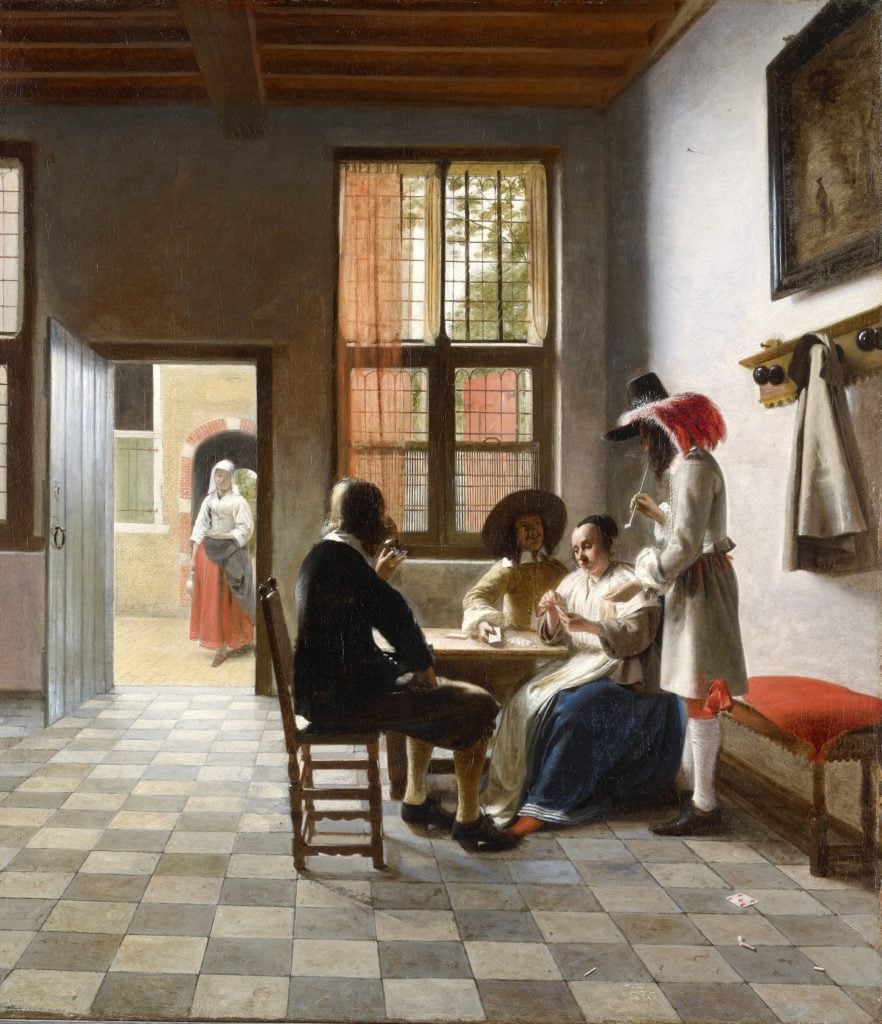
Pieter de Hooch, Cardplayers in a
Sunlit Room (1658). Image courtesy The Royal Collection / HM
Queen Elizabeth II 2019.
Anita Jansen, the senior curator
at Museum Prinsenhof Delft and the exhibition’s co-curator, says:
“Research on techniques during the past two years revealed that De
Hooch often signed his paintings on a window frame. If you next
encounter remnants of paint in precisely that spot, alarm bells
[should] go off.”
As with the signature, the
fingerprint found in Cardplayers in a Sunlit Room
(1658) was also identified ahead of the exhibition,
again by a conservator. Krista Blessley of the Royal Collection in
Britain made the discovery as was packing the work for shipment to
the Netherlands.
The painting, which has been
lent by Queen Elizabeth II, portrays card players mid-game seated
in a tiled room. The fingerprint, thought to be the artist’s thumb,
which is impressed onto the tiled floor, was mostly likely
imprinted while the paint was still wet. Jansen speculates that the
artist left his mark when lifting the freshly painted canvas from
an easel.
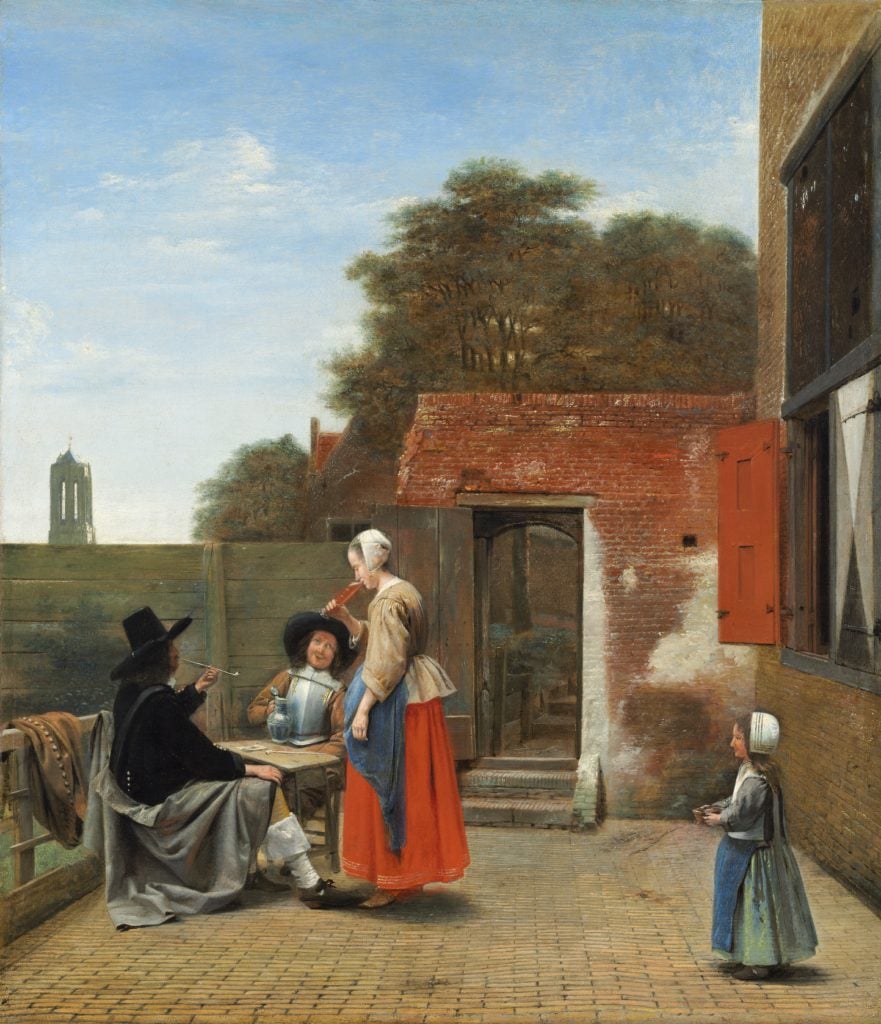
Pieter de Hooch, A Dutch
Courtyard (1658-1660). Image courtesy National Gallery of Art,
Washington, D.C., Andrew W. Mellon Collection.
Underdrawings of ships’ masts
were found in A Dutch
Courtyard (around
1658-60), following infrared imaging conducted at the National
Gallery of Art in Washington, D.C. The masts were spotted in the
upper left corner of the canvas, as if the ship were “floating” in
the sky. The artist
depicted the masts of rigged ships far too large to sail into the
city of Delft at the time of the painting, suggesting that the
drawings either belonged to an earlier, discarded draft of a work,
or rather, a recycled canvas.
The museum’s Pieter de Hooch
show has proven to be highly successful, drawing 30,000 visitors
since it opened in October. It is on course to beat the attendance
of the institution’s 2016 exhibition “Vermeer Returns Home” which is apt given the
17th-century artists’ rivalry.
“Pieter de Hooch: From the Shadow of Vermeer,” October 11
through February 16, 2020, Museum Princenhof Delft.
The post Experts Discover the Secrets of a Dutch Old Master
After Nearly 400 Years appeared first on artnet
News.
Read more https://news.artnet.com/art-world/pieter-de-hooch-discoveries-1718295
Further reading


Leave a comment