
‘Formal Analysis Cannot Occlude the Real Issues’: How Curators Are Addressing Gauguin’s Dark Side in a New Show at the National Gallery in London
How do you deal with a problem like Gauguin? Curators are
grappling with the issue more openly than ever in a major
exhibition that acknowledges the French artist’s sexually predatory
behavior in the South Pacific.
The poster child of the show “Gauguin Portraits,” which has just
opened at London’s National Gallery, is the artist’s portrait of
his Tahitian mistress, Teha’amana a Tahura. It may shock some
visitors to learn that she was probably 13 years old when she
became the much older artist’s “wife.”
The exhibition, which the National Gallery co-organized with the
National Gallery of Canada in Ottawa, where it first opened,
coincides with the second anniversary of the #MeToo movement.
Gauguin exhibitions until very recently have focused on his
greatness as a Post-Impressionist. This is the first time that such
high-profile institutions have broken a curatorial taboo to also
discuss his flaws as a man.
“Gauguin undoubtedly exploited his position as a privileged
Westerner to make the most of sexual freedoms available to him,” a
wall text states midway through the show. The publication
accompanying the exhibition places his behavior in the South
Pacific in its historical context. In the 1890s, “a young Tahitian
woman would not have knowingly lived with a married man,”
suggesting that Gauguin kept his Danish wife and family back home a
secret.
Gauguin’s infidelity to his wife, Mette Gad, who he left back
home in Europe to help sell his paintings, has long been known by
art historians and curators, as well as his predatory behavior in
the South Pacific and in Asia. Upon his return to Paris, his dealer
Ambroise Vollard described the artist as an “Oriental prince,” with
a Javanese girl in attendance.
“Even five years ago when we started working on the exhibition
we realized that things had moved on, and that we would need to
address these issues,” says Christopher Riopelle, the National
Gallery’s curator of post-1800 paintings, who has co-organized
the show with guest curator Cornelia Homburg of
the National Gallery of Canada. “Formal analysis [of
paintings] cannot occlude the real issues,” he says.
The National Gallery is also opening itself up to a debate about
how it should show Gauguin’s art in the light of the #MeToo
movement. Questions such as: “Can we still love the work of artists
whose behavior we loathe?” and “Do Gauguin’s artistic achievements
justify what he did to underage women?” will be debated this
Friday, October 11, at a discussion organized by the National
Gallery. Speakers include scholars and writers, including Janet
Marstine, an honorary associate professor at the University of
Leicester’s school of museum studies and the co-editor of
forthcoming publication “Curating Under Pressure.”
Marstine calls the Gauguin exhibition “an important first step”
for a national gallery. “They want to be responsive to the
contemporary context,” she says, adding, “if they are not, they may
well be held accountable.” Marstine adds that, increasingly, the
ethics of a museum are being judged in part by the way “they
navigate the ethics of the artists they are exhibiting.”
Jackie Wullschläger, art critic for the Financial
Times, did not pull any punches in her review of the show. In
reference to one of the show’s highlights, Gauguin’s
Self-Portrait with Manao Tupapau (1893-94), which is on
loan from the Musée d’Orsay in Paris, the critic described
Gauguin’s self-image as being “as sinister a Humbert Humbert
prowling new world as ever envisioned in paint.”
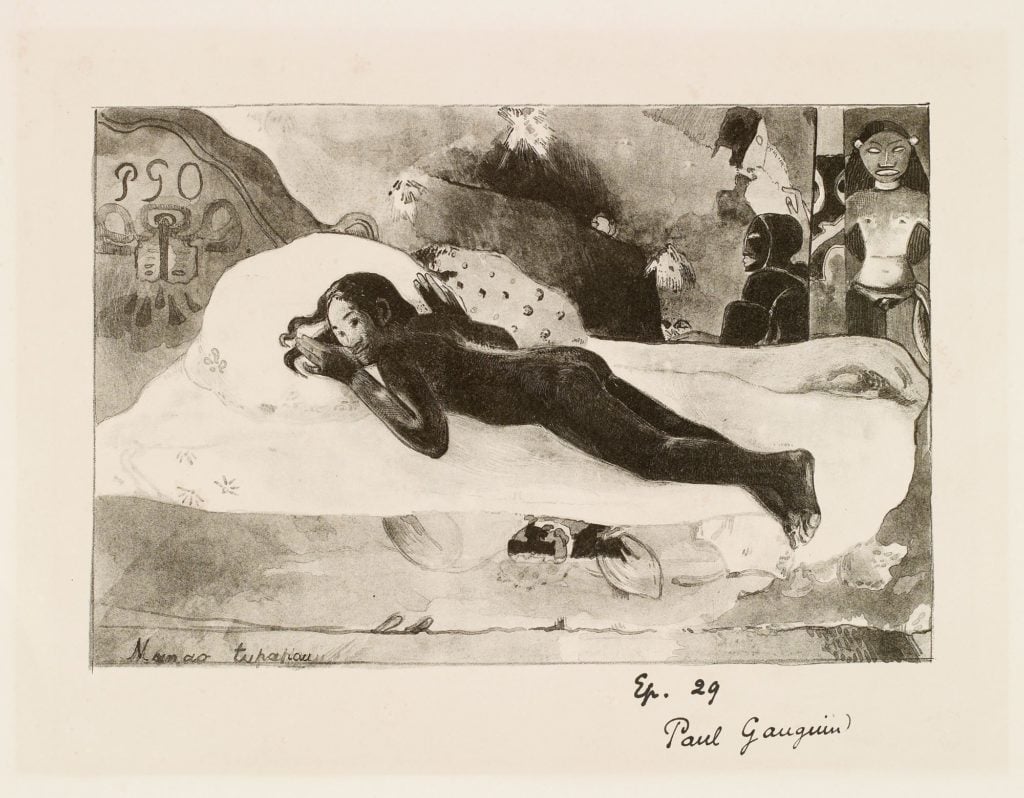
Hanging on the wall in the background of the self-portrait is
the artist’s own nude painting of his underage Tahitian mistress,
Manao tupapau (The Spirit of the Dead Watching (1894), a
work that is now in the Albright-Knox Art Gallery. Gauguin’s
lithographic print of that controversial nude hangs nearby in
“Gauguin Portraits.” It is an alluring but unsettling image. The
exhibition caption euphemistically states that the painting is
“one of his most disturbing portraits.” The publication
downplays Gauguin’s possibly abusive relationship with the
girl, stating that the composition suggests “as if both her body
and soul are at risk of assault” from disturbing spirits.
In her essay on Gauguin’s portraits that feature his young
Tahitian mistress, Elizabeth C. Childs, a professor of art history
at Washington University in St. Louis, speculates that his many
depictions of Teha’amana “can best be understood more as
reflections of his self-exploration and his artistic process in the
face of engaging—but to him exotic—subjects than as direct records
of personal encounters with a particular woman.”
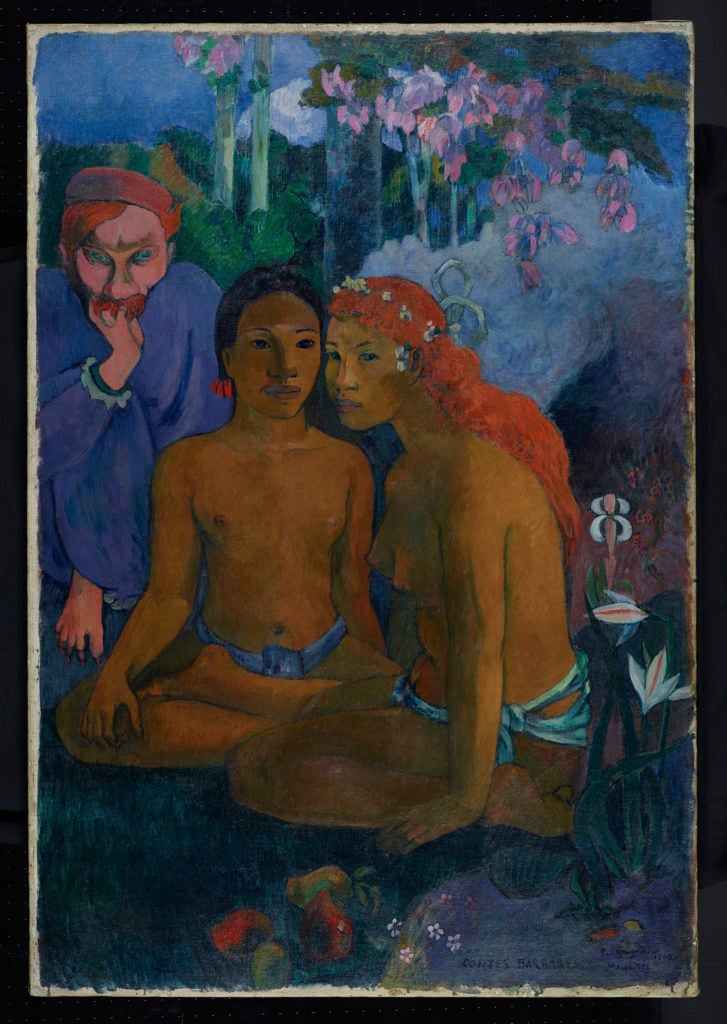
Paul Gauguin, Contes
barbares (1902). Courtesy of the Museum Folkwang, Essen.
The exhibition’s star loan is Gauguin’s last major
painting, Barbarian Tales (1902), from the Folkwang
Museum in Essen, Germany. It features two girls from the Marquesas
islands. Painted a year before he died, at age 54, the syphilitic
artist included a diabolical figure in the background based on his
long-dead friend back in Paris. The wall text in this room reverts
to type, merely noting that Gauguin “started new relationships with
local women,” and called his studio hut the “House of
Pleasure.”
Martine warns that art institutions can risk sending mixed
messages if their approach to a problematic biography is too
tentative. She cites the Ditchling Museum in the South of England
as a good example of how to reframe works by an artist who was a
serial sexual abuser. In its 2017 exhibition on British artist Eric
Gill, whom art historians have long known abused his own children,
the museum grappled with whether you can separate the artist from
the abuser. “They helped viewers to make their own ethical
decisions and shared some of the difficult conversations staff had
to devise,” Marstine says.
Reflecting on how art museums have belatedly addressed artists’
behavior, even when it was reprehensible in their own day,
Rioppelle says: “There was, at a certain point, a hope that art
could remain a separate elevated realm, but now we realize more
clearly that it has all the complications and unappealing aspects
of real life.”
“Paul Gauguin Portraits” October 7 through January 26, 2020,
National Gallery, London
The post ‘Formal Analysis Cannot Occlude the Real Issues’:
How Curators Are Addressing Gauguin’s Dark Side in a New Show at
the National Gallery in London appeared first on artnet
News.
Read more https://news.artnet.com/exhibitions/gauguin-metoo-national-gallery-1672810
Further reading


Leave a comment