
Goodbye Art World, Hello Art Industry: How the Art Market Has Transformed—Radically—Over the Past 30 Years
A version of this story
originally appeared in the fall 2019 artnet Intelligence Report.
The date on the New York Times in your hands is
September 21, 1989. You’re on the subway home, trying to read the
cover story about Mikhail Gorbachev purging the USSR’s Politburo,
but Mayor Ed Koch’s plan to air-condition every train in New York
hasn’t reached the one you’re on, and the heat is oppressive.
Besides, you’re too anxious that the big deal you’re trying to
close for your auction house may just blow up in your face.
There’s a new collector in Tokyo you need to call after
tonight’s episode of Cheers ends. The fax he sent you at
the end of his workday came through as nothing more than a smear of
black ink, so it’s still unclear if his financials actually check
out. He says he’s in real estate (naturally), and the way the
Japanese market has been climbing for the past few years, there’s
no telling how much he could spend in November if he’s serious. A
single Van Gogh almost hit $54 million less than two years ago, and
the Impressionist market has stayed so volcanic since then that
you’re starting to dream the record could be broken again soon.
Problem is, you couldn’t find the collector’s card in your
Rolodex today. Your assistant is driving to Florida, so you won’t
be able to ask where it might have gone until she calls you from a
motel room to check in tomorrow morning. Too bad those new “mobile
phones” Motorola just released cost $3,000. Then again, holding a
wireless electronic device up to your ear all day probably gives
you cancer or psychosis, so the whole product line might be dead in
a year or two.
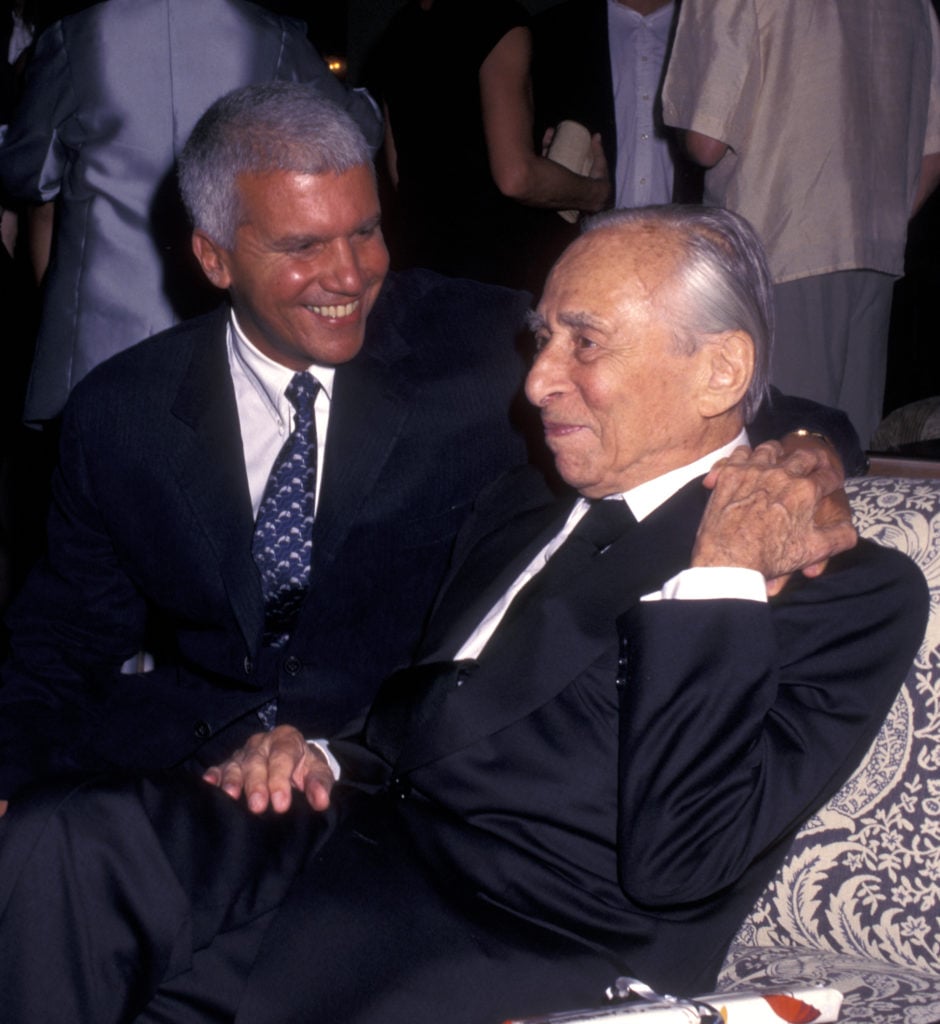
Young buck Larry Gagosian cozying up to
Leo Castelli in 1996. (Photo: Ron Galella Collection via Getty
Images)
Speaking of psychosis, you wonder if Leo Castelli is losing his
mind. At lunch today, you finally stopped by 65 Thompson Street in
SoHo, where a few months back he started up a partnership with that
40-something LA shark Larry Gagosian. As if fighting with the other
auction houses didn’t make your life difficult enough, Gagosian has
been running around for the past few years acting like dealers have
some kind of God-given right to compete in the resale market. What
does he think, auction houses are going to start putting on
exhibitions and offering works by living artists? Doesn’t he
understand there’s a particular way of doing things in this
business? Is the whole art world as we know it breaking down?
Fast-forward 30 years from this hypothetical day in the life and
it’s clear that, in a way, the art world as it existed back then
really did break down over the ensuing decades. That clubby
handshake business where everybody knew your name has been replaced
by a multibillion-dollar international industry.
Today, that industry still has plenty of growing up to do, but
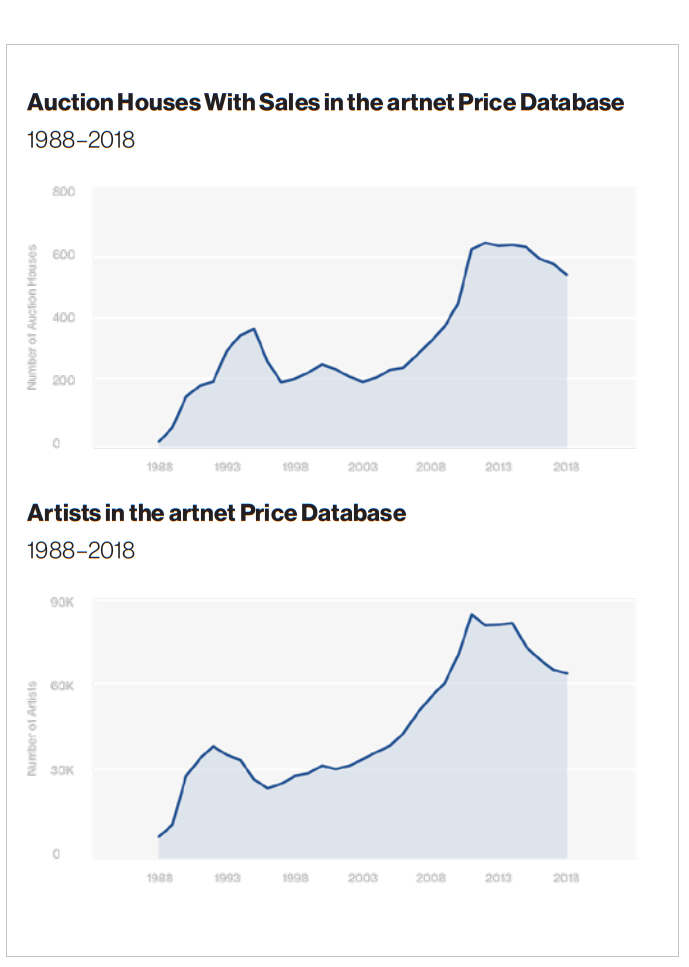
the refinement process has begun. Consider that, in 1988, the
Artnet Price Database tracked only 18 auction houses and about
8,300 artists. Over the next 24 years, those figures skyrocketed:
By 2012, there were 632 auction houses and 90,275 artists. But,
like any mature industry, it is now entering a period of
consolidation after decades of expansion. Last year, Artnet
recorded only 534 houses (a drop of around 16 percent from the
high-water mark) and 71,621 artists (down 25 percent from the
peak).
Still, the scale and contours of today’s art world would have
been largely inconceivable to dealers, auction-house professionals,
and collectors 30 years ago. Tastes have changed; non-Western
economies have emerged as essential forces; and what was once a
quaint cottage industry has become surprisingly corporate.
How was this transformation possible? Because three supposed
truisms about the art market in the late 1980s have proved to be
totally, completely wrong. Here, we explore the art-world myths
that the rise of the art industry shattered.
Myth 1: Contemporary Art Will Never Be
Popular
It has been said that “we are what we repeatedly do.” And based
on the history of Artnet Price Database searches, we have become an
industry ravenous for artists who started out in graffiti, vinyl
toys, and (possibly staged) documentaries. The artists who saw the
greatest increase in interested users over the past 15 years
include KAWS (#1), Mr. Brainwash (#6), and Banksy (#7).
The rise of street art would no doubt be jarring to the dealers
and collectors who were battling over Van Goghs in the late
1980s—as would the realization that what is driving the market is
the ascent of young art in general. Most of the artists occupying
this list’s upper reaches—40 of the top 50 names—were born in 1945
or later.
“The attention contemporary art gets today is what we were
always hoping for,” says Thaddaeus Ropac, whose five international
galleries grew from a single location in Salzburg opened in 1983.
“It was once a small group of followers—we were happy with whatever
number of visitors we got; we were happy about any small sale. But
expectations today are on a totally different level.”
This trend toward the new is unmistakable in the data. For
instance, of the 150 artists with the greatest increase in
interested users since 2005, only one does not qualify as either
postwar (which covers artists artists born between 1911 and 1944)
or contemporary (artists born after 1945): the abstract color
theorist Josef Albers (1888–1976). And he ranks seventy-third.
© Artnet Intelligence, 2019.
From today’s vantage point, it seems almost unbelievable that an
era existed when contemporary work—which by its nature mirrors the
issues and spirit of its age—did not enjoy such broad popularity.
But Allan Schwartzman, chairman of Sotheby’s Fine Art Division,
recalls that there was “no market for contemporary art” as recently
as the late 1970s.
That all changed in the big-money 1980s, a decade during which,
he says, art began “being filtered through the eyes of dealers” who
largely championed “brash, bold, invincible” works by the likes of
Julian Schnabel, Anselm Kiefer, and Robert Longo. The stock market
crash of 1987 and the AIDS crisis threw a shroud over this Masters
of the Universe mentality. The newly foreboding climate chimed with
“a more introspective sensibility” shared by several important
young artists whose work explored themes of mortality, intimacy,
imperfection, and transience. From Robert Gober and Marlene Dumas
to Rirkrit Tiravanija and Elizabeth Peyton, these artists “became
the critical names in art, and often in collecting, in the decades
that followed,” says Schwartzman.
As the number of wealthy individuals around the world grew from
the late ‘90s into the 2000s, demand for artworks as symbols of
refinement and success drastically increased—and contemporary art
had inherent advantages over older art among all but the most
moneyed of this ascendant class. That’s because, while the very top
of the market became increasingly sophisticated about which pieces
across different genres were worth significant price premiums, the
rank-and-file rich gravitated to the next best and most available
thing. And works by living (or recently dead) artists vastly
outnumbered the classics.
From gallery dinners and studio visits to art-fair parties and
biennials, the social incentives also heavily favored the
contemporary, particularly as the amount of money flooding into the
art business made these events more lavish and exclusive. This
revenue boost translated into bigger budgets, greater ambition, and
more robust marketing for successful galleries and artists.
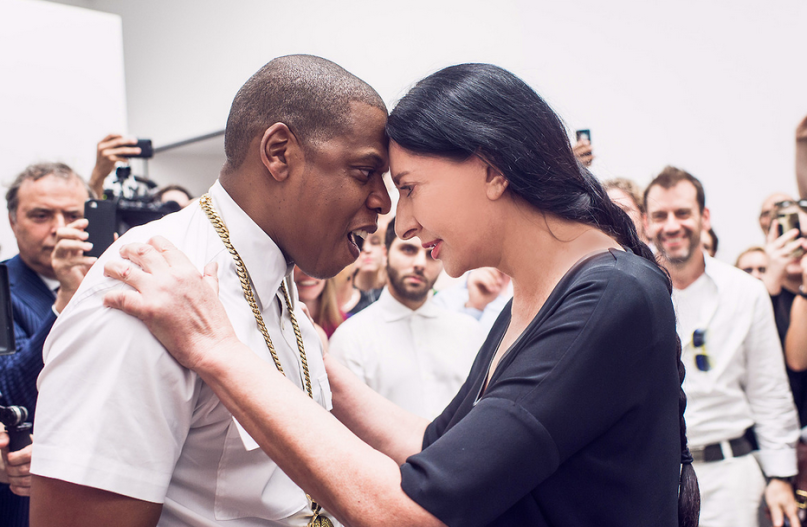
Jay-Z and Marina Abramovic during the
filming of Picasso Baby in 2013. Courtesy of Pace.
Before long, this expansion became a virtuous cycle. The more
contemporary art bubbled over into the celebrity and mass-culture
spheres, the more global brands were keen to partner with artists,
and the more popular the artists became. Audiences can now
encounter the work of fine artists in Jay Z videos, on the cover of
Vogue, on Louis Vuitton handbags and Nike sneakers, in
tequila ad campaigns, and in a thousand other venues far more
visible than the traditional art context—and museums reap the
benefits of this enlarged viewership.
Consider the fact that the Broad, the privately funded Los
Angeles museum opened in 2015 by Eli and Edythe Broad, two of the
most prominent collectors in the emerging class of contemporary
mega-buyers, became one of the 15 most-attended American museums in
its first year and has since grown its audience by 12 to 15 percent
annually.
© Artnet Intelligence, 2019.
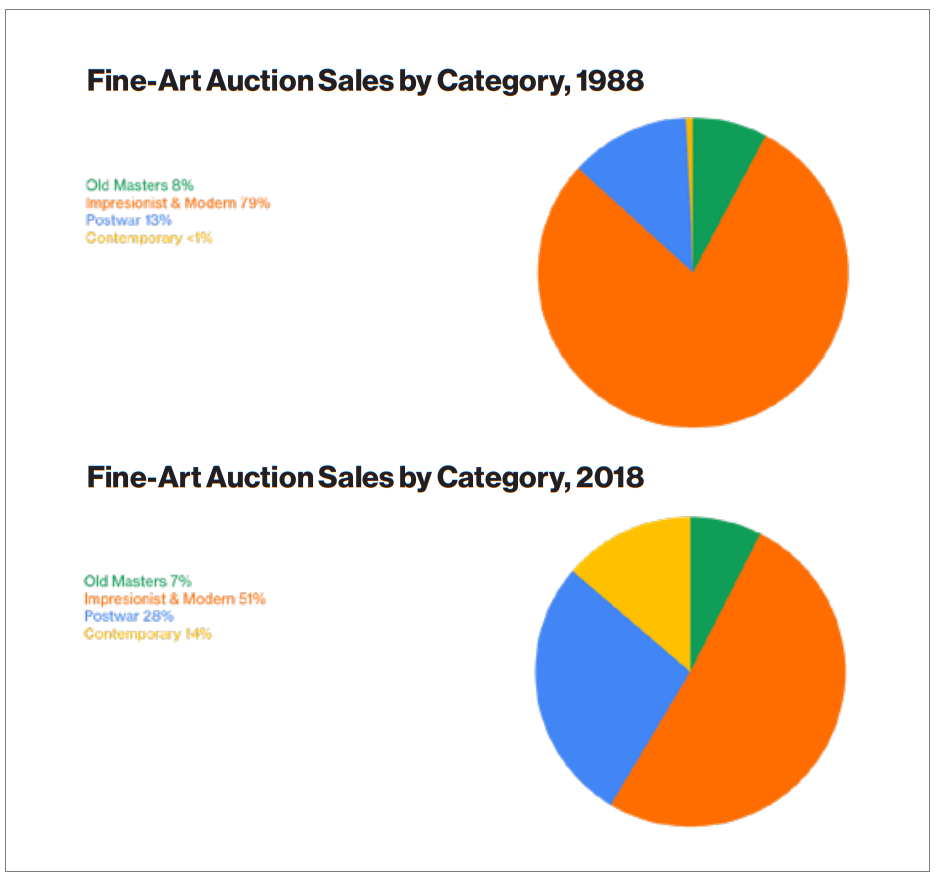
But does a huge gain in interest in contemporary art correlate
to a major rise in sales? Inflation-adjusted auction results over
the past 30 years certainly say so. Artists born after 1945 have
seized more auction market share than any other segment in the past
three decades, going from just 0.8 percent of total sales value in
1988 to 13.7 percent in 2018. That’s a gain of 1,700 percent.
Of the remaining categories of fine art, only postwar increased
its market share over this time frame, from 12.5 percent in 1988 to
27.7 percent in 2018—a very healthy boost of about 120 percent, but
an order of magnitude less than the game-changing growth of
contemporary art.
Myth 2: Auction Houses and Art Galleries Are Different
Things
Unpacking how and why sales gravitated toward the new lays bare
some of the most fundamental changes in the art world since the
late ‘80s. One of the biggest is the breakdown of the traditional
border between auction houses and galleries. This development,
which is arguably still in its early stages, has done much to
transform the art business into a mature industry able to exploit
the growing opportunities that lie before it.
© Artnet News Intelligence.
Thirty years ago, auction houses did not sell much contemporary
art, which was considered the domain of art dealers. “When I joined
the business, there was a rule that you wouldn’t offer an artwork
by a living artist that wasn’t at least 10 years old, so nothing
truly contemporary was offered in a postwar sale,” recounts
Phillips chairwoman Cheyenne Westphal, who began her auction career
at Sotheby’s in 1990. “That has changed dramatically.”
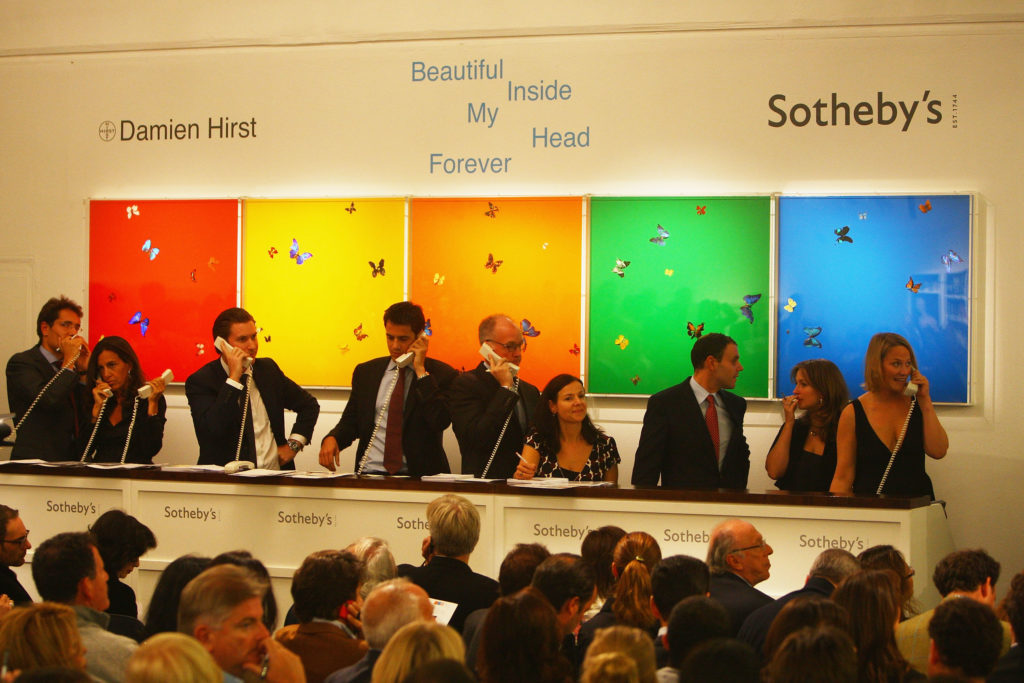
Among the biggest signs of this shift were the sales at
Sotheby’s of objects and ephemera from Damien Hirst’s Pharmacy
restaurant in 2004 and the 2008 “Beautiful Inside My Head Forever”
auction of Hirst that, Westphal recalls, “bypassed any gallery
system and did something you would call ‘direct to consumer,’ which
was definitely not a term used in the art world at the time.”
Haunch of Venison, as seen from the
street. Courtesy of Haunch of Venison.
The collapse of the distinction between auction houses and
galleries occurred “step by step,” according to Ropac. He recalls
Sotheby’s 1996 acquisition of André Emmerich Gallery, then
primarily known for representing American color-field painters such
as Morris Louis and Kenneth Noland, as an early milestone in a
“slow process” through which the auction houses “tried to
understand how they could get the best out of contemporary art.”
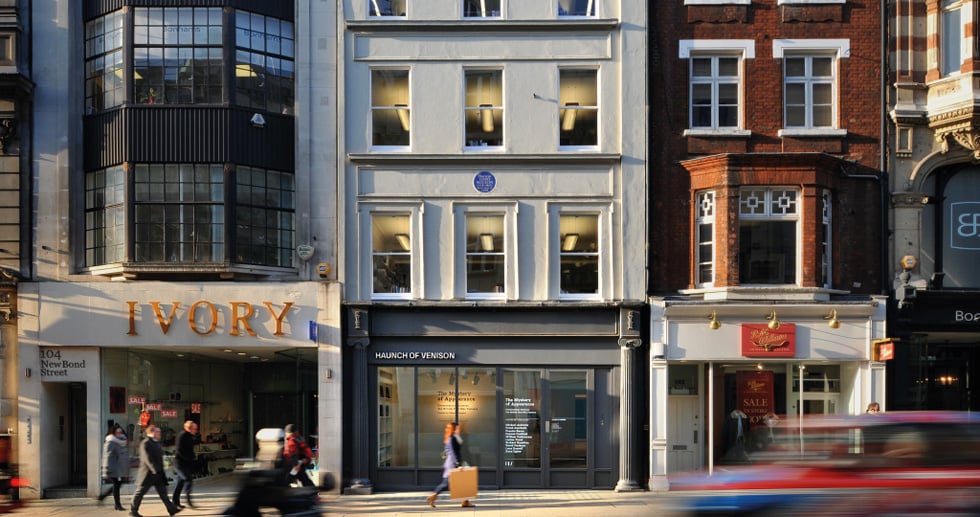
Christie’s followed suit in 2007 by acquiring the international
contemporary gallery Haunch of Venison, which then handled the
likes of Richard Long, Bill Viola, and Rachel Whiteread.
The major houses eventually realized that running galleries that
represented living artists was, in Ropac’s words, “a step too far,
and stepped back” to, at most, operating exhibition spaces focused
on private sales. But even this development was a meaningful one,
and their consignments of contemporary works less than a decade old
gradually moved from day-sale experiments to evening-sale fixtures
over the past 10 years, at least in the United States.
Auction house employees man the phones
during the “Beautiful Inside My Head Forever” sale at Sotheby’s,
September 15, 2008. (Photo by Daniel Berehulak/Getty Images)
Dealers have been equally responsible for redrawing the art
market’s borders. From Lucy Mitchell-Innes and David Nash, who
exited Sotheby’s in the mid-‘90s, to Brett Gorvy, who departed
Christie’s in 2016, major auction-house staffers have proved
increasingly unafraid to pivot to the gallery sector, where new
work from the studio is, in many cases, offered alongside
secondary-market material premium enough to lead an evening
sale.
This exploding distribution mechanism for contemporary work
powered up the sector in a way that no competing category could
match. It is no coincidence that the period during which the
contemporary category made its greatest gain in the auction
market—between 2004 (when contemporary accounted for 5.9 percent of
all sales) and 2014 (14.9 percent)—maps almost exactly onto the one
in which the number of worldwide art fairs ballooned (from 68 in
2005 to more than 220 by 2015).
So why is this increasing overlap between auction houses and
galleries significant? Because each sector lacks what the other
offers. Auction houses have corporate structures that allow them to
scale up their operations on a global playing field and pursue
long-term strategies despite changes in CEOs or ownership, but they
lack access to fresh-to-market inventory. Galleries, on the other
hand, have direct access to artistic production, but they are often
passion-driven businesses operated by a charismatic founder (or
founders) whose unique gifts and relationships cannot be easily
transferred to successors. Combine the two, and you have
something approaching the kind of vertically integrated corporate
structure that has enabled companies in other industries to thrive
in a global marketplace.
The facade of Gagosian, courtesy of
Shutterstock.
We’re not there yet, to be sure, but this increasing
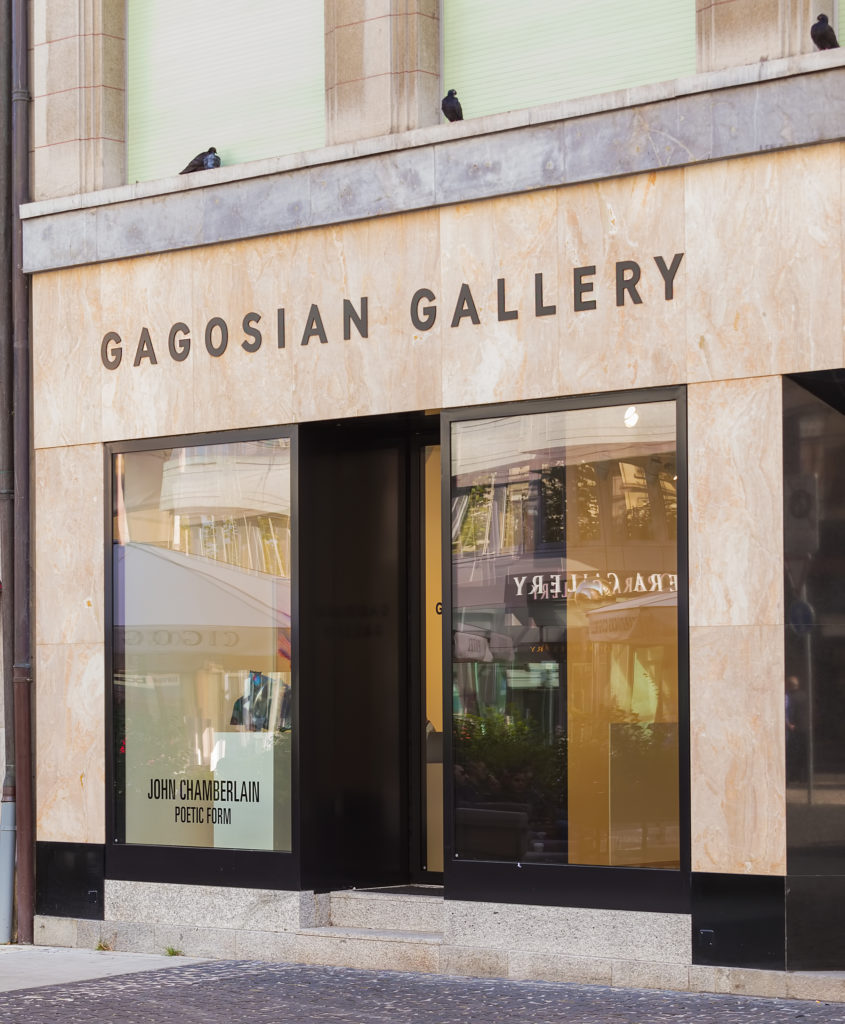
hybridization shows no sign of slowing down. This spring, Gagosian
announced the
appointment of gallery veteran Andrew Fabricant to the newly
created position of chief operating officer, the establishment of a
24-member advisory board of top salespeople, and, perhaps most
notably, the creation of a new, separate business called Gagosian
Art Advisory, LLC, led by Christie’s veteran Laura Paulson.
The move echoed the acquisition by Sotheby’s, three years
earlier, of the art advisory firm Art Agency, Partners. For both
high-end galleries and auction houses, it seems, the goal is to
transform into 360-degree art-service juggernauts capable of
handling a client’s every need, from private buying and selling to
advising and estate planning to collections management and
logistics. The race is on to see who will be best able to
capitalize on the opportunities created by the growing—and
increasingly global—market, ultimately becoming the LVMH of
art.
Myth 3: There Is No Such Thing as Global
Taste
It can be easy to forget how far the art market has come in
Asia, and how fast. Patti Wong says that when she was appointed
chairman of Sotheby’s Hong Kong in 2004, the city was still viewed
as a “regional hub” whose business relied on “Chinese collectors
buying Chinese things.”
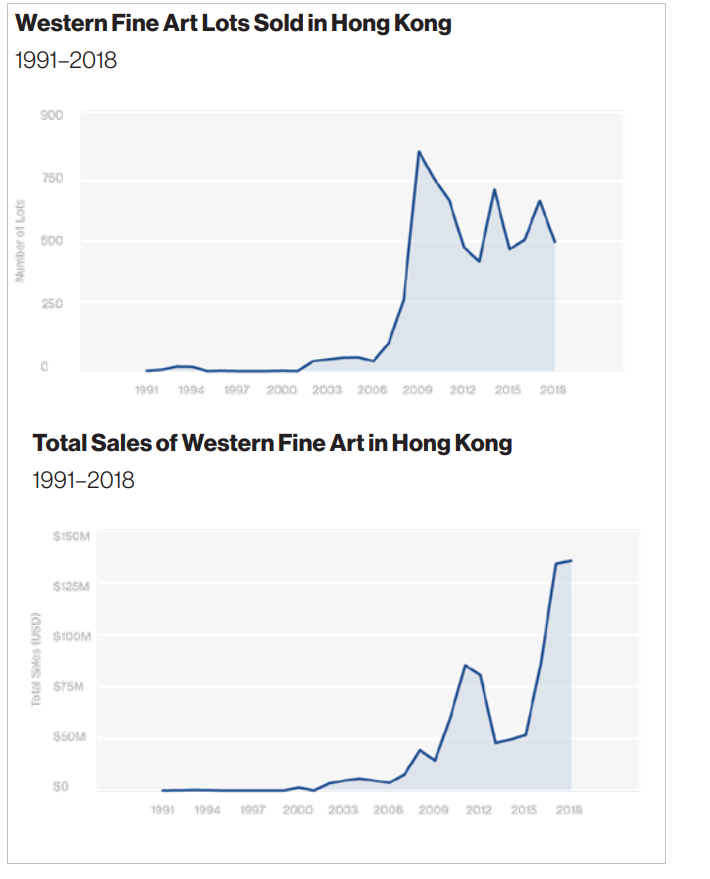
Indeed, from 1991 (when Artnet’s records for Hong Kong begin) to
2004, a grand total of just 124 works by Western artists sold at
auction in the city, with a combined value of roughly $12.1
million. Fast-forward to 2018, and 498 Western works collectively
brought in $132.7 million—almost 1,100 percent more in one year
alone than Western art made in that first 13-year stretch.
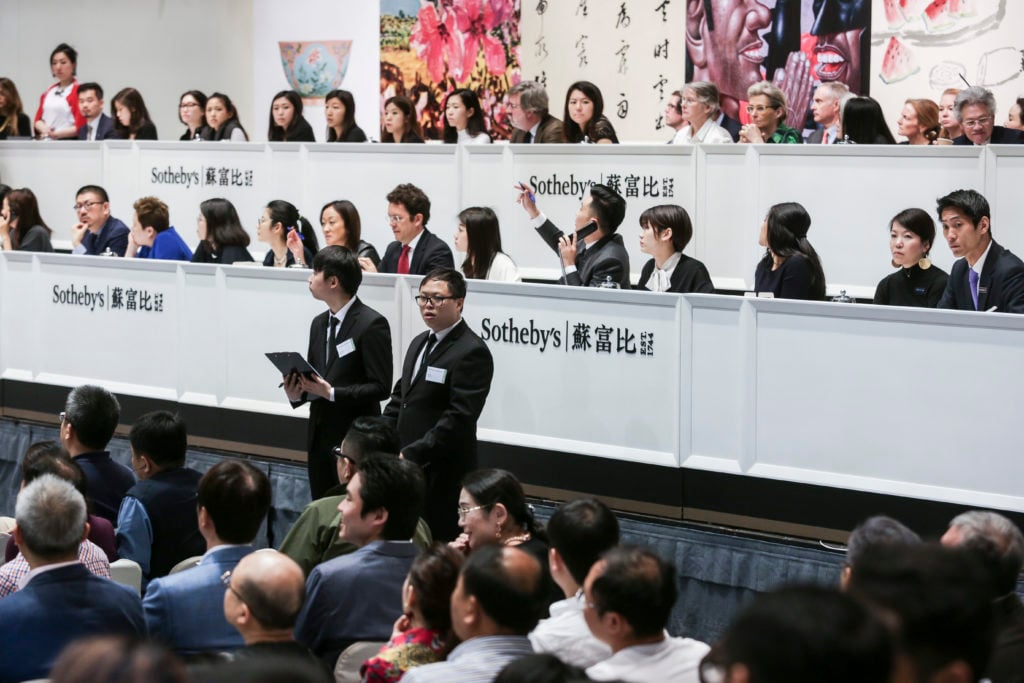
Sotheby’s staff take phone bids during
an auction at Sotheby’s in Hong Kong on April 3, 2018. Photo: Isaac
Lawrence/AFP/Getty Images.
Just as telling, Wong contends that a “key message of the last
10 years has been the Asian buying power outside of Asia,” with
sales in New York, London, and other Western markets being
increasingly propelled by East Asian clients.
In this respect, fine art is aligned with other 21st-century
businesses. The world’s major commercial and cultural economies are
now intertwined to an unprecedented degree. It seems completely
intuitive, for instance, that Marvel’s Avengers: Endgame
grossed $178 million at the mainland Chinese box office over Labor
Day weekend, or that it is as easy to find a Chanel store in Seoul
as in Paris or New York.
© Artnet Intelligence, 2019.
Yet blue-chip Western art did not become blue-chip global art
until the 2010s. It isn’t just that the preceding decades saw
vanishingly few works by non-Asian artists come to auction in Hong
Kong. The Western artists with strong presences in East Asia during
this earlier era tended to be regional sensations with little to no
strength under the gavel in other art-market hubs. In fact, even
though he was Belgian by birth and ethnicity, one of these early
top-sellers, the Modernist painter Adrien Jean Le Mayeur de
Merprès, is normally included in Sotheby’s sales of Southeast Asian
art today.
Looking strictly at paintings, the top-selling non-Asian talent
in Hong Kong during the 1990s was British artist George Chinnery,
whose renditions of Chinese subjects and scenes amassed about
$124,500 at auction. The two decades since then have been led by Le
Mayeur, who spent much of his career in Indonesia (and whose
regional fame culminated with a museum in his honor in Bali). His
paintings brought close to $20.3 million in the 2000s, and and have
earned more than $43.1 million to date in the 2010s.
Le Mayeur aside, the sales rankings will look much more familiar
to the average Westerner since 2010, after which point the
internet, the identical international circuit traveled by
socioeconomic elites, and other factors seem to have carried
blue-chip artistic taste past an inflection point. The other
top-sellers at Hong Kong auctions to date this decade are KAWS
(nearly $37 million), Jean-Michel Basquiat (about $30 million), and
Gerhard Richter (about $25 million).
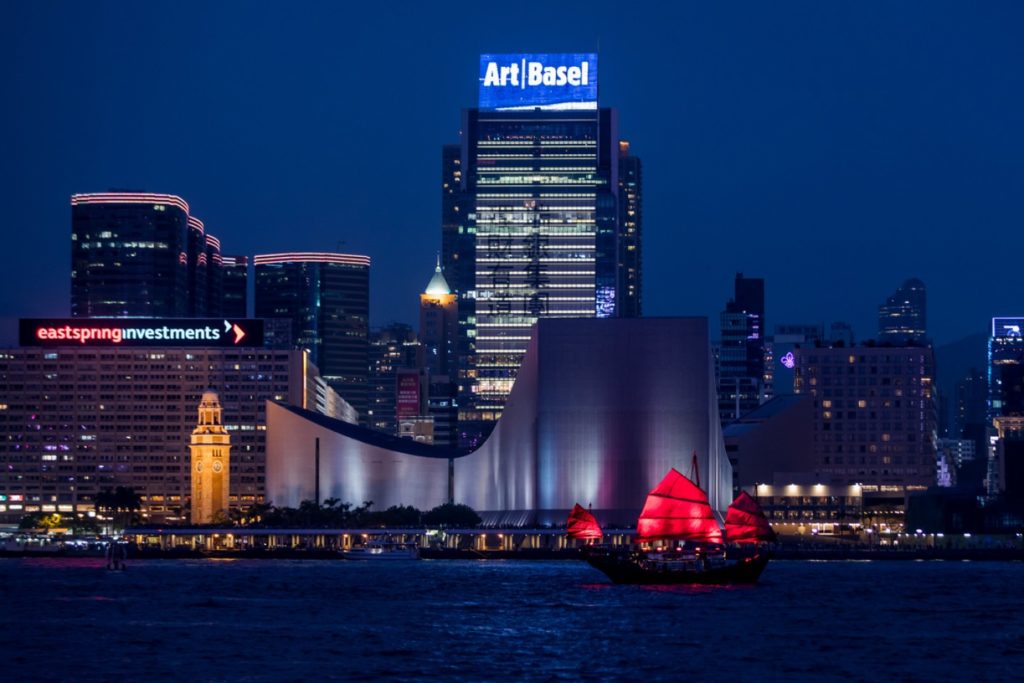
Art Basel Hong Kong. Courtesy Art
Basel.
East Asian collectors haven’t just become more international in
an astonishingly short period of time. They have also become
dramatically more discerning. Only a few years ago, Allan
Schwartzman says, the predilection for “buying names rather than
works” made the region’s buyers vulnerable to “various people in
the market who took advantage [of them] to sell inferior works at
healthy prices.” Those days are gone. According to Wong, “Asians
rely on data,” typically researching not just previous sales prices
but also how those prices landed relative to presale estimates so
that they can make shrewd decisions.
The result? Hong Kong is rapidly approaching price parity with
London and New York, if it is not already there. As evidence, Wong
points to the results for Andy Warhol’s Mao (1973), one of
the marquee lots in Sotheby’s Hong Kong’s Modern and contemporary
evening sale in April 2017, which included Western artworks for the
first time. The fiery red canvas sold for the equivalent of $12.6
million with premium—identical, in terms of US dollars, to the £7.6
million it brought at Sotheby’s London three years earlier and a
gain of £2.4 million if the pound sterling’s drop over that period
is taken into account.
This accelerated learning curve has equipped the art market as a
whole to expand quickly and aggressively throughout East Asia. The
inauguration of Art Basel Hong Kong in 2013 ushered in a new era
for the territory’s relationship to Western galleries. Although
Pace recently announced it would close its Beijing space, the
globe-spanning gallery continues operating in (currently
protest-ridden) Hong Kong, which also plays host to such
heavyweights as Gagosian, David Zwirner, Hauser & Wirth, and Lévy
Gorvy. Other high-tier galleries have set up permanent spaces
elsewhere in the region: Perrotin and Lehmann Maupin in Seoul; Sean
Kelly in Taiwan; Blum & Poe in Tokyo.
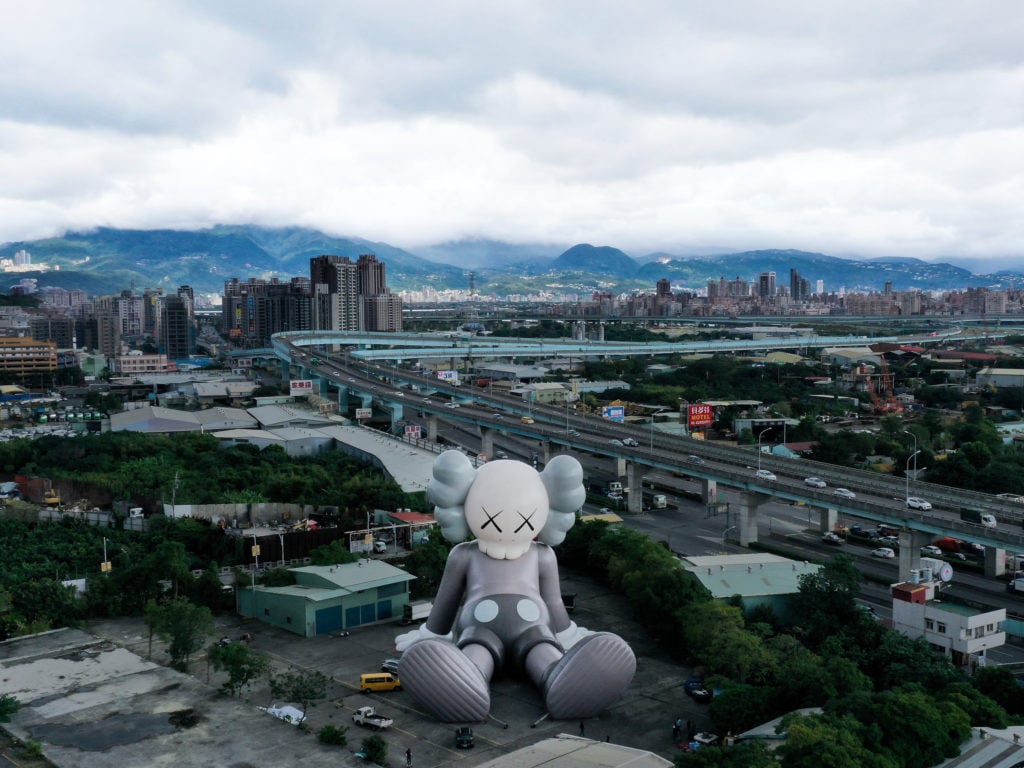
KAWS, Holiday (2019). Photo:
courtesy of AllRightsReserved.
This development has been largely driven by East Asia’s
first-generation inheritors of mega-wealth. A large proportion of
this demographic grew up in families that collected in more
traditional categories, such as regional antiquities or Chinese ink
paintings, and were educated (and culturally embedded) in the West
during some of their formative years.
“It’s quite regular that we have a collector in his late 20s or
early 30s buying seriously at auction—and not just one or two, but
in volume,” says Westphal. “It’s a generation of collectors very
used to absorbing information, very keen on finding out what is
going on and what is going to be the next big thing, and driving
that, as well.”
© Artnet Intelligence, 2019.
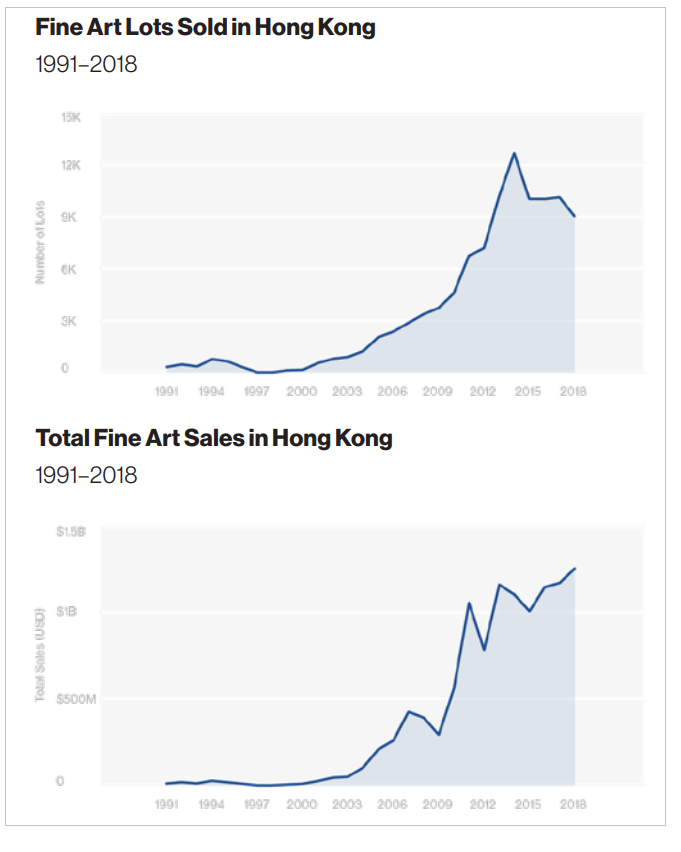
Having two generations of collectors with roots in East Asia has
made a colossal difference for the Hong Kong auction market. In
1991, Hong Kong houses in the Price Database combined to sell 313
fine artworks (by both Asian and non-Asian artists) for $10.9
million. In 2018, a total of 9,017 works changed hands to generate
almost $1.4 billion in sales, a 234-fold increase in 27 years.
Wong says that understanding the data-driven mind-set of East
Asian collectors has allowed Sotheby’s to, in her words, move
beyond “what people expected: the Warhol Mao, [Yoshitoma] Nara,
[Yayoi] Kusama” and begin offering high-quality works by artists
with solid market profiles but no sustained prior presence in Asia.
Last April, for example, Sotheby’s Hong Kong set new world records
for both Ethiopian-born, New York-based painter Julie Mehretu and
New York-based sensation KAWS.
This is why Wong says Asian collectors “no longer just follow
the data but are part of making the data” that charts the global
market’s path—a development many would have considered unthinkable
30 years ago. So the next time you hear a colleague or client gripe
that the art market is doomed to keep repeating the same mistakes,
feel free to remind them that an awful lot tends to change in three
decades.
A version of this story originally appeared in the fall
2019 artnet Intelligence
Report. To download the full report, which has juicy details on
the most bankable artists, a survey of what top collectors are
buying and why, and a deep dive into the market for African
contemporary art, click here.
The post Goodbye Art World, Hello Art Industry: How the Art
Market Has Transformed—Radically—Over the Past 30 Years
appeared first on artnet News.
Read more https://news.artnet.com/market/how-the-art-world-became-the-art-industry-1710228
Further reading


Leave a comment