
Here Are the 8 Absolute Worst Works of Art We Saw in 2019, as Chosen by the Artnet News Staff
WORST ART
ART
OF 2019
Sometimes we come across an artwork so profound, so thrilling,
so completely beautiful that it lingers fondly in the mind for
years to come. Other times, we look at something and think,
“Whoa… that stinks.” Like, big time. Here are some of
those 2019 duds, as chosen by our writers and editors.
Thomas Heatherwick’s
Vessel (2019)
at Hudson Yards
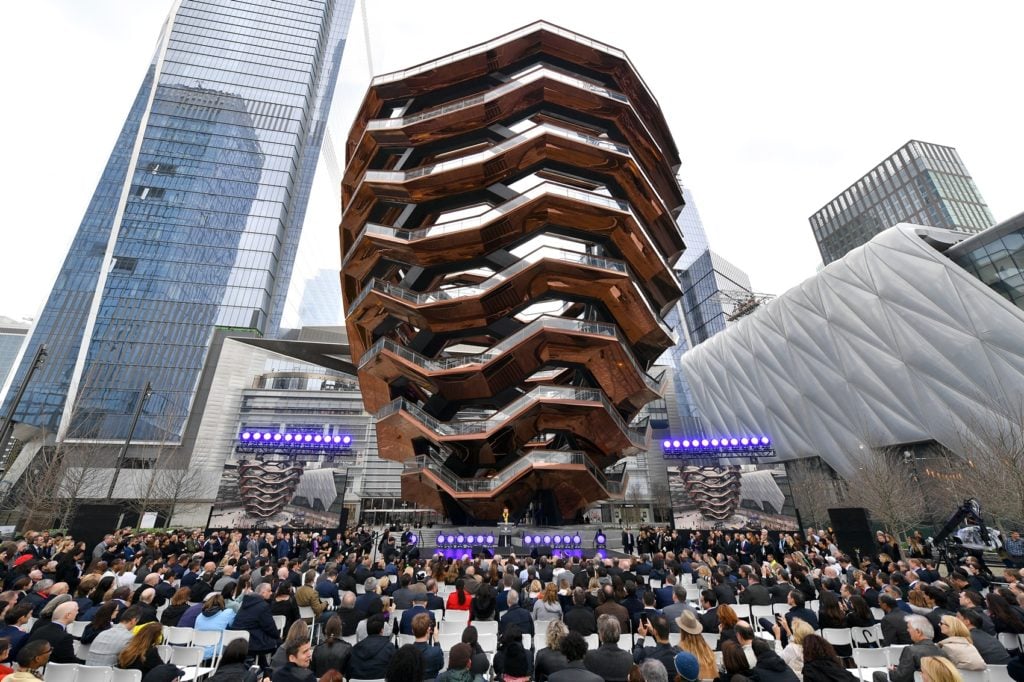
Designer Thomas Heatherwick speaks
onstage at Hudson Yards on March 15, 2019, in New York City. Photo
by Dia Dipasupil/Getty Images for Related.
While this has been stated over
and over all year long, it’s worth typing it out again: Vessel, the
stairway to nowhere at the dystopian fake-Oz of Hudson Yards, is
the most visually repugnant public structure to be inflicted on
Manhattan in its history. Each time I see it I’m gobsmacked anew by
how mindbogglingly stupid the thing is. I fear that several
generations of Thomas Heatherwick’s child-aged progeny, who should
be (mostly) spared blame for this, will be brutally mocked by
future bullies who realize that their schoolmate’s zero-talent hack
of an ancestor gave this great city such an eyesore. As for us here
now, we’ll spend the rest of our lives trying to avoid any sight of
it.
—Nate
Freeman
Pablo Picasso’s Ceramic
Plates
at the Museu Picasso, Barcelona
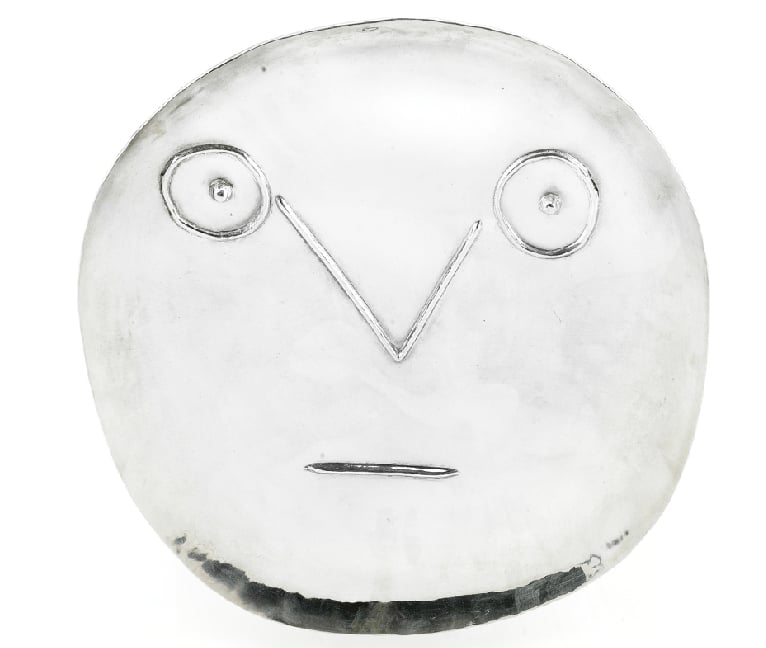
Pablo Picasso, Visage Geometrique aux
Traits (1956). Photo by Flickr user cea +.
Offsetting a number of genuinely
compelling works on view at the Museu Picasso this January was a
gallery centered on a large vitrine full of the artist’s ceramic
plates, each one featuring some variation on… an enormous smiley
face. Sun smileys! Painted smileys! Embossed smileys! All displayed
solemnly under glass inside an ornate Gothic interior alongside a
dedicated security guard as if they were the pinnacle of artistic
achievement.
Reader, I laughed so hard that
all the photos I tried to take at the time were too blurry to use.
To me, the only real value in these pieces is as cautionary tales.
They are vivid reminders that even the most colossal talents can
churn out ridiculous dreck, and it’s on all of us to look past the
creator’s reputation and call it like it is.
—Tim Schneider
Maurizio Cattelan’s
Comedian (2019)
at Perrotin, Art
Basel Miami Beach
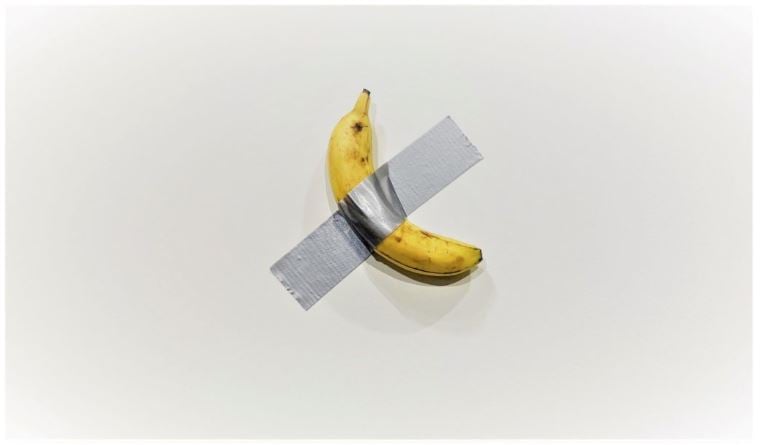
Maurizio Cattelan’s Comedian,
at Art Basel Miami Beach. Photo by Sarah Cascone.
Don’t get me wrong, I am a big fan of Cattelan’s work and can
appreciate art that embodies humor and irony. My issue with the
banana isn’t with what the artist did—he was clearly trying to make
a statement about the art world’s consumerist nature—but with the
collector who gained only a certificate of authenticity and
bragging rights to a pop-cultural meme. $120,000 seems like a high
price to pay for something that you will not be able to look at
with love and pride in your home, or have as an investment piece in
your collection. For the sheer silliness of the situation, I find
this to be the worst artwork of the year.
—Neha Jambhekar
Ai-Da’s entire
oeuvre
at the Barn Gallery, St. John’s College,
University of Oxford
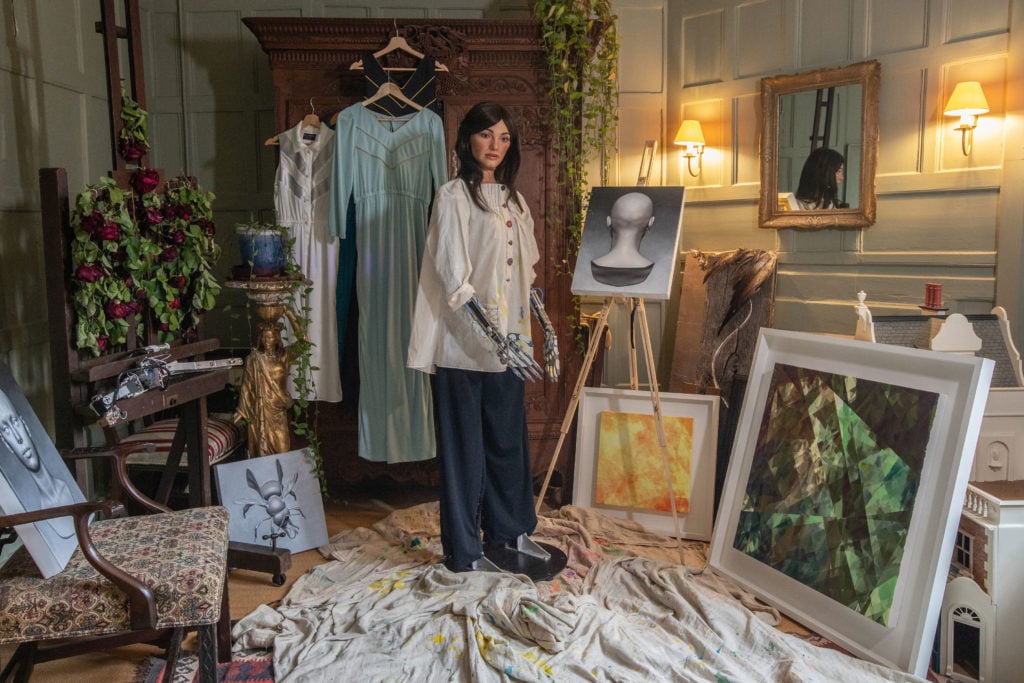
Ai-Da with Her Paintings. Photo by
Victor Frankowski.
I didn’t have to think for too
long about this one. Back in the summer, as part of my adventures
on the art and technology beat, I traveled out to Oxford University
to meet “the world’s first ultra-realistic humanoid Ai artist,”
Ai-Da. Now, I already called this
thing out as a scam, so
perhaps I’m beating the dead horse (twice, I guess, as it was never
alive to begin with), but it annoyed me so much I figured I’d come
back for round two.
In essence, this is a robot that
makes constellation-like line drawings based on images translated
from cameras in its eyes, which is charming enough. The issue I
took with the whole thing was not with the artwork per se, as much
as it was with the whole package that it was sold in. The robot was
gussied up in a paint-smeared smock, and given long dark locks and
a pair of luscious lips in an effort to seduce us into overlooking
the fact that it is not actually the autonomous creator it claims
to be on the tin. The
wheeler-dealer behind the curtain even had the audacity to defend
making this sexy outer-casing because, he reckons, the art world
needs more female voices. Ahem.
And to add insult to
misogynistic injury, he was not just selling the robot’s line
drawings, but also abstract painted interpretations of them done by
an actual human female artist, which were credited to Ai-Da. Enough
said.
—Naomi Rea
Edmund de Waal’s Elective
Affinities (2019)
at The
Frick
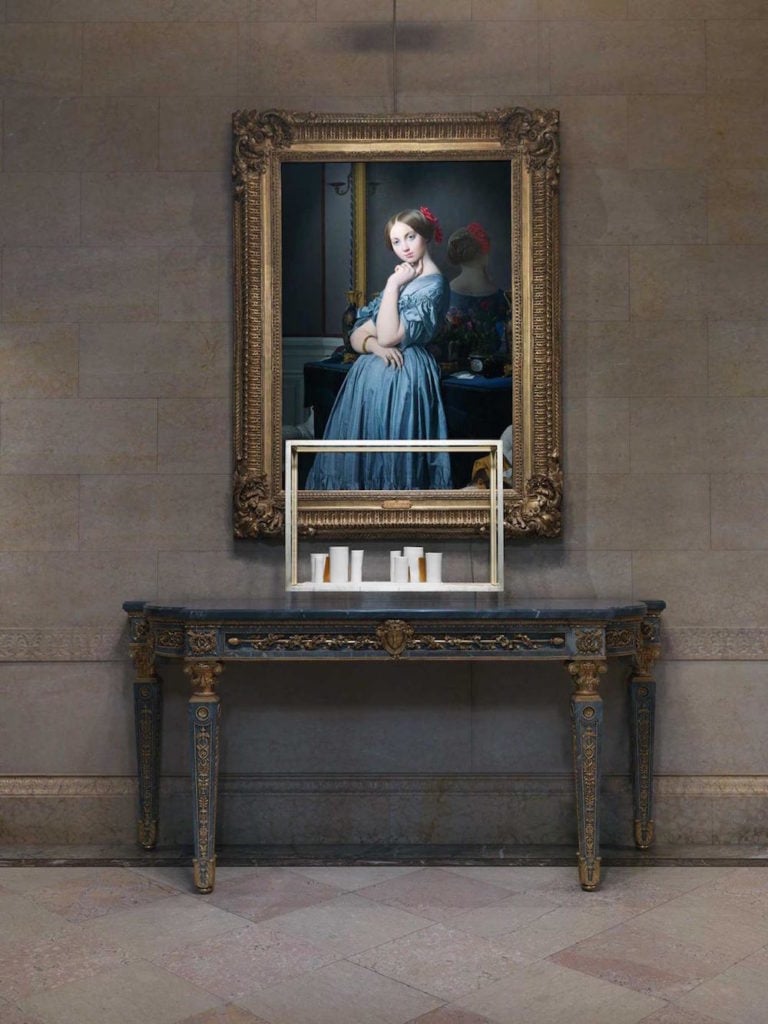
Installation view of Edmund de Waal
“Elective Affinities” at The Frick. Image courtesy of the
Frick.
I admit I didn’t know much about the artist at the time that the
Frick—one of my favorite places to visit in all of New York
City—announced this show. De Waal, a renowned ceramicist, would
present a temporary installation of site-specific sculptural works
made of porcelain, steel, gold, marble, and glass to be displayed
throughout the museum’s main galleries alongside works from the
permanent collection. I was further intrigued when my colleague
raved about de Waal’s bestselling book, The Hare with
Amber Eyes, a memoir in which he delves into his family’s
intriguing history via objects. When I arrived at the Frick and
asked where the installation was, I was given a map that marked
locations of de Waal’s installations throughout the museum.
I guess disappointment played a huge role here: When I did find
the all-too-easy to overlook installations, I first questioned if
they were, in fact, what I was supposed to be looking at, and then
wondered how on earth the ceramic vessels of varying heights and
sizes represented a “response” to the Frick’s collection. When
artwork requires an explanation of the explanation, I tend to tune
out. The visit was not a total loss though, I still enjoyed seeing
the collection, as always, and also the stunning Edouard Manet
paintings on temporary loan from the Norton Simon Museum. And oh
yeah, The Hare With Amber Eyes is still one I’m going to
read when I get the chance.
—Eileen Kinsella
Oscar Murrillo’s
“Collision/Coalition”
at the Shed
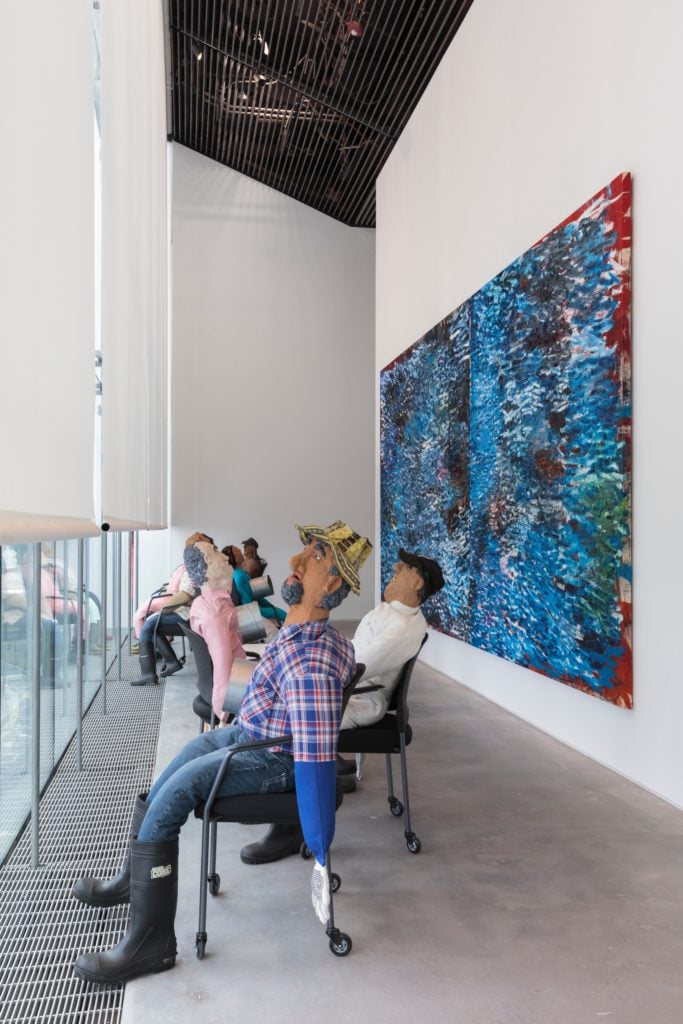
Installation view of “Oscar Murillo:
Collision/Coalition” at the Shed.
My brain must filter out most
everything I’d like to forget in my sleep because I had to do a
deep dive through my cell phone photos to conjure up some
displeasure. In the end, I chose Oscar Murillo’s commission for
“Collision/Coalition” at the
Shed this summer, which paired his works with commissions by Tony
Cokes, along with a video work by Yanina Valdivieso and Vanessa
Bergonzoli. I don’t particularly dislike Murillo’s work, but the
whole exhibition seemed like a missed opportunity, with the
cavernous space eating up the art and a flatlining logic of display
that reminded me of why talented curators are so essential. In all
honesty, I might just have it out for the Shed. In a wider net of
culture, the worst thing I saw all year was also there—the
abominable play Norma Jeane Baker of Troy,
starring Ben Whishaw and Renée
Fleming, which was so ungodly pretentious and incomprehensible that
I’d still like to be reimbursed for it, despite the tickets being
free. Fool me once, shame on the Shed. Fool me twice, it gets added
to this list.
—Katie White
Christoph Büchel’s
Barca Nostra (2019)
at the Venice Biennale

Christoph Büchel’s controvesial Barca
Nostra is towed into place in the Arsenale for the Venice
Biennale. Photo by Luca Zanon Awakening/Getty Images.
Christoph Büchel installed a migrant boat as a part of Ralph
Rugoff’s Venice Biennale. With no signage (apparently, the artist
did not want any context to immediately surround the boat), the
ship became easy prey for hurried visitors to stop and take
pictures. Are they to blame? No one could readily know that
Büchel’s Barca Nostra (Our Boat) was the one that sank in
the Mediterranean in 2015, killing up to 1,100 migrants fleeing
north Africa. It lacked critical context, which did not strengthen
its ability to be “art,” as Büchel implies. Instead, it
instrumentalized suffering. Once word traveled about the boat’s
history, people’s horror, again on social media, was co-opted into
the “meaning” of the project. What violent irony. It’s important to
push boundaries and to productively offend, but this is not that,
this is a grossly irresponsible gesture that was not done with
appropriate intelligence or empathy—and I am saying that to the
curator and the artist.
–Kate Brown
I know it may be a cop out to double up, but Barca
Nostra was so far and away the worst work of art I saw
last year that it seemed unfair to target anything else just
because Kate beat me to it. I use the term “saw” lightly—I passed
it, sure, but the way the boat was positioned on the canal, just
outside a cafe and alongside other boats docked for deliveries, it
was nearly impossible to give it the solemn respect it deserved.
Bringing what is, essentially, a mass grave—the boat where more
than 1,000 migrants died in the Mediterranean in 2015—to the Venice
Biennale is almost impossibly callous, even for an artist
like Christoph Büchel, who lives to provoke. But to do so
without any context, label, or other notation is what made the work
truly irresponsible. Whether the artist intended to or not, he used
the pain and death of migrants to make a point about the art world
and its callousness, without even giving passersby the context
necessary to behave as they should have. I would object to anyone
who says what Büchel made isn’t art, or that he did not have the
right to create it. But I question the wisdom of taking a symbol of
one of the biggest tragedies and injustices of our era and dropping
it into an art exhibition. Everybody involved is poorer for it.
—Julia Halperin
Ai Weiwei’s Sunflower
Seeds (2010)
at the Marciano Art Foundation
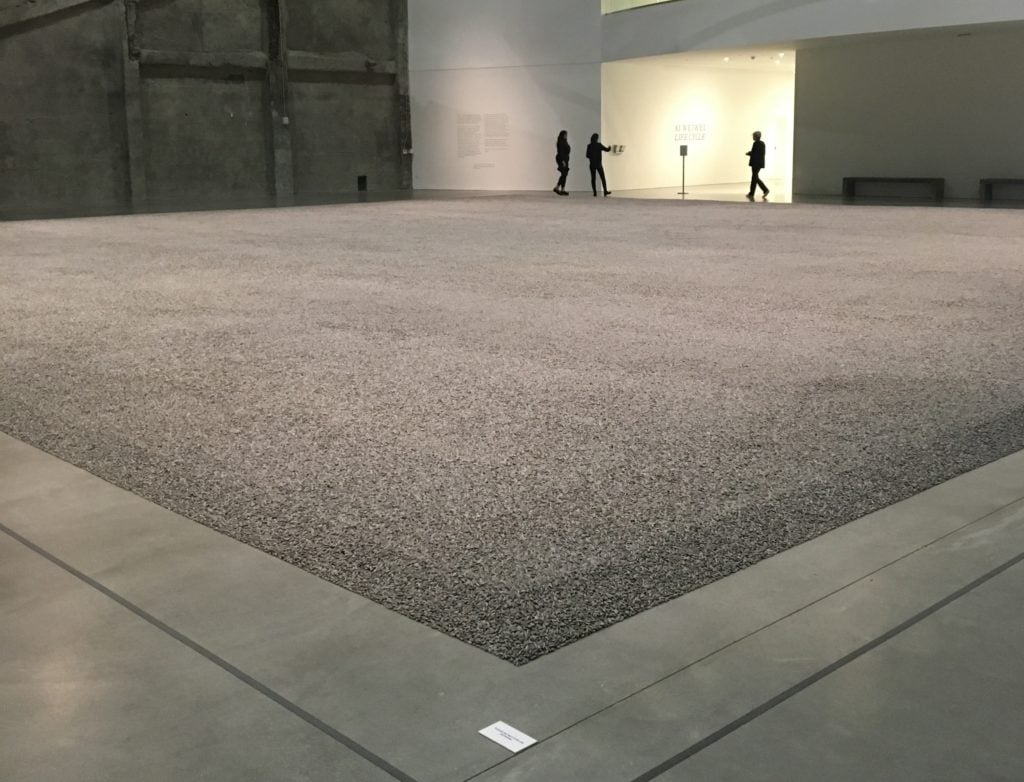
Ai Weiwei, Sunflower Seeds
(2010) installed at the Marciano Art Foundation in 2019. Photo by
Javier Pes.
The politically engaged Chinese artist seemed to have gone
Hollywood at the now shuttered Marciano Art Foundation. Every work
was supersized but the reasons why seemed superficial. When Ai
first installed millions of porcelain sunflower seeds in Tate
Modern’s Turbine Hall in 2010, it felt like an important statement
about the human cost of China’s Communist Party’s embrace of
capitalism. But then small but expensive heaps of seeds cropped up
at fairs. It took the seeds a long way from the 1,600 mainly female
workers who toiled for two years to make them by hand in China. The
large-scale iteration of Sunflower Seeds in the now
defunct Marciano Art Foundation’s most cavernous space further
devalued the spectacle. Now we know more about the Marciano
brothers’ dubious record as museum employers, Ai’s overblown show
seems a missed opportunity. Never apologize, as the artist is fond
of saying, but a show of solidarity with the institution’s low-paid
workers would have been truly impressive.
—Javier Pes
The post Here Are the 8 Absolute Worst Works of Art We Saw
in 2019, as Chosen by the Artnet News Staff appeared first on
artnet News.
Read more https://news.artnet.com/art-world/the-8-worst-works-of-art-we-saw-2019-1710969
Further reading


Leave a comment