
How One Artist Helped Invent a Paint That Can Be Used to Detect Cancer, Diabetes, and High Blood Pressure
Not every artist can say that his or her work is helping in the
fight against cancer. But over the past several
years, Joseph Cohen has done
just that, working to develop a new, high-tech paint that can be
used not only on canvas, but also to detect cancers
and medical conditions such as hypertension and diabetes.
Sloan Kettering Institute scientist Daniel Heller first
suggested that Cohen come work at his lab after seeing the artist’s
work, which is often made with pigments that incorporate diamond
dust and gold, at the DeBuck Gallery in New York.
“We initially thought that in working with an artist, we would
make art to shed a little light on our science for the public,”
Heller told the Memorial Sloan Kettering
blog. “But the collaboration actually taught us something that
could help us shine a light on cancer.”
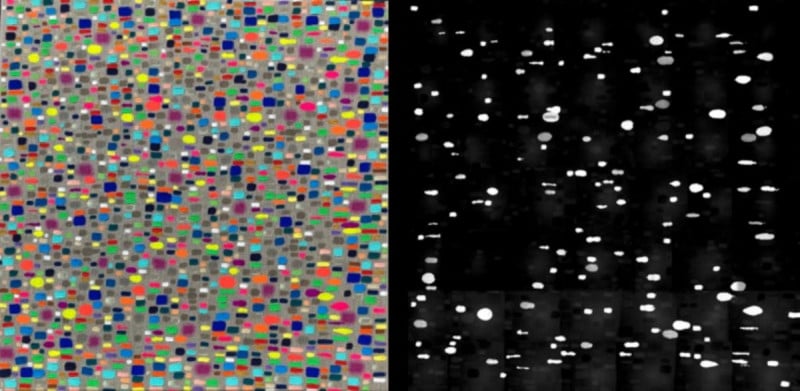
One of Joseph Cohen’s paintings
incorporating carbon nanotubes photographed in normal light with a
standard camera (left) and under yellow light with a near-infrared
camera (right). Photo courtesy of Joseph Cohen.
For Cohen, the project was initially intended to develop a new
way of art-making. In Heller’s lab, he worked with carbon
nanotubes, which Heller was already employing in cancer research,
for their optical properties. “They fluoresce in the infrared
spectrum,” Cohen says. “That gives artists the opportunity to
create paintings in a new spectrum, with a whole new palette of
colors.”
Because human eyesight is limited, we can’t actually see
infrared fluorescence. But using a special short-wave infrared
camera, Cohen is able to document otherwise invisible effects,
revealing the carbon nanotube paint’s hidden colors.
“What you’re perceiving as a static painting is actually in
motion,” Cohen says. “I’m creating paintings that exist outside of
the visible experience.”
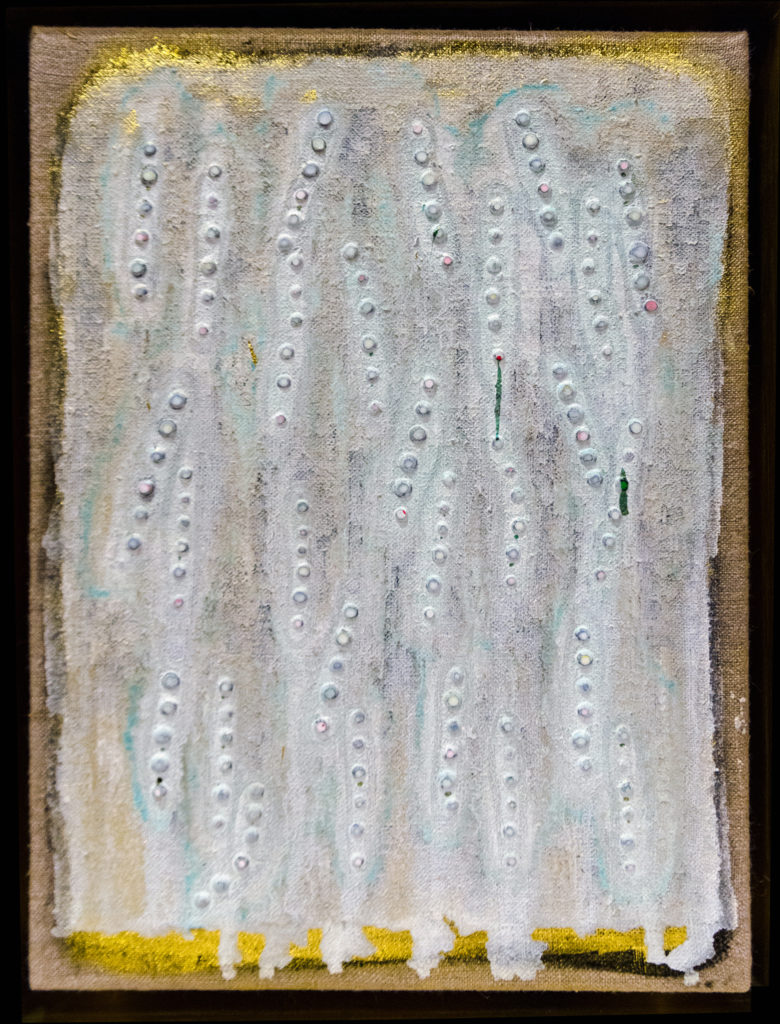
One of Joseph Cohen’s painting
incorporating carbon nanotubes photographed in normal light. Photo
courtesy of Joseph Cohen.
Art Supplies—and a Diagnostic Tool
That same imaging technique can be used by doctors looking
for microalbuminuria, a condition that causes the kidneys to
leak trace amounts of albumin into urine, which is an early sign
of of several cancers, diabetes, and high blood pressure.
Cohen helped co-author a paper published this month
in Nature
Communications about using the nanosensor paint in
litmus paper tests with patient urine samples. The study found that
the paint, when viewed through infrared light, was able to reveal
the presence of albumin based on changes in the paint’s
fluorescence after being exposed to the urine sample.
“It’s easy to detect albumen with a dipstick if
there’s a lot of levels in the urine, but that would be like
looking at stage four cancer,” Cohen says. “This is early
detection.”
What’s more, a nanosensor paint can be easily used around the
world, even in poor areas that don’t have access to the best
diagnostic technologies. Doctors may even be able to view the urine
samples using an infrared imaging attachments on their
smartphones.
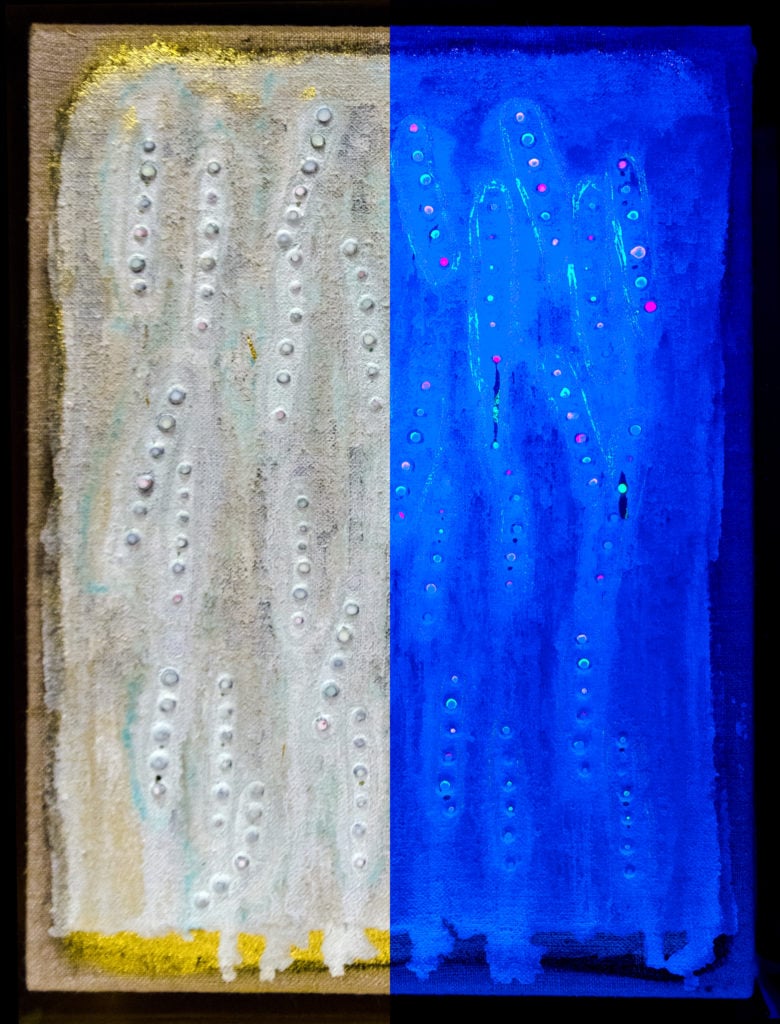
One of Joseph Cohen’s painting
incorporating carbon nanotubes shown in both the visible light
(left) and in UV fluorescence (right). Photo courtesy of Joseph
Cohen.
Paint on Canvas
But developing a carbon nanotube paint that adheres to canvas
and to other materials was no easy task. It took Cohen three years
of trial and error to discover the right of materials to mix with
the nanotubes.
“Imagine having a clump of lapis lazuli,” Cohen says. “It needs
to be broken up and made into a paint.” From there, the materials
need to be further refined by separating the liquids in a
centrifuge, which Cohen compares to mining for gold. “You’re
continuing to break up the material and sift out what you
want.”
The final step is adding a binder, like linseed oil in oil
paint. The resulting paint has incredible potential. Unlike
oil paint, carbon nanotubes will not degrade over time.
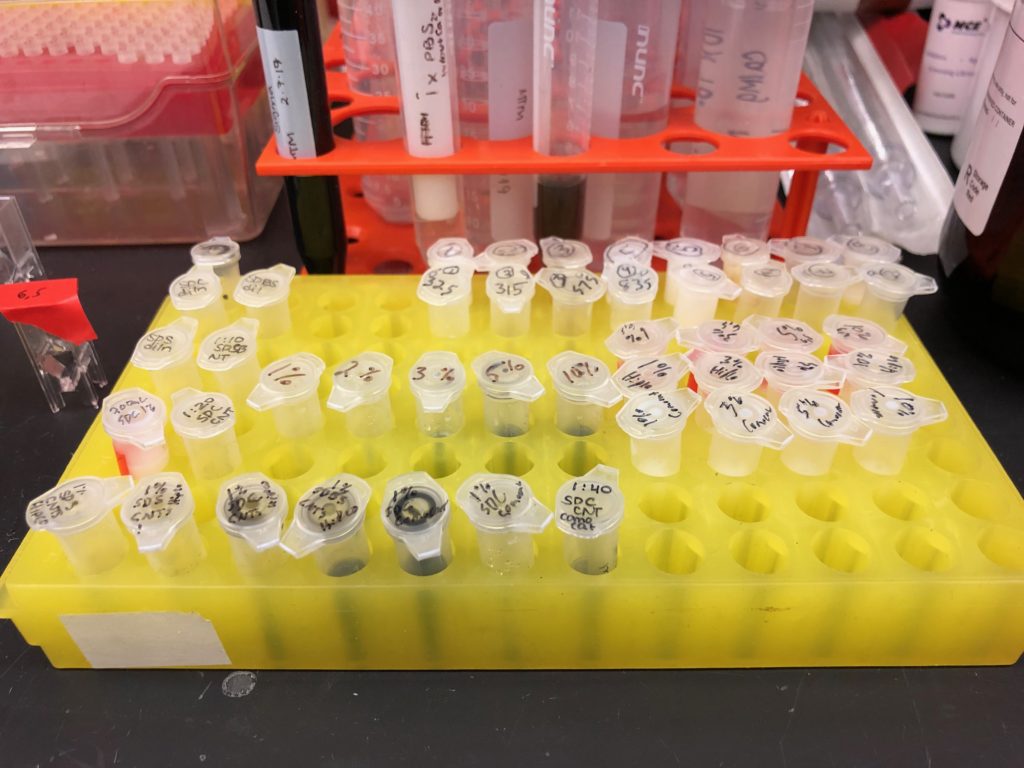
Part of the process of making carbon
nanotube paint. Photo courtesy of Joseph Cohen.
“They are structurally sound, which is much different than any
other artist material,” Cohen says. Further, carbon nanotube paint
adds another layer for conservators to test a painting’s
authenticity.
The paint has other potential applications: it could be used,
for example, in the construction of buildings or bridges in
earthquake-prone parts of the world. Were one to hit, a strain in
the paint could indicate problems with structural integrity.
The next hurdle, however, is bringing down the cost of
production.
“A 1.5 milliliter thing of the paint probably [costs] $100,”
Cohen says. “My paintings run from $10,000 to 20,000—which is
pretty cheap when you look at the material cost!”
The post How One Artist Helped Invent a Paint That Can Be
Used to Detect Cancer, Diabetes, and High Blood Pressure
appeared first on artnet News.
Read more https://news.artnet.com/art-world/carbon-nanotube-cancer-paint-1638340
Further reading


Leave a comment