
How Scholars and Curators Helped Create an International Art Market for Pioneering American Modernist Marden Hartley
Two stunning paintings by the American Modernist Marsden Hartley
were the first things curator Mathias Ussing Seeberg
encountered when he visited “America Is Hard to See,” the Whitney
Museum of American Art’s inaugural permanent collection show at its
new location in 2015.
Seeberg, a curator at the Louisiana Museum of Modern Art outside
Copenhagen, described the show as a “complete revelation” about
American art. But it was Hartley’s vibrant colors and bold
brushstrokes in the two 1914 paintings—Forms Abstracted
and Painting, Number 5—that stayed with him.
“My first feeling, aside from that they were brilliant, was kind
of embarrassment that I didn’t know this artist,” Seeberg told
artnet News in a phone interview. “I felt this gap in my knowledge
of American art needed filling.”
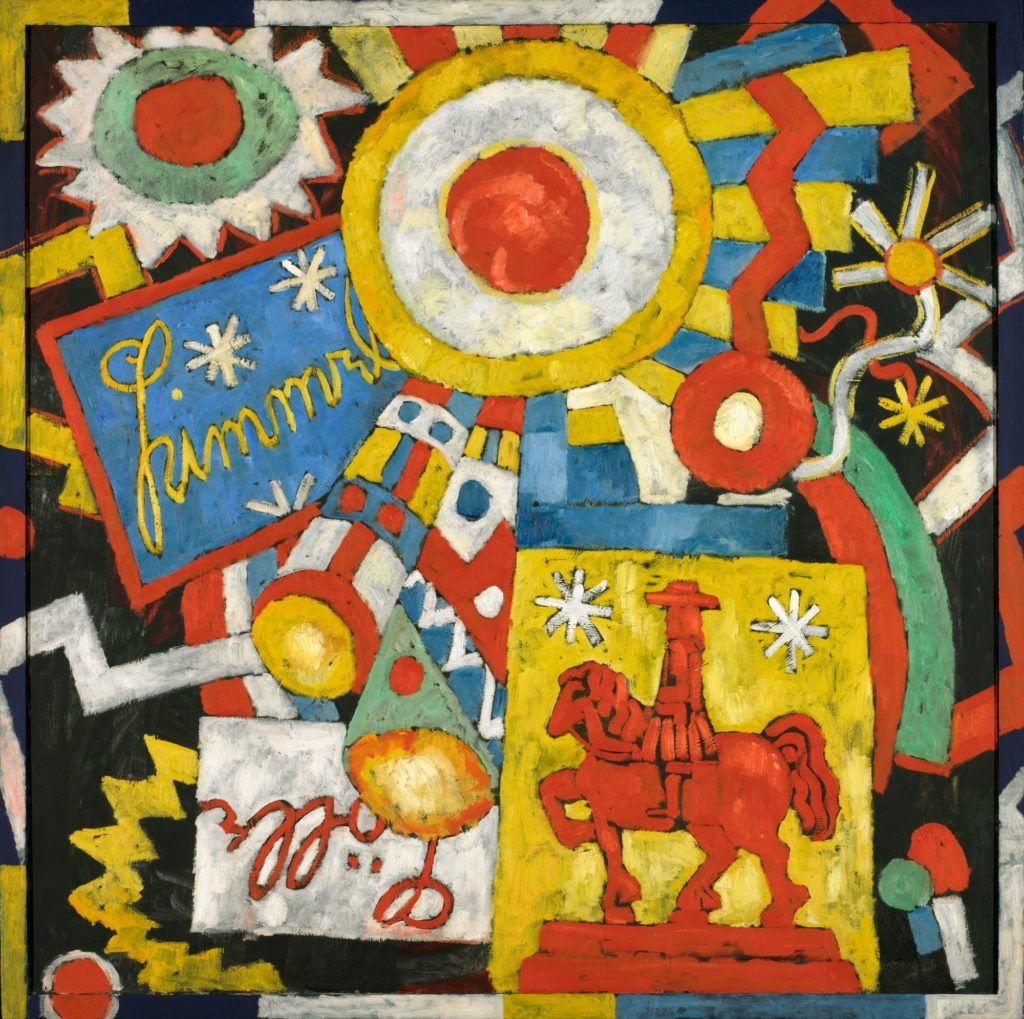
Marsden Hartley, Himmel
(1914–15). Photo: Jamison Miller. Courtesy the Louisiana Museum,
Denmark.
“I saw in Hartley’s work—especially in the later work—the seeds
of what later became Abstract Expressionism,” Seeberg said. “It
showed me there is definitely a lineage where you can look at
Hartley and see Guston and Rothko and Pollock.”
That initial lightening bolt—further solidified after the
curator saw more works by Hartley at the Brooklyn Museum and
the Metropolitan Museum of Art—was the impetus for “Marsden
Hartley: The Earth Is All I Know of Wonder,” a major retrospective
organized by Seeberg that just opened at the Louisiana Museum last
week (September 19), and which runs through January 19, 2020.
In all, there are 140 works on view, roughly 113 of which are
paintings (the rest are mostly pastels). It is the first major show
of the artist’s work in Europe in nearly six decades, and
illustrates also his major influence on contemporary art.
Included in the show are videos and essays by artists such
as Karin Mamma Andersson, David Hockney, Alex Katz, David
Salle, Dana Schutz, Tal R., and Shara Hughes, each of whom draws
something from Hartley.
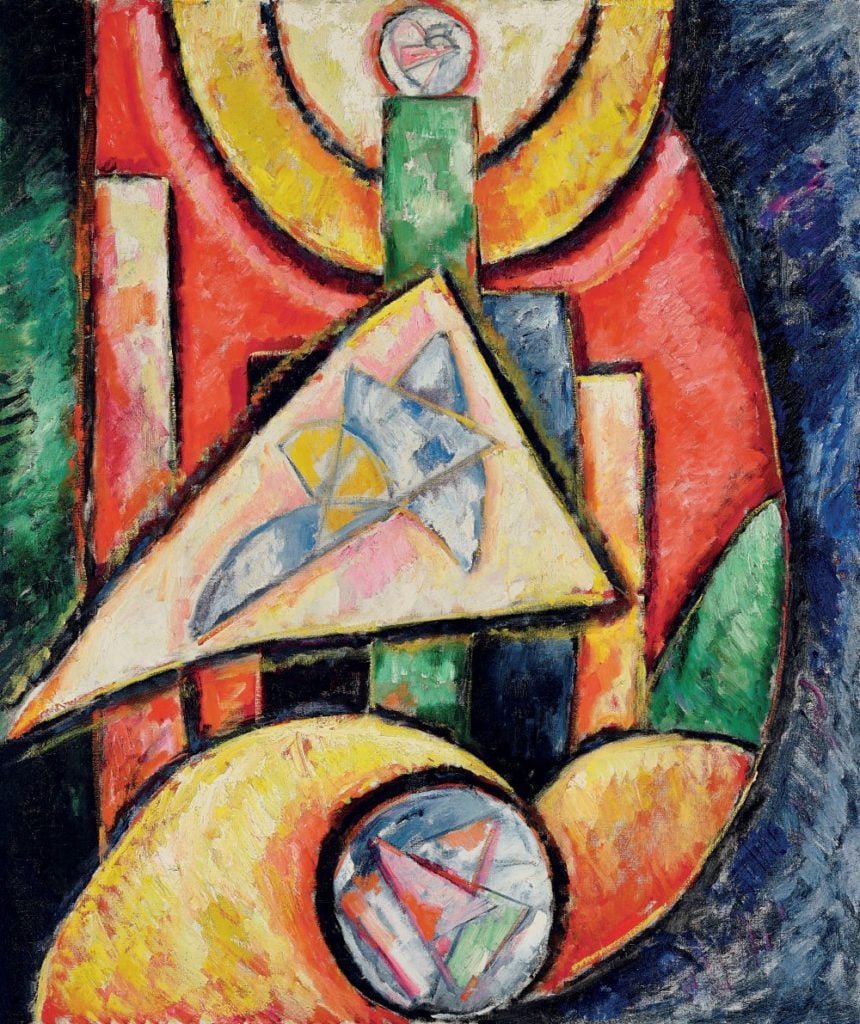
Marsden Hartley, Abstraction
(1912–13). Image courtesy Christie’s.
A Pioneering Modernist
Hartley was born in Lewiston, Maine, in 1877, to parents who
immigrated from England. After studying art in Cleveland in his
teenage years, he moved to New York City in 1899 and attended
painter William Merritt Chase’s art school before transferring to
the National Academy of Design.
He met photographer and dealer Alfred Steiglitz in
1909, and following a solo show at Steiglitz’s New York
gallery, traveled to Europe with the photographer’s support. While
living in Berlin in 1913, he was associated with (and showed works
alongside) Expressionist artists such as Wassily Kandinsky and
Franz Marc. When he returned to the United States in 1915, he began
moving away from abstraction towards expressive landscapes, still
lifes, and unconventional portraits.
“Hartley has always been at the forefront of collectors’
interests in American Modernism, particularly the Stieglitz Group,
which included Georgia O’Keeffe, John Marin, and Charles
Demuth,” says New York dealer and American art specialist
Hollis Taggart.
Hartley’s early introduction in Paris, through American
writer Gertrude Stein, to Picasso, Matisse, and Cezanne,
afforded him a certain cachet in America, which has endured until
today, Taggart says.
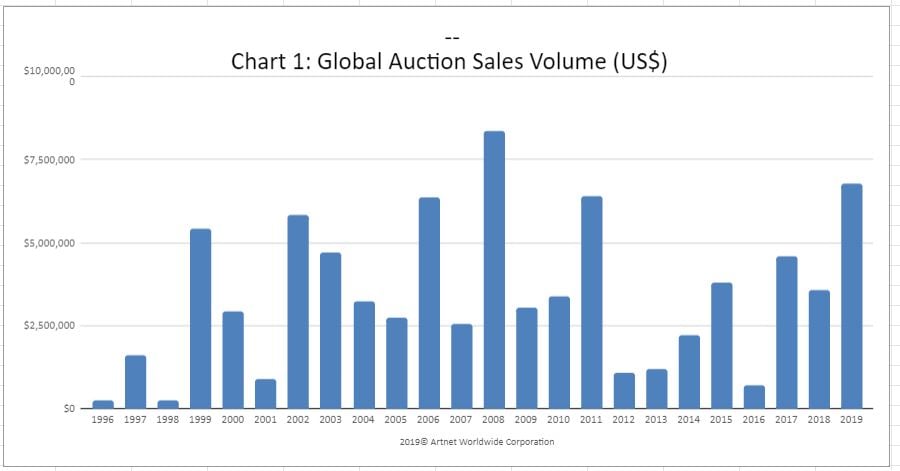
Global auction sales for Marsden Hartley
from 1996—2019. Source: artnet Analytics
In the American art market, Hartley has never been ignored or
entirely undervalued, and his star has been especially on the rise
as of late. This past May, a decade-old auction record was
broken at Christie’s New York when Abstraction, a work
from 1912–13, sold for $6.7 million.
(The previous record, also set at Christie’s New York, of $6.3
million, was paid for Lighthouse from 1915, in May
2008.)
Among the best-known Hartley works are his Berlin paintings.
First shown in the US at the 1913 Armory Show, they continue to be
prized by institutions and private collectors alike, with private
sales bringing in even higher prices than the $6.7 million
record.
These bold, decorative works “contain Hartley’s unique
iconography and reflect the way he was influenced by the pageantry
of the German army officers and parades,” Taggart says.
“These Berlin paintings are personal, which I think add to the
mystique and interest,” Taggart says, noting that Hartley encoded
homo-erotic elements into the works. (While in Germany, Hartley
fell in love with a German officer named Karl Freyberg, who
was killed in the First World War.)
“A subtle homo-erotic undertone comes through in these works,
and later, far more obviously, in Hartley’s Maine pictures in the
1930’s and 40’s,” Taggart says.
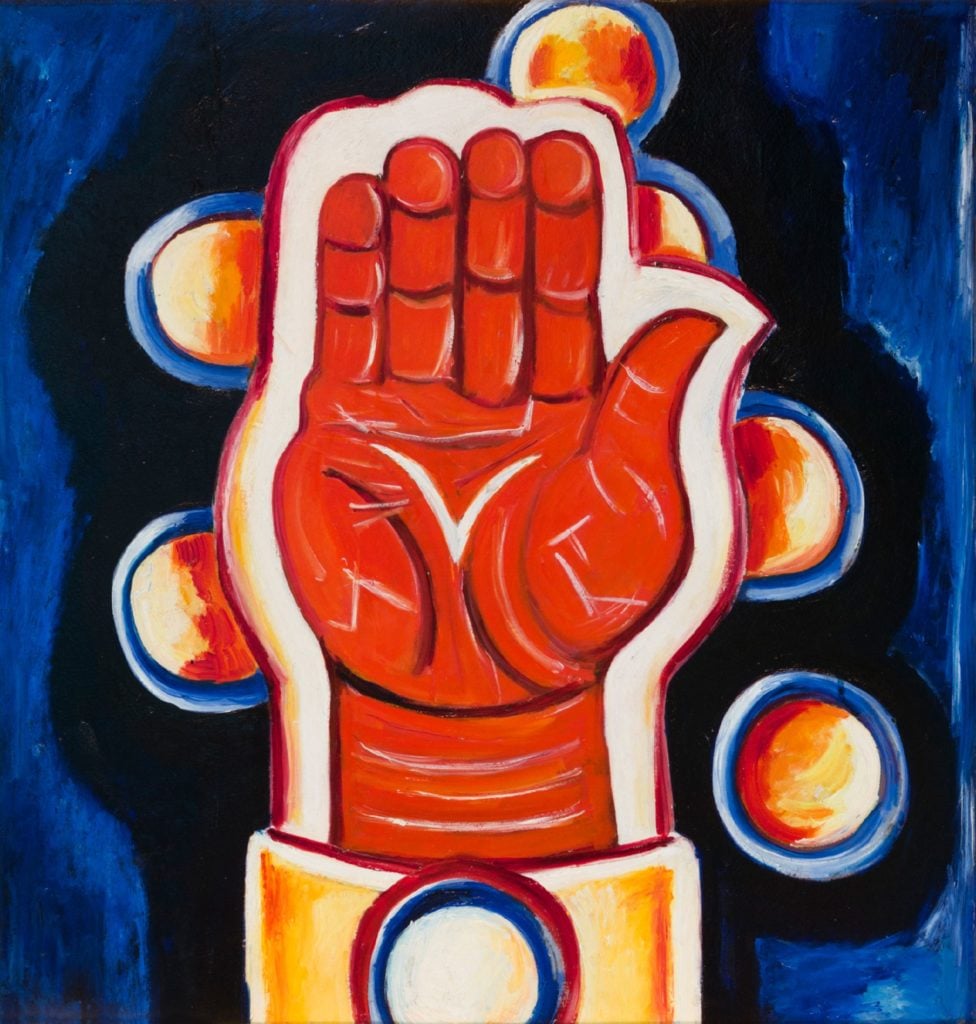
Marsden Hartley, Morgenrot
(1932). Courtesy of the Louisiana Museum of Modern Art,
Denmark.
A Scholarly Turn
But the market has broadened since historians have begun to
focus on other periods of the artist’s work.
Eric Widing, deputy chairman at Christie’s and an American art
specialist, joined the auction house at a time when American
Modernism was first getting a closer look from scholars. At the
time, O’Keeffe’s exuberant, blooming flowers tended to dominate the
scene.
“Hartley didn’t catch on as early because he changed his style
often,” Widing says, adding that his subject matter was not as
immediately appealing to viewers.
Widing believes the turning point was a 2003 show at the
Wadworth Atheneum in Hartford, Connecticut, spearheaded by
Elizabeth Kornhauser (now a curator at the Met), titled “Marsden
Hartley: American Modernist.”
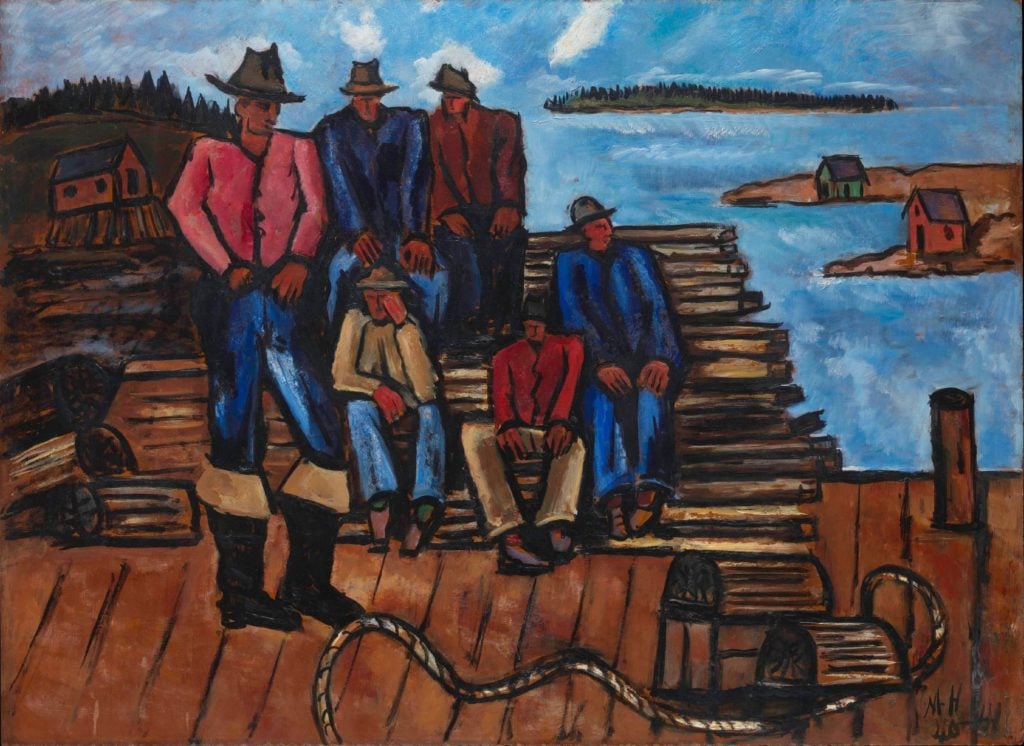
Marsden Hartley, Lobster
Fishermen (1940–41). Photo: The Metropolitan Museum of Art/Art
Resource/Scala, Florence Courtesy of the Louisiana Museum of Modern
Art.
Kornhauser “treated his whole career as worthwhile and basically
revived the interest in the later work, which has a coarser, darker
palette and is considered tougher by collectors and scholars
alike,” Widing says. “She deserves a lot of credit for transforming
people’s understanding of the work.”
Widing says Kornhauser was not immediately certain of her
success; when she was preparing for the show, he says, she confided
in him that she was concerned no one would come see it.
Both of them were surprised when a packed crowd filled
out Christie’s Rockefeller Center headquarters for a lecture
on the artist ahead of the exhibition. At the time, there was a
dearth of information on the artist, Widing says, and collectors
traveled from cities such as Minneapolis and St. Louis for the
event.
And since then, interest has only broadened.
“For years, the market for American Modernism was largely
domestic,” Liz Sterling, chairman of Sotheby’s fine arts division
told artnet News. But there is a shift towards overseas as of late,
she noted.
“I think we’re at a moment when there is great curiosity that
goes beyond niche categories.”
The post How Scholars and Curators Helped Create an
International Art Market for Pioneering American Modernist Marden
Hartley appeared first on artnet News.
Read more https://news.artnet.com/market/marsden-hartley-art-market-1662718
Further reading


Leave a comment