
‘Important and Timely’ or ‘the Ugliest Painting Ever Made’? How the Art World Is Parsing Nate Lowman’s New Show at David Zwirner London
On October 1, 2017, I took a flight from Kennedy airport to
Heathrow to attend Frieze London, slept intermittently on the
flight, and when I landed the next morning, I reached for my iPhone
to swipe off airplane mode. Collectively, alongside my jet-lagged
travelers, news alerts streamed in that, a few hours earlier, a
gunman had used 14 semi-automatic rifles equipped with bump stocks
and eight AR-10 battle rifles to murder 58 people at a music
festival in Las Vegas. He sprayed bullets into the crowd from a
perch in a suite at the Mandalay Bay Hotel. It was the deadliest
mass shooting in American history.
Two years later, I took the same
flight and, a few years after landing yesterday, I went to David
Zwirner’s London gallery to be among the first to see new paintings
by Nate Lowman—work that grapples with that very massacre in a show
that opens the two-year anniversary. It’s also Lowman’s first show
with the global mega-gallery, having joined its prestigious roster
earlier this year. When I arrived, Lowman was standing in the
center of the gallery, hands brushing back his thick
gray-gone-white shock of hair, as he led Zwirner himself and a
handful of top gallery directors through the show.
The stakes could not be higher
for Lowman. Long a market-friendly artist who has been embraced by
the fair-going demimonde but not by brow-furrowing critics, Lowman
is entering into his mid-career phase with a hell of a high-profile
opening slot. The October show at Zwirner’s London space—in an
exquisite townhouse on tony Dover Street in Mayfair—is a coveted
one for its coincidence with Frieze. Last year at this time Zwirner
held the first gallery show of new work by Kerry James Marshall in
four years, and the first since he became the world’s most
expensive black artist.
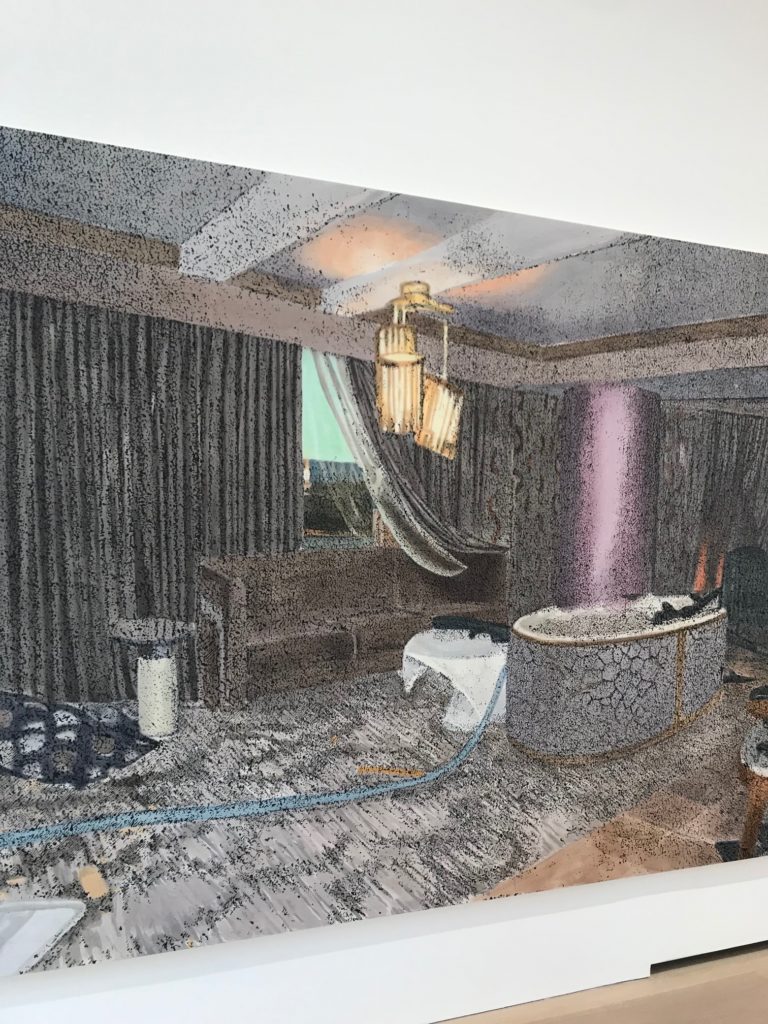
One of Nate Lowman’s paintings in the
show.
The show is titled “October 1,
2017,” a reference to the date of the mass shooting in Las Vegas.
There are 16 paintings, all rendering crime-scene photos of the
shooter’s hotel room in the Mandalay Bay. They are each named
according to the police investigators’ own titles for the
images—Picture 23 (2019), Picture 11 (2019), etc.
The paintings are, like some past Lowman work, pointillist by
technique, so the set pieces for bloodshed appear fragmented when
seen face-to-face, the dots and black marks made by applying a mix
of oil- and alkyd-based paints to linen.
When you step back far enough,
they show large guns strewn on the beds and floors, overturned
tables, ammo, as well as the generic hotel-suite artwork on the
wall. The killer and
his act are never shown, but the menace is overwhelming.
“If you read true crime books
and reports you know that everything is in the details,” Lowman
said. “And of course, in this situation, the details are so chaotic
and violent they’re almost impossible to approach.”
In several of the works the
details appear innocuous at first, then chill to the bone. A blue
L-bracket on a door turns out to be a handmade hurdle added by the
killer to keep anyone from entering the suite once he opened fire.
On a piece of pink index paper he’d written some numbers that, when
inspected, are the distance in yards that bullets travel and the
angles at which the gun needs to be pointed in order to hit the
most bodies. In the end, 851 people were injured in the
attack.
Lowman walked over to a painting
that depicted a more mysterious item, a hose that had at its end
the mouthpiece of a snorkel. “If you’re shooting so many bullets, it creates
an enormous amount of gun smoke, and that hose leads to the source
of not-smoky air, so he could breathe while he was doing this,”
Lowman said.
One painting appears, at a
distance, to be an abstract white-on-blue Color Field work. In
fact, it’s an oil tanker that was sprayed by gun residue due to the
shooting.
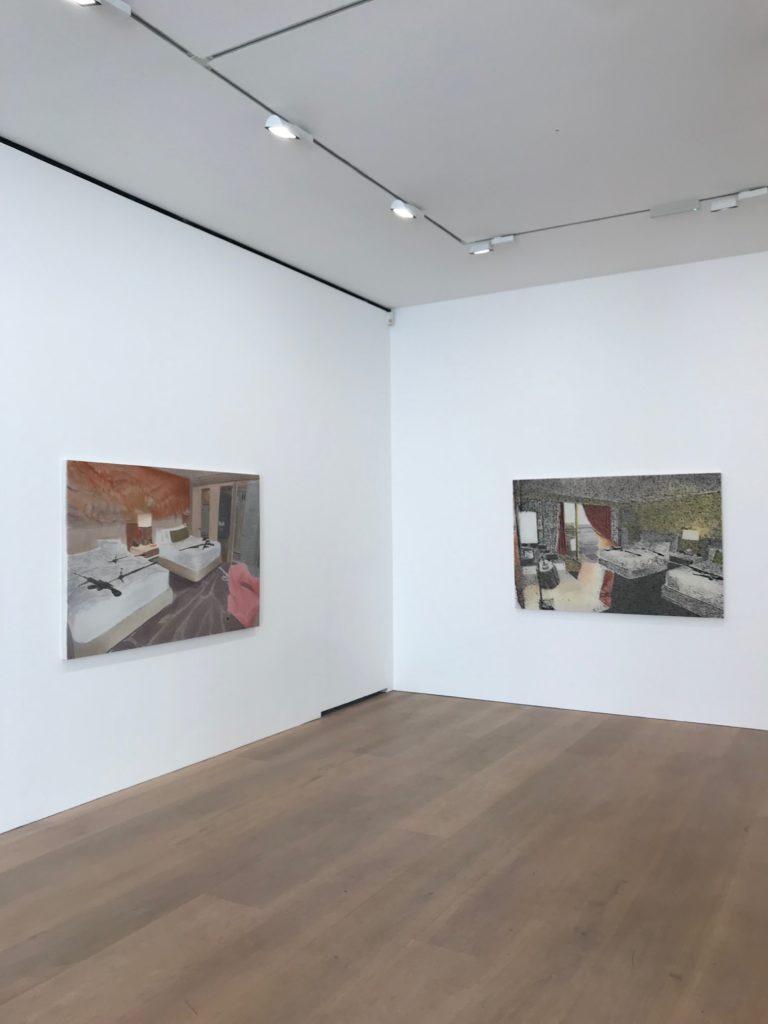
An installation view of “October 1,
2017.”
“This is a fuel tank and this is
at the McCarran airport,” said Lowman, who is from Las Vegas. “If
you land in Las Vegas at McCarran airport—which is where you land
if you fly to Las Vegas—depending on which side you’re sitting on,
when you’re looking out what you see is the Mandalay Bay directly,
and there’s this low expanse in between, and part of that
in-between-space is where the music festival is
happening.”
Growing up in Sin City was
pivotal establishing Lowman’s vocabulary, as it infused into his
system a healthy dose of the dark runoff of the American dream—sex
bought and sold, fortunes lost on the card tables, singers slumming
it in casino residencies, buildings built and destroyed in the
desert, gangsters killed for money. More than anything, his oeuvre
reflects the country’s insatiable taste for violence, sex, and
celebrity.
Lowman’s handle on such subjects
propelled him to fame in his late 20s alongside his fellow enfant
terribles, Dan Colen, Ryan McGinley, and Dash Snow, and while his
work is collected deeply by heavyweight museum-builders such as
Steven A. Cohen and the Marciano brothers (as well as, um, Ivanka
Trump) he has yet to be an artist that is taken seriously by the
cognoscenti. He’s been profiled by the New York Times
Styles section, but not the New York Times Arts section. A
2013 review in the
New York Observer said of Lowman’s show at the
private museum owned by the billionaire paper magnate Peter Brant,
“Much bland, derivative art
has been buoyed by the surging market in recent years, but little
of it is as painfully lazy as Mr. Lowman’s.”
And since 2015, his auction
prices have receded and then plateaued. After a one-off exhibition
with Gagosian in 2018, he instead signed with arch-rival Zwirner,
perhaps intent that he could sell at mega-gallery price points but
be taken seriously as a mid-career artist. David Zwirner said in a
statement that Lowman was “an artist whose career I have been
following with interest for many years.”
“His critical engagement with
contemporary culture as much as with art history is evident in his
strikingly relevant works,” Zwirner said.
In London, the prices for work
in the show ranges between $180,000 and $350,000, depending on the
size of the work. This is roughly the same price points as the show
at Gagosian, where Lowman showed his giant drop-cloth
“Maps”—according to several advisors who asked not to be named—but
well below his top lot at auction. That was achieved in 2014, when
one of his “Marilyn” works—interpretations of Willem de Kooning’s
Marilyn Monroe (1954), which proved to be trophy items for
big-game hunter collectors—sold at Phillips in London for $871,100.
But four years later, in November 2018, another “Marilyn” that was
slightly smaller than the 2014 record-breaker sold for just
$200,000.
Directors at Zwirner did not
immediately respond to questions about sales of the works at the
gallery.
The show doesn’t technically
open until Wednesday, but there’s been much chatter about whether
or not the paintings have been selling. One advisor said that while
he enjoyed it, he wasn’t able to place the works with any clients.
Another found it cynical and exploitative; another said it was the
best show in London. The anonymous Instagram account
@whatanartshole said Picture 19 “may be the ugliest
painting ever made by anyone” and described the show as
“ever-perfect murder-porn for the super rich to help them feel
‘woke.’” Art advisor Meredith Darrow said that she didn’t feel any
connection to the images when she looked at the PDF, but was
convinced of their greatness when she saw them in person. One of
her biggest clients, the Miami-based collectors Rosa and Carlos de
la Cruz, purchased one painting.
“We have an extensive collection of Nate Lowman’s works dating
back to his early pieces,” the de la Cruzes said jointly in a text.
“We feel that it is a strong addition to our collection. This is an
important and timely body of work that continues to critically
engage issues of American culture.”
When I returned to the gallery
the next day, it was crawling with local and out-of-town collectors
despite being technically closed, and they walked slowly through
the show, poring over the renderings of images of the haunted room
muttering “Oh my God” to themselves as they took in the violence.
David Zwirner himself was there to greet each one as they came down
the stairs.
The paintings did look more
arresting in person than I remembered—thematically horrifying, but
possessing an almost lurid amount of beauty.
As for their legacy, it’s hard
to say. During his talk to gallery visitors, Lowman admitted that,
regardless of how much the show succeeds in highlighting gun
violence in America it will not help solve the crime. Two years
later, investigators have yet to find a motive as to why the
shooter, who killed himself after the slaughter, felt the need to
commit such an act.
“We’re at a loss,” Lowman
said.
The post ‘Important and Timely’ or ‘the Ugliest Painting
Ever Made’? How the Art World Is Parsing Nate Lowman’s New Show at
David Zwirner London appeared first on artnet News.
Read more https://news.artnet.com/exhibitions/nate-lowman-david-zwirner-london-1666705
Further reading


Leave a comment