
‘It Was Like Relationship Bootcamp’: Artists Julie Curtiss and Clinton King on Going Broke to Chase Love, and the Struggles Before Success
How do two young artists, struggling to carve out a place in the
increasingly competitive art world, make love last? For
painters Julie Curtiss and Clinton King, their 15-year relationship is
built on the bedrock of their shared creative drive and passion for
art.
Curtiss, 37, born in France, is a newly minted art star, her
market exploding overnight in 2019 when a trio of her figurative
canvases—which recall the work of the Chicago Imagists—sold for a combined $1.1 million over the
course of just 24 hours at Phillips New York.
King, 43, an abstract painter who hails from Ohio, may not be
far behind her. Curtiss’s first breakthrough came three years ago
with a booth at New York’s SPRING/BREAK Art Show. At this year’s
edition of the fair, opening next week, Brigitte
Mulholland—who represents Curtiss at Anton Kern Gallery in New
York—is curating a solo booth featuring King. Curtiss will also be
there, as a curator with a booth featuring her friend Margaux Valengin.
Ahead of the busy install at the DIY fair, Artnet News sat down
with the two for our “Portraits of Love” series. In their
art-filled Brooklyn apartment, King and Curtiss were candid about
how they survived moving together to a foreign country; their years
of long-distance love; and their day-to-day existence in New York
City as two emerging artists trying to make a living.
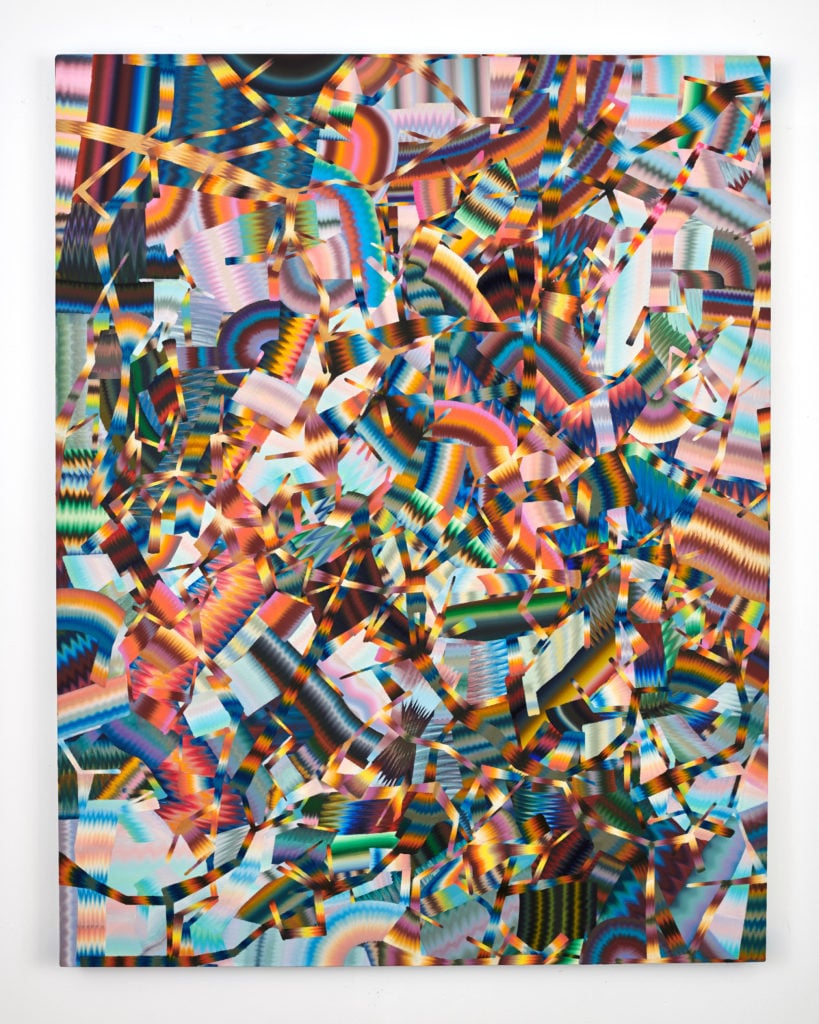
Clinton King, Spectral mass
(2019). Courtesy of the artist.
How did you two meet and what were your first
impressions of each other?
Julie: We’ve known each other since 2005. I
went to the Art Institute of Chicago as a foreign exchange student
for six months. Clint was friends with my roommate.
Clinton: I was in love with her immediately. I
was like “Wow, who’s that women?” Or, who’s that girl, because she
was so young!
Julie: He was like, grinning and staring at me.
We were at a mutual friend’s birthday party at a karaoke bar. I
asked my roommate, “Who’s that guy?” She was like, “Oh that’s
Clinton, he’s so flirty.”
Clinton: My friends dared me to go talk to her,
and we got along quite well.
Julie: We went straight to the art discussion,
the deep stuff.
So what was your first date?
Clinton: I invited her to a show. But I
used to be a performance artist, so I was in a costume.
Julie: There were all these performers and
I was looking at their feet, trying to figure out which one was
Clinton. I guessed wrong! You were the one in the death cloak.
Clinton: I was the drummer. I bought a
museum replica 16th-century monk robe. It had this giant black
hood. It was a holocaust cloak, like in The Princess
Bride! I pulled off the cloak and she was like “Oh, it’s
you!”
Julie: At the afterparty we talked, just
you and I, for the entire evening. Then you were like, “Let me give
you my phone number.” It was back when you still had little address
books.
Clinton: Before smartphones!
Julie: He handed it back to me and there
were little hearts drawn everywhere around his name.
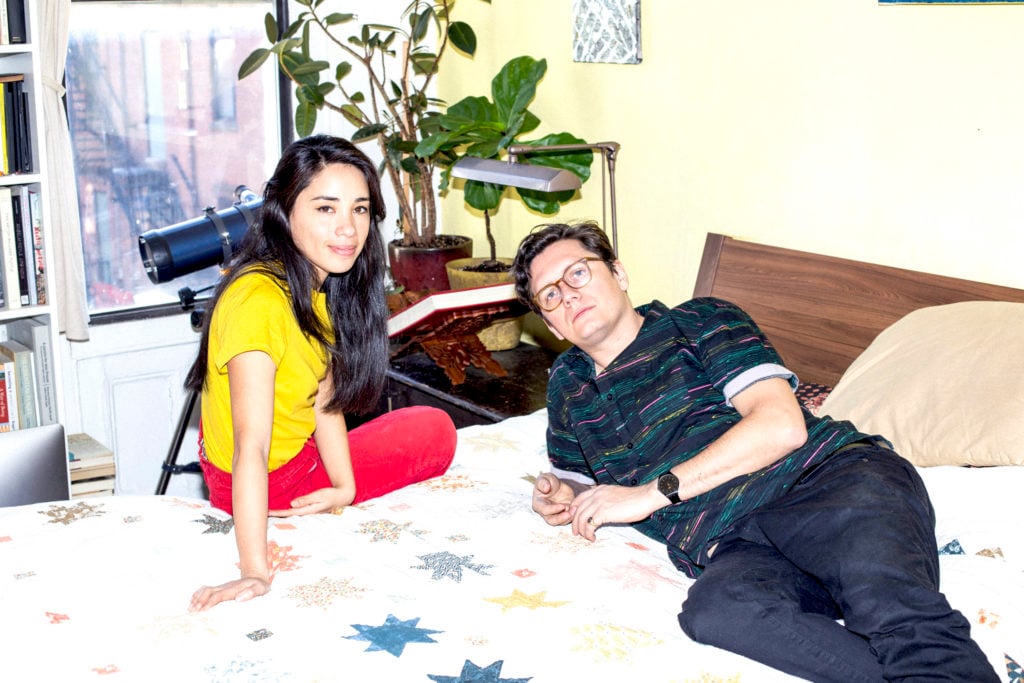
Curtiss and Clinton at home. Photograph
by Nicolas Bloise.
So you fell in love, but Julie was going back to France,
right?
Clinton: I followed her there two times.
Used up all my money.
Julie: He went for vacation. He was really
broke.
Did any of those early dates revolve around
art?
Julie: One time, we took Adderall and went
to the Louvre, and we went on a six-hour rampage. It was like we
couldn’t stop.
Clinton: That was awesome. We went to
[see] the Byzantine art, and the Egyptian, and the Greek. We were
really focused on everything.
So after Clinton visited France, you wanted to go
somewhere you could be together.
Julie: After I graduated with my
Beaux-Arts certificate, we decided to go to Japan. I was free to go
anywhere, and I had always wanted to go to Japan.
Clinton: I had already been there but I wanted
to go back.
Julie: And it was easier with papers for both
of us.
Clinton: We got to Tokyo with no plan. I was
there for a few months before her.
And you hadn’t spent much time together at that
point…
Julie: We almost split up after a year in
Japan. It was very challenging. We didn’t know each other, and we
were in a country where we didn’t know the language, didn’t know
many people, didn’t know what we were going to do with our lives. A
lot of challenges.
Clinton: It was like relationship bootcamp. And
it was a deeply introspective period of time for both us.
Julie: It was rough. We weren’t our best
selves.
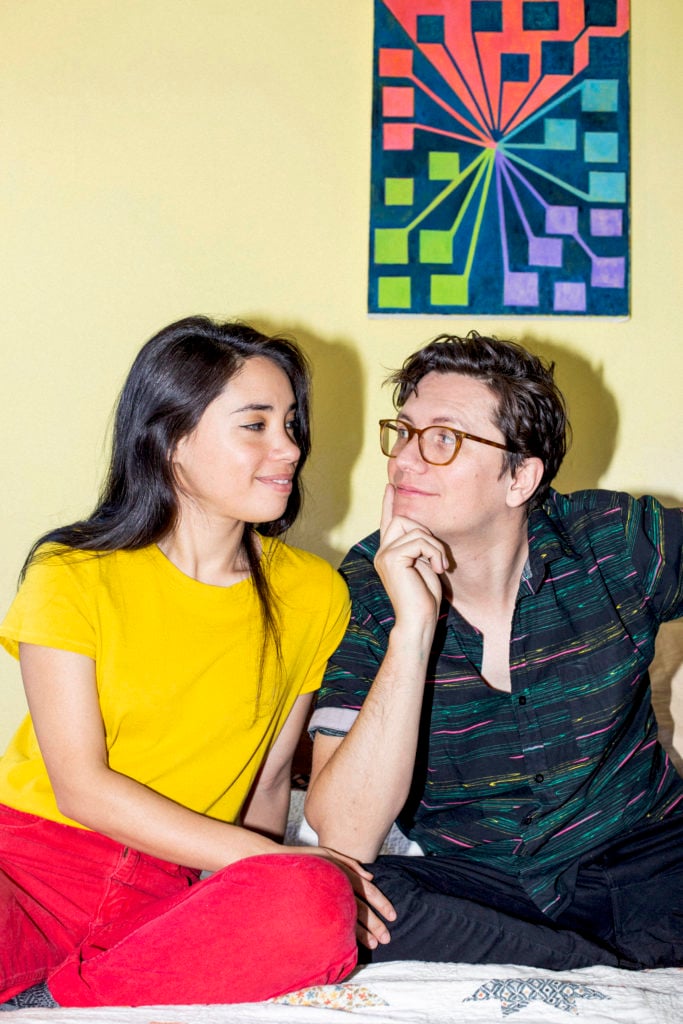
Curtiss and Clinton. Photograph by
Nicolas Bloise.
Did you have a studio while you were there?
Julie: We practiced at home. The people we
were renting the apartment from were an old couple who ran an
artist residency, the Yukobo Art Space.
Clinton: I just found them by chance, and they
gave us shows and everything!
Julie: They were so sweet, and they
created this art community. We went back recently for a two-month
residency for their 30th anniversary. It’s the longest running art
residency in Asia.
So after Japan, you had a period where you were
long-distance.
Julie: I went back to France. My mother was
very sick and I had to be with her.
Clinton: I stayed in Japan for a year,
alone.
Julie: We were long-distance for three
years.
Clinton: Skype, phone. We met in Vietnam, in
France, she came back to Japan to visit once. And then I went back
to the US and she would visit there.
Julie: When we started in Japan, we
weren’t really ready. During the long-distance years, we grew. It
was hard, but it was actually good, too. You stuck around for
me.
Clinton: When her mother died, it brought us
together.
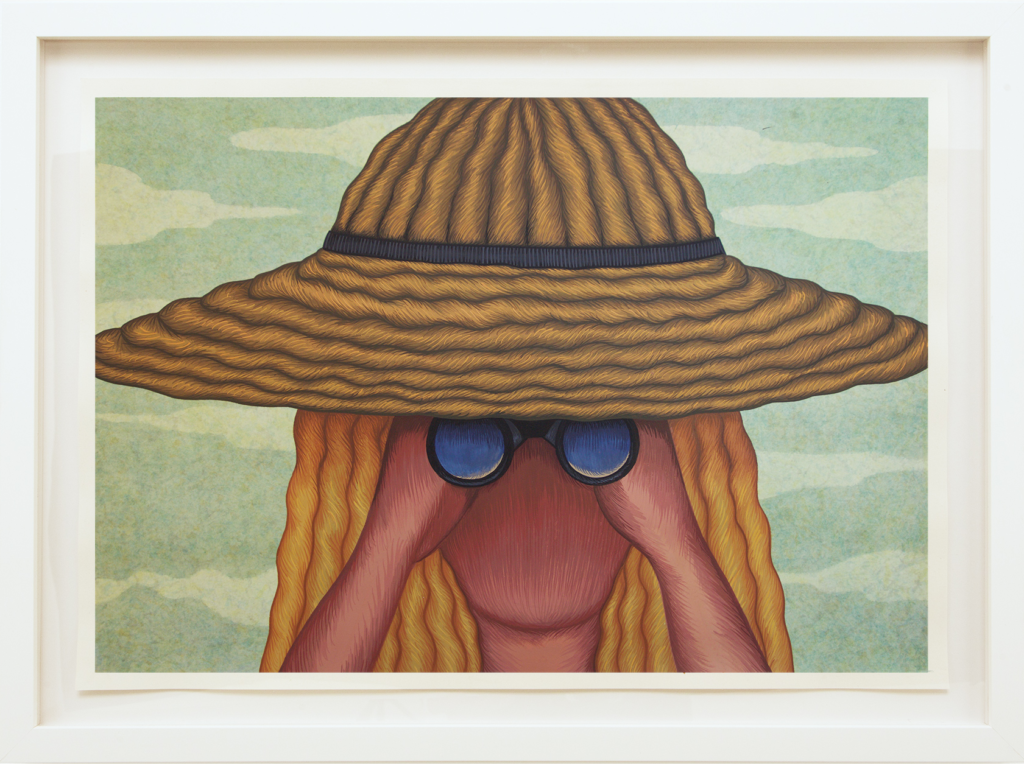
Julie Curtiss, Voyeuse (2018).
Courtesy of the artist and Anton Kern.
How did you find your way to New York?
Clinton: I realized one day in Japan that if I
stayed, I was going to stay there forever. I had a show in Hong
Kong, and they were looking for Sol LeWitt draftsmen there for a the big
retrospective at MASS MoCA. I applied and that was my ticket out of
Japan. I went straight to MASS MoCA, with just a few
days in my hometown. Julie came to North Adams for a month or
two.
Julie: Then we decided to go New York.
Clinton: I moved first. I lived in this
tiny closet off Fort Hamilton Parkway. It was terrible. I didn’t
even have a bed or blanket. I was working for an art-handling
company and I was using shipping blankets as bedding.
Julie: You didn’t have enough money to eat. You
were eating bananas.
Clinton: And beer and oatmeal.
Do you think having a partner who was also an artist
helped you persevere despite those financial
struggles?
Clinton: I was so driven. I knew it could
happen. Being on the trucks as an art handler, I could see it. I
thought, “If you just go with this, I think it’s possible.” And I
went to France and I told Julie, “I think if we went to New York,
we could do this.” And she came to New York and it was really
difficult. But eventually you get into one or two shows, and you
meet people….Someone told me, that’s how you do it: You meet people
and you make good work.
Julie: New York, I think, is one of the
rare places [where] that can happen. I think it’s way harder in
Paris. In Tokyo, I don’t see that happening.
Clinton: Chicago wasn’t working. I’m from
Columbus and I went as far as I could there. I showed at the
Columbus Museum of Art in my early twenties. Where do you go from
there? When I came to New York, I said, “If it’s going to happen at
all, this is where it happens.”
Are there any cons of having a fellow artist as a
partner?
Clinton: [Deciding] whose time is more
valuable. Artists are very self-centered by nature; they have to go
in the studio and do their thing. We had to start regimenting:
“When do we meet?”
Julie: It’s true. Time is tough. A practice can
encroach on time together. But since we’re professionals, that got
sorted out quickly.
Clinton: It’s competitive.
Julie: Yeah, but it doesn’t need to be! At
first it seemed maybe it was a very terrible decision to both be
artists. We were both broke. Trying to compete out there was really
tough, but I think as we’re growing older, we realize we have so
much in common. It outweighs the financial thing. And now
financially, it’s getting more comfortable.
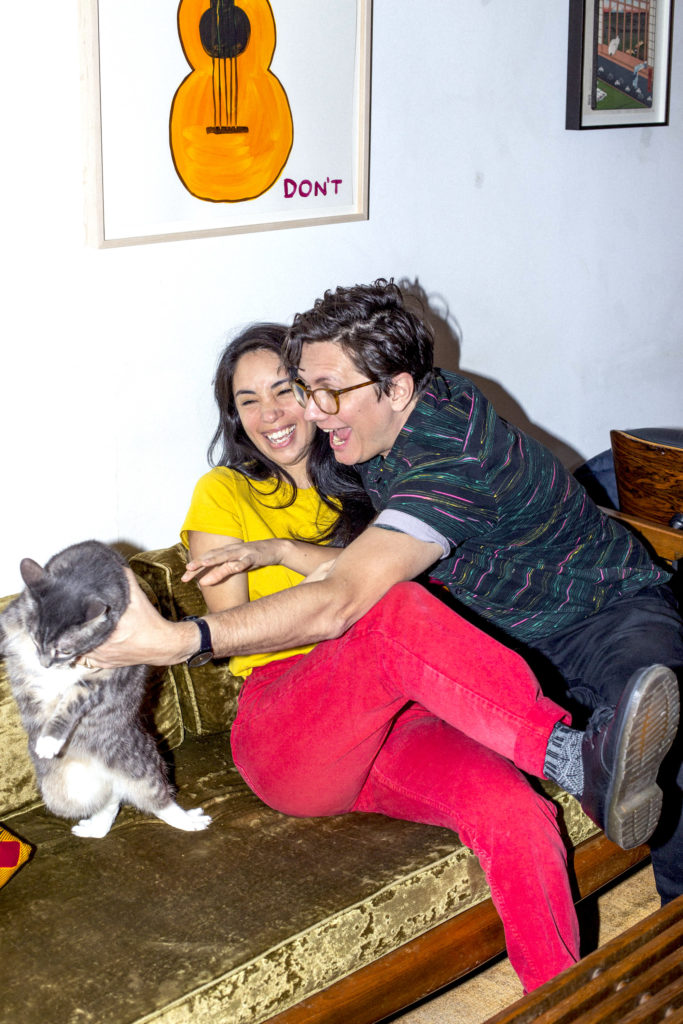
Clinton King and Julie Curtiss with
their cat Dini (short for ‘Houdini’). Photo by
Nicolas Bloise.
What drew you both to art?
Clinton: I’ve always done it, since I was a
little kid—it’s really the only thing I can do very well. Art is
all I’ve ever done.
Julie: Same thing here. I’m an only child, so I
had a lot of time to kill by myself. I was in dance class and music
class, so art was the only moment of freedom and self-expression I
could get. It was already a practice when I was, I would say, 14. I
wanted to be an illustrator before I went to school.
Clinton: I wanted to be Van Gogh.
Julie: Then when I went to prep school, I
realized, “Fuck illustration. I don’t want to illustrate, I want to
do my own stuff.” It was a very revealing moment. Clint and I, we
don’t come from artistic backgrounds. My parents brought me to
museums, and my dad is very artistic, but we didn’t have any models
of people making a living out of art.
And when did you get married?
Julie: September 13, 2011. It was two
years of working on the papers to get married. And then my mother
died right after I got to New York.
Clinton: That was terrible. Because Julie
was waiting for the green card, she couldn’t even go back for the
funeral. But the wedding was beautiful.
Julie: It was pretty artistic. We had no money.
We got married at New York’s City Hall, and then we did a small,
spiritual ceremony in France, in Burgundy, where my parents have a
small country house. We invited our closest friends and family.
Maybe 40, 50 people. We found an old monastery that was close
by. Our Japanese friends flew in and played sitar for the ceremony,
and my mother’s best friend married us.
Clinton: We kind of invented a ritual.
Julie: And then it was a dance party, and
we had a magician. But the cost of doing everything ourselves was
that we were so exhausted we didn’t even have energy to party! The
good part was the honeymoon. We did a stopover in Iceland, four or
five days. I still dream of it.
Clinton: There was nobody there! Just some
sheep. Rainbows everywhere. We went into a lava cave deep under the
ground, and were the only people there.
Julie: We saw a melting glacier. There were
these blocks of ice in purple and blue colors floating on the lake.
We stayed there in silence with the sea lions. It felt really
special. It was like our playground.
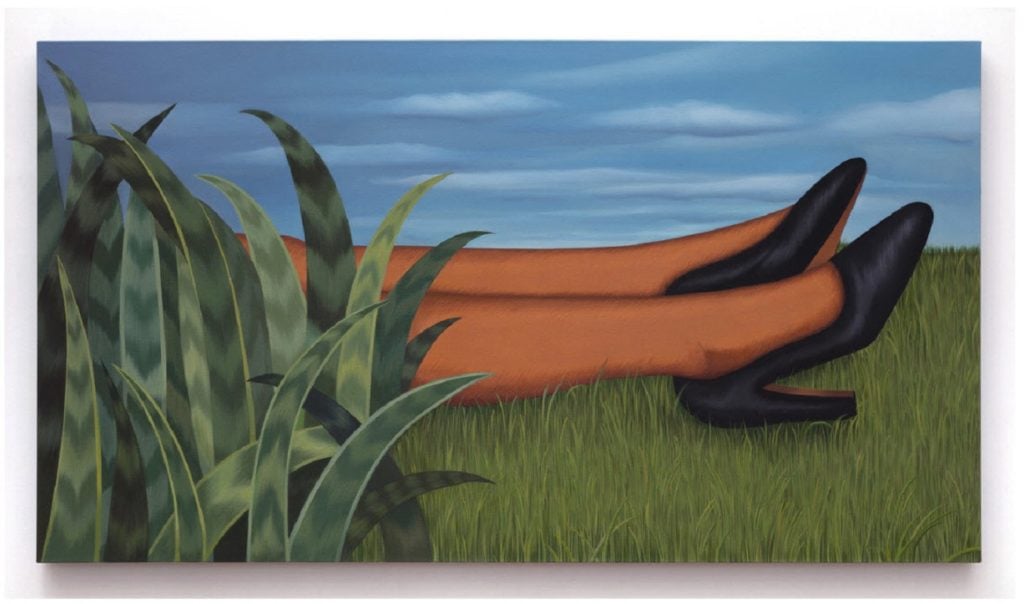
Julie Curtiss, Woman in High
Heels, 2018. Courtesy of the artist and Anton Kern Gallery.
And now what are your daily lives as artists
like?
Julie: I work almost every day of the week
right now. There’s no routine, just working all the time in
the studio.
Clinton: I work for a private art dealer
on the Upper East Side, part-time. At night I go to the studio, and
on the weekends. Mondays I have off. Our studios are in a building
just two blocks away.
Julie: We’ve been doing our own thing
lately.
Clinton: But one thing that unifies us is
Reverberation Radio. We listen to it all the time when we’re making
art.
Julie: It’s a mix of surf rock and
international pop and everything. They constantly come up with
really great playlists.
Clinton: The music constantly changing in
the background keeps us kind of flexible in the studio. You don’t
get bogged down into one mood.
How involved do you get in each other’s
practices?
Clinton: We’re pretty engaged. We’ve
always worked together on things. We’ve even done some
collaborative projects.
Julie: I’ve been using Clinton a lot when
I can’t make up my mind about stuff. I send him images. It’s
usually about a very specific question: “There’s a problem with
this. What is it?” I don’t know if I’m as useful as he is for
me. [With] abstraction, you kind of have to make your way through
it.
Clinton: I ask her, “Does this feel done?”
And she asks me, “Does this look done?”
Julie: And then you ask me and I tell you
something and you don’t follow it anyway!
Clinton: But more often than not we help
each other out.
Julie: There was a whole period of time
where your opinion was too important to me and I wasn’t asking
for your input as much. I just needed to really focus on myself and
make the mistakes I was going to make and figure it out myself. It
confused me, but once I became stronger and I knew what I really
wanted, I could invite you again and not care as much.
Where do you differ, as artists?
Clinton: Her sense of color is different
than mine. I think it’s because she’s European. That’s a theory we
have.
Julie: I have weird colors! But we are
almost opposites.
Clinton: I produce a lot of work over a
short period of time. It’s very explosive, and then I rest. And
she’s consistently there.
Julie: I’m slow. I’m more like a marathon
runner. You’re a sprinter.
Clinton: Her focus and work ethic, it
makes me want to go the studio and work harder.
What are some things that you’ve seen lately that have
inspired you?
Clinton: When we were in Japan, we liked
the Ukiyo-e prints at the Ota Memorial Museum in Tokyo. Both of our
influences kind of met in these prints. The complexity of them, the
level of detail, was similar to mine, but the use of line was
similar to Julie’s art.
Julie: They have the most extensive
collection of prints in Japan. It was amazing. But since we got
back in December we’ve been absolutely busy and not going to shows
together.
Clinton: Nahmad Contemporary had an Albert Oehlen show called “Gray”
[“Grau“]. It was so good.
I liked Alan Shields at Paula
Cooper.
Julie: I didn’t see those. I really
liked Félix Vallotton
at the Metropolitan Museum
of Art. The prints were really fun and surprising. The
simplicity and effectiveness of them, especially after Japan—it was
really cool.
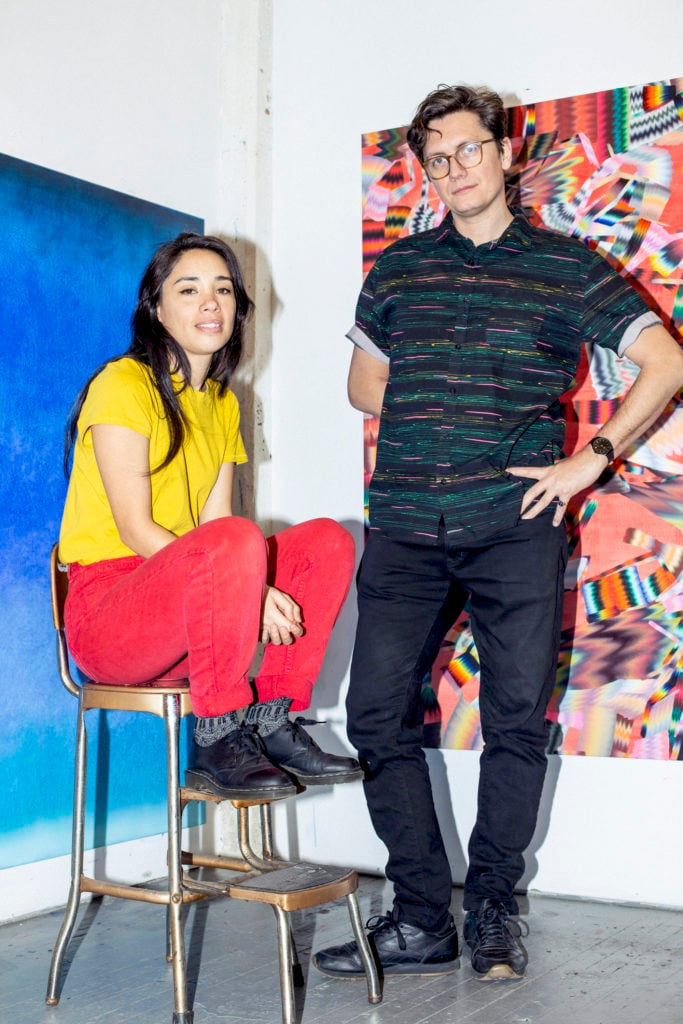
Clinton King and Julie Curtiss. Photo
by
Nicolas Bloise.
What kind of art do you live with at
home?
Julie: We collect our friends, we do art
trades. We have Hein Koh, Loie Hollowell, Chris Dunlap… We have this David Shrigley print.
Clinton: A Kelley Walker…we have the Wrong Gallery
[edition] from Maurizio Cattelan. We have a Chris Martin dwarf sculpture.
Julie: Esther Ruiz. Really eclectic
stuff.
Clinton: And this is a Sol LeWitt wall
drawing [on the living room wall]. One of the chief draftsman who
was friends with Sol helped me designed it.
Julie: We have to paint over if we move out.
It’s strictly for ourselves.
What would you be your dream work to
own?
Clinton: A Matthew Barney drawing. Christian Marclay Clock video
up on the wall.
Julie: We’ve talked about what an important
piece that was for us.
Clinton: I worked with Christian on
The Clock at Paula Cooper Gallery [in New York]. We set it
up and I got to talk with him about how he did it. It was really
amazing.
Julie: We watched hours and hours! But if we
can go crazy, I’d like to have really old stuff.
Clinton: I want a Hieronymus Bosch, or a
nice Albrecht Dürer print!
The post ‘It Was Like Relationship Bootcamp’: Artists Julie
Curtiss and Clinton King on Going Broke to Chase Love, and the
Struggles Before Success appeared first on artnet
News.
Read more https://news.artnet.com/art-world/julie-curtiss-clinton-king-1788015
Further reading


Leave a comment