
Museums’ Rejection of Fossil Fuel Sponsorship Is More Than Just Symbolic. Here’s Why It Can Have Real-World Impact
This week, news emerged that
Rebekah Mercer—a mega-donor to conservative causes who scientists
have described as a “sponsor of fake news and climate
disinformation”—would no
longer serve as a board member of the American Museum of Natural
History. For an institution committed to communicating the history
of science, this should have been a simple step toward restoring
some ethical consistency. But even now, the museum is remaining coy
about the reasons for her departure, confirming only that her term
expired in December. It has declined to acknowledge publicly any
impact that the imaginative protests of activists, the internal
pressure from its own curators, or an open letter signed by
hundreds of scientists might have had on Mercer’s
resignation.
As the impact of climate change
intensifies, such alliances among artists, activists, scientists and staff
are powerfully targeting cultural institutions that accept money
from the fossil fuel industry—funds that have historically allowed
donors to “artwash” their image, associating them in the minds of
the public with a progressive, educational agenda when their
private activities achieve anything but.
In the wake of such protests, we
have seen changes: fossil fuel apologists such as Mercer and the
late David H. Koch, like the former Whitney Museum vice chair
Warren Kanders, have stepped down from leadership positions on
boards, and some museums, like Tate and the Van Gogh Museum, have
declined to renew sponsorship deals with fossil fuel companies. But
is this ethical shakeup just a series of symbolic victories? Or, as
these events start to snowball, could they have a genuine impact
outside the walls of the museum and out in the world?
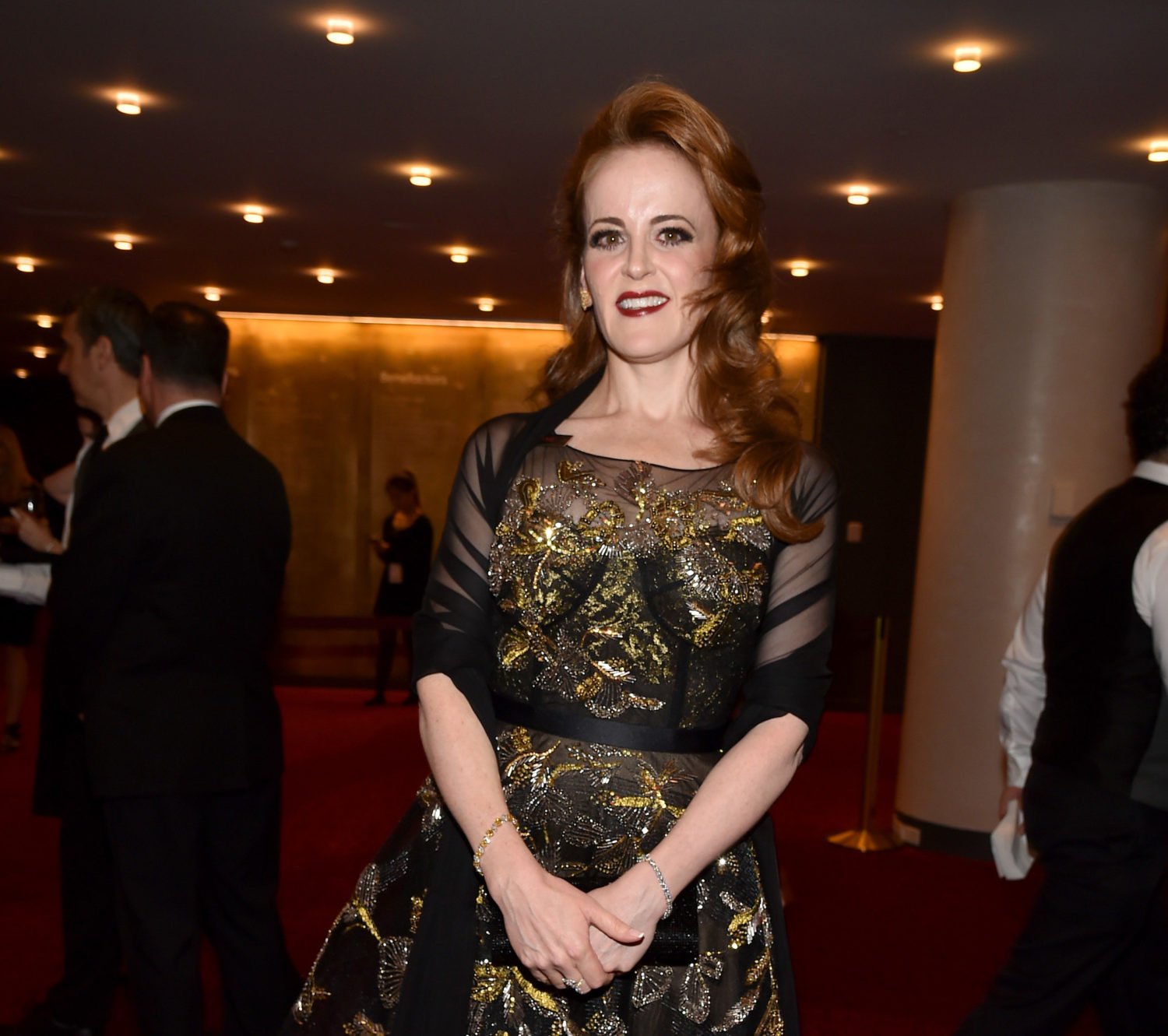
Rebekah Mercer was on the board of the
Museum of Natural History in New York, but her family’s foundation
funds groups that deny climate change. ©Patrick McMullan. Photo
Patrick McMullan/PMC
Oil giant BP’s recent
announcement that it plans to reach “net zero by 2050” suggests
that the latter is true. While commentators have often dismissed
the interventions of artists
on the issue of oil sponsorship as
“virtue signaling,” BP’s CEO effectively conceded in his speech
that opposition to the company’s sponsorship deals has
had a tangible impact. In his statement on the new policy, he
addressed protesters directly as he discussed rebuilding the
public’s trust. “Many question our motives in supporting the arts,”
he said. “I get that.”
In this new reality,
controversial corporate sponsors know they can no longer disguise
themselves as arts philanthropists to distract from their harmful
business practices. Just five months ago, the Royal Shakespeare
Company announced that it would end its BP sponsorship deal
halfway through a five-year
contract; the National Galleries of Scotland cut its ties to the oil and gas firm shortly
thereafter.
At the time, these were seen
more as significant symbolic victories for activists. But in hindsight,
perhaps they can be appreciated for their true impact. Through
sustained pressure, public rejections of BP and other fossil fuel firms have become an effective tool for challenging
what is known as the industry’s “social license” to
operate. Warm
words have done little to end the industry’s pursuit of fossil fuels,
but cutting cultural and financial ties is now changing the
discursive space. Like other investors in artwashing, BP is having
to accept that the rules of cultural sponsorship have fundamentally
changed in recent years as ethical red lines are being redrawn.
What was once a space to cheaply sustain a company’s social license
is now a site of robust, ethical scrutiny.
What artists, galleries, and
museums must do now is stand their ground and refuse to be charmed
by empty rhetoric. Financial analysts have already called BP’s net zero target
“gloriously vague” and highlighted
how it is “still holding open the possibility that it will increase
production of oil and gas for many more years.” So, while many
artists and arts institutions are declaring a climate emergency and
cutting their use of fossil fuels, BP plans to still turn a profit
from extracting oil and gas in 2050.
Rather than leave fossil fuels
in the ground as climate scientists are urging, BP is instead
talking up unproven techno-fixes like carbon capture, which are
unlikely to permanently remove from the atmosphere the
significant massive emissions it would continue to
produce.
Somewhat appropriately, BP’s net
zero announcement appears to be—like its sponsorship of the
arts—more about managing its public profile than creating
meaningful and lasting change.
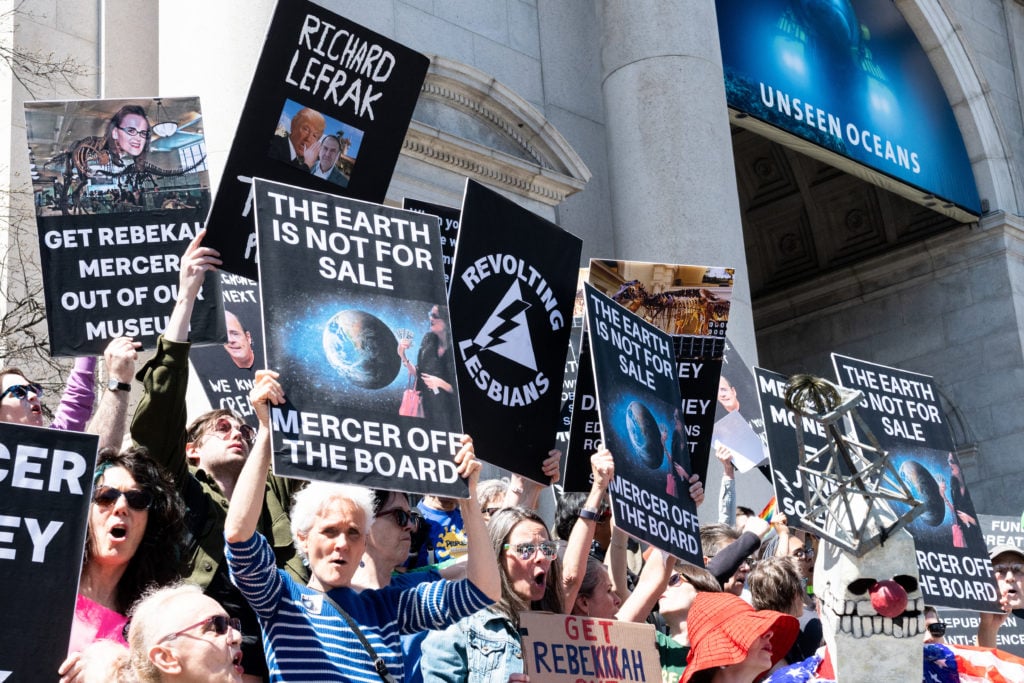
Demonstrators holding placards and
banners during a protest against Rebekah Mercer being a member of
the board of trustees of the American Museum of Natural History
held in front of the museum in New York in 2018. Photo by Michael
Brochstein/SOPA Images/LightRocket/Getty Images.
Of course, oil, arms, and
tobacco companies have utilized the arts as a way to
deflect scrutiny for
decades. It’s been
nearly 10 years since BP’s Deepwater Horizon drilling platform exploded, killing 11 rig
workers and causing crude oil to flow into the Gulf of Mexico for
87 days. While the US courts handed down record criminal
fines to BP, major arts
institutions such as Tate helped to rehabilitate the oil giant’s
brand (before the sponsorship arrangement ended in 2016). The
gallery’s then-director Nick Serota controversially commented
at the time, “You don’t abandon
your friends because they have what we consider to be a temporary
difficulty.” Of course, the impact of BP’s disaster was
not temporary for those communities and species that continue
to be affected today.
Serota, like other prominent
figures in the arts, failed to recognize the extent of his ability
to affect systemic change. Instead of taking the opportunity to
usher in a new era for ethical patronage, he opted to lend
legitimacy to BP as it backed climate denial, lobbied against climate legislation, and
invested in new reserves of fossil fuels. It’s therefore deeply
troubling that the director of the British Museum is now following
the same path, publicly defending BP’s business rather than paying
more than lip service to the concerns that many stakeholders have now raised. Just last week, he
uncritically repeated BP’s disputed claim that it is “committed to
the Paris climate goals” and—with no hint of the impartiality
required from a national museum director—asserted that BP “will
have to be part of delivering these goals.”
The Paris Agreement’s goals
require roughly a halving of global fossil fuel
emissions in the next
ten years, while BP still plans to keep around 97 percent of its
capital in fossil fuels, so this kind of direct endorsement from a
cultural leader is extremely valuable when the gap between actions
and words is so wide.
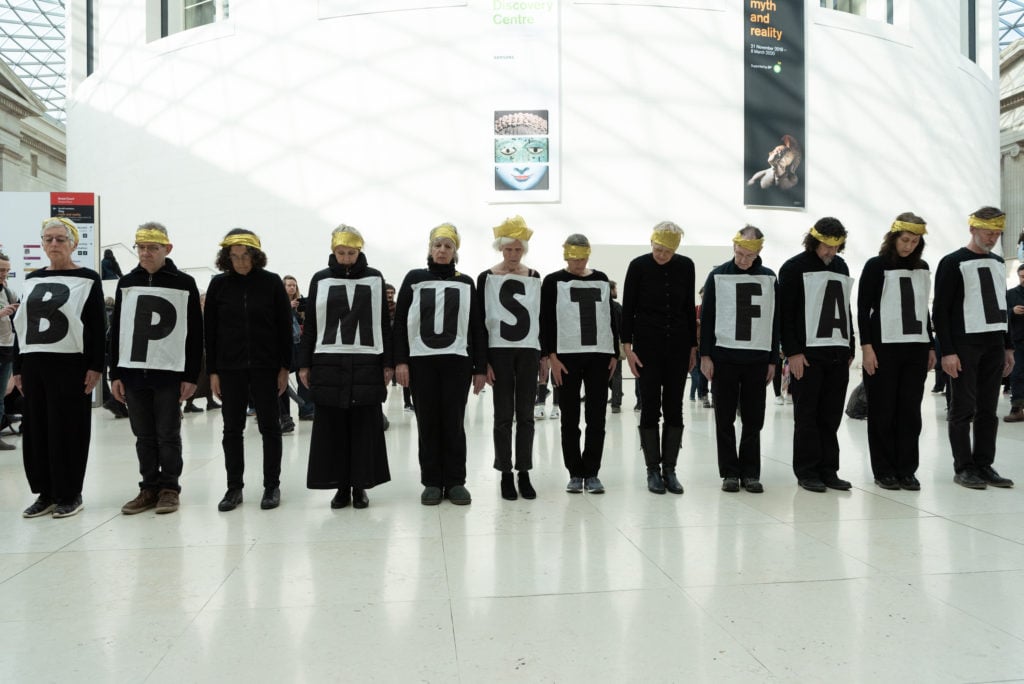
Photos of the mass action at the British
Museum by Ron Fassbender.
The debate over sponsorship is
now helping to expose the myth of museum
neutrality, prompting
many arts institutions to review how they embody their values and
social purpose not only in the programs they produce, but also the
way they do business. Recent developments have shown that it’s in
these spaces that social license can be granted or withdrawn.
Within museums and galleries, we have the opportunity to decide—as
a culture—what is acceptable to us and what is not, and inform the
kinds of systemic change we urgently need.
If select arts institutions
making the decision to cut ties with fossil fuel companies has
brought us to this fertile moment, then a clear ethical consensus
across the sector could be a seismic shift in the direction of a
more climate-friendly world. Perhaps one of the easiest ways arts
institutions give up their power is by thinking that taking down a
BP logo or removing the Sackler name can only be a symbolic
act.
Dr. Chris Garrard is
co-director of the campaigning and research organisation Culture
Unstained.
The post Museums’ Rejection of Fossil Fuel Sponsorship Is
More Than Just Symbolic. Here’s Why It Can Have Real-World
Impact appeared first on artnet News.
Read more https://news.artnet.com/opinion/culture-unstained-museum-sponsorship-op-ed-1789302
Further reading


Leave a comment