
‘No One’s Culture Is Better’: Why Artist Tania Bruguera Opened a School for Multicultural Cooking, Crafting, and History
Cuban artist Tania Bruguera has long wanted to open her
School of Integration, but had never found the right place
or partners until last month. That’s when her intensive course in
cultural diversity transformed the Manchester Art Gallery into
something more like a classroom.
The ambitious project, the latest manifestation of Bruguera’s
organization Art Útil (art as tool), was a highlight of last
month’s Manchester International Festival. More than 3,400 people
signed up for the school’s eclectic syllabus, which ranged from
cookery lessons to banner making. The goal, Bruguera says, was to
show that “no one’s culture is better than another person’s
culture” and that integration is a “two-way street.”
The project’s timing presented an added urgency for the artist,
who says society is “quickly going backwards, especially
politically.” Bruguera’s school was taking place in England amid
the anti-migrant rhetoric, euphemistically called “taking back
control of borders,” used by politicians who support a hard Brexit
from the European Union.
The artist says she hoped the School of Integration
would help “bring complexity and consideration to the discussion
around immigration instead of relying on confused and extreme
emotions.”
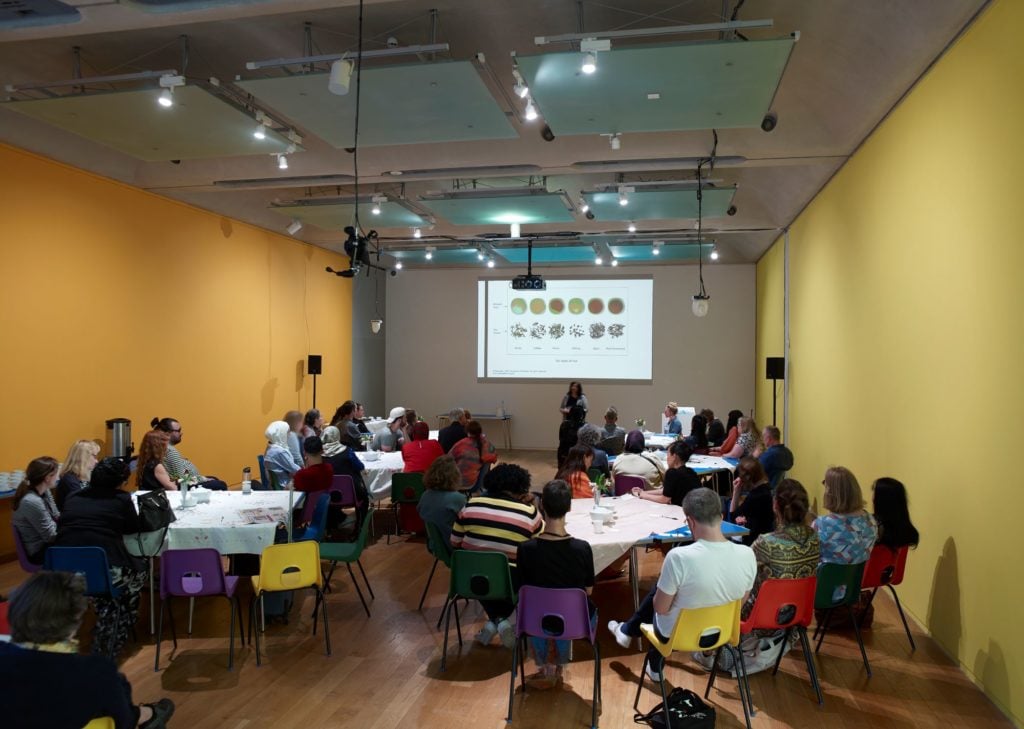
Tania Bruguera’s School of
Integration, Manchester International Festival 19. Photo by
Michael Pollard.
Anyone could take a British citizenship test, which was among
the drop-in sessions on offer in the School of Integration
at the museum. (All sessions were free but most had to be
pre-booked.) Multiple-choice questions on the test ranged included
Who built the Tower of London? Which British colony declared
independence because it demanded no taxation without
representation?
Immigrants and their children tended to get more questions
correct and pass the test, says Shanaz Gulzar, an artist and
Manchester International producer who worked closely with Bruguera
on the project. “My colleague who is white British failed,” Gulzar
says. “Maybe if you come from an immigrant background you have a
thirst for history because that helps you place yourself even
though you are always being told ‘to go home.’”
Many of the classes took place surrounded by Manchester’s
collection of 19th-century art, acquired when the city’s economy
boomed during the Industrial Revolution. “It is a collection of
colonial portraiture—all the things Britain did to the world,”
Bruguera says. Decolonization should be talked about “especially in
museums,” she says, and “museums should be sanctuaries for
migrants.”

The School of Integration’s
Pakistan-style threading class in the Manchester Art Gallery. Photo
by Javier Pes.
Another well-attended class was led by two Manchester-based,
British-Pakistani women. They taught a hands-on lesson about
threading to remove unwanted hair, which has its origins in China
and Persia. The class took place in a gallery where some of
Manchester’s most famous 19th-century paintings hang. Among them
is Hylas and the Nymphs (1896), John William
Waterhouse’s canvas depicting a male youth falling for the charms
of nude water nymphs.
It is one thing to hold a 90-minute lesson in the gallery, but
when a radical change seems permanent it can lead to a backlash, as
the Manchester Art Gallery discovered last year. Kate Jesson,
the museum’s curator of Modern and contemporary art, recalls
“Nymphgate” with a rueful smile. That was when artist Sonia Boyce
temporarily removed Waterhouse’s canvas to make a point about
representation in historic collections, prompting media outcry.
Now, Boyce’s wallpaper and video intervention Six
Acts, some of the irate comments, and Waterhouse’s
canvas share the same gallery.
The socially-engaged director of Manchester Art Gallery,
Alistair Hudson, took Nymphgate in his stride. (He began the job a
few days after the story broke.) He is committed to making the
city’s prestigious museum more “useful,” writing that the
School of Integration shows how a museum can be a place
where everyone can learn about another’s culture. Unlike Boyce’s
project, no one seemed upset by Bruguera’s school taking over the
galleries, though in many ways it was as radical a challenge to the
traditional division of power between an institution and its
visitors.
In total, more than 100 Manchester residents from 53 countries
led the various classes that took place during July. Bruguera says
that it meant she had to surrender artistic control. “In
socially-engaged projects, I’m not the author but an ‘initiator,’”
she says.
“These temples of culture need to be more open,” Gulzar says.
“There’s no going back. Who knows what could be the next piece of
work taking this forward?” Bruguera has shown a way.
The post ‘No One’s Culture Is Better’: Why Artist Tania
Bruguera Opened a School for Multicultural Cooking, Crafting, and
History appeared first on artnet News.
Read more https://news.artnet.com/exhibitions/tania-bruguera-school-of-integration-1608730
Further reading


Leave a comment