
Police Removed a Work From the India Art Fair on the Suspicion That It Referenced Ongoing Political Protests in Delhi
Political tensions rising across Delhi bubbled to the surface on
the last day of the India Art Fair on Sunday, as
police shut down a live community artwork installed that afternoon
at the booth of the Italian Embassy Culture Centre by Post-Art
Project, an art studio founded by Gargi Chandola and Jefrey
Yaman.
The protests across the city against the Citizen Amendment Act
were something of a silent presence throughout the fair, which
posted signs at the entrances warning that although organizers “are
aware of events taking place across Delhi” and that they “support
art as a means of expression,” there would be a “zero-tolerance
policy against banners.”
“It’s about safety and security for everyone here,” fair
director Jagdip Jagpal told Artnet News, citing the event’s
permissions. We were speaking on Saturday, when dealers were
reporting promising sales and the political works on view were
flying under the radar.
Just a 15 minute drive from the fairgrounds, Delhi’s Shaheen
Bagh neighborhood has become the epicenter of opposition to the
CAA. A sit-in protest has blocked a Delhi highway there since
December 15, the camp largely made up of Muslim women standing up
for their faith.
"background:#FFF; border:0; border-radius:3px; box-shadow:0 0 1px 0 rgba(0,0,0,0.5),0 1px 10px 0 rgba(0,0,0,0.15); margin: 1px; max-width:500px; min-width:326px; padding:0; width:99.375%; width:-webkit-calc(100% - 2px); width:calc(100% - 2px);">
View this post on Instagram
The CAA would force all residents to prove their citizenship.
The act also offers a pathway to citizenship for refugees
persecuted for their religion—unless they are Muslim. Opponents of
the legislation contend that the CAA will strip Muslims of their
citizenship if they are unable to provide sufficient proof of
identity.
The censored piece contained no overt references to the CAA,
according to the artists. “It was about celebrating the power of
women in India,” Chandola told Artnet News in an Instagram message,
noting that it featured the work of roughly a dozen artists
representing differing backgrounds, including the Hindu and Muslim
faiths, as well as the LGTBQ community. The artists invited
fairgoers to help sew together artworks to create a cohesive
work.
“Every thread is a wish—a wish for solidarity and unity and the
rise of women bringing that to fruition,” Chandola added.
Apparently, not everyone saw it that way. The police
allegedly descended on the art project just 20 minutes before the
fair was to close
Authorities “were responding to an anonymous complaint made
about ‘artwork being prepared by someone wearing clothes resembling
the women sitting in Shaheen Bagh,’” wrote the project artists on
Instagram, noting that the police
initially left before fair officials came and instructed them to
remove the work before closing the booth to visitors. “The art fair
is NOT a safe space.”
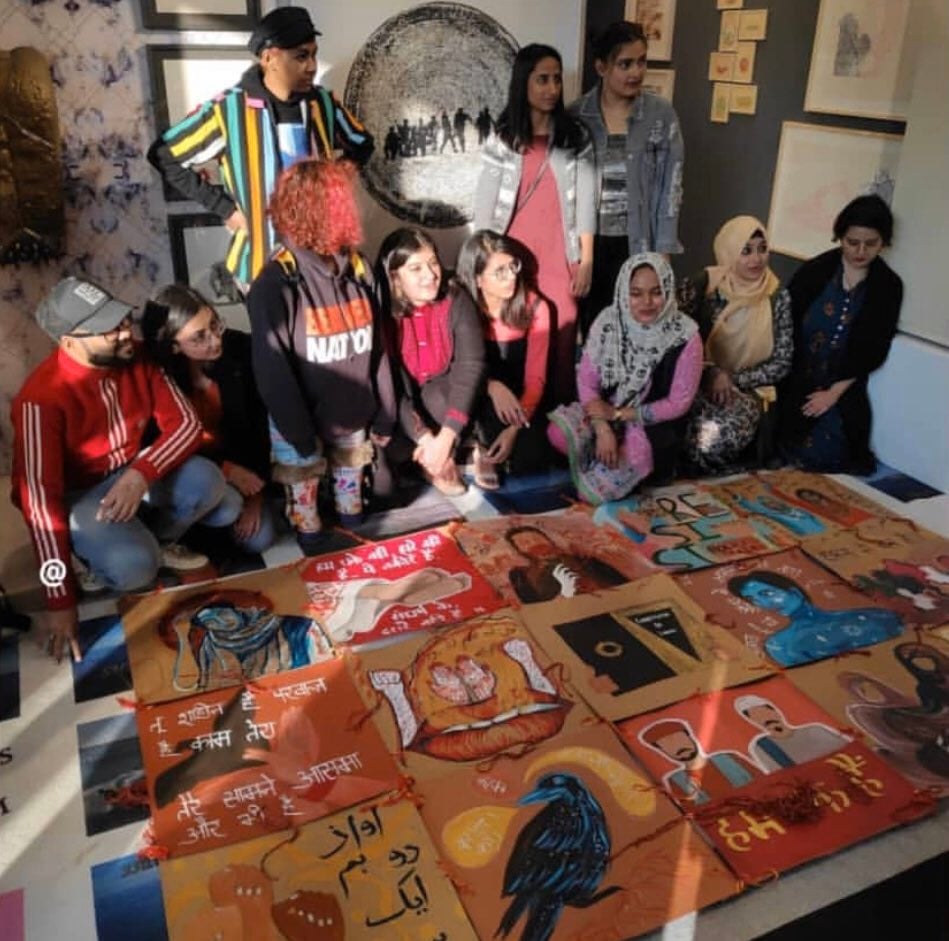
Police responded to complaints about
the Italian Embassy Culture Centre’s booth at the India Art
Fair, featuring an interactive piece by Post-Art Project, an art
studio founded by Gargi Chandola and Jefrey Yaman. The fair
organizers responded by shutting down the exhibition and removing
the work, which was about female unity, from view. Photo Aparna
Jain, via Twitter.
“India Art Fair organizers don’t seem to have a spine
whatsoever,” booth curator Myna Mukherjee told local internet media
outlet the Quint. “We deferred to
the fair’s rules. There was no sloganeering.” One of the works
included the word Shaheen, while another read “Hum Ek Hain,” Hindi
for “We are one.”
The fair contends that it did not know all of the details about
the performance at the embassy’s booth, and that they only learned
of the communal piece from the police. “The India Art Fair embraces
freedom of expression and believes individuals have the right to
express their opinions in their own way,” said a representative of
the fair in a statement to Artnet News. “Artists are conscience
keepers of a society and we place their voice at the centre of our
program.”
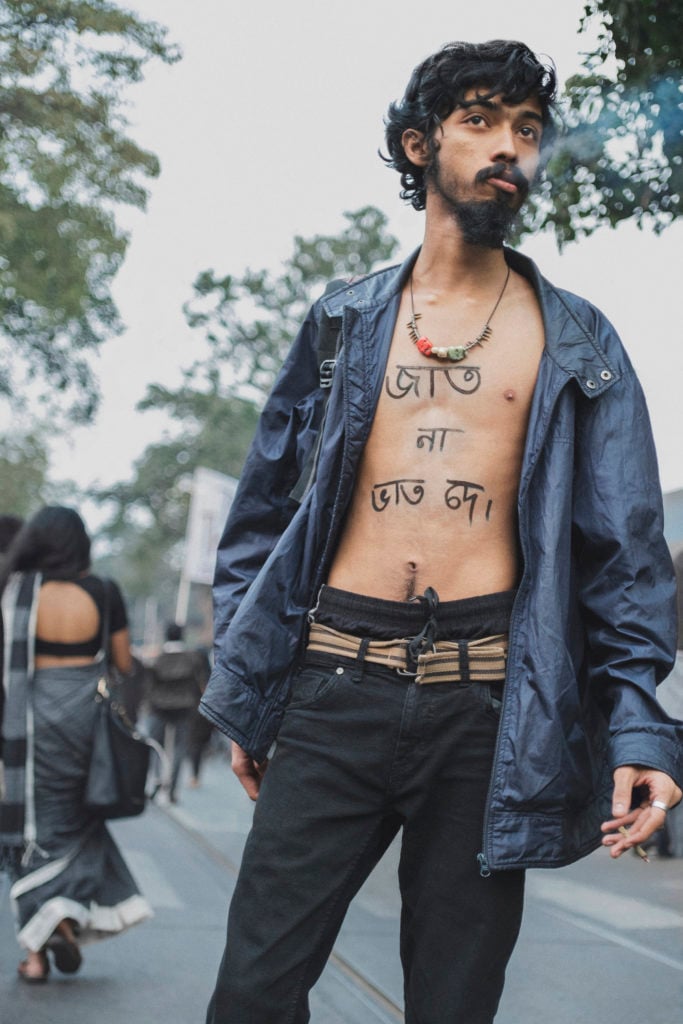
Ronny Sen, Portrait of Protest
(2019). Photo courtesy of TARQ.
The response from both the police and the fair suggests that
Mumbai’s TARQ gallery was wise to leave Ronny
Sen’s Portrait of Protester tucked on the back
wall of their booth. The photograph captures a young rapper at a
recent protest, the words “Don’t give me religion, give me food”
emblazoned across his chest.
“The situation is very heightened in Delhi, and you don’t know
who is going to take offense to it,” the gallery’s Aashna Jhaveri
said to Artnet News of the piece. But having it on view at all, she
added, was important, especially given that Sen is one of the
biggest influencers posting about the protests on social media.
“It’s putting out the message about the political situation, and
it’s taking a stand about what’s going on, and not being
neutral.”
Equally outspoken was the work of Shilo Shiv Suleman, who
painted a poem about her dual Muslim and Hindu identity on the wall
of Mumbai gallery Art Musings’s booth. The written words
accompanied her large-scale paintings inspired by the Buraq, a
mystical figure from the Koran that is half woman, half horse.
“I’m half Hindu and half Muslim, and I was brought up drinking
deep in both faiths,” Suleman told Artnet News. “When all
of the stuff with the CAA began, I began to have these dreams where
I was growing out these iridescent wings and flying away to a safer
place. It felt almost as if the Buraq was visiting me.”
The artist has actually been spending most of her time not at
the fair, but at Shaheen Bagh, where she was painting a mural in
support of the protesters.
The encampment and the strength of the women there “is like the
most beautiful thing that I have ever seen,” said Suleman.
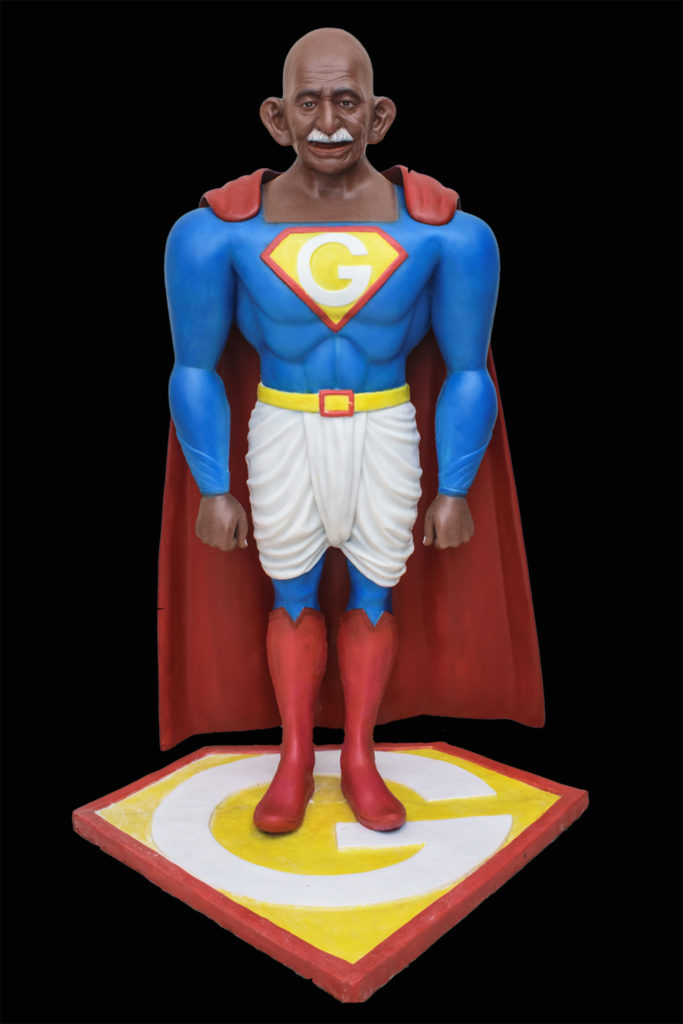
Debanjan Roy, Super Gandhi
(2019). Photo courtesy of Akar Prakar.
Other pieces at the fair also tapped into the political
zeitgeist, such as a number of works featuring Mahatma Gandhi, who
supported the notion of an independent India of many faiths. “When
you see some of the works that have political resonances, there’s
obviously a very direct dialogue with what’s happening [at the
protests],” said Ankush Arora of Akar Prakar, which has locations
in New Delhi and Kolkata.
He was pointing to a Superman-style statue of Gandhi—”the most
photographed piece in the fair,” he claimed—by Debanjan Roy, titled
Super Gandhi and for sale for 800,000 rupees
($11,200). But the booth also had the more subtle Portrait of a Memory
by Debasish Muiherjee, a large sculpture priced at 600,000
rupees ($8,400).
“It’s inspired by Gandhi’s final fast in 1947 in order to unite
the Hindus and Muslims,” Muiherjee told Artnet News. “The
piece is made from contrasting materials, sandstone and fabric, to
show that the two communities can certainly stand tall and create a
monument.”
The artist hand-embroidered the fabric components of the work—a
representation of “the undeciphered wounds of generations” and
hopes that the government will listen to the protests, because
“this is not the time to go backwards.”
Political turmoil aside, the mood at the fair earlier in the
weekend was upbeat, with numerous dealers reporting multiple sales.
Mumbai’s Chatterjee & Lal reported a strong first day, selling out
of drawings by Nikhil Chopra, which range in price from 300,000 to
about 1 million rupees. And newcomer PSM, of Berlin, was pleasantly
surprised to have sold four works—including a €14,000 ($18,200)
Daniel Lergon and a Nathan Peter painting that they had left in
Germany and could only show on the iPad—despite having no existing
collector base in the region.
Now in its third year under Jagpal, the fair retains its
commitment to South East Asia with a dedicated 70 percent of
dealers hailing from the region. But the slate of international
galleries is getting stronger. David Zwirner—one of the first
mega-galleries to sign under Jagpal back in 2018—was showing an
impressive site-specific mural by Marcel Dzama to accompany new
work by the artist that incorporates elements of Indian visual
culture and history. Three of the paintings, priced $15,000–50,000,
had already sold come end of day Friday.
The post Police Removed a Work From the India Art Fair on
the Suspicion That It Referenced Ongoing Political Protests in
Delhi appeared first on artnet News.
Read more https://news.artnet.com/market/india-art-fair-2020-political-tension-1768323
Further reading


Leave a comment