
Protests Targeting Colonial Statues in the UK and Belgium Have Ignited a Long-Brewing Reckoning Over Racist Monuments in Europe
In recent days, city officials
in both the UK and Belgium have rushed to remove controversial
monuments from their streets. The moves grow out of solidarity
protests in response to the killing of George Floyd in the US,
which have reignited debates about ridding public spaces of
monuments that celebrate racist figures from the past.
While Black Lives Matter
demonstrators in the US have targeted monuments to Confederate
soldiers, in Europe a groundswell of activism has focused on
toppling monuments to problematic figures, from slavers to
colonizers.
Dramatic images of the toppling
of a statue to a slave trader in
Bristol during protests
over the weekend have spread widely, sparking fierce debate in the
UK over other troubling monuments.
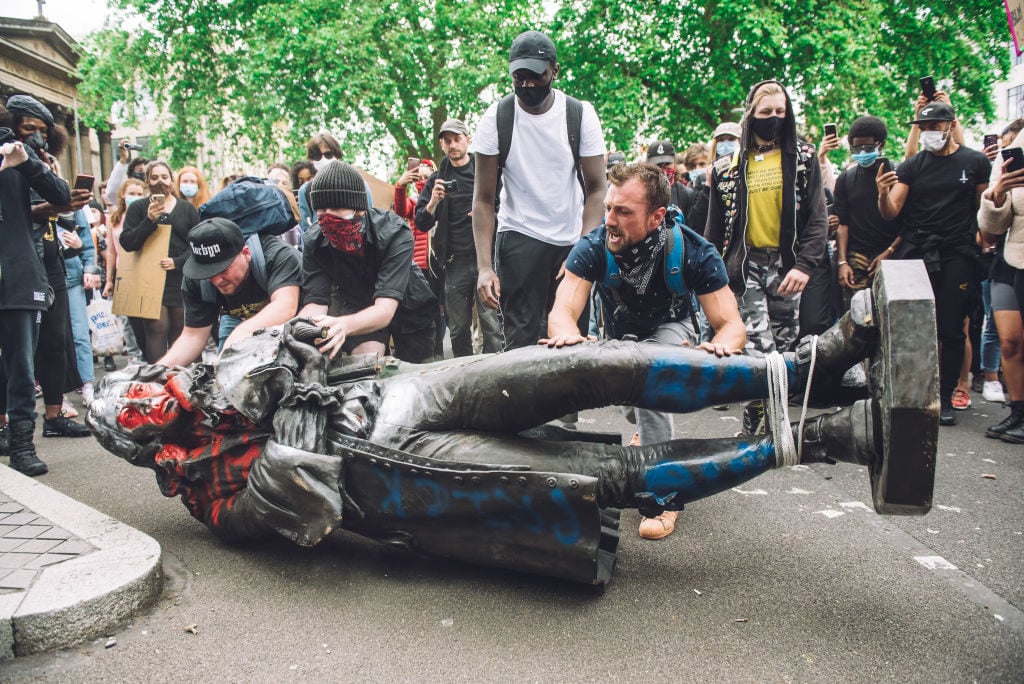
Protesters transporting the statue of
Colston towards the river Avon. Photo by Giulia Spadafora/NurPhoto
via Getty Images.
The artist Hew Locke, who has
been thinking about the symbolism in
these kinds of monuments for nearly two decades in his work,
explained his reaction to the toppling of the Bristol monument to
Artnet News. “I was
stunned, quite frankly, and I was quite emotional about it because
I have focused on these things for so long,” he says. “It reminded
me of when the Berlin Wall came down. You think that things will
never change—and all of a sudden radical change
happens.”
Confronting Violent Histories
In London, authorities quickly
removed a statue of another slave trader, Robert Milligan, outside
of the Museum of London Docklands yesterday, June 9, after a
petition to remove it gathered more than 2,000 signatures in 24
hours. The local mayor said in a video that the statue had become
“the focus of a lot of anxiety and anger” in the community, and
would be put into storage.
In response to the uproar, the
mayor of London, Sadiq Khan, vowed to review and improve “the
diversity of London’s public landmarks.” Khan also acknowledged
that “there are some slavers that should come down.”
Hew Locke says the mayor’s
decision is welcome, though he remains skeptical. A government
“review” could mean that the debate around monuments could
“drag out forever” until a “watered down” conclusion is
reached.
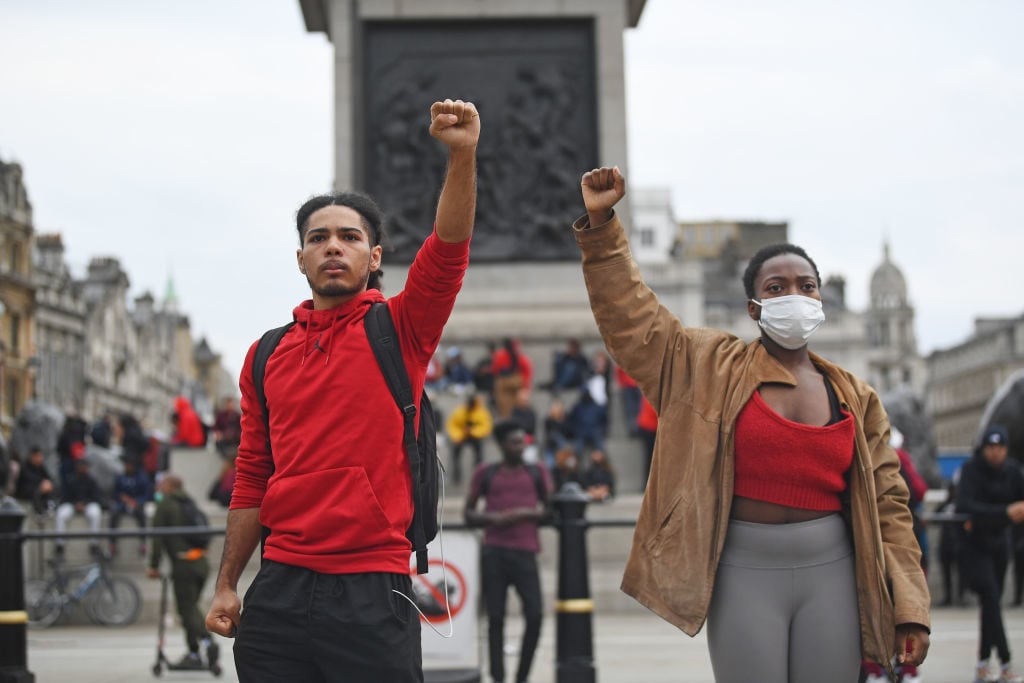
Protesters in front of Nelson’s Column
in London’s Trafalgar Square during a Black Lives Matter rally.
Photo by Victoria Jones/PA Images via Getty Images.
Taking decisive action about
removing some monuments will also inevitably raise questions about
others. While there are some monuments celebrating slave traders
that need to go, there are all sorts of other monuments that are
tied to that history in different ways.
“I think that this is where
things are going to get really heated and interesting, because what
do you do with people like Nelson?”, Locke asks. Lord Nelson is
regarded as one of Britain’s great seafaring heroes, and his statue
is an iconic part of London’s Trafalgar Square. It is seldom
mentioned as part of his legacy that Nelson was a vocal opponent of
abolishing slavery.
In Oxford, debate is resurfacing
over what to do with a controversial statue of the Victorian
imperialist Cecil Rhodes, which campaigners have been fighting to
bring down for years. The leader of Oxford City Council has
written to Oxford University’s Oriel College inviting
it to request planning permission to remove it from its Grade II
listed building, citing a “moral obligation to reflect on the
malign symbolism of this statue.”
And in Edinburgh, following
calls to remove the Melville Monument in St. Andrew Square, which
memorialized Henry Dundas, another staunch opponent of abolishing
the slave trade, the city council has promised to add a
contextualizing plaque setting out his links to the slave trade “as
quickly as possible,” after dragging its heels on for the past two
years.
The Legacy of Colonization
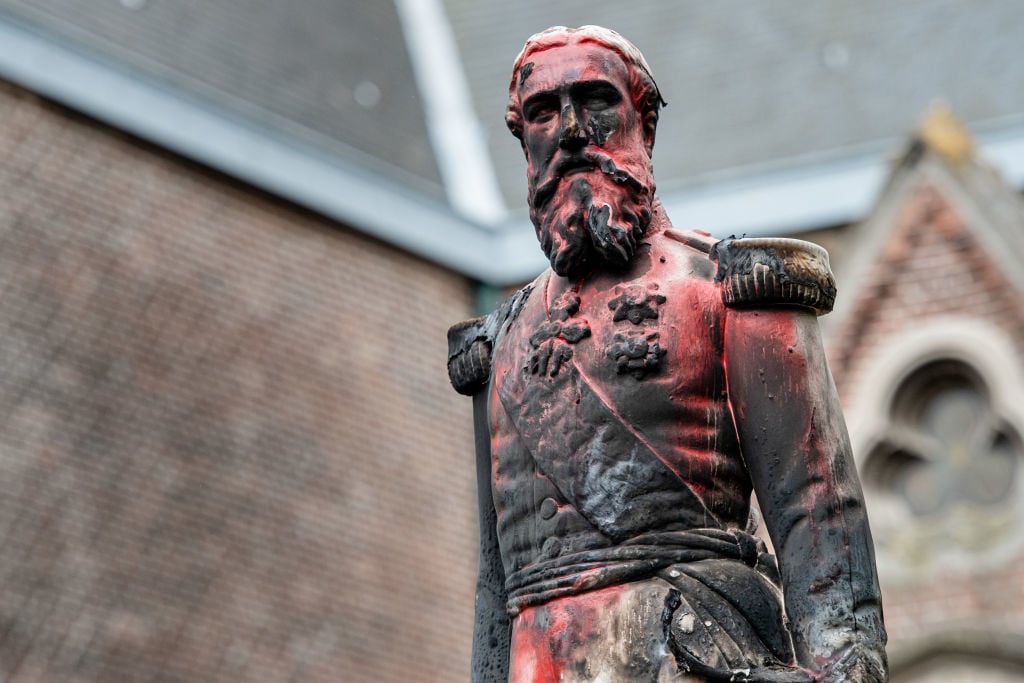
A statue of King Leopold II of Belgium
is pictured on June 4, 2020 in Antwerp after being set on fire the
night before. Photo by Jonas Roosens/Belga/AFP via Getty
Images.
The debate has also swelled
outside of the UK to Europe. In Belgium, campaigners have been
petitioning to tear down monuments to King Leopold II, a brutal
ruler who was responsible for brutalizing and killing millions of
people in Congo during the 19th century. Over the weekend
protesters targeted various statues of Leopold II in Brussels,
Antwerp, and Ghent. Yesterday morning officials in Antwerp removed
a statue of the monarch and transferred it to storage in the
Middelheim Museum.
“In Belgium, this conversation
has been going on since the ‘80s,” the Belgian historian Omar Ba
tells Artnet News, adding that activists have been increasingly
mobilizing to demand the removal of the statues over the past
decade.
“Regularly, different statues of
King Leopold II have been painted red or smeared, or even stolen
and hidden away,” Ba says. In 2004, activists actually removed the
hand from a statue of a Congolese man looking up at a horse-mounted
depiction of the king, a gory reminder of a common punishment that
was meted out to the Congolese population during Leopold’s
reign.
But it is not just statues of
Leopold that activists have been focusing on, with protesters
taking issue with all statues that have links with
colonization.
With regard to the statue that
was removed in Antwerp, Ba emphasizes that some press reports have
misrepresented the statement being made by local authorities by
removing the statue from public view. Protesters had painted the
sculpture red two weeks ago, and then last week significantly
damaged it by burning it.
“It’s not officially the removal
of a colonial statue; it is the removal of a damaged statue,” Ba
explains. It has been taken into storage, although the historian
adds, “I don’t think that they will be in a hurry to restore
it.”
Forward Momentum
While many agree that the
removal of offensive monuments from public spaces is long overdue,
one of the common questions raised by opponents is whether their
removal is a way of erasing history. This question has led many to
support relocating them to more appropriate settings such as
museums, or leaving them where they are but contextualizing them
with explanatory plaques or counter-monuments.
One thing stressed by Hew Locke
amid protesters’ victory over tearing down monuments is that the
very real and practical causes the Black Lives Matter demonstrators
are marching for should not be forgotten.
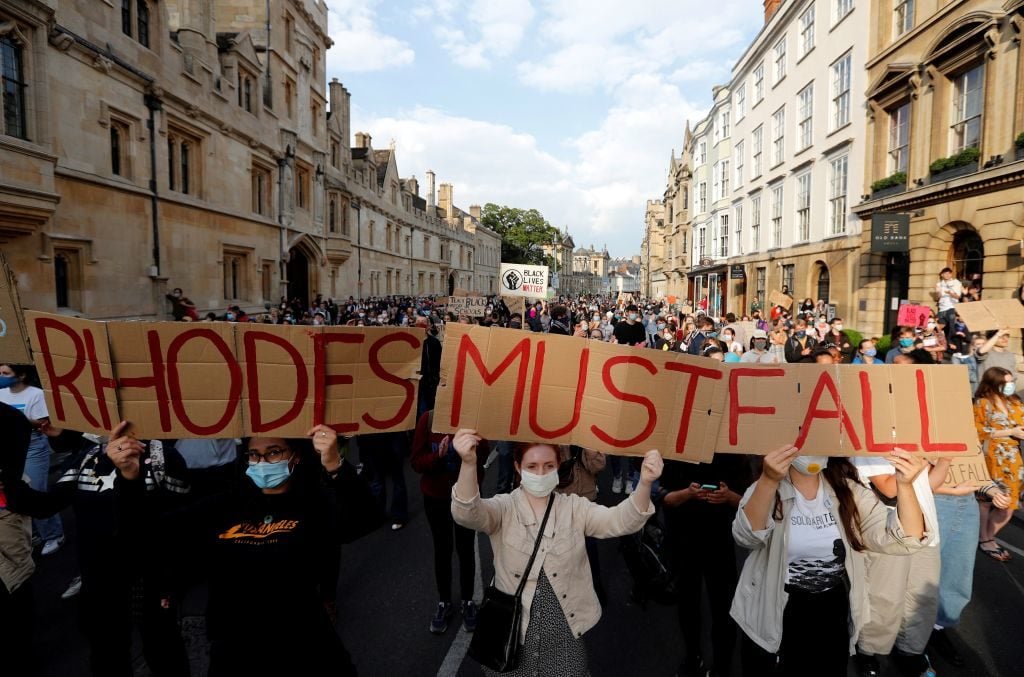
Demonstrators hold placards during a
protest arranged by the ‘Rhodes Must Fall’ campaign, calling for
the removal of a statue of British businessman and imperialist
Cecil John Rhodes, from outside Oriel College at the University of
Oxford. Photo by Adrian Dennis/AFP via Getty Images.
“This doesn’t solve the problems
of Black, Asian, and Minority Ethnic people in this country. It’s a
symbolic gesture,” Locke says. As we head towards another recession
that will likely disproportionately impact black and brown people,
it is time to think about the systemic changes society also has to
make. The artist emphasizes the need to teach and talk about
slavery and its legacy in schools.
Similarly, Omar Ba stresses the
need for the process of decolonization in society to go beyond
tearing down monuments. Among other things, Ba suggests a museum
that focuses solely on the issue of
colonization. “I think
that there should be a real Museum of Colonization like there is a
museum of the Holocaust so that people can reflect on that colonial
fact,” he says.
That setting would be an
appropriate one to display fully contextualized representations
from the era, as well as to
commemorate its victims and reflect on situations that were
produced by that history and its impact on current society.
“Institutions should be supporting these initiatives and showing
that society is ready to deal with its past,” Ba says.
The post Protests Targeting Colonial Statues in the UK and
Belgium Have Ignited a Long-Brewing Reckoning Over Racist Monuments
in Europe appeared first on artnet News.
Read more https://news.artnet.com/art-world/monuments-uk-belgium-1883412
Further reading


Leave a comment