
Researchers Reveal the Transformative Effect of Art Museums for People Living With Dementia
Dementia affects people’s memory and also how they think and
feel, but visiting an art museum can help alleviate depression and
reduce stress levels, researchers in Australia have discovered.
While the positive impact of
art on people’s mental health and wellbeing is increasingly recognized by doctors, a
recently released study by the University of Canberra
shows the significant benefits of experiencing art in a safe space
for those living with dementia.
The study published in
the Journal of Alzheimer’s Disease reported reduced levels of
depression, and improved quality of life, as well as cognitive
function, in people with dementia who participated in a special
program at the National Gallery of Australia in Canberra.
A group of 28 participants, each
supported by a carer or family member, took part in the six-week
program, which was followed up after 12 weeks. The art selected for
discussion included a mix of paintings, sculptures, and
textiles. The pieces were chosen to stimulate new thoughts
and perceptions of art, and to encourage different types of
discussion within the group.
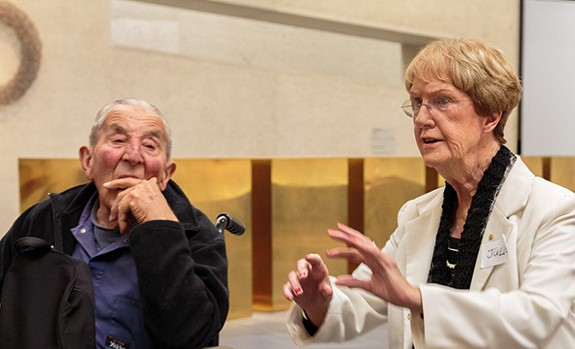
Participants in the National Gallery of
Australia’s Art and Dementia program. Courtesy of NGA,
Canberra.
Researchers broke new ground by
gathering saliva samples to test participants’ cortisol levels in
order to measure feelings of stress. According to the results, “the
HPA-axis function,” which is the human’s central stress response
system, was “altered following engagement in a specific and
tailored program for people living with dementia.”
Nathan D’Cunha, who led the
study, says there were notable improvements in the elderly
participants. “Some of the participants were selected by staff
at the aged care facilities because they were quite depressed, but
we didn’t expect them to become so talkative and animated after
only the first and second visits to the NGA,” he says.
D’Cunha, who is an academic
teaching nutritional science at the University of Canberra, adds:
“The use of anti-depressants in residential aged care in Australia
is quite common, and it was interesting to see that getting out of
the facility and coming to the NGA reduced depressive
symptoms.”
He says for some participants
there was a “stunning” difference after their museum visits. They
were “transformed and smiling while at the NGA,” he says.
Australia’s national art museum has
been organizing special tours of the collection for people with
Alzheimer’s and related conditions since 2007.
The post Researchers Reveal the Transformative Effect of Art
Museums for People Living With Dementia appeared first on
artnet News.
Read more https://news.artnet.com/art-world/research-dementia-art-museums-1718127
Further reading


Leave a comment