
Robert Frank, the Godfather of Snapshot Photography and a Pioneer of Everyday Realism, Has Died at Age 94
Robert Frank, a trailblazing
photographer known for fundamentally altering the landscape of
20th-century documentary art, has died. He was 94.
The news, first reported by the
New York Times,
was confirmed by Pace-MacGill Gallery head Peter MacGill, who
has represented Frank’s work since the gallery opened in
1983.
Frank’s 1959 photo book, The
Americans, which brought together 83 photographs from a series
of cross-country road trips he took earlier in the decade, is
widely regarded as one of most important books of its kind. It is
credited with spawning the gritty snapshot aesthetic that
influenced future photographers such as Lee Friedlander, Garry
Winogrand, Weegee, and others.
“Robert Frank, very simply, changed the way the world looks at
America,” MacGill told artnet News. “Through the unvarnished,
phenomenally capable eye of an immigrant, he saw us for what we
are.”

Robert Frank, Bus-Stop, Detroit
(1955). Collection Fotostiftung Schweiz, Winterthur. Gift of the
artist.
Frank was born in Zurich on
November 9, 1924, the son of a Swiss mother and German father.
After studying photography and graphic design in his home country,
he moved to New York at age 23, seeking a more progressive artistic
culture.
Through a series of hand-made,
hand-distributed photo books, Frank gained the attention of photo
giants such as Walker Evans, then a photo editor at
Fortune magazine; Alexey Brodovitch, art director at
Harper’s Bazaar; and Edward Steichen, the Museum of Modern
Art’s head of photography. All three wrote recommendations for
Frank’s 1955 Guggenheim Fellowship application, which would finance
the road trips that led to The Americans.
The photographer estimated that
he traversed some 10,000 miles on his trips and took more than
27,000 black-and-white frames with his Leica 35mm camera. Rather
than glorifying the country through well-lit, traditionally
composed pictures of the American sublime, he trained his lens on
the subject matter of the every day, foregrounding his own point of
view.
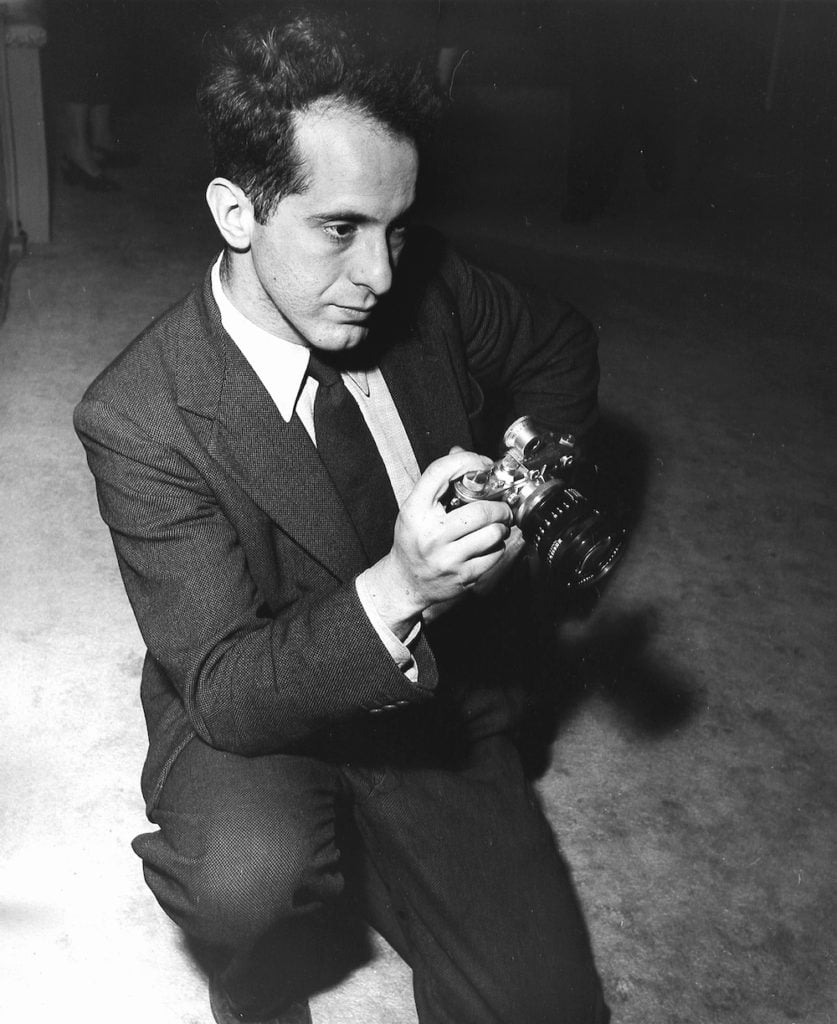
American photographer Robert Frank
holding a pre-war Leica camera, 1954. Photo: Fred Stein
Archive/Archive Photos/Getty Images.
Though the book initially met
with little fanfare, within several years it became recognized as a
landmark work of art that upended the staunch formalism of the
medium’s previous practitioners.
Thereafter, Frank settled back
in New York where he trafficked in a social circle of Beat
Generation personalities such as Jack Kerouac, Allen Ginsberg, and
Alfred Leslie. His practice turned increasingly toward filmmaking,
and he co-founded the New American Cinema Group with a number of
other artists and filmmakers, including Jonas Mekas and Peter
Bogdanovich.
In the early 1970s, Frank moved
to Mabou,
a small community on
Cape Breton
Island, Nova Scotia, where he lived until his
death.
“Robert was a dear friend for over 40 years and kept all of us
who knew him dancing with his wit, humor, and extraordinarily keen
intellect,” MacGill said. “It is an understatement to say that he
will be missed.”
The post Robert Frank, the Godfather of Snapshot Photography
and a Pioneer of Everyday Realism, Has Died at Age 94 appeared
first on artnet News.
Read more https://news.artnet.com/art-world/robert-frank-obituary-1646614
Further reading


Leave a comment