
Staff Force the Louvre to Close Its Doors and Venice Becomes a Ghost Town As Coronavirus Hits Tourism
Staff at the Louvre forced the
museum to close on Sunday due to growing fears over the spread of
the coronavirus. The move
comes after the French government became the latest to ban large
gatherings. Museums and
historic sites around Europe face a sharp fall in attendance
because of the disruption caused by the fast-spreading
virus.
Swathes of visitors were left
standing in line in the rain outside the Louvre yesterday, March 1,
as staff voted to close the Paris museum during an emergency
meeting. A union
representative tells AFP that staff voted “almost
unanimously” not to open the museum. It is unclear when the museum
plans to reopen. Artnet News contacted the Louvre for comment, but
did not hear back by press time.
On Saturday, the French
government banned gatherings of more than 5,000 people in an effort
to contain the spread of the virus. The country has so far
confirmed 130 cases, and two deaths. “The Louvre is a confined
space which welcomes more than 5,000 people a day,” the union
representative said. “There is real concern on the part of
staff.”
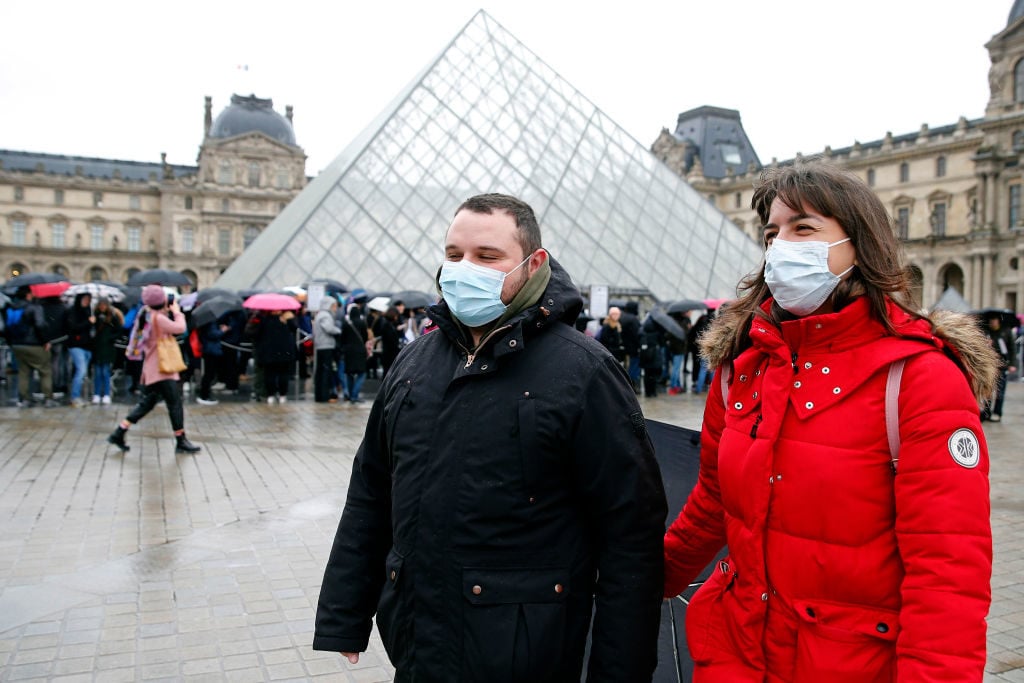
Tourists wearing face masks walk past
the Louvre Museum as the museum was closed for a staff meeting
about the coronavirus outbreak on March 2. Photo by Chesnot/Getty
Images.
Around 86,000 people have been
infected around the world, with cases in more than 60 countries,
and more than 3,000 deaths, the majority in
China. Last week, more
than $5 trillion was wiped from the global stock market over
concerns about the economic impact of the infection. Fears about the impact on
the art market are growing.
Meanwhile, the number of
coronavirus cases in Europe continues to rise sharply. The French
finance minister, Bruno Le Maire, warns the virus could impact
French growth “much more significantly” than previously thought,
according to Le Parisien. Museums
and cultural sites look set to see a drop in international tourism,
especially if the virus continues to spread into the high summer
season.
The European commissioner for
internal market and service, Thierry Breton, told the
French-language outlet BFMTV that EU member states recorded two million
fewer overnight stays in January and February, which amounts to a
loss of around €1 billion ($1.1 billion) each month. The fall is
being attributed to a drop in tourism from China, where the virus
first broke out in December.
At the end of January the
Chinese government blocked people from buying tour packages and
discouraged citizens from traveling abroad. France is a top
destination for Chinese tourists, around 2.2 million of whom travel
there each year. The Louvre is the most visited museum in the
world, and 75 percent of its 9.6 million visitors last year were
from abroad. The majority of oversees visitors come from the US but
China is now in second place, according to the museum.
As governments around Europe are
advising citizens to avoid non-essential travel to affected
countries, the economic impact from the lost tourism could be even
more severe. In Italy, which was the first European country to
report a significant spread of the disease, there are now 1,694
cases of the virus, and 41 people have died.
Last Monday, authorities shut down all museums in northern
Italy. In the city of
Venice, which is still recovering from severe flooding in November,
the annual carnival was ended early and the majority of tourists
have emptied out of the city. “We were waiting for the carnival to
get the economy going again after the acqua alta, but now we have a
new problem,” a shop worker tells the Guardian. While the flooding saw income drop by 40
percent at the end of last year, new figures suggest the virus
could cause a 30 to 40 percent dip in the first quarter of
2020.
In Germany, the number of cases
has risen to 129, and Switzerland, which has 27 cases, has also
banned large gatherings. On Friday, the Baselworld watch and
jewelry fair was postponed until 2021. It is organized by the MCH
Group, which was forced to cancel its 2020 edition of Art Basel
Hong Kong.
The UK has reported 36 cases so
far and is preparing for a further spread. UK prime
minister Boris Johnson
has called an emergency meeting today to discuss further measures,
which could also see restrictions on large gatherings.
As the number of coronavirus cases in the UK rises, the British
Museum in London says on its website: “We continue to closely
review the advice from Public Health England who assess the UK risk
as moderate,” and so it has made not changes in its operations.
Today it updated that advice, adding: “The safety of our staff and
visitors is of the utmost importance and we keep situations like
this under active review and update advice issued accordingly.”
The post Staff Force the Louvre to Close Its Doors and
Venice Becomes a Ghost Town As Coronavirus Hits Tourism
appeared first on artnet News.
Read more https://news.artnet.com/art-world/coronavirus-louvre-europe-economy-1790850
Further reading


Leave a comment