
The Gray Market: Why Sterling Ruby’s Fashion Shows Won’t Save the Art Market (and Other Insights)
Every Monday morning, artnet News brings you The Gray Market. The column decodes
important stories from the previous week—and offers unparalleled
insight into the inner workings of the art industry in the
process.
This week, asking whether
fashion is really the art world’s antidote, and vice
versa…
PITTI PARTY
On Monday, the New
Yorker published a
saga from Christina Binkley about cross-disciplinary-art phenom
Sterling Ruby’s journey to produce his first fashion line. Debuted
at the prestigious Florentine menswear showcase Pitti Uomo in June,
Ruby’s label, S.R. Studio LA. CA., has become an increasingly
significant focus of his practice in recent years, in no small part
because he sees the runway as a viable course of treatment for the
art market’s ills. But the piece highlights again and again that
the two industries are already too similarly afflicted for either
to cure the other’s most frustrating symptoms.
First, though, the background:
Ruby, who began designing and sewing his own clothes as a teenager,
has spent much of the past two years building up a serious fashion
infrastructure at his Vernon, California studio complex. Aside from
usurping a “supermarket-size room” on the grounds to serve as its
headquarters, S.R. Studio boasts a robust staff including “a
general manager, a head of production, two sample-makers, and
several consultants,” per Binkley. She also notes near the story’s
conclusion that Ruby’s longtime studio director “now spends half
his time on the fashion company.”
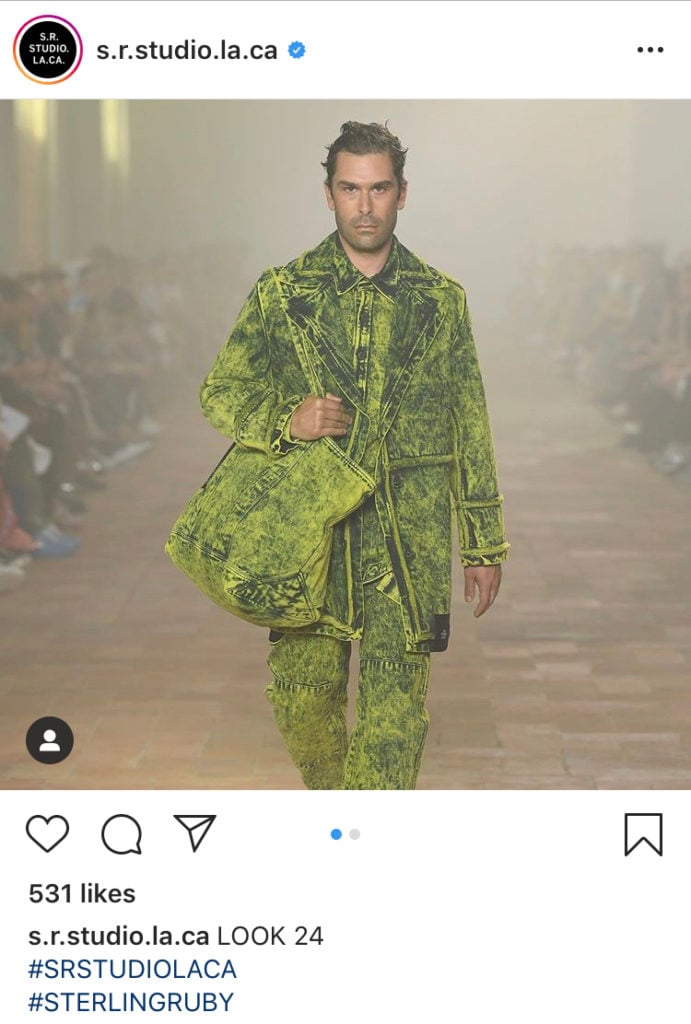
A look from the debut collection from
Sterling Ruby’s clothing line, S.R. Studio LA. CA. Photo via
Instagram.
Close observers of Ruby’s work
know that he has been steadily marching toward this inflection
point for years. His collage-paintings have often incorporated
fabric scraps. He sometimes ornaments his sculptures and
installations with dyed yarn, and his “soft sculptures” are
essentially enormous, gleefully demented plush toys. He has also
assembled a rich working history with couture designer and former
fashion-house creative director Raf Simons, who has commissioned
Ruby to design runway backdrops, interiors for his own boutique and
the Calvin Klein flagship store, and, in 2014, even a collaborative
collection of menswear.
As Binkley notes, plenty of
artists have dabbled with the runway over the years, and fashion
luminaries such as Helmut Lang—now an aspiring
sculptor after retiring
from his revered label in 2005—have tried to permanently cross over
in the opposite direction. Still, Ruby’s S.R. Studio endeavor
counts as the first time a significant visual artist has birthed an
entire fashion line, let alone one taken seriously by the
Devil Wears Prada
set.
Personally, I support Ruby’s
commitment to branching out. I’m just skeptical that couture solves
the larger economic and philosophical problems disillusioning him
about the contemporary-art world.
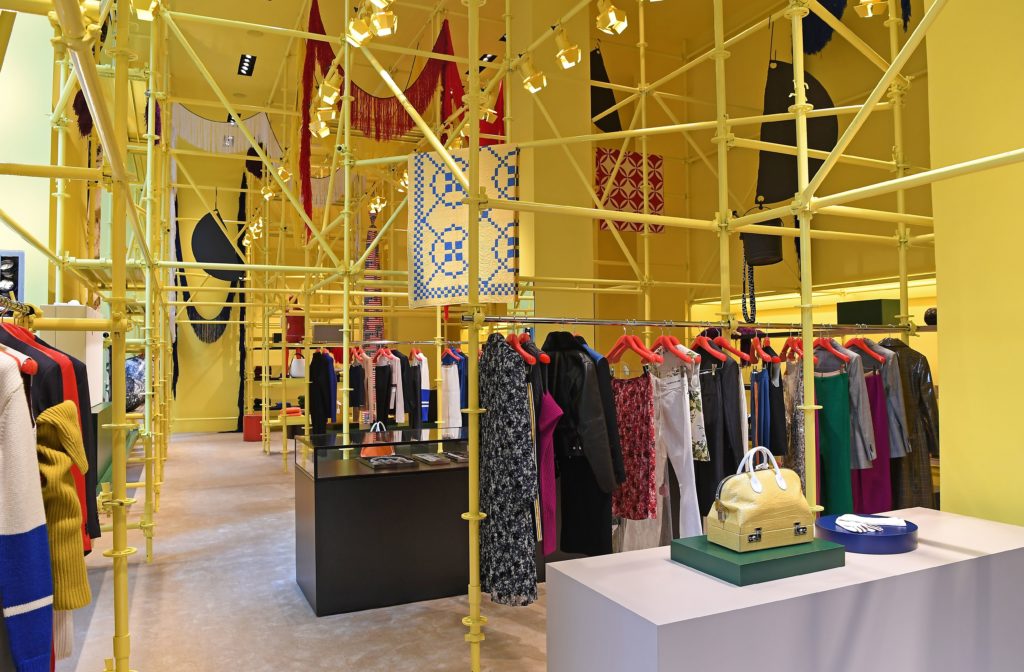
Interior view of the 2017 redesign of
the Calvin Klein Store on Madison Avenue, featuring a
floor-to-ceiling installation by Sterling Ruby and the debut of Raf
Simons Fall 2017 collection. Photography by ANGELA WEISS/AFP/Getty
Images.
SIX OF ONE, HALF A DOZEN OF THE OTHER
At multiple points in the piece,
Ruby stresses that his apparel line is an expansion of his
gallery-and-museum mandate, not an attempt to opt out of it. Yet
the clothes aren’t just about aesthetics or creative adventure for
him. Here’s Binkley relaying Ruby’s ideological hopes for S.R.
Studio:
He’d told me that one of the
reasons he wanted to branch out from art is that he views that
world as becoming too commodified. He hoped that producing clothing
would be a way of democratizing his work, making it available to a
wider audience….
And later:
“I’m restless about art,” [Ruby] told me, during a final model-casting session. “I’m not excited
about what art has become, as an industry. I think it’s become very
investment-heavy, with people looking at artists like racehorses. I
don’t think it’s making artists do better work.”
Setting aside the mention of
“democratizing” art—always a trigger for me, and one we’ll come
back to soon—I’m super sympathetic to this viewpoint. In the past
20 years, artists have become heavily disincentivized to experiment
and/or indulge in extended research and reflection for the sake of
advancing their practice. The art market has mutated into a volume
business in thrall to strict production cycles. As I put it back in
2014,
many gallerists and collectors now
“have little interest in going along with artists on a surprising,
challenging journey. Commodities are not meant to be challenging.
They are meant to be intuitive. The longer it takes to understand
them, the harder it is to flip them to the next buyer.”
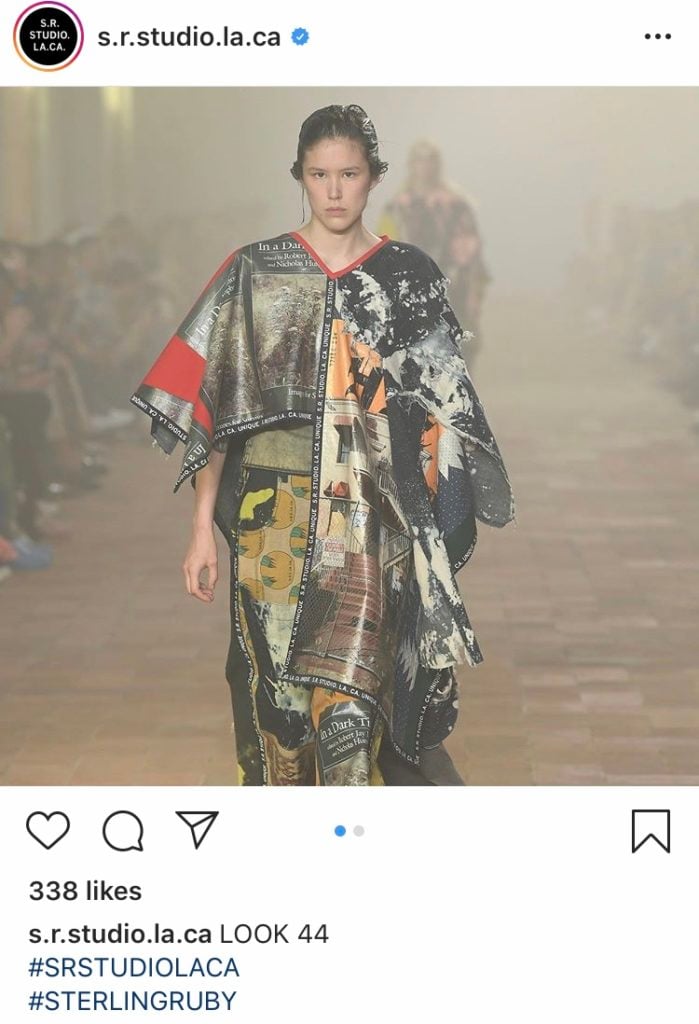
A look from the debut collection from
Sterling Ruby’s clothing line, S.R. Studio LA. CA. Photo via
Instagram.
So why am I skeptical that the
runway will save Ruby or other artists from the hyper-capitalist
rat race that is the art industry? Because his confidant Raf Simons
seems to be sick of the fashion industry for the exact same
reasons! Here’s Binkley again:
Although he continues to design
his own menswear line, from Belgium, [Simons] told me that he was
having second thoughts about fashion altogether. Rather than
produce seasonal collections, he is contemplating showing his
designs along with the work of other artists and designers,
inspired by the Bauhaus model…. He added that for years he had been
thinking of becoming an artist. I asked what was holding him back.
“Fear, of course!” he replied.
In other words, Ruby wants to
use fashion to short-circuit the hyper-commodified art-world
treadmill, and Simons wants to use art to short-circuit the
hyper-commodified fashion-world treadmill. (Binkley relays that
Ruby, too, “has no interest in churning out collections every three
to six months,” preferring instead to “make clothes on his own
timetable.”)
To me, this isn’t even like the
yin-yang longing of so many married versus single people, where the
former envies the latter for the freedoms they enjoy, and the
latter envies the former for the love and trust they can rely on.
Those jealousies are at least spawned by genuinely inverse
scenarios. In contrast, Ruby and Simons have the same complaints about their native domains, and they’re each
looking across the fence hoping to find the same answer on the opposite side. Kinda seems like a
warning sign, no?
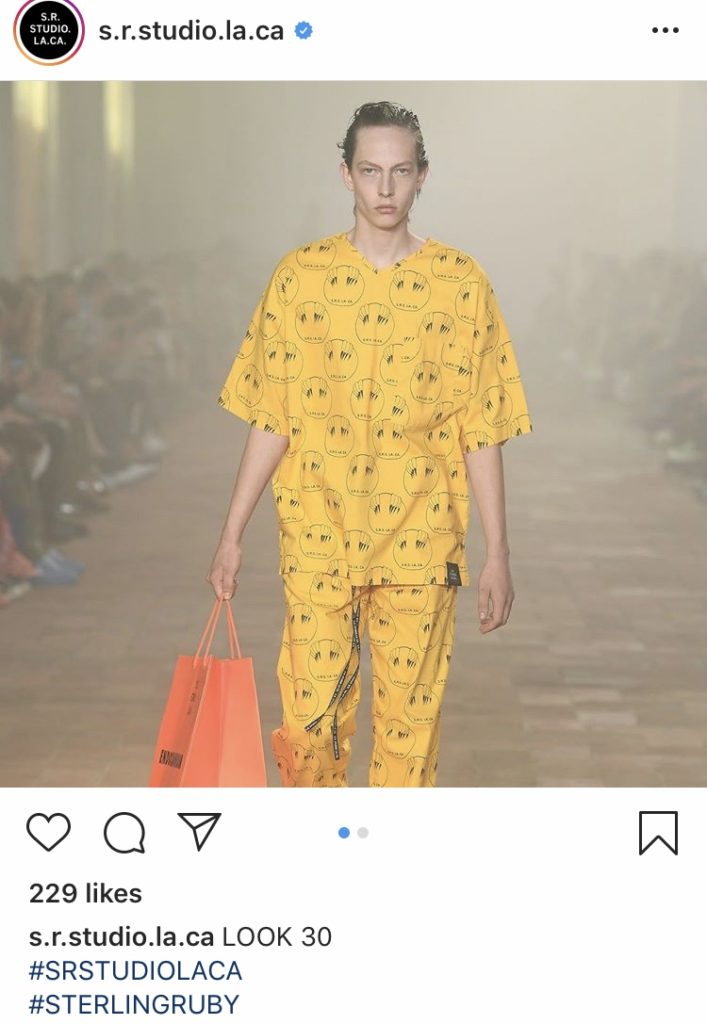
A look from the debut collection from
Sterling Ruby’s clothing line, S.R. Studio LA. CA. Photo via
Instagram.
CAPITAL GAINS
If you think I’m just stirring
the pot with conjecture, I’m sorry to say that the early financial
returns for S.R. Studio put some real meat into this
gumbo.
Haunting Ruby’s dreams of
connecting with a larger cross-section of the public through
fashion is his label’s pricing structure. On the high end of the
scale, the inaugural S.R. Studio collection includes a handful of
unique, hand-worked pieces costing between $40,000 and $45,000
each. But on the “low” end are ready-to-wear offerings like
t-shirts, leggings, and denim… all priced at $400 and
up.
Binkley hits the conundrum right
between the eyes by writing that Ruby “seemed to think that the buyers of $400
t-shirts would be a different order of consumer from the buyers of
million-dollar paintings.” Of course, Ruby’s perception pans out in
only the most superficial way, as exemplified by a post-Pitti-Uomo
scene in which the teen grandchildren of mega-collectors Don and
Mera Rubell all go online to cop S.R. Studio ready-to-wear
items.
It turns out that even this
prank version of populism—I’m tempted to start referring to it as
the “de-mock-ratization of art”—is an exception rather than the
rule. Binkley reports that, shortly after the runway show, Ruby’s
label “had received inquiries for nearly every one of the eight
unique pieces,” including from “several” museums. But the t-shirts
and sweatshirts designed for mass consumption “went largely unsold”
by the time she finalized her piece, while the more
expensive limited-edition
garments, such as $2,495
hand-dyed prairie dresses, “sold briskly.”
To sum up, then, the fashion
project Ruby embarked on to bring his work to a wider audience at
lower prices instead reinforced the strength of the same
high-priced scarcity model that helped sour him on the art world in
the first place. And given that his friend Simons straight-up told
us that he fantasizes about escaping the traditional fashion grind
largely to produce less work—or at least produce work less
often—and exhibit it alongside that of artists, I don’t think the
outcome should have hit anyone with the unexpected force of a
falling window air-conditioner.
I applaud Ruby for pushing
himself out of his comfort zone with the S.R. Studio line. I agree
with his critiques of the high-speed, low-risk 21st century art
market. Based on the rhetoric and results in Binkley’s piece, I
just don’t think the high-fashion model is the balm for those
maladies (even if it’s decoupled from the seasonal cycle). Instead,
to find real solutions, we have to follow the lead of Ruby’s runway
models, and keep walking.
That’s all for this week. ‘Til
next time, remember: the grass isn’t always greener on the other
side, but it sure as hell tends to look that way.
The post The Gray Market: Why Sterling Ruby’s Fashion Shows
Won’t Save the Art Market (and Other Insights) appeared first
on artnet News.
Read more https://news.artnet.com/opinion/sterling-ruby-fashion-line-1645129
Further reading


Leave a comment