
The National Geographic Society Was About to Destroy This Sculpture to Make Way for a Plaza. After a Backlash, It’s Being Forced to Reconsider
Plans to renovate and expand the entry plaza of the National
Geographic Society in Washington, DC, which would have included the
controversial removal of Marabar, an acclaimed 1984
sculptural installation by American artist Elyn Zimmerman,
have run into a speed bump.
After getting more than two dozens letters of
protest regarding the proposed removal of the artwork,
including one from Adam Weinberg, the director of the Whitney
Museum of American Art, the city’s Historic Preservation Review
Board has reconsidered its approval of the project, which was
issued last August.
The board is now advising the National Geographic
Society to revise its blueprints and “strongly consider
retaining the sculpture in some form, possibly relocating it
somewhere on the site as part of a new concept, or if not, why that
is not at all possible,” panel chairwoman Marnique
Heath said.
“It’s made this lockdown feel a lot better,” Zimmerman told the
New York Times about the latest
development.
The advocacy group Cultural Landscape Foundation mounted a
campaign to save the work on March 31 as part of its efforts to
preserve threatened works of landscape architecture. The
organization argued that the National Geographic Society had
neglected to mention the artwork or its importance in presenting
its initial renovation plans.
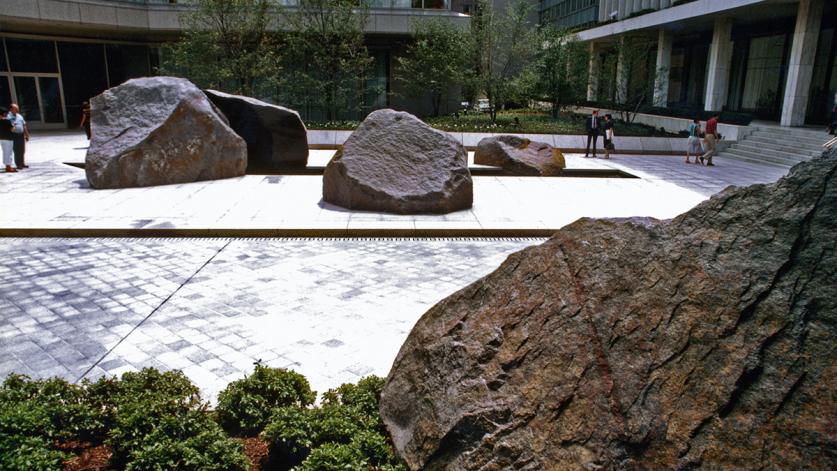
Elyn Zimmerman, Marabar (1984) at
National Geographic Society Headquarters, Washington, DC. Photo
courtesy Elyn Zimmerman.
In a statement following the board’s latest decision, Cultural
Landscape Foundation CEO Charles A. Birnbaum applauded its decision
and urged the National Geographic Society to work with its
architects and Zimmerman “to develop a design that meets the
Society’s programmatic needs and
retains Marabar.”
The society declined to comment on the decision, but had argued
previously through a lawyer that “Marabar is not
historic” and that its removal was necessary to build a
much-needed entrance pavilion.
When the society first decided to remove Marabar,
it invited Zimmerman to relocate the piece at the organization’s
expense. But Zimmerman claims she was unable to find a suitable
home for the massive, technically complex work, which involves
a hydroelectric system to keep water flowing.
Mined from granite quarries in Minnesota and South Dakota, the
boulders in the work collectively weigh over a million pounds, and
were installed in their current location only after the plaza was
engineered to hold them.
Named after the Indian caves featured in E.M. Forster’s “A
Passage to India,” Marabar features five
boulders surrounding a 60-foot-long rectangular pool of water. It
was the artist’s first large-scale and permanent public
artwork.
The post The National Geographic Society Was About to
Destroy This Sculpture to Make Way for a Plaza. After a Backlash,
It’s Being Forced to Reconsider appeared first on artnet
News.
Read more https://news.artnet.com/art-world/national-geographic-society-campus-zimmerman-1874049
Further reading


Leave a comment