
The New Empire Builders: How Pace and Other Art Dealers Are Reinventing What a Gallery Space Should Do
When Pace unveils its new eight-story gallery on 540 West 25th
Street this week, the building will stand as a symbol of the
lengths art dealers must now go to stay on top in the increasingly
competitive elite art market.
The scale—and the costs—are staggering. Inside Pace’s
74,500-square-foot volcanic stone-clad building, which happens to
be larger than the Met Breuer, are novel exhibition spaces and
private viewing rooms; 2,200 square feet dedicated to showcasing
new media work, performance, and public programming; a
10,000-volume research library open by appointment; and the kind of
open storage that is becoming increasingly popular among new
contemporary art museums. There is also a garden for sculpture on
the roof, which can support art that weighs as much as 360 tons
(not to mention a food truck for visitors).
This transformation does not come cheap. The building cost an
estimated $80 million, according to
reports, plus an additional $18.2 million to
build out the interior. Oddly enough, Pace does not own even the
building designed by New York-based firm Bonetti / Kozerski, but
rather is leasing it from the developer Weinberg Properties.
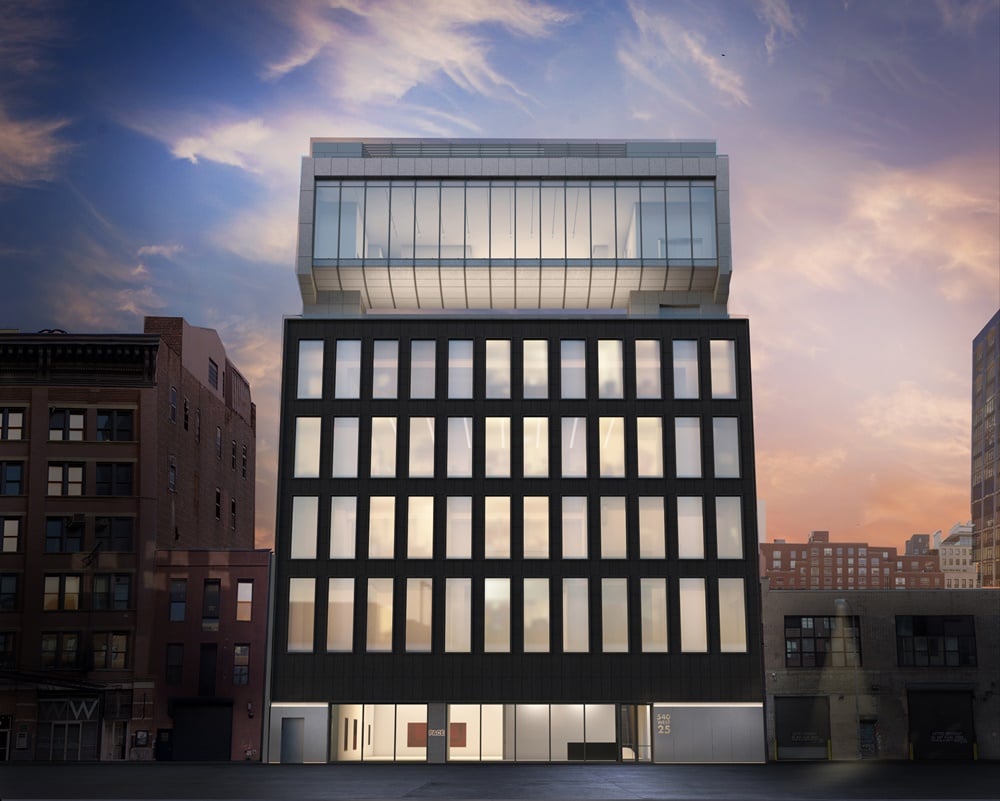
Rendering of Pace Gallery’s new HQ at
540 West 25th Street, New York. Image: Bonetti /Kozerski
Architecture.
In essence, the new, multi-faceted Pace building recasts the
very notion of an art gallery and represents an increasingly
pronounced shift in Chelsea away from smaller, modest showrooms and
toward flashy, starchitect-designed bonanzas. Notably, the cost of
Pace’s project is on the same level as the New Museum’s $89 million
capital campaign.
But while the construction cost and the amenities are akin to
those for any major museum, “the decided difference is that unlike
museums, dealers are totally profit driven,” says Mark Walhimer, a
partner at the consultancy Museum Planning, LLC.
Looking Toward Retail
It might seem counterintuitive that Pace and other major
galleries are doubling down on brick-and-mortar at a time when
retail is in crisis. There are now more than 20 empty storefronts
on Madison Avenue. But the idea is that by transforming galleries
into spaces for experiences and injecting dance, film, and music—a
growing trend in the retail sector—galleries can become hubs of
activity yet again.
For Pace, this concept has already proven lucrative. The
mega-gallery may have roped in as
much as $10 million in ticket sales alone
from their teamLab exhibitions in Palo Alto, London and Beijing,
which drew more than half a million people and charged $20 each for
admission.

teamLab’s Universe of Water
Particles on a Rock where People Gather, 2018. Image courtesy
of Pace Gallery.
Incorporating dedicated space for performances and screenings is
also a gamble that may help the gallery lure new multimedia
artists, such as Nick Cave and William Kentridge, to join its
roster.
But Pace has competition in the realm of high-gloss buildings.
In all, at least eight Chelsea dealers—including Marlborough
Gallery, Hollis Taggart, and others—are ramping up in scale and
plunking down considerable sums for new quarters. Hauser & Wirth is
adding 542 West 22nd Street, a new 7,400-square-foot building
designed by Annabelle Selldorf that will include private viewing
rooms.
David Zwirner is also in the process of building a five-story, $50 million
flagship at 540 West 21st Street, due to open in 2021. It will
be the first commercial gallery designed by the Pritzker
Prize-winning architect Renzo Piano, who lent his talented hand to
the Whitney Museum of American Art in New York.
And Larry Gagosian, whose empire spans 178,000 square feet
globally, with five spaces in New York alone, is also ramping up
his Chelsea enterprise. He is now renting the former
quarters of Mary Boone and Pace adjacent to his
26,000-square-foot gallery on West 24th Street. He paid $5.75
million to buy his Chelsea gallery in 1999, according to realtor
Susan B. Anthony.
Keeping Up With the Joneses
The largest galleries are not the only ones shelling out
millions of dollars to remain competitive in the space race.
Lehmann Maupin acquired three floors
of a building in Chelsea—a total of 7,800 square feet—for $27
million, according to Ran Korolik, partner of the real estate firm
the Victor Group, which developed the building. The new space
opened last year.
The goal for these galleries appears to be to maximize the space
available not only to artists, but also to collectors. Paul
Kasmin’s latest space on 28th
Street includes three private viewing rooms totaling 3,400
square feet, while a mere 460 square feet is set aside for public
exhibitions and offices. Viewing rooms “allow us to spend
uninterrupted time with collectors and curators in order to discuss
a single work in detail,” says Nick Olney, a Kasmin director.
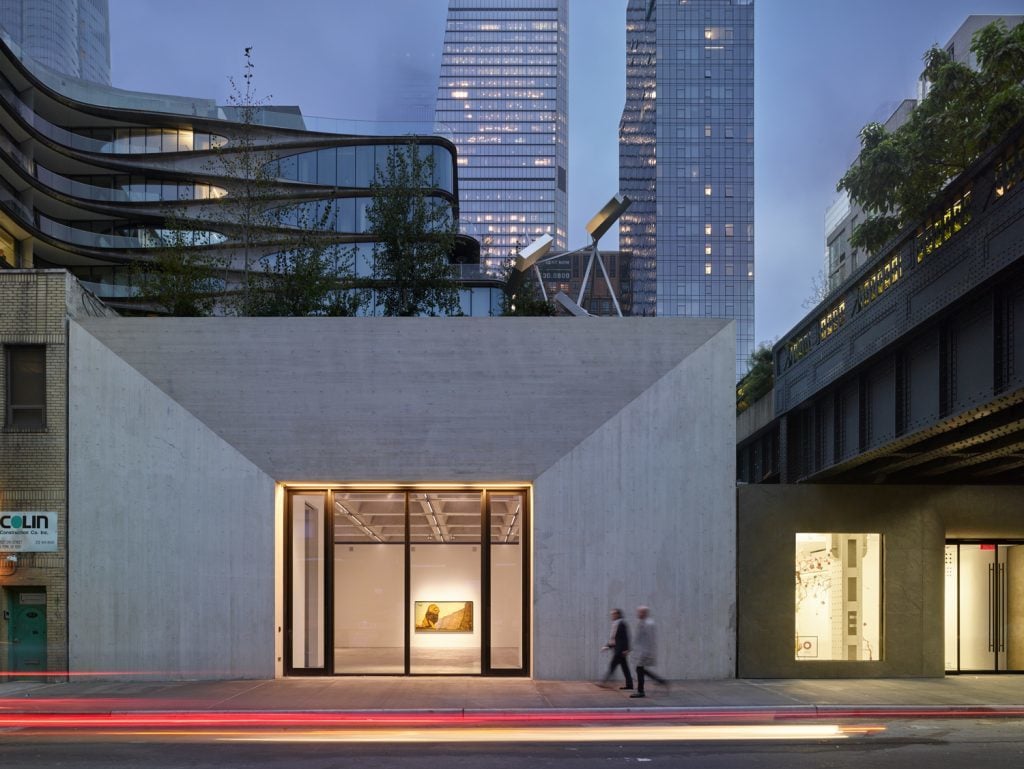
The facade of Kasmin Gallery, Photo
Courtesy Kasmin Gallery, © Roland Halbe.
That expansion connects to Kasmin’s 509 West 27th Street
flagship, which is studded with a stunning 28 skylights and cost a
reported $8 million, according to one source.
What’s Ahead
Are such gargantuan expansions sustainable, considering their
hefty price tags? It seems likely, as West Chelsea continues its
transformation into a high-gloss destination for billionaires and
millionaires (as well as tourists) thanks to the massive $20
billion Hudson Yards development.
But as mega-galleries erect giant art fortresses in Chelsea,
smaller dealers are cashing out and fleeing to less competitive and
expensive shores. Longtime Chelsea dealers Leslie Tonkonow and
Julie Saul have picked up stakes and are now dealing privately.
Andrea Rosen and Luhring Augustine recently sold their joint 24th
Street space to a developer for $18 million. And Murray Guy, Mike
Weiss, Kansas, and even the 25-year stalwart CRG Gallery have
shuttered their doors in recent years, while Cheim & Read vacated its Chelsea
storefront for a small gallery uptown.

Christopher Wool’s Apocolypse Now
at Christie’s. (Photo by rune hellestad/Corbis via Getty
Images)
Meanwhile, a number of dealers, including P.P.O.W., Andrew
Kreps, and Bortolami, have opted to relocate to Tribeca.
“Chelsea just got to be too corporate for us and our identity,”
P.P.O.W.’s Wendy Olsoff recently told ARTnews. “It just didn’t
match anymore.”
Still, boosters of the neighborhood maintain that Chelsea will
always have a place in New York’s cultural ecosystem, even as
scrappier galleries leave in droves. “The bottom line is that the
buildings with multiple tenants will dwindle as residential and
office buildings will take over,” says Louis Puopolo, co-head of
operations at real estate firm Douglas Elliman. “Even though it
will be the survival of the fittest, Chelsea will remain vibrant as
a gallery district.”
The post The New Empire Builders: How Pace and Other Art
Dealers Are Reinventing What a Gallery Space Should Do appeared
first on artnet News.
Read more https://news.artnet.com/market/mega-galleries-expansion-1646140
Further reading


Leave a comment