
The Notorious Collection of Nazi-Looted Art Amassed by Hildebrand Gurlitt Will Travel for a Poignant Show in Jerusalem
The infamous Gurlitt trove—roughly 1,590 artworks that the
reclusive Cornelius
Gurlitt inherited from his art dealer father, a Nazi
collaborator, and kept hidden in his apartment for decades—is
coming to Israel. An exhibition of some 100 pieces from the
collection, including works by Pierre-Auguste Renoir, Édouard
Manet, Otto Dix, and Max Ernst, as well as
never-before-seen Eugène Delacroix drawings, will go on view
at the Israel Museum later this month.
Amassed by Hildebrand Gurlitt,
the art collection was discovered by German authorities during a
2012 tax investigation. Given the elder Gurlitt’s known work with
the Third Reich, the provenance of the works, found in Munich and
Salzburg, immediately came into question. How many of them had been
sold under duress by Jewish families, or seized outright by the
Nazis?
The Israel Museum exhibition, titled “Fateful Choices,” marks
the first time that works from the Gurlitt hoard have made the trip
to Israel. The show will include Otto Mueller’s Portrait
of Maschka Mueller, declared “degenerate” by the Nazis and
acquired by Gurlitt in 1941, as well as Dix’s Self
Portrait Smoking, seized by the US Army in 1945 and returned
to Hildebrand Gurlitt in 1950. Other works, like Ernst’s collage
(Woman Soldier House), have no red flags that might
indicate ties to the Nazis.
“The historical circumstances behind the Gurlitt Art Trove make
it our responsibility to expose the works and the story to the
public,” said the museum’s director, Ido Bruno, in a statement. “’Fateful
Choices’ describes the fate of art in Europe in the dark years
of the Third Reich regime and generates a profound discussion about
the connection between art and ethics, as well as the difference
between political preferences and personal taste.”
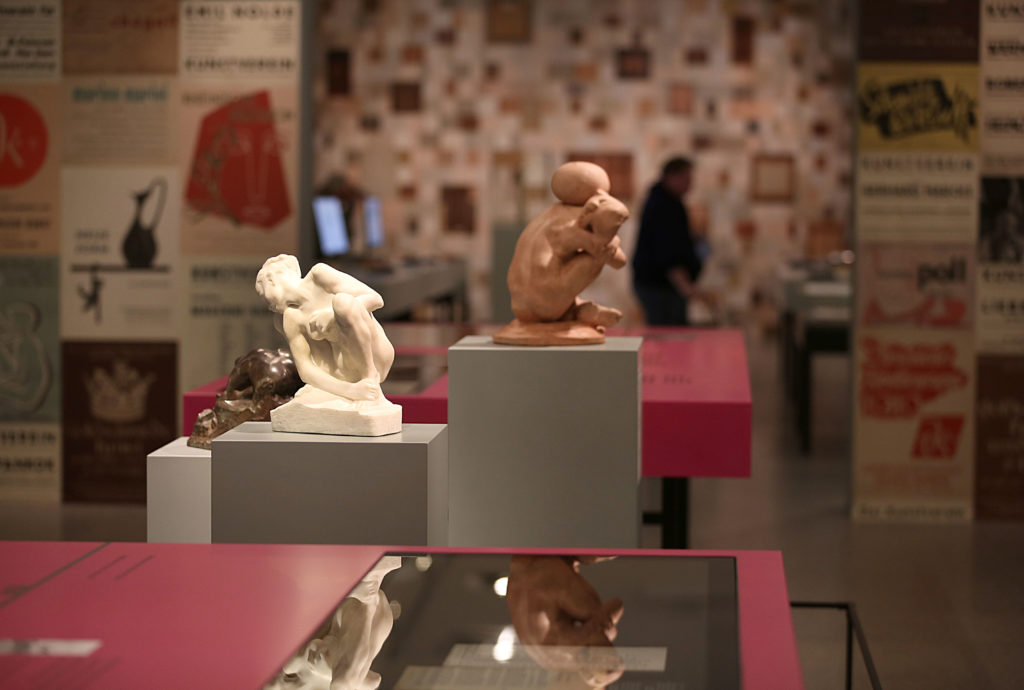
Sculptures by Auguste Rodin at the
exhibition “Inventory Gurlitt” in Bonn, Germany, at the
Bundeskunsthalle. Photo by Oliver Berg/picture alliance/Getty
Images.
Before Gurlitt’s death, he bequeathed his entire collection to
Switzerland’s Kunstmuseum Bern. The museum, which is
helping to organize the Israel Museum show, held the first
exhibition of the works in a joint presentation with the
Bundeskunsthalle in Bonn, Germany, in 2017 and 2018.
In Jerusalem, the show will address issues of provenance head
on—and an ongoing, state-led Gurlitt Provenance Research Project is
working to identify any potentially looted works with an eye toward
restitution. (There have been six stolen pieces found to date.)
When the exhibition was
announced in October, Monika Grütters, Germany’s federal
government commissioner for culture and the media, told the press that she
hoped it would boost efforts to identify Jewish owners of the
art.
“We wanted to be open and transparent and to show the German and
international public what was effectively in this Gurlitt trove and
to make clear the background history, the art dealing during World
War II and the Nazi period,” Rein Wolfs, director of the
Bundeskunsthalle and a member of the Israel Museum’s exhibition
advisory committee, told the Times of
Israel. “It’s a lot of questions, and touchy questions of
restitution.”
“Fateful Choices: Art from
the Gurlitt Trove” will be on view at the Israel Museum, Derech
Ruppin 11, Jerusalem, Israel, September 24, 2019–January 24,
2020.
The post The Notorious Collection of Nazi-Looted Art Amassed
by Hildebrand Gurlitt Will Travel for a Poignant Show in
Jerusalem appeared first on artnet News.
Read more https://news.artnet.com/exhibitions/gurlitt-trove-israel-1644586
Further reading


Leave a comment