
Thirty Years After Opening Her Gallery With an All-Female Roster, Barbara Gross Reflects on How the Market Has—and Hasn’t—Changed
The German art world was surprised when stalwart gallerist
Barbara Gross announced last week she would be closing her gallery
after more than three decades in the business. But the veteran
Munich-based dealer, who was an early champion of female artists,
has decided to end on a high note.
“It had nothing to do with economics, it was more that I
realized that I had to slow down,” Gross tells Artnet News. She
acknowledges that juggling her gallery program with art fairs has
been a challenge, which many founder-directors of
ambitious smaller galleries will recognize. “I never had
someone who could just take up going to a fair instead of me and
make sure that it works,” she says.
For the past three decades, Gross has represented or
collaborated with many great female artists, including VALIE EXPORT
and Miriam Cahn as well as the late Maria Lassnig, Louise
Bourgeois, and Nancy Spero. Back in 1988, when Gross opened her
gallery, art stars were predominantly male, especially in Germany.
And while gender equality is still a long way off today, many
important female artists at the time were relatively unknown and
their works were even more undervalued than they are now.
Though Gross’s gallery has always been a small operation, her
shows were well-respected and influential curators, including Hans
Ulrich-Obrist and the late Okwui Enwezor, have been speakers at her
openings.
Gross decided to shutter her gallery in the fall of last year.
Announcing it last week amid Germany’s lockdown was coincidental,
but still painful: She was forced to shutter her final show early,
an exhibition juxtaposing the works of Silvia Bächli and the late
Marthe Wéry.
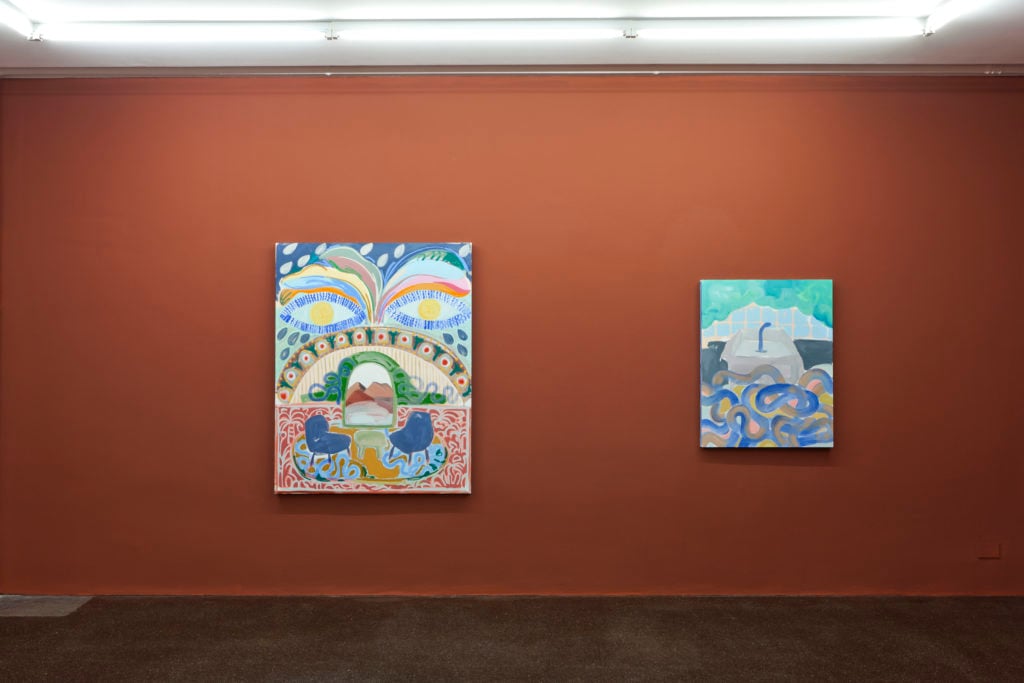
Sol Calero Pasaje del olvido
(2019). Installation view, Barbara Gross Galerie. Photo: Wilfried
Petzi
Still, Goss knows first-hand what it takes to weather tough
times. She survived the global recession in 2008, and German’s
economic downturn in 2003. “One has to reduce in moments like that,
and no one will get the money they are looking for,” Gross
says.
Asked about what she would advise dealers in the current crisis,
Gross recommends thinking about the big picture. “It is a good time
to rethink what one wants with their gallery,” she says, adding
that dealers need to find out who is really interested in their
artists, and focus on selling substantial works by them. “In
difficult times, you need to be more specific [with your
offers to collectors],” she says.
Back in the 1980s
Gross opened her gallery after studying art history and being
active in the women’s movement. Frustrated by the
underrepresentation of female artists in museums, she launched her
program in 1988 with only women artists, focusing on producing
editions with Austrian artists VALIE EXPORT and Lassnig, among
others. Her first group show included Hannah Collins, Katharina
Sieverding, and Nancy Spero, some of whom she gave their German
debut.
While it was not uncommon to see female gallerists at the time
(there was Monika Sprüth and Philomene Magers in Germany, Maureen
Paley and Victoria Miro in London, and Marian Goodman in New York,
to name a few) it was unusual for a dealer, male or
female, to organize a program centered entirely on women.
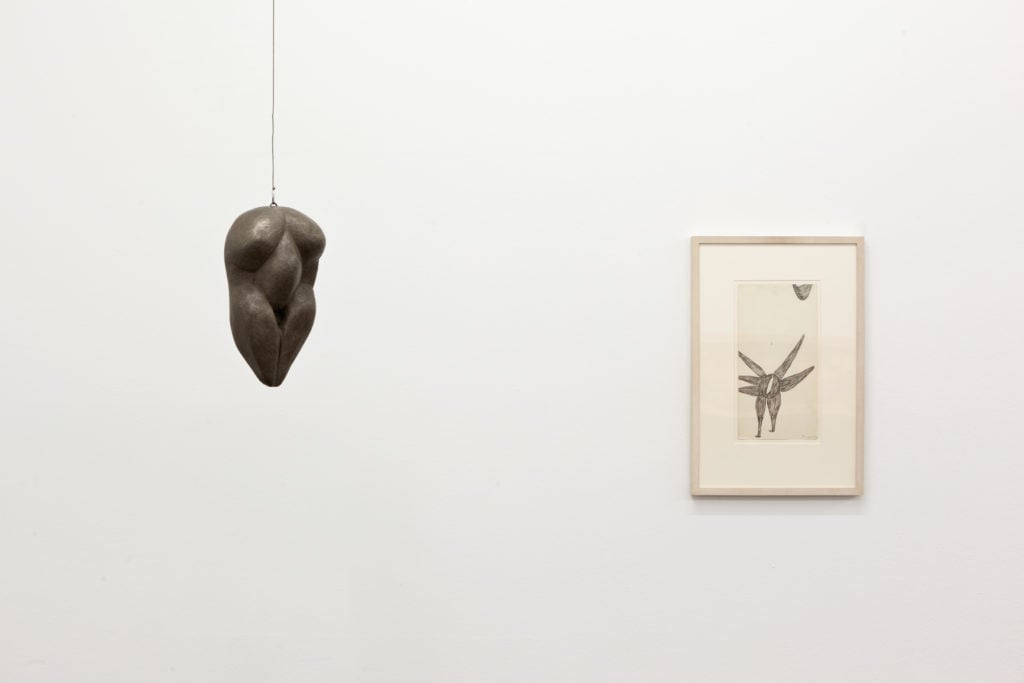
Louise Bourgeois Another Normal
Love. Installation view, Barbara Gross Galerie, 2015. Photo
Wilfried Petzi, © The Easton Foundation
Museum-rich Munich provided fertile ground for her program—once
she managed to convince its institutions that female artists’
paintings, such as Lassnig’s highly personal portraits, belonged
there. “People in Germany hated her,” recalls Gross of
Lassnig. “They would say: ‘She’s hysterical; she’s
narcissistic.’”
But Gross says she quickly realized working with only women
would not be financially sustainable. “I needed to work with male
artists because one must make a balance, but also show that women
are equal to men.” When she started expanding her program, she
recalls there was not much of a reaction among fellow dealers.
“Many seemed to have thought that I was not competition because I
was only showing women artists,” she recalls. But, she says, it was
hard to find male artists to include in her program that had
“personalities and reputations like Ida Applebroog or Nancy
Spero.”
Prices for female artists started to change in the early 1990s,
Gross noticed. But that does not mean that her gallery scaled up;
rather, Gross always kept her gallery a manageable size. “I
was always careful and modest in the gallery operations,” she says.
It was not always smooth sailing, however. “The gallery didn’t make
money all the time… There were moments throughout the years where I
wondered if I would have to close.”
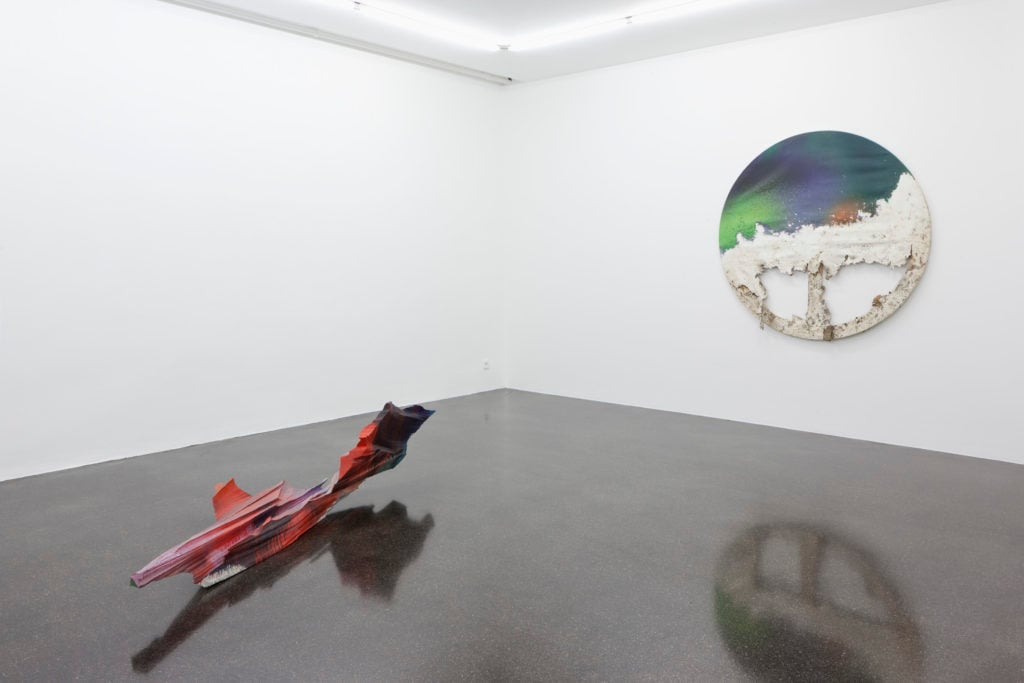
Katharina Grosse. Installation view
Barbara Gross Galerie, 2016. Photo: Wilfried Petzi.
She credits her gallery’s modest size and overhead, and her
sense of caution, for surviving major economic hiccups. “You have
to slow down and concentrate on what you can do and what is
essential,” she says. The 2008 crisis was not really a problem for
her gallery, though she said sales took longer than before. “We
were about to sell a painting by Leon Golub to an American
collector when the crash hit,” she says. “The collector pulled out
because he was bankrupt. So I waited three months, and then I
decided to reduce the price a bit.” Within a few months, the
collector’s finances had improved. “By the end of that year, the
collector changed his mind,” she recalls. She says that
recessions are often marked by collectors, rather than galleries,
dictating prices.
Gross attended Art Cologne, Art Basel, and other fairs like the
now-defunct Art Berlin with limited success. “My experience was
also that only certain things would sell at fairs. For example, one
year we brought Eva Hesse to Art Cologne, and we did not sell. But
I could sell it to the Pompidou and other museums. It was for many
of my artists like that, including Nancy Spero and Boris
Mikhailov.”
Looking ahead, she still plans to work with her artists in an
advisory capacity. “I had the feeling that it was time, and I was
just waiting for the right moment. I did not want anyone to see me
slowing down, or getting boring,” she says of taking the decision
to close. “I don’t want to wait until it’s necessary.”
The post Thirty Years After Opening Her Gallery With an All-Female
Roster, Barbara Gross Reflects on How the Market Has—and
Hasn’t—Changed appeared first on artnet News.
Read more https://news.artnet.com/market/barbara-gross-tk-1819467
Further reading


Leave a comment