
‘Western Museums Expanding Into China Is a Joke’: Ai Weiwei Decries Cultural Institutions for Their Silence on Hong Kong’s Fight for Democracy
The activist artist Ai Weiwei has accused international museums
that work in China of turning a blind eye to the country’s
authoritarian government.
Speaking as pro-democracy campaigners in Hong Kong defied a ban
on anti-government protests, and after police fired tear gas and
used water canons on demonstrators this past weekend, Ai mocked
Western institutions for their silence on the crackdown, and
self-censorship.
“Western museums expanding in China is a joke,” the
Chinese-born, Berlin-based artist told artnet News. “China is an
authoritarian state under heavy censorship. By choosing to expand
into China, you have chosen to obey these dictates; you are willing
to be censored.”
Several major institutions have formed partnerships as well as
organized major loan exhibitions on the mainland and in Hong Kong
in the past decade. These include London’s Tate, Victoria & Albert
Museum, and British Museum as well as the Center Pompidou in
Paris.
“Partnering with Chinese museums while being involved with
issues at the forefront of contemporary culture is laughable,” Ai
said, referring to human rights, freedom of speech, and democratic
values.
Last week, three prominent anti-government leaders were detained
by Hong Kong authorities who had hoped to block a large-scale
protest planned for Saturday. Joshua Wong, secretary general
of the activist group Demosisto, was reportedly arrested on Friday
morning, and group member Agnes Chow was taken into custody
shortly after. Andy Chan Ho-tin, the leader of a banned
separatist political party, was arrested the night before while
boarding a flight out of Hong Kong.
“Western institutions that are not standing up and protecting
essential values, such as freedom of speech and human rights, are
further evidence of the moral bankruptcy in our society,” Ai said.
“Protecting democratic values should not be a choice for Western
institutions to make but a duty that they are bound to uphold,
otherwise it is all simply a charade.”
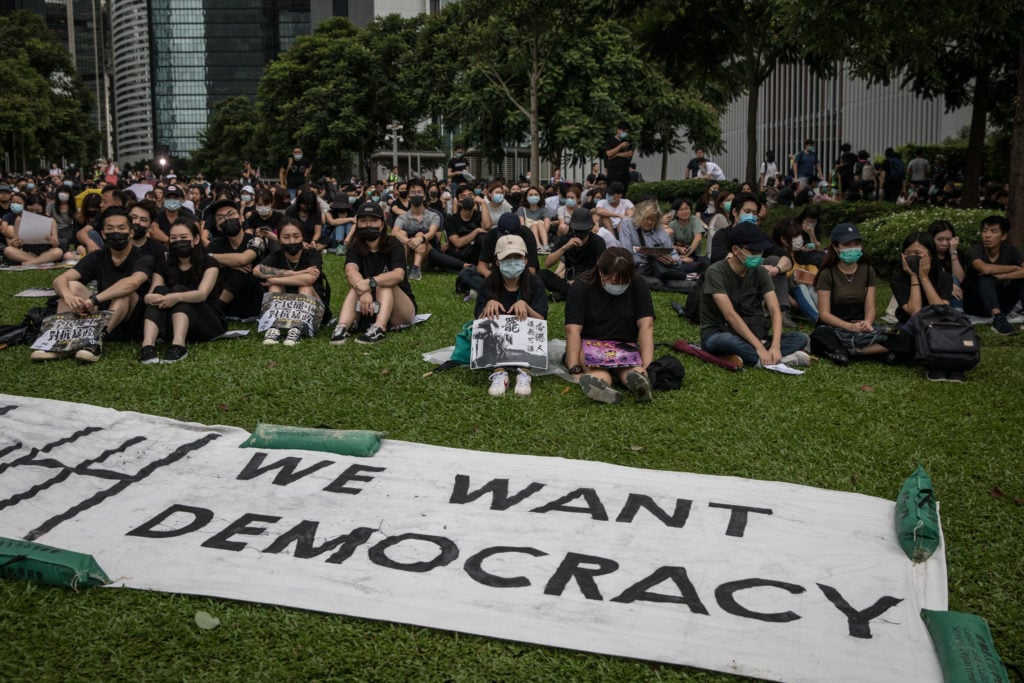
Protesters take part in a school boycott
rally at Tamer Park in Hong Kong, on September 2, 2019. Photo by
Chris McGrath/Getty Images.
Business As Usual?
For months, millions of Hong Kong residents have taken to the
streets to protest a controversial extradition bill that would make
it more difficult for Chinese dissidents to seek protections in the
semi-autonomous city. Since then, the movement has expanded while
Beijing’s rhetoric has become increasingly inflammatory. Chinese
officials have called the protest “political terror.”
Recently, protesters have also rallied against police brutality
after authorities struck a woman in the eye with a beanbag
during a march in the district of Kowloon.
Over the weekend, tensions continued to rise. Some protesters
lit petrol bombs and fires while police were recorded beating
protesters with batons. On Sunday, a Chinese state-run news
agency sent an unequivocal message: “The end is coming for those
attempting to disrupt Hong Kong and antagonize China.”
“From the very beginning, I have been saying that China will not
hesitate to use its military force if the situation becomes
untenable,” said Ai, who earlier this summer sent assistant to Hong
Kong to document the protests.
“This has already been demonstrated in 1989 when tanks were sent
in to crush the non-violent student protests,” he added. “When
there is no other way that they can solve the issue, at a certain
point they will do it. After 1989, the Chinese state faced no
serious repercussions for their actions when the West failed to
enact sanctions.”
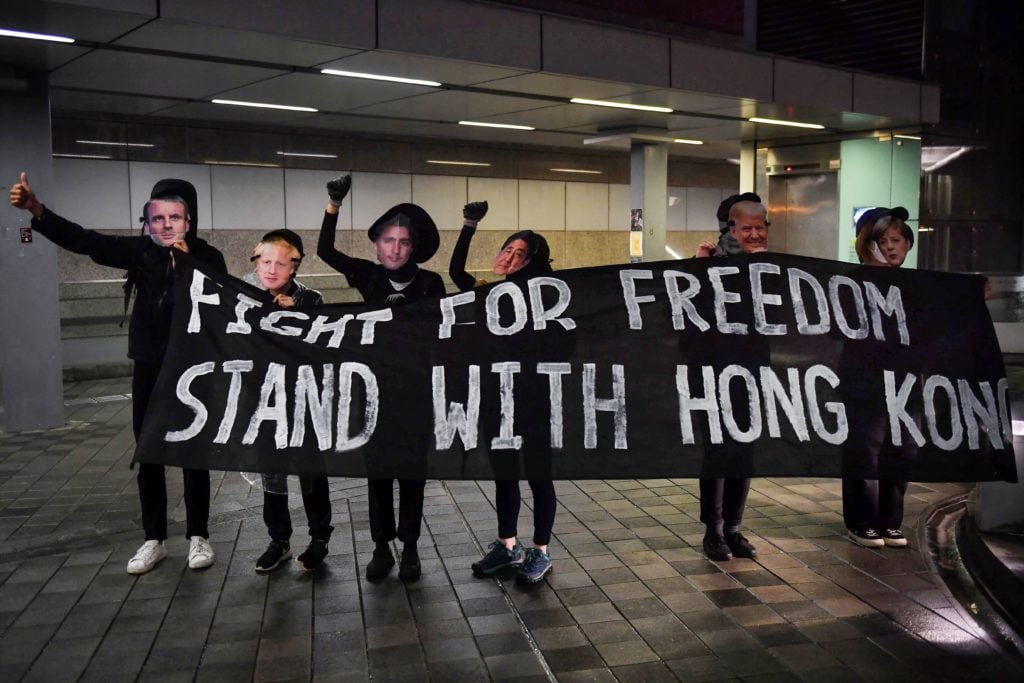
Protesters wearing masks of (left to
right) French President Emmanuel Macron, British Prime Minister
Boris Johnson, Canadian Prime Minister Justin Trudeau, Japan’s
Prime Minister Shinzo Abe, US President Donald Trump and German
Chancellor Angela Merkel urge them to support the Hong Kong
pro-democracy campaign, September 2, 2019. Photo: Lillian
Suwanrumpha/AFP/Getty Images.
International Institutions Move In
Western Museums have been jumping at opportunities to work in
mainland China and Hong Kong in recent years.
The Tate recently announced that it had agreed a partnership
that will see works from its collection travel to the new Pudong
Museum of Art in Shanghai. The Centre Pompidou’s long-held ambition
to gain a foothold in the city looks likely to succeed in the near
future.
The British Museum, meanwhile, has organized several loan
exhibitions in China and partnered with Chinese conglomerate
Alibaba since 2016. (A pop-up shop in Beijing sold out of British
Museum souvenirs last year.)
artnet News has also learned that London’s National Gallery has
been in discussion with a Chinese partner to open shops selling
museum-branded merchandise in the mainland.
The V&A Museum was the first UK museum with a branded
gallery in mainland China, a 1.3 billion renminbi ($200
million) collaboration with the company China Merchants Shekou.
Called Design Society, the V&A-approved gallery opened
in Shenzhen in 2017.
In a show of strength designed to intimidate the Hong Kong
protesters, Chinese state media recently broadcast dramatic
footage of armored personnel carriers driving to the
border in Shenzhen. Last week, more footage of soldiers at the
border was shared
online, though authorities have described it as “a normal
annual rotation of its garrison in the city.”
artnet News reached out to the European institutions asking
if issues surrounding freedom of speech where considered in
the lead up to their their respective expansions. A Tate
spokesperson said: “Tate’s commitment to freedom of creative
expression throughout the world will underpin this
relationship.”
The Centre Pompidou
declined to comment on the matter, and the V&A only confirmed
that it no longer has staff on secondment in Shenzhen. (However,
the V&A’s director, Tristram Hunt, referred to the Hong Kong
demonstrations in a comment piece for the Evening
Standard about the legacy of the 1819 Peterloo
Massacre in Manchester.)
A National Gallery spokesperson confirmed that its trustees had
backed its business partnership with China. “The National Gallery
Company has been working with a licensing partner in China for more
than two years, undertaking a number of projects,” she
confirmed.
Speaking about his support of the Hong Kong protesters, Ai said:
“Once you identify yourself with the values embraced by the youth
of Hong Kong, you are more concerned with the safety of those young
people. You are concerned with how their values can be faithfully
and truthfully documented because you share the same values. If we
stick together, we might just win. If we do not defend those
values, we don’t even need museums or art.”
Javier Pes contributed reporting.
The post ‘Western Museums Expanding Into China Is a Joke’:
Ai Weiwei Decries Cultural Institutions for Their Silence on Hong
Kong’s Fight for Democracy appeared first on artnet
News.
Read more https://news.artnet.com/art-world/ai-weiwei-hong-kong-protests-1639111
Further reading


Leave a comment