
With Monuments Falling All Over Europe, We Asked Historians and Artists to Weigh in on How They Should Be Replaced
Protesters in the English town
of Bristol have reignited a fierce debate over the role of statuary
in public spaces after they toppled a monument
celebrating Edward Colston, a board member of the Royal African
Company, the biggest slave-trading firm in British history, as one
of the city’s “most virtuous and wisest sons.”
The statue was toppled and dumped into a harbor on June 7 after
the Bristol City Council spent
years equivocating over the wording of a plaque proposed in 2018
that would clarify Colston’s links to the slave
trade. The statue was
erected in 1895, more than 150 years after his death, and 88 years
after Britain abolished the slave trade, to commemorate the gifting
of his vast fortune to the city of Bristol.
Adding plaques and new wording to contextualize problematic
statues has been a common method of dealing with Confederate
monuments in the US, but in
the UK, disputes over wording can drag on without closure. Oxford
University has reviewed
several such proposed plaques for its controversial statue of the
Victorian Imperialist Cecil Rhodes, but none have yet been
approved.
Moreover, some opponents of these measures are dissatisfied with
the sanitizing language that is often used to contextualize
monuments, which they say does not do enough to inspire people to
think differently about historical legacies.
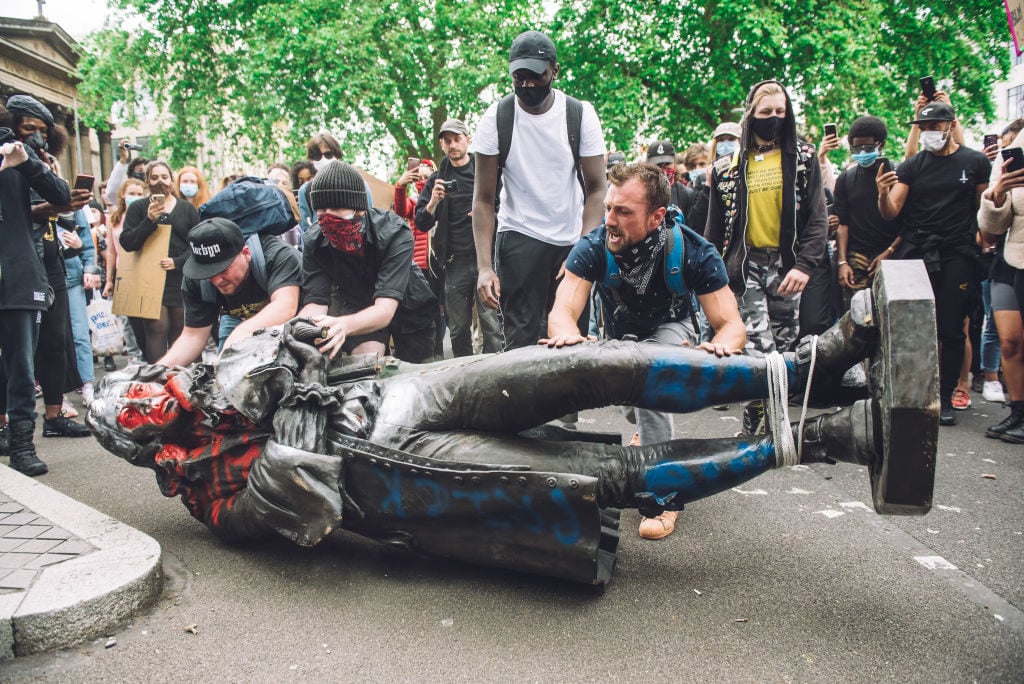
Protesters transporting the statue of
Colston towards the river Avon. Photo by Giulia Spadafora/NurPhoto
via Getty Images.
Edward Colston’s Fate
In Bristol, demonstrators took
matters into their own hands, and activist groups around the UK are
now organizing to
topple more monuments,
even as officials in some cities have begun to voluntarily remove
them on their own.
Now the question is: what comes
next?
Some have called for the Colston statue to remain in the habor.
(As the historian David Olusoga recently pointed out,
the water burial is somewhat “poetic,” given that many of the
victims of Colston’s enterprise drowned in the Middle Passage.) But
the Bristol City Council has other plans, and has already fished
the monument out of the water (but not before someone updated its location on
Google Maps). The statue is now in secure storage and will be added
to the city’s museums collection, although the council has given no
indication of where or how it will be displayed.
“I don’t believe that you can erase history.
It’s more dangerous to erase history,” the artist Yinka Shonibare
tells Artnet News, adding that he feels the most appropriate
setting for the felled monument is in a museum.
“If the community wants
[monuments] to be removed, then they should be removed, but they
should remain in public view, by creating museums for them, as a
reminder so that we don’t make the same mistakes in the future,”
Shonibare says.
Similarly, the director of the Victoria & Albert
Museum’s V&A East Project, Gus
Casely-Hayford, says the removal of the sculpture presents an
opportunity for Bristol to confront the issue head
on. “I could
see the statue in its present state along with placards from the
march as the culmination of a wider exploration of slavery and race
at one of the city’s museums,” he says. (The artist Hew
Locke suggests that the work could be installed in a museum
“on its side, not resurrected up
like an attractive statue.”)
But others say that statues like these cannot be properly
contextualized in existing museum collections, which have their own
already entrenched hierarchies
of knowledge, and have called for these monuments to be displayed
on their own.
“I think that there should be a real Museum of Colonization,
like there is a museum of the Holocaust ,so that people can reflect
on that colonial fact,” says the Belgian historian Omar
Ba.
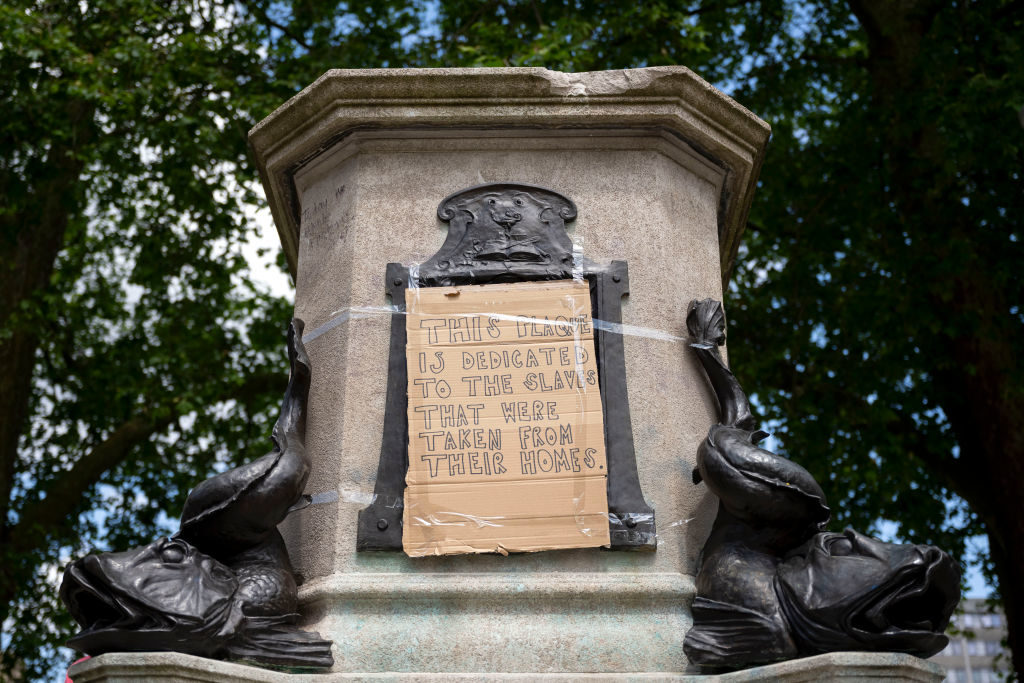
The now-empty Edward Colston statue
plinth. Photo by Matthew Horwood/Getty Images.
Replace It
As for what to do with the empty
plinth, nearly 45,000 people have signed a petition asking that it be used to memorialize a local
civil-rights leader, Paul Stephenson, who led the 1963 Bristol Bus
Boycott, which began after local transportation authorities refused
to employ Black or Asian bus crews. His actions influenced the
creation of the 1965 Race Relations Act, the first piece of
legislation in the UK to outlaw racial discrimination.
Another suggestion, put forward by the London-based sculptor Sokari Douglas
Camp, is to install in the space a permanent artwork commemorating
the abolition of slavery. (Her work, All the world is now richer,
which commemorates the end of
slavery and salutes survivors of its legacy, was shown in Bristol
Cathedral over the burial site of a number of slavers in
2013.)
“But there is a glass ceiling
when proposals like this are brought forward,” Douglas Camp says.
“This time of change is an opportunity to site the work on the
Edward Colston site, if Bristolians are willing.”
But not everyone agrees that the statue of Colston should be
permanently removed. Hew Locke, who has been reimagining public sculptures of
problematic historic figures in his work since the 1980s, suggests
that an artist be commissioned to make a permanent intervention on the statue
itself.
“Insulting” the statue means
that “you walk past it every day and you don’t ignore it anymore,”
he says.
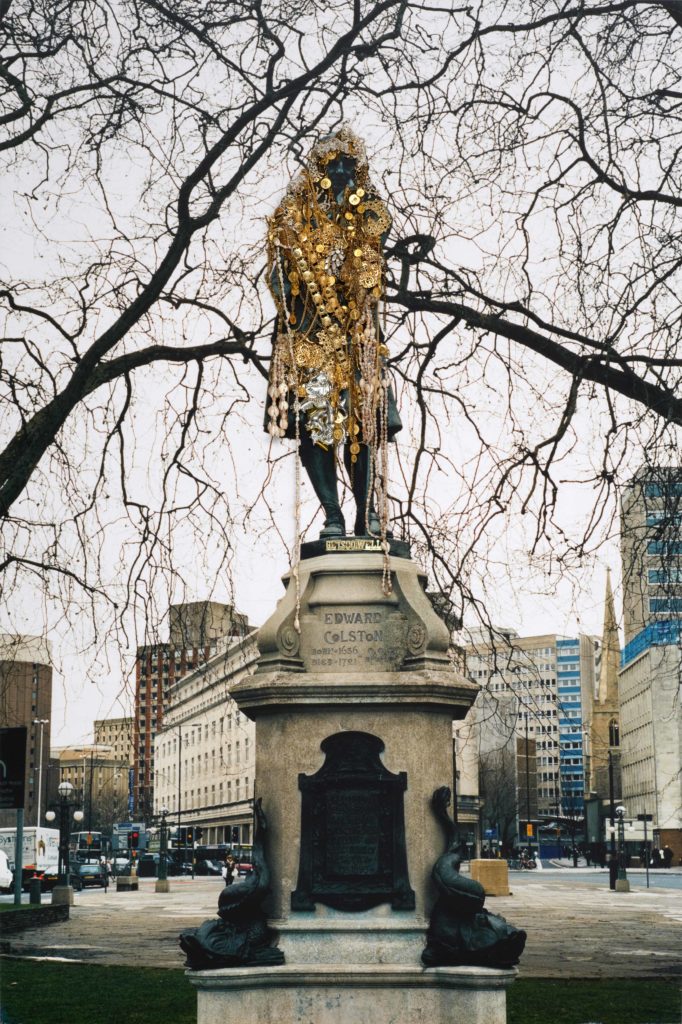
Hew Locke, Colston (RESTORATION
series) (2006). Image courtesy the Artist, Hales Gallery
and P·P·O·W. © Hew Locke. All Rights Reserved, DACS 2020.
An alternative solution would be
to restore the statue alongside a counter monument
“with equivalent presence
and power, to really ignite a conversation, and to show
opposition,” Ba says.
In fact, the Bristol-born street
artist Banksy has put forward his
own proposal on Instagram for how to deal with the monument,
suggesting that it be reinstalled with the addition of bronze
figures of protesters in the act of pulling him down. It’s a
solution that works
“for both those who miss the
Colston statue and those who don’t,” Banksy wrote.
But artist Heather Phillipson, whose work is about
to be installed on London’s Fourth Plinth, counters that it may be
best for white artists to step aside.
“I think it’s time for white
people to listen and make space,” she says. “And this may just be
the perfect opportunity to, literally, do that.”
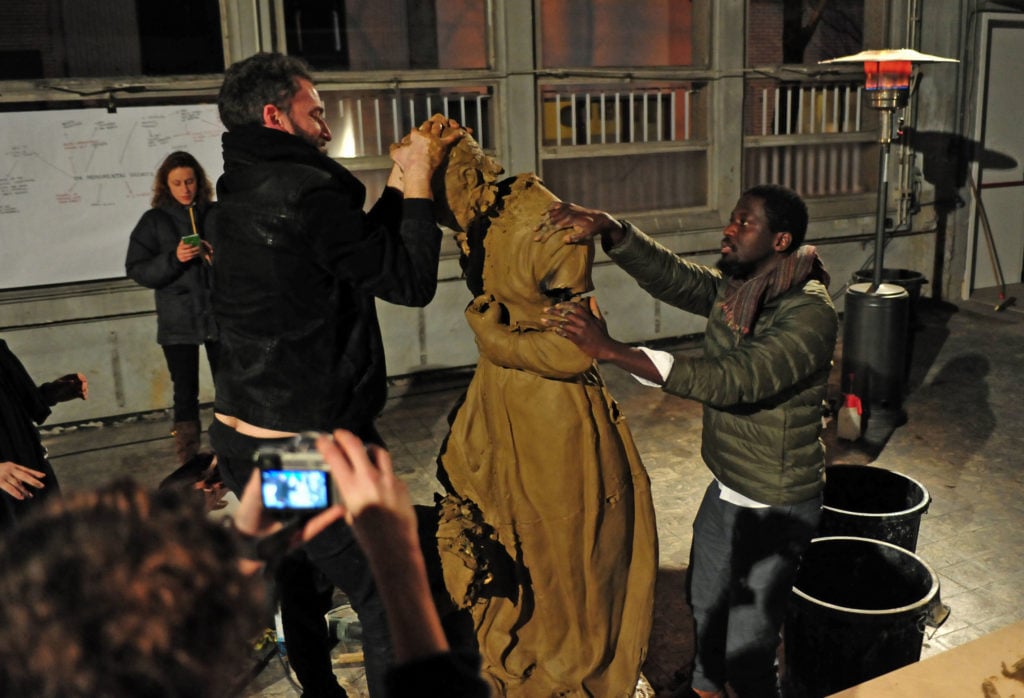
Shot of Ibrahim Mahama, “Silent
Recreations,” © Mark Rietveld, courtesy Extra City.
Monumental Silences
Whatever solution is decided upon, how the decision gets
made—and what lasting policy changes are put in place—is just as
important as what the decisions are.
In 2018, curators Antonia
Alampi and iLiana Fokianaki of Kunsthal Extra City in Antwerp
worked with Ba and the artist Ibrahim
Mahama to
imagine a potential
counter-monument to
a local statue of the colonial missionary and explorer Constant de
Deken standing with one of his knees on the back of an enslaved
African person (people are now campaigning to remove
this sculpture).
But the pair ended
up resigning from their
jobs a year into the project, saying that the museum had failed
to implement serious
anti-racist policies beyond its programming schedule.
The institution’s leaders had
“no real understanding of the issues at stake” and changed nothing
about their internal operations, the curators told Artnet News in a
statement.
(In another incident in Antwerp, after authorities removed a
sculpture of the brutal colonial-era ruler King Leopold II from a
public space, the reason given was that the statue was damaged by
protestors, implying no official condemnation of the monument’s
subject.)
Alampi and Fokianaki say that
now, with the momentum gathered by heated protests around the
world, is the time for systemic change.
“We should aim to shape
educational models and curricula, rename, unlearn, and listen to
all those narratives that have been malevolently erased,” they
said. “Otherwise, to be frank, it all is an empty symbolic gesture
that whitewashes the real problems away and ultimately violently
capitalizes on pain.”
The post With Monuments Falling All Over Europe, We Asked
Historians and Artists to Weigh in on How They Should Be
Replaced appeared first on artnet News.
Read more https://news.artnet.com/art-world/topple-monuments-what-next-1884873
Further reading


Leave a comment