
Here Are the 10 Best Works of Art We Saw in 2019, as Chosen by the Artnet News Staff
BEST ART OF
2019
Sometimes you see a show or an artwork that you can’t forget.
Below, our editors pick the most memorable, exciting, and
enchanting examples they saw this past year.
Gretchen Bender’s Total
Recall (1987)
in “So Much Deathless” at Red
Bull Arts, New York
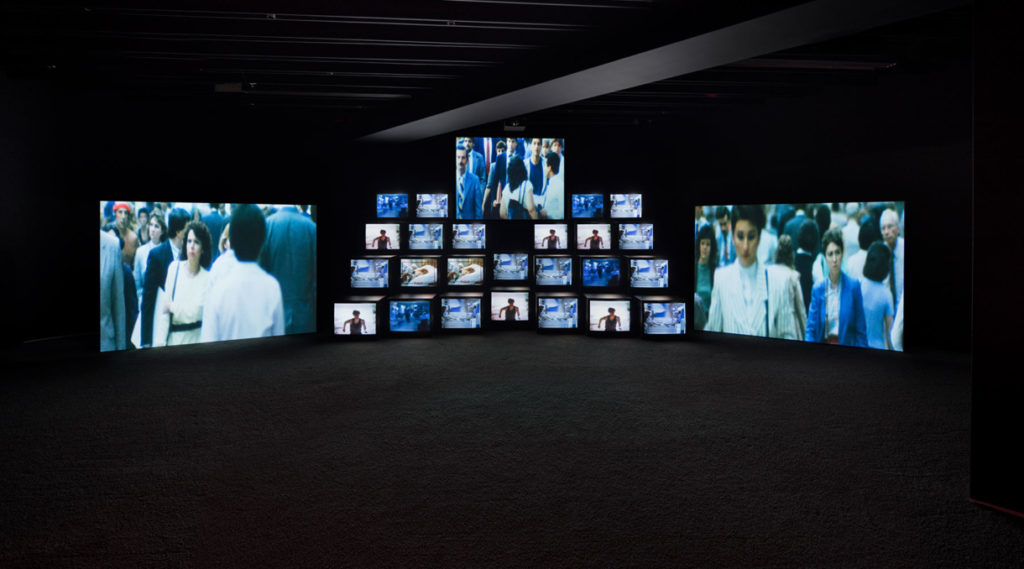
Gretchen Bender, Total Recall
(1987) on view in “Gretchen Bender: So Much Deathless” at Red Bull
Arts New York, 2019. Image © Gretchen Bender Estate.
Five years ago, I walked into a
darkened gallery at a group show at the Hammer Museum in Los
Angeles with no prior knowledge of Gretchen Bender.
Total Recall
lunged out of the black, grabbed me
by the shoulders, and held me transfixed for the next 18 minutes.
After I left the museum, I spent the rest of the day wandering
around in an awed haze, trying to process what exactly I’d just
experienced, and wondering whether I’d ever have another chance to
engage with it in a more capable, sophisticated
way.
“So Much Deathless,” Bender’s
bravura retrospective at Red Bull Arts this year, gave the older,
slightly wiser me a second shot. I’m thrilled to report it lived up
to my memory. Propelled by a synth-driven original score that
defines late-1980s menace, the work’s procession of images
slam-dances across a stack of screens, transporting viewers into
the mind of an unseen narrator trying (and failing) to chase away
psychic pain with consumer goods, mass entertainment, and the
hollow American dream of the Reagan era. It’s simultaneously
troubling and seductive in the way that only the work of a true
visionary can be.
—Tim Schneider
Laure Prouvost’s Deep
See Blue Surrounding You / Vois Ce Bleu Profond Te Fondre
(2019)
in the French Pavilion at the Venice
Biennale
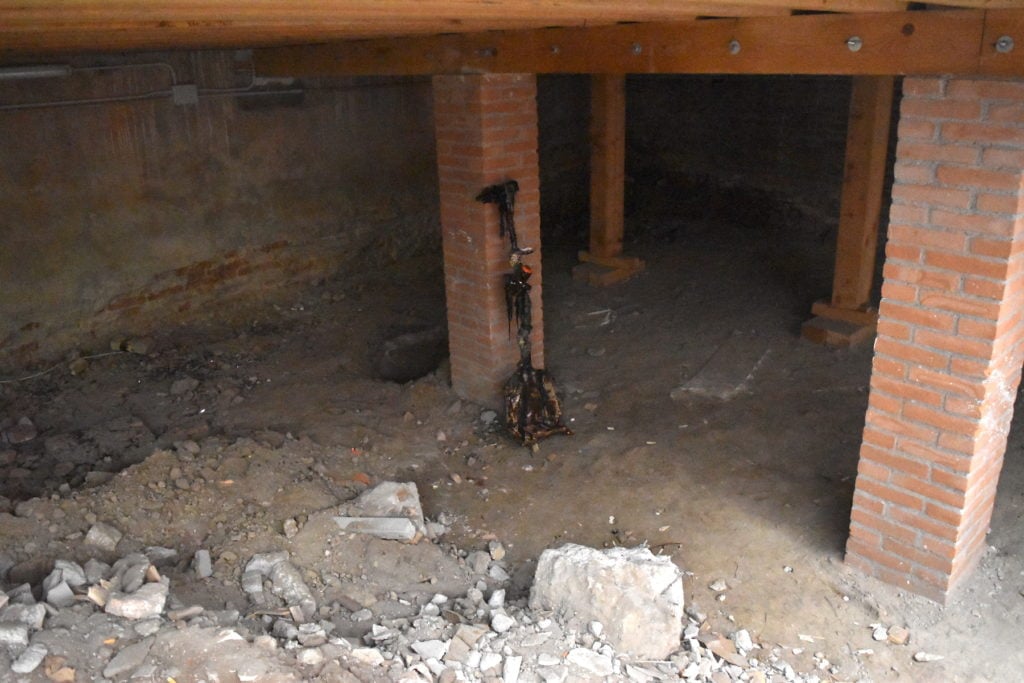
Laure Prouvost’s installation at the
French Pavilion. Image courtesy Ben Davis.
There is a lot to say about
Laure Prouvost’s brilliant Venice biennale
presentation for France, a deeply layered installation for one
of her films featuring delicate Murano glass absurdities, a squishy
octopus’s belly, and boobs galore.
The film tracks a motley crew’s
phantasmagoric road trip to Venice, an extraordinary journey that
includes a visit to a shell-covered and dream-like (but very real)
palace. But my favorite part was actually happening underneath the
pavilion. Instead of having visitors enter through its grand
entryway, Prouvost funneled them around the back of the pavilion
and into the earth-filled basement, where she was in the middle of
digging a hole across the Giardini to the British
pavilion. Digging is a
recurring theme in Prouvost’s work, a way of exploring
below-surface ambiguities. Here she is: a Belgium-based artist (who
spent enough time in the UK to win the Turner Prize) representing
France in the kind of nationalist art-world Olympics that is the
biennale. As a third-culture kid myself, I appreciated this gesture
as a colossal middle finger (or tentacle) to Brexit, and a humorous
collapsing of the walls and divisions that have sadly sprung up all
around us. Taken altogether, it captures something of our liquid
modernity.
—Naomi Rea
Lubaina Himid’s Five
Conversations (2019)
in “En Plein
Air” at the High Line, New York
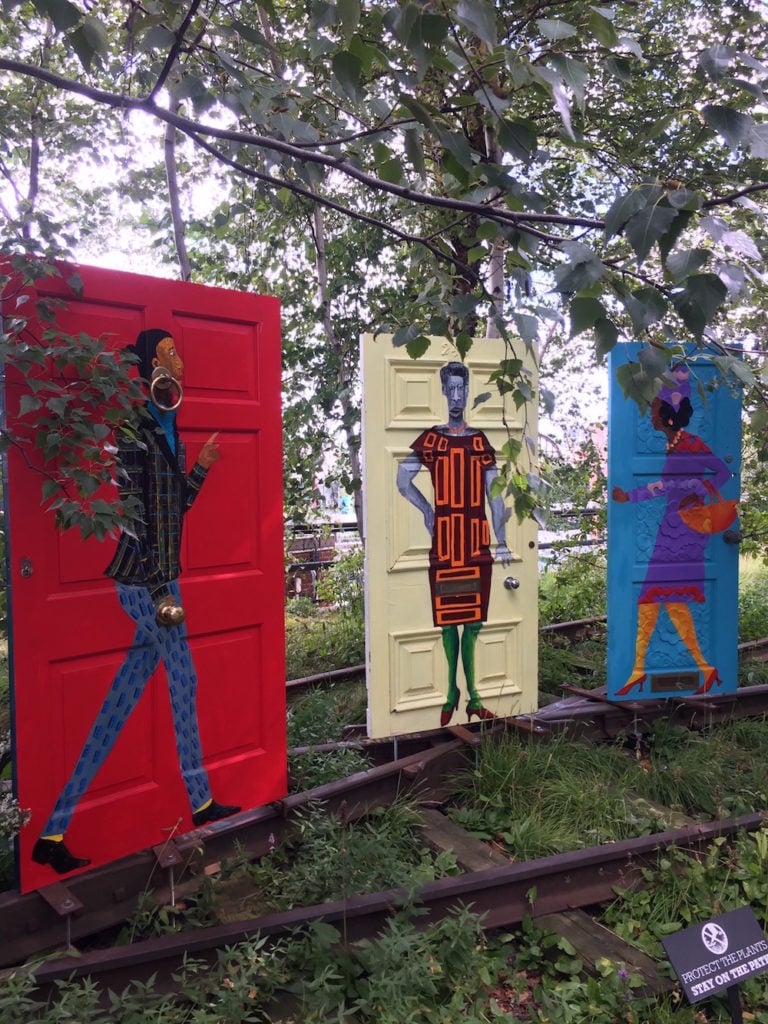
Lubaina Himid, Five Conversations
(2019) in “En Plein Air” at the High Line. Photo by Eileen
Kinsella
One of the reasons I loved this installation so much was because
of how unexpected it was. Walking along the High Line on a
beautiful autumn afternoon, I suddenly spotted the brilliant hues
of these painted, standing doors peeking out from behind the
elevated park’s lush greenery and overhanging leaves and I was
immediately intrigued. The Tanzanian-born painter is known for her
life-size portraits cut into silhouettes that stand freely as flat
sculptures. In Five Conversations (2019), Himid introduced
five reclaimed doors from Georgian townhouses painted with
portraits of stylish women who converse with one another.
—Eileen Kinsella
Rugilė Barzdžiukaitė, Vaiva
Grainytė, and Lina Lapelytė’s Sun and Sea
(Marina) (2019)
in the Lithuanian Pavilion at the Venice Biennale
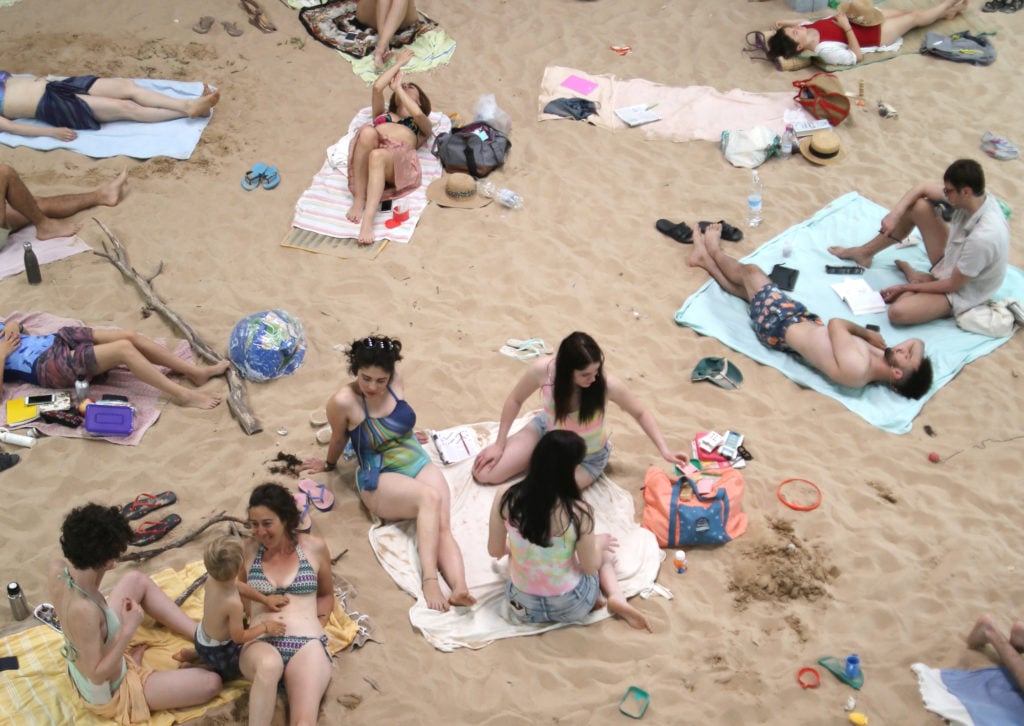
Lina Lapelytė, Vaiva Grainytė and
Rugilė Barzdžiukaitė, Sun and Sea (Marina) (2019).
Performance, Lithuanian Pavilion at the 58th Venice Biennial. Photo
by Laima Stasiulionytė.
If this was the year that the art world—and the world at
large—finally began to reckon viscerally with the reality of
climate change, then I can think of no more enduring artwork from
2019 than Sun and Sea (Marina), the haunting opera
and installation that won the Golden Lion at this year’s Venice
Biennale. Organized by curator Lucia Pietroiusti, the Lithuanian
Pavilion may seem like a gimmick at first: it’s a song-and-dance
about climate change set at a beach. But it is actually one of the
most understated and affecting artworks about climate change I’ve
ever seen.
You watch it from a balcony, looking down at the familiar
tableau of towels, beach chairs, and bright-colored bathing suits.
(It’s hard to overstate the verisimilitude; dogs wander through,
people listen to music on their iPhones—it’s all tonally just
right.) As the performers sunbathe, they sing about their mundane
vacations and minor annoyances. Slowly, it becomes clear that this
sunny, sandy holiday masks real decay taking place offstage.
Travelers tell stories of air travel interrupted by a volcanic
eruption, a scuba-diving trip to the milky-white Great Barrier
Reef, and a Christmas spent in springlike weather. Astoundingly,
these scenarios seem considerably more likely now, just over six
months after I saw the performance, than they did then.
The production is haunting because unlike most art about climate
change, it doesn’t attempt to knock you out with the gravity of the
problem. Instead, it chills you by presenting a world not so
different from your own—one in which you sit idly in the sun while
everything around you rots.
—Julia Halperin
Mary Sibande’s A
Reversed Retrogress, Scene 2 (2013)
in “I Came Apart at the Seams” at Somerset House, London
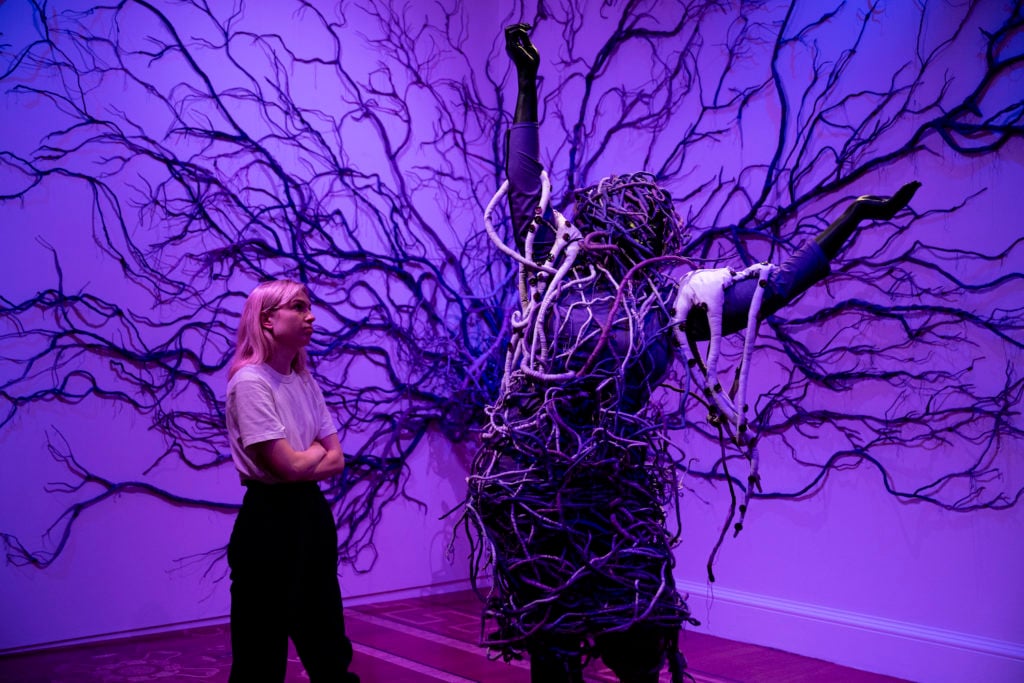
Mary Sibande’s A Reversed Retrogress,
Scene 2 (2013) at Somerset House, London. Copyright the artist.
© Anne Tetzlaff.
Every once in a while, an
artwork takes your breath away. It sounds clichéd, but it happened
to me back in 2013 at Pierre Huyghe’s show at the Centre Pompidou,
when the pink-legged dog in the film I was watching grazed by my
body. And it happened again just this fall at the Somerset House
when I walked around South African artist Mary Sibande’s
exhibition, “I Came Apart at the Seams.” In these moments, at least
for me, I am left vulnerable and all my assumptions about the world
crack apart.
Sibande is a singular artist
brilliantly thinking through all the problems of voyeurism,
especially when it comes to representing black experience and
navigating narratives around post-colonialism. Her work deals with
very difficult subject matter, addressing colonial history in South
Africa, which she channels through a futuristic domestic worker
named Sophie. Sophie is modeled after Sibande’s own body and is
posed in vibrant traditional dresses, which are unravelled and
reinterpreted in places as to revise and emancipate Sophie from the
past. In A Reversed
Retrogress, Scene 2 at
Somerset House, Sophie
is covered in papal purple tentacles that emanate out of her and up
the wall as she stretchers her arms into the air. It seems like her
body extends beyond her figure and reaches into the past and future
simultaneously. The human scale of the work brings Sophie to life
while also reminding viewers like me that we cannot ever truly
begin to understand or know Sophie, whose face is hidden. It’s a
deeply humbling work.
—Kate Brown
Mike Nelson’s
The Asset Strippers
(2019)
at Tate
Britain, London
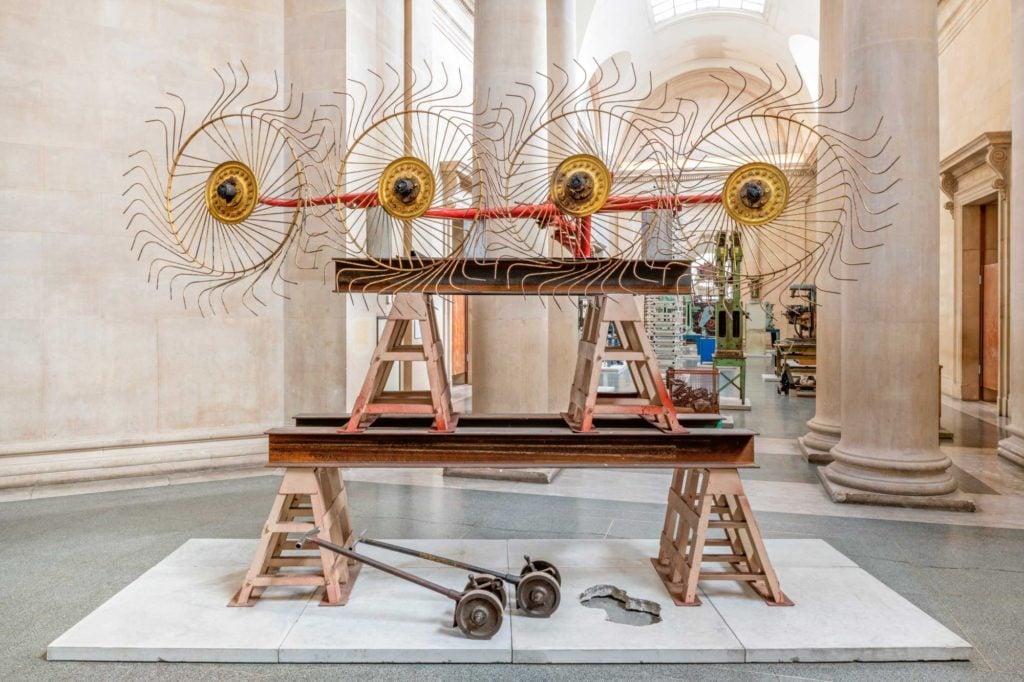
Mike Nelson’s The Asset
Strippers (2019). Tate Photography, Matt Greenwood.
The British sculptor Mike Nelson is a one-man-band who
orchestrates epic assemblages that hit you in the solar plexus, and
linger in the memory. This spring, Nelson transformed Tate
Britain’s neo-classical Duveen Galleries into a cross between a
monument-strewn graveyard and petrified forest with the brutally
titled The Assest Srippers. Old factory machinery,
salvaged NHS hospital doors, telegraph poles, tarpaulins, and
agricultural machinery, many sourced online from salvage auctions,
became a melancholic monument to post-industrial Britain. Nelson’s
Duchamp-meets-dystopia installation seemed topical from March
through October as Britain teetered on the edge of crashing out of
the European Union, its parliament in stalemate. After a tumultuous
year, which ended in triumph for vote Leavers in the UK’s general
election in December, Nelson’s work seems prophetic. The silent
machinery belongs to a different age, frozen for an unforgettable
moment and placed on a plinth before heading to the scrapyard of
history.
—Javier Pes
T.C. Cannon’s Two Guns
Arikara (1974–77)
in “At the Edge of America” at
the Smithsonian National Museum of the American Indian, New
York
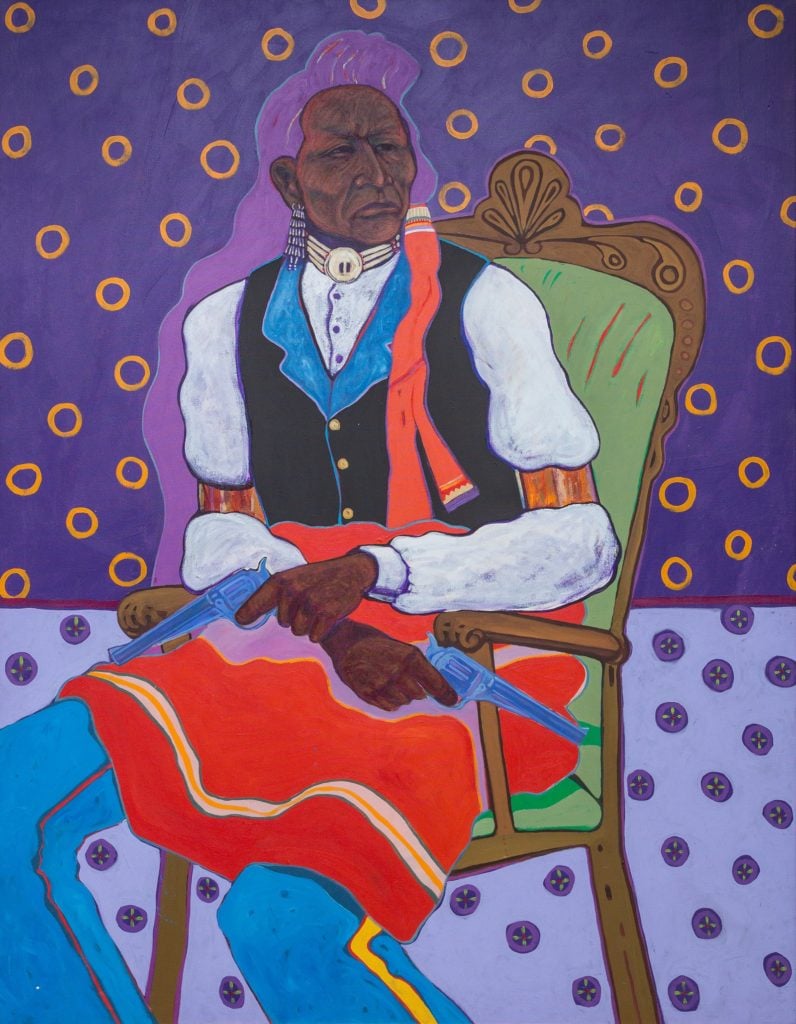
T.C. Cannon, Two Guns Arikara
(1974–77), Courtesy of the
National Museum of the American Indian.
When I popped into the National
Museum of the American Indian on a rainy afternoon this summer I
admit I knew next to nothing about the late T.C. Cannon, and this
unexpected exhibition felt like the art-historical rug had been
(thankfully) pulled out from under me. How exactly had I never
heard of this guy? During the 1960s and ‘70s, the Caddo and Kiowa
artist created dazzlingly colorful depictions of contemporaneous
Native American life, melding his cultural heritage with political
and cultural references from the Vietnam War (in which he fought)
to fashion and music.
For me, Two Guns
Arikara especially embodied Cannon’s virtuosity as he
effortlessly brings together indigenous emblems, tropes of Western
portraiture, and a dazzling Pop color palette. And it’s hard not to
note that Cannon’s preference for patterned, colorful backgrounds
prefigures so much of what we’re still seeing in figurative
painting today. In the end, I find this portrait at once dignified,
alive, and incredibly stylish. I love the slight, very 1970s flair
of his pants, which quietly situate Two Guns
Arikara in a specific American cultural
moment.
—Katie White
David Hammons’s
work
in “David Hammons” at Hauser & Wirth, Los
Angeles
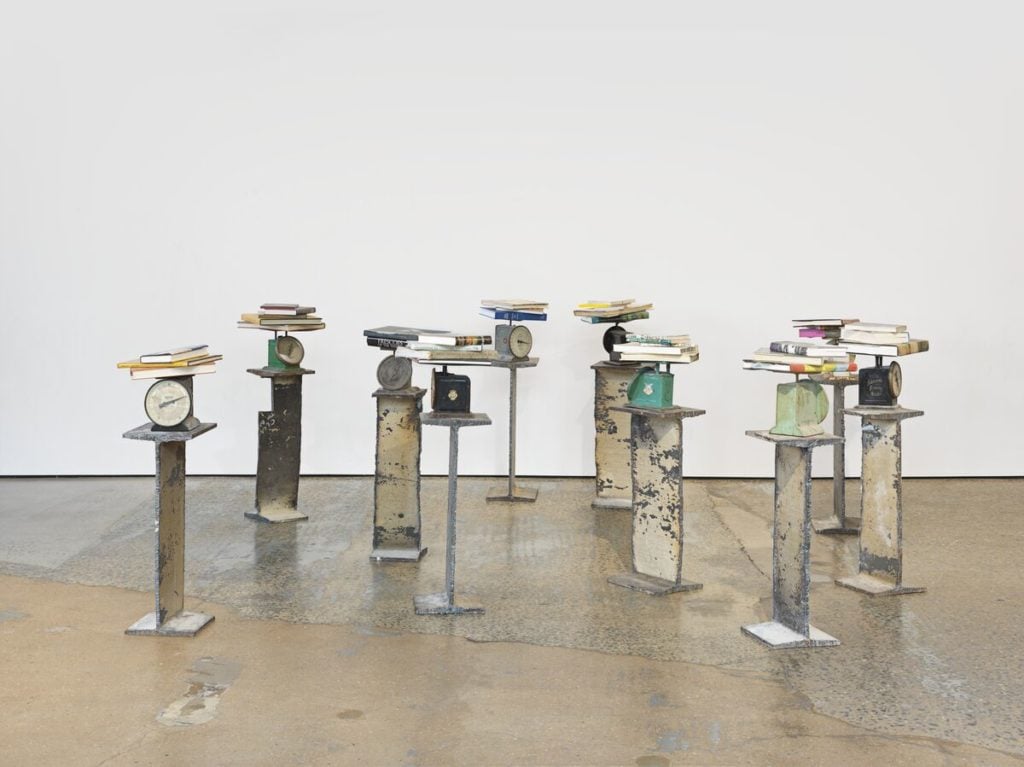
David Hammons, Untitled (2018). ©
David Hammons, photo: Genevieve Hanson, courtesy of Hauser &
Wirth.
The David Hammons show at Hauser & Wirth Los Angeles—and it
should be taken as an entire show, not just a group of individual
works—was self-important and visually dazzling, full of grand
universal beauty and insider-y easter eggs, complex installs and
straight-up cheap tricks. God, I loved how infuriating it was, how
contradictory, how rewarding after a long, long viewing. Dedicated
to Ornette Coleman, the show knew no meter or key signature, and
just flowed like the free jazz it was. Everything else seems boring
now—and it was endlessly funny, to boot. And while there was an
uproar over the tents, with some distance, it was brilliant that
Hammons invaded the views of the Tinseltown influencers getting
brunch at the gallery’s trendy Manuela restaurant with a reminder
of how close they are to the shantytowns of Skid Row.
—Nate Freeman
Ana Mendieta’s Untitled
(Esculturas Rupestres) (1981)
in “Ana Mendieta” at Galerie LeLong, New York
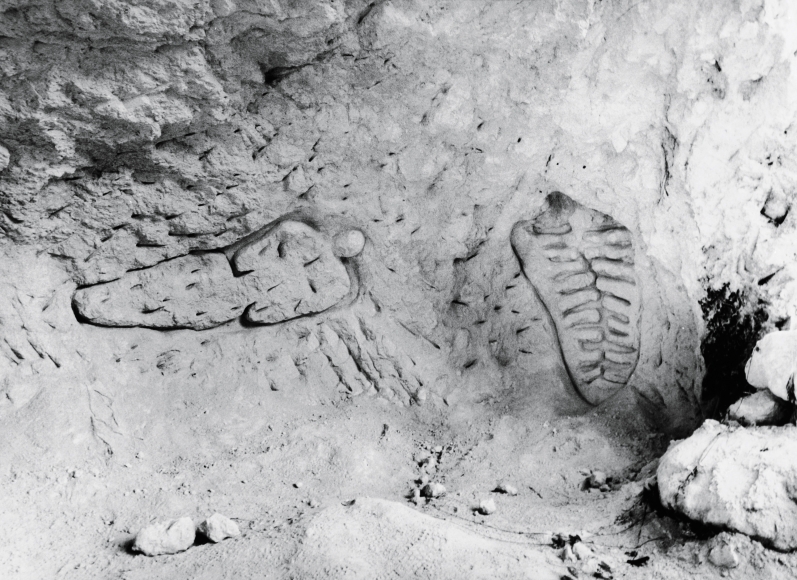
Ana Mendieta, Untitled (Esculturas
Rupestres) (1981). Courtesy of Galerie Lelong.
Choosing the best art I saw in a year that involved visits to
the National Gallery in Washington, DC, the Pushkin Museum in
Moscow, and several trips to the Met presents the problem of an
embarrassment of masterpieces. So I’m picking one of the best
surprises I saw this year: Ana Mendieta’s carvings into Cuban
caves, which she called her Rupestrian sculptures.
Mendieta, who fled the revolution in Cuba at age 12, returned to
the island as an adult in 1981 and began to paint on and cut into
rock. In some cases she left behind vague resemblances of a female
silhouette, reminiscent of her earlier series of crime scene-style
outlines of her own body on the ground. Others are forms taken from
nature, such as leaves, and still others are pure abstractions. Her
photographs of the sculptures, which were on view at Galerie Lelong
this fall, revealed an exiled artist’s poignant attempt to make her
“mark” on a landscape that wouldn’t have her.
—Rachel Corbett
Alina Perez’s Seen
Upon, In the Garden (2019)
in “Sub
Rosa” at Deli Gallery, New York
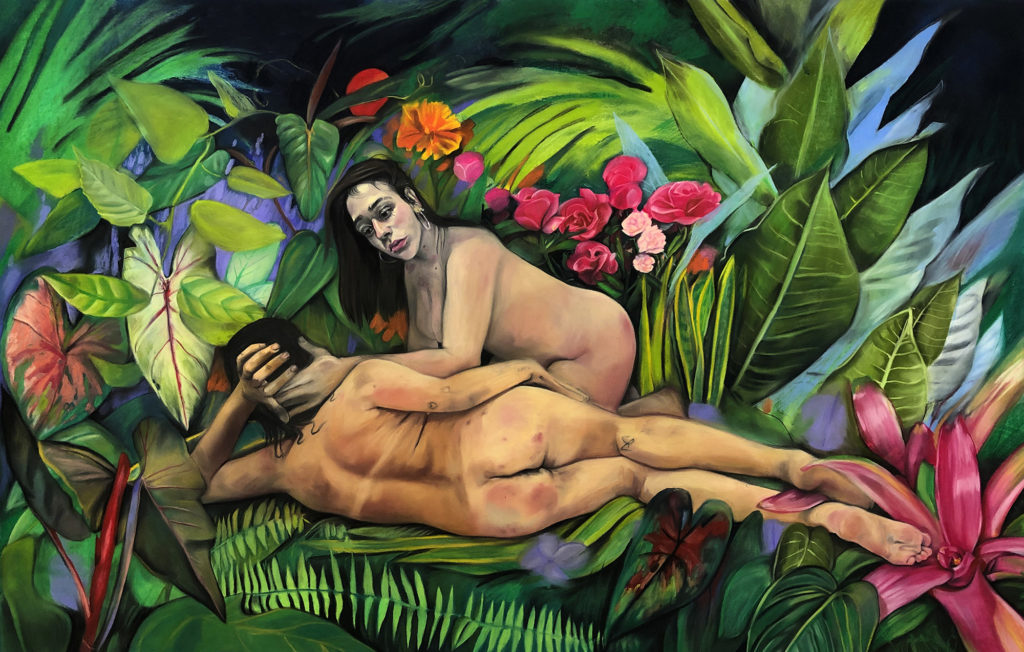
Alina Perez’s Seen Upon, In the
Garden (2019).
I saw this work by Yale MFA candidate Alina Perez in February
and I still think about it. At a whopping 50 by 75 inches, this
fantastic yet realistic depiction of two lovers demands
attention.
—Cristina Cruz
The post Here Are the 10 Best Works of Art We Saw in 2019,
as Chosen by the Artnet News Staff appeared first on artnet
News.
Read more https://news.artnet.com/exhibitions/10-best-artworks-2019-1710957
Further reading


Leave a comment