
Lucian Freud and Francis Bacon Were Irritable Sitters, But Painting Each Other’s Portraits Taught Them Valuable Lessons About Art
This was the first portrait from the life that Bacon attempted;
that’s to say, the first to enter the oeuvre. It was done at the
Royal College of Art where, for a year or so, Rodrigo Moynihan gave
Bacon the use of a studio. [Lucian] Freud expected to have to be
there, to make his presence felt as Harry Diamond had done for him.
“He asked me to sit and when I came the first time this painting
was already virtually finished.” Bacon never normally worked with
someone else in the room. He talked, mainly to
himself—“exasperation, explanations, self-criticism,
unselfconscious”—and there was “a lot of movement and noise and
lots of mixing color on the forearms, very, very, strenuous. And a
lot of irritation, but not for me though: he’d got such good
manners, making it clear that him and it, not you, were the
problem. He had a photograph of Kafka leaning on the doorway and he
had been using that. I was amazed; it looked terribly good to me.
First time he just did the foot. Then I came and stood about four
or five times and it got worse and worse every time and then, at
the end, not very good. It isn’t very good, but it’s lively.”
The Bacon Portrait of Lucian Freud (1952), in the
Whitworth Art Gallery, Manchester, bears no resemblance to Freud
and little to Kafka. A coltish young man enters through what could
be a revolving door into blinding glare. Soon after this Freud
rejected an approach from a Slade student, Lorenza Mazzetti, for
him to play the lead in her film adaptation of Kafka’s
Metamorphosis. It would have been, he thought, an
impersonation too far. Another Slade student, Michael Andrews, took
on the role.
Michael Hamburger, who had known and quite liked Freud longer
than most, liked him least, he said, when he saw him in Soho with
Bacon. “He adopted a sort of manner, which I disliked: being very
sophisticated and smart and making remarks supposed to be
shocking.” Bacon, a practiced exerciser of charm, urged him to
think about how he presented himself. “I thought the best thing was
to be rude. I don’t mind being on no terms or bad terms. I just
don’t want to be on false terms,” was Freud’s response. But Bacon
insisted that good manners were useful. “Francis opened my eyes in
some ways. His work impressed me, but his personality affected
me.”
During the war, when he was summoned to a tribunal to assess his
fitness for military service, Bacon had hired a dog from Harrods
and spent the night with it knowing that this was a good way to
bring on an asthma attack. “He had got this idea about Harrods: if
he was near Harrods he couldn’t go too wrong, he thought.” The
store was his universal provider. “Everything was linked to
Harrods. At first, early on, the bills came and they got more and
more nasty but he took no notice and eventually they just pretended
that they had been paid. He had a little man there who made these
round-cornered suits for him that suited nobody but him.” And he
used to filch from the Food Hall, initially out of necessity, then
out of habit. It was, Freud thought, simply a case of him helping
himself rather than exercising sleight of hand.
“Francis made a great thing about the sensuality of treachery
(which wasn’t original) and he used to go on about the cult of the
hands, which, in his pictures, he tended to miss.”
Bacon turned to advantage his lack of conventional expertise. To
adapt William Empson’s phrase, he learned a style from a despair.
Or, in John Berger’s equally arresting phrase, “horror with
connivance.” It obliged him to be summary, to skirt formal
difficulties,exaggerating to disguise incapability, swiping
in the hopes of hitting it off, passing off anguish as hilarity
and, occasionally, hilarity as angst. He said, “We live our life
through our whole nervous system”; he thrilled to violence, or to
the image of violence. Orwell’s image, in Nineteen
Eighty-Four, of the fascist state “stamping forever on the
human face” is verbal Bacon. The paintings were as showy as figures
of speech, as impressive as the ludicrous warning from Mrs. Joe in
Great Expectations when Joe and Young Pip hurry off to
watch convicts being recaptured: “If you bring the boy back with
his head blown to bits by a musket, don’t look to me to put it
together again.”
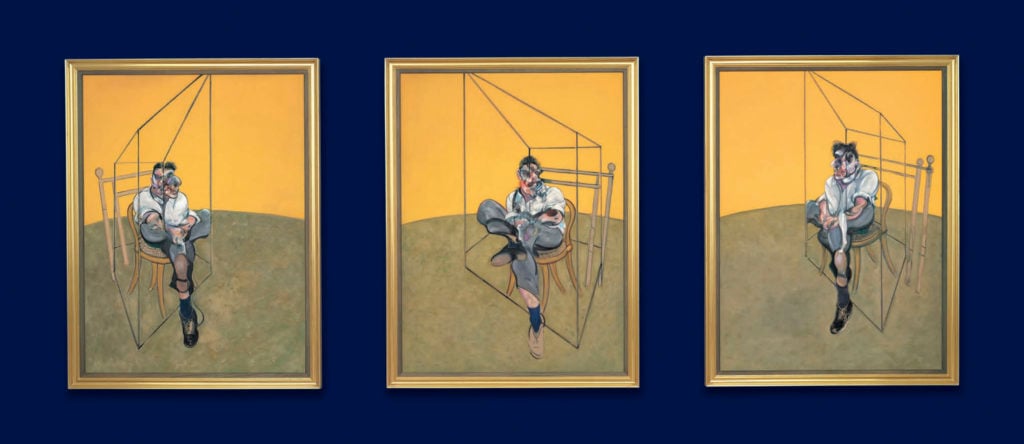
Francis Bacon, Three Studies of
Lucian Freud (in 3 parts) (1969). Photo courtesy Christie’s
Images Ltd.
Where, intuitively, Picasso used to slice profiles and
reposition eyes, Bacon, relying on reflex, made faces that loomed
blurrily: ghostly monoprints lifted from the sticky tonalities of
photo culture. Like André Gide not knowing “whether I feel what I
believe myself to be feeling,” Bacon found expression in having a
stab at things. “Art is a method of opening up areas of feeling
rather than merely an illustration of an object,” he told a
reporter from Time magazine in 1952. “Real imagination is
technical imagination. It is in the ways you think up to bring an
event to life again.” Matthew Smith, he stressed, in the
introduction he contributed to the catalogue of Smith’s Tate
retrospective in 1953, had this essentially painterly imagination.
“He seems to me to be one of the very few English painters since
Constable and Turner to be concerned with painting—that is,
with attempting to make idea and technique inseparable.” What was
true of Smith was even more true of himself: “I think that painting
today is pure intuition and luck and taking advantage of what
happens when you splash the stuff down.”
Suspicious of such notions as happy accident, Freud balked at
this. “I don’t know with Matthew Smith. It’s impossible not to like
it, but you don’t feel that truth plays much part in it.”
Listening though to Bacon, seeing him most days, he found himself
echoing his words. “I used a phrase, ‘memory-trace,’ to Colin
Anderson. He said, ‘You’re talking like Francis: is that
right?’ Sort of bitchy.”
Bacon, Freud found, was better to talk to than anyone else he
knew, deft and provocative, always stimulating. And he even agreed
to be painted. “It took two or three months. He grumbled but sat
well and consistently.” Bernard Walsh, who ran Wheeler’s in Old
Compton Street, their favorite eating place, used to go on at them
to do portraits of one another. “What I want is a Bacon of Freud
and a Freud of Bacon,” he said, so it was a virtual commission.
Freud saw it as a favor rendered. “That little picture I really did
for him; but when I left Kitty and married Caroline he was so
unpleasant. ‘I didn’t know Lucian was a ponce,’ he said, and I was
so depressed I fell off the bar stool on to the floor. I couldn’t
do anything else as he owned the place and was thirty years older.”
Otherwise, he said, he would have thumped him.

Lucien Freud, Reflection
(Self-Portrait), 1985. Courtesy of Wikimedia Commons.
Francis Bacon, One of Two Studies for a Self-Portrait
(1970). Courtesy of Sotheby’s.
As with most of the other small portraits he did around that
time Freud used a copper plate, small enough to be hand-held if the
detailing demanded it. “Life-size looks mean,” Bacon said, whereas
shaving-mirror-scale looks intimate. Freud’s Bacon is side-lit,
half dour, half sunny, his voluptuous features, nostrils and chin,
temples and jowls, uneasily patted together. Sitting knee to knee,
within three feet of him, Freud caught the air of unconcern, or
diffidence even, the heavy-lidded eyes downcast, blond hair mussed
over traces of penciling, a flicker of disdain crossing his mind
possibly.
Freud was prompted—shamed even—by Bacon. “I got very impatient
with the way I was working. It was limiting and a limited vehicle
for me and I also felt that my drawing and my making
artifacts—graphic artifacts—stopped me from freeing myself and I
think my admiration for Francis came into this. I realized that by
working in the way I did I couldn’t really evolve. The change
wasn’t perhaps more than one of focus but it did make it possible
for me to approach the whole thing in another way.” He
appreciated that expression—as distinct from Expressionism, which
was pseudo-primitive Mannerism—involved a degree of emphasis
bordering on abandon. Bonnard said, “Draw your pleasure—paint your
pleasure—express your pleasure strongly.” As Delacroix wrote in his
diary, “One never paints violently enough.”
Excerpted from The Lives
of Lucian Freud by William Feaver. Copyright
© 2019 by William Feaver. Excerpted by permission of
Alfred A. Knopf, a division of Penguin Random House LLC. All rights
reserved. No part of this excerpt may be reproduced or reprinted
without permission in writing from the publisher.
The post Lucian Freud and Francis Bacon Were Irritable
Sitters, But Painting Each Other’s Portraits Taught Them Valuable
Lessons About Art appeared first on artnet News.
Read more https://news.artnet.com/art-world/lucian-freud-biography-excerpt-1716354
Further reading


Leave a comment