
How Diego Rivera and Frida Kahlo Turned Their Love Affairs Into an Art Form (and 10 Other Wild Romances That Changed Art History)
Muse, lover, rival: when it
comes to artists in love, one person has often been all three. And
when creative spirits find themselves entangled in messy romances,
there’s little predicting what will happen. Sometimes, the meeting
of these kindred beings blossoms into long-lasting collaborative
bliss. Other times—and perhaps more often—their unions combust in a
blaze of drama, jealousy, and infidelity.
With Valentine’s Day on the
horizon, here’s a closer look at 11 of the most fascinating
art-world romances that changed the course of art history as we
know it.
Gala and Salvador
Dalí
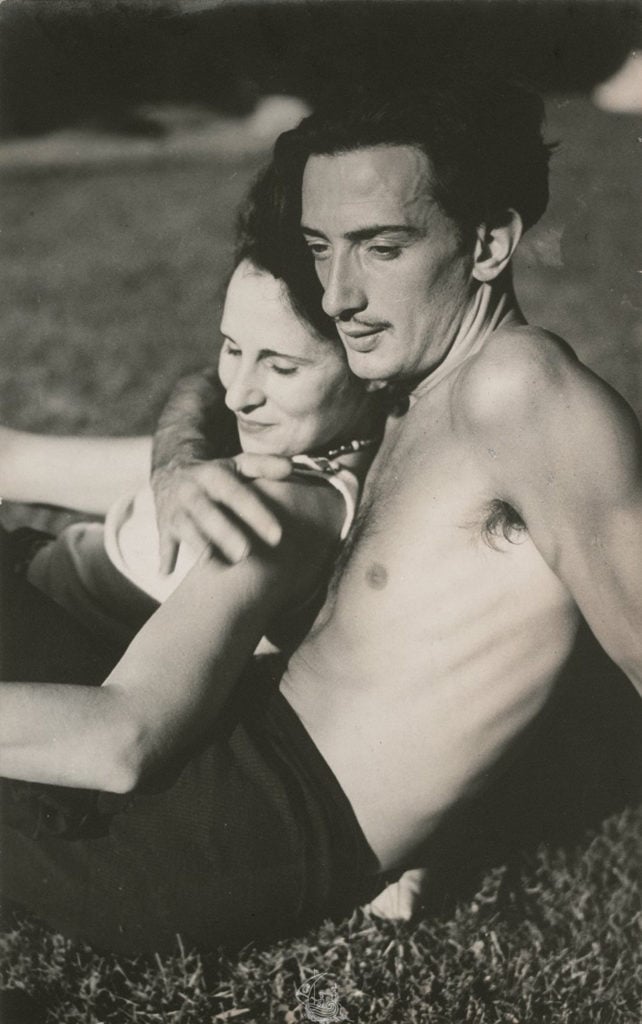
Gala and Salvador Dalí. Courtesy of Fine
Art Images/Heritage Images/Getty Images.
Against the
Odds: When Gala and Salvador Dalí met in 1929, the pair
faced what could have been serious romantic obstacles: Gala was ten
years older than the 25-year-old Salvador, and she happened to
still be married to the artist and poet Paul Éluard, with whom she
had a daughter. None of that deterred the young Dalí, who was
wholly captivated by the Russian émigré, later writing, “She
was destined to be my Gradiva, the one who moves forward, my
victory, my wife.” Dalí’s father, however, was so scandalized by
the union that he cut off all contact and financial support when
they wed in 1934. But they proved their skeptics wrong, and
remained married until Gala’s death in 1982.
Muse & Manager:
Their love was both collaborative and unconventional—Gala believed
Dalí to be a genius, while he saw her as the fount of all his
creative inspiration and energy. She often acted as his muse and
model, and was pictured famously as the Virgin Mary in his painting
The Madonna of Port
Lligat (1949).
Though content to play second-fiddle to Dalí’s celebrity, she was
also the managerial
whiz behind his success, handling his sales, exhibitions, and
finances.
Unorthodox Arrangements: Dalí openly
acknowledged his fear of intimate relationships. To skirt the
issue, the couple had an open
marriage, with Dalí regularly encouraging his wife to explore
herself outside of their union. However, over the years, the
marriage became strained as the artist became increasingly consumed
by a fear of abandonment, distraught by the money and time Gala
spent on her lovers. The relationship even occasionally devolved
into violence on both parts. And though Dalí had grown embittered
by his wife over the decades, her death, at the age of 87,
ultimately devastated him and he entered a state of isolation that
lasted through the remainder of his years.
Marina Abramović and
Ulay
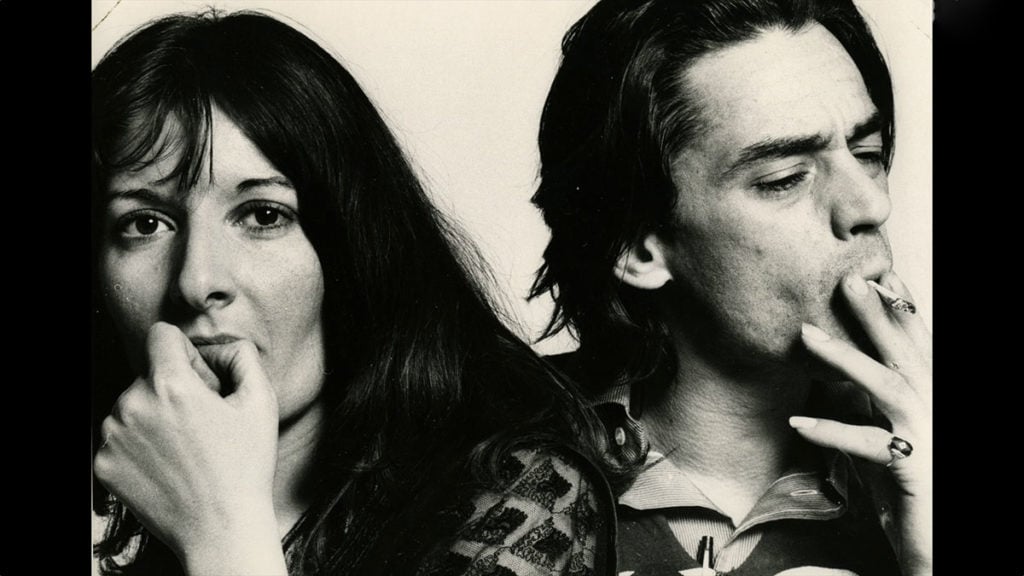
Marina Abramović and Ulay. Courtesy of
the Louisiana Channel.
Extreme Intimacy: The Yugoslavian-born performance artist
Abramović and the German-born Ulay met in Amsterdam in 1975 and
started working together immediately, forming a collective they
called “the other.” The pair referred to themselves as a
“two-headed body,” who felt as close as twins.
Trust Exercises: Together, the young artists developed a series
of hyper-intimate tests of physical endurance and emotional trust.
One of the performances, Rest Energy (1980), involved Ulay
holding a bow and arrow, which Abramović pulled her weight against.
“We actually held an
arrow on the weight of our bodies, and the arrow is pointed right
into my heart,” she recalled. “It was a performance about complete
and total trust.”
Great Wall Goodbye: Though their romance laid the groundwork for
the future of performance art, this same ambition ultimately pulled
them apart. In Nightsea
Crossing—a dual
performance in which the artists were meant to sit, staring at one
another from across a table—Ulay’s endurance wavered, and
during one performance, Abramović continued on her own, facing the
empty chair in front of her. The pair split in 1988 and, fittingly, marked
the end of their relationship by walking from opposite ends of the
Great Wall of China and meeting in the middle.
Public Reunion:
The two were reunited after decades during Abramović’s 2012 MoMA
retrospective, “The Artist is Present.” There, Ulay (apparently
unexpectedly) joined Abramović across a table in a moment
reminiscent of Nightsea Crossing and the pair shared an
emotional moment that brought both to tears. Nevertheless, the
acrimony endured, with Ulay suing his former partner for alleged
unpaid royalties and erasing him from formerly co-authored works in
the years that followed. Since 2017, the pair, however, have
reportedly put the past behind them.
Christo and
Jeanne-Claude
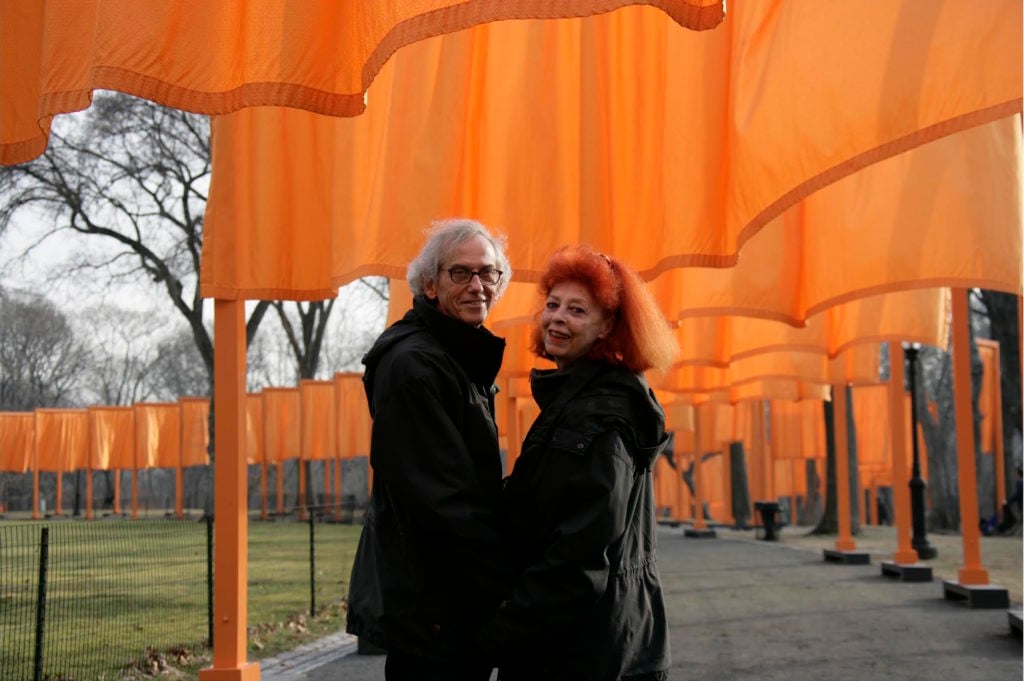
Christo and Jeanne-Claude
during The Gates in Central Park, New York
(2005). Photo by Wolfgang Volz, ©Christo, 2005.
The French Connection: He
was born in Gabrovo, Bulgaria, and she in Casablanca, Morocco, but it was Paris
that would bring them together, when, in October 1958,
Christo, a refugee living in the city of lights, was hired to paint
a portrait of Jeanne-Claude’s mother. Though Jean-Claude was
engaged when they met—and even went through with her marriage—she
ultimately followed her heart and left her new husband for Christo
during her honeymoon.
Gemini Twins: These
two artists were born on the same day: June 13,
1935.
Creative Concealment: The husband-and-wife duo
became famous for their large-scale environmental artworks of
draped fabric, including The Gates in Central Park
and the epic 24-mile Running Fence in California. In
addition, they swathed architectural icons, like the Reichstag and
the Pont-Neuf bridge, in veil-like drapery. Taciturn about
interpretation, the couple maintained that the only significance of
their creations was visual impact.
Nota Bene: For decades, Christo was the only
artist credited for their installations. Then, in 1994, their
entire body of work was retroactively credited to “Christo and
Jeanne-Claude.”
Robert Rauschenberg and
Jasper Johns
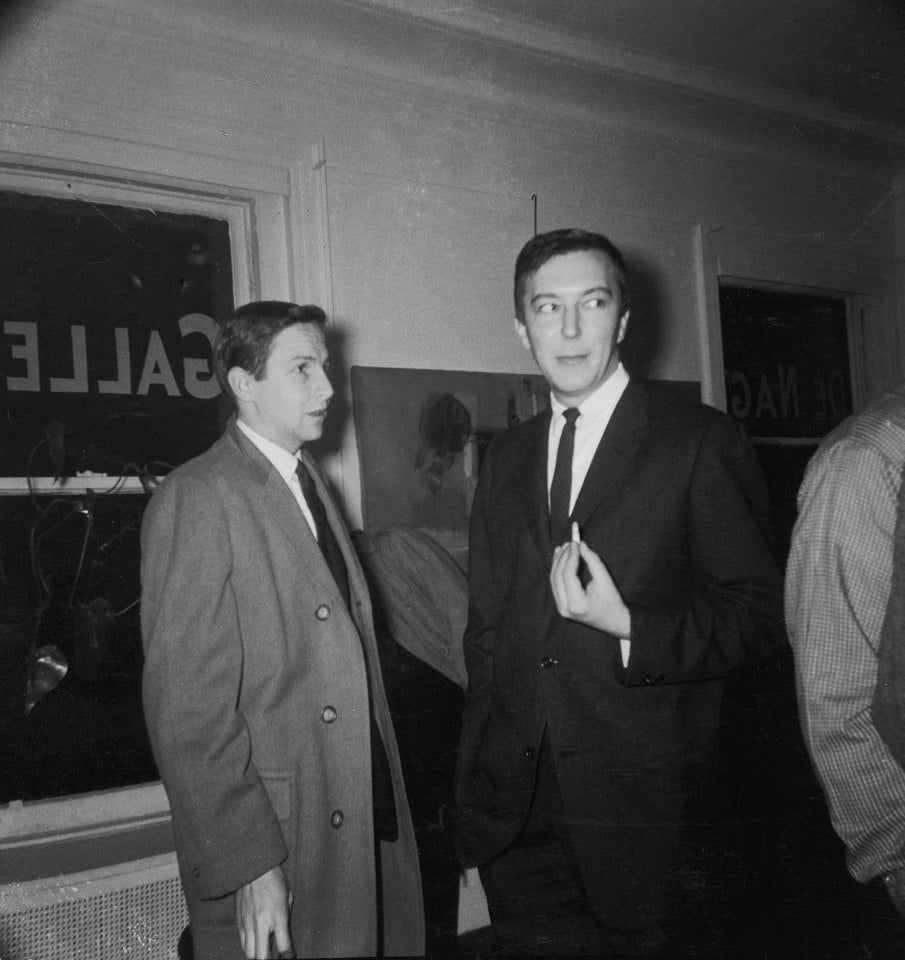
Robert Rauschenberg and Jasper Johns
attend a Larry Rivers gallery opening at the Tibor de Nagy Gallery
in New York on December 1, 1958. Courtesy of Fred W. McDarrah/Getty
Images.
Downtown Dreamers: Though
perhaps the most quintessential New York couple of all, Jasper
Johns and Robert Rauschenberg were only together from 1956 to 1961.
The pair had studios on different floors of an industrial building
on Pearl Street and lived, for a time, on Coenties Slip near the
South Street Seaport alongside other artists, including Agnes
Martin and Ellsworth Kelly.
Opposites Attract:
Rauschenberg was a gregarious, chatty fellow, while Johns was
reticent and a little bit removed. Despite their differences, the
couple came together to unravel the dominance of Abstract
Expressionism: Rauschenberg with his “Combines” and Johns with his
“Flags” and “Targets” series, which respectively offered new paths
forward from the macho-individualistic aesthetics of the
era.
The Green-Eyed Monster: Perhaps more poisonous than romantic jealousy
is the professional sort—and this couple was not immune. As history
would have it, when renowned gallerist Leo Castelli came to visit
Rauschenberg’s studio to plan for a scheduled exhibition, he
happened upon Johns’s works while in the building and signed the
artist on the spot. Rauschenberg’s show, meanwhile, was postponed
indefinitely. The couple’s ensuing breakup was bitter, and the pair
didn’t speak for many years after their split.
Frida Kahlo and Diego
Rivera
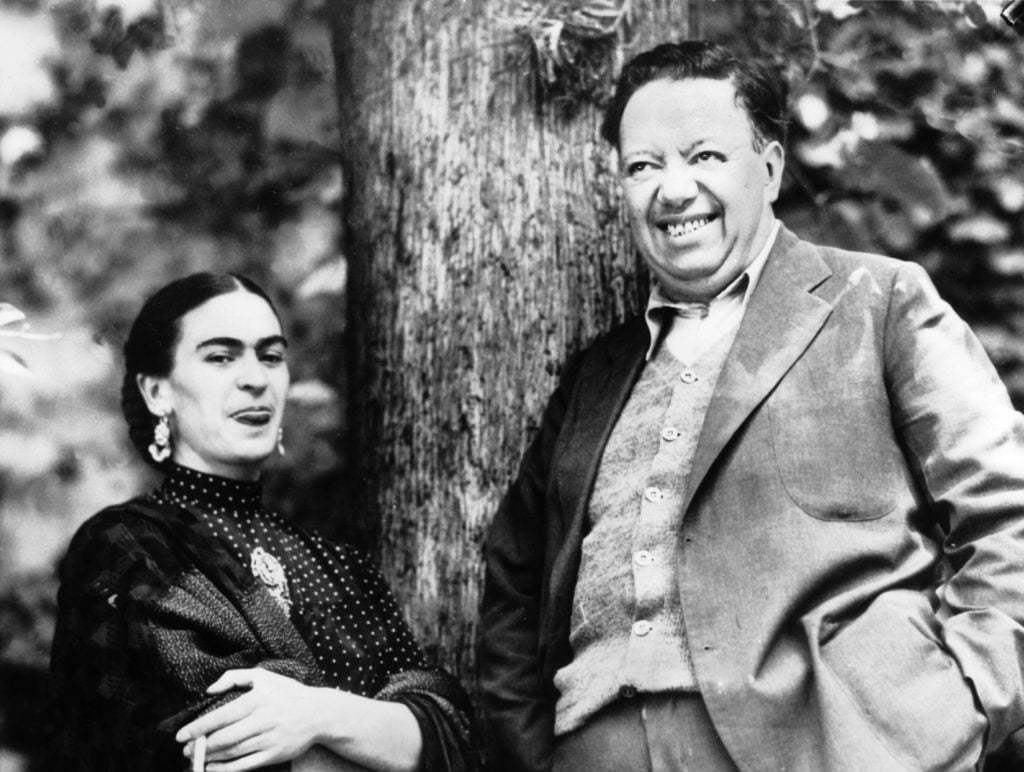
Frida Kahlo and Diego Rivera. Photo by
Keystone-France/Gamma-Keystone via Getty Images.
Epic
Proportions: We’d be hard pressed to name a
greater and more turbulent love
affair in art history than that of Frida Kahlo and Diego Rivera. A
May–December romance, Kahlo was still an art student when she took
up with Rivera, who, at 20 years her senior, was already a giant of
Mexican art. Disapproving of the marriage, her parents infamously
nicknamed the couple “the elephant and the dove”—a not so subtle
jab at the disparity between their sizes.
The Art of
Infidelity: Rivera revered Kahlo’s talent, and she his,
and their relationship was a whirlwind of creative support and
mutual fascination coupled with romantic disloyalty on both parts.
The openly bisexual Kahlo enjoyed love affairs with both women and
men (including, famously, Trotsky). However, Rivera crossed a line
too far when he pursued Kahlo’s younger sister, Cristina, a
discovery that absolutely ruined Kahlo.
He Said, She
Said: The couple divorced in 1939, but the forces of
passion and admiration kept bringing them back to one another, and
they remarried the following year. Rivera once referred to Kahlo as
“the great fact of my life.” She was not always so certain.
Alluding to the streetcar accident that nearly killed her, she said
“There have been two great accidents in my life. One was the
streetcar, and the other was Diego. Diego was by far the
worst.”
Political
Passions: In the 25 years they were together until Frida’s
death in 1954, at the age of 47, the couple were the faces of
socialist activism in Mexico. Nicknamed “a ribbon around a bomb” by
André Breton, Kahlo pioneered a new, daring form of
self-portraiture, and became the first Latin American woman to have
a painting in the Louvre. Rivera, meanwhile, revived the Mayan
mural tradition and created a contemporary, wholly Mexican visual
language that spoke to the lives and experiences of laborers in his
native country.
Françoise Gillot and Pablo
Picasso
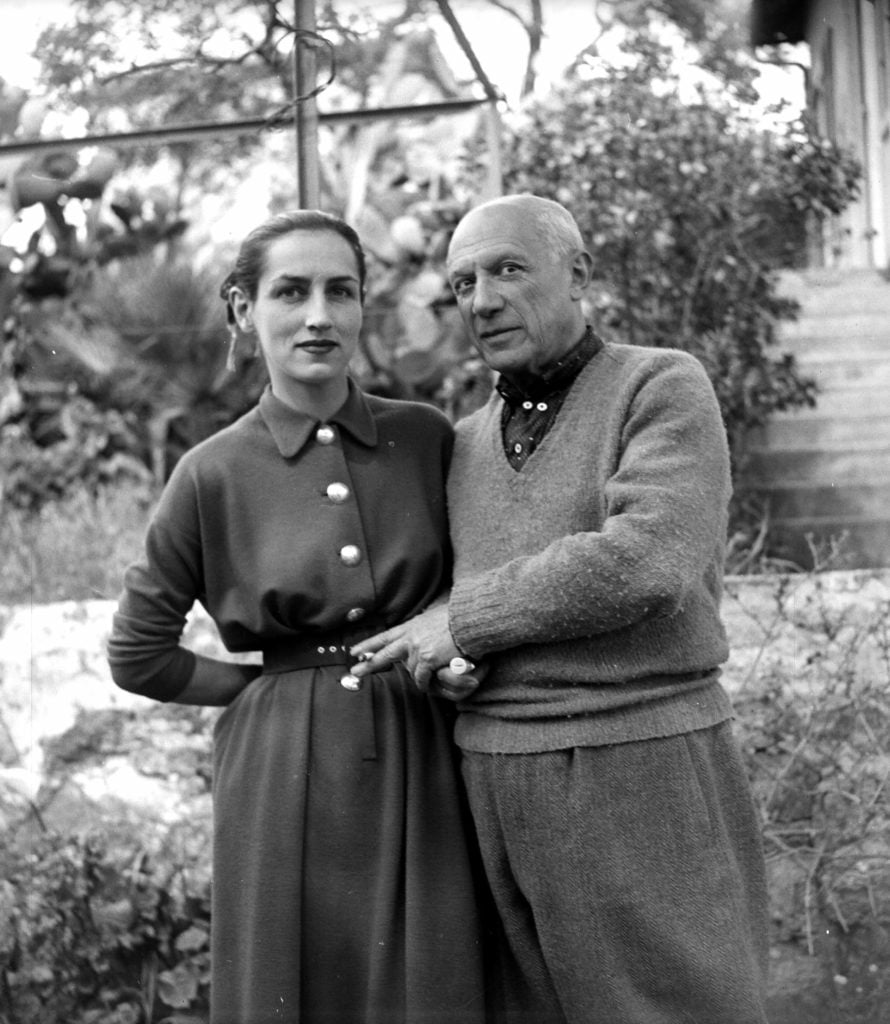
Françoise Gillot and Pablo Picasso,
1952. Photo by Roger Viollet via Getty Images.
Cafe Encounter: In May 1943, the 61-year-old
Picasso locked eyes with the 21-year-old Gilot while she was with
friends at the Parisian restaurant Le Catalan. Though Picasso was
dining with his then lover (the photographer Dora Maar), at the end
of the meal, he approached Gilot’s table with a bowl of cherries
and an invitation to visit his studio.
Three’s a
Trend: Gilot became the object of Picasso’s affections
while he was still involved with Maar, whose own intensity had
charmed the Spanish artist while he was still living with his young
French lover, Marie-Thérèse Walter. (Of course, the 17-year-old
Walter had likewise first delighted the artist while he was still
amidst the demise of his marriage to the Russian ballerina Olga
Khokhlova.) The young Gilot was enraptured by the famed artist, but
also cautious of Picasso’s intentions, writing later, “I came
onstage with an unavoidably clear vision of three other actresses
who had tried to play the same role, all of whom had fallen into
the prompter’s box.”
The 10-Year
Itch: During their nearly decade together—and through
the births of two children, Claude and Paloma—Gilot supported
Picasso as he experimented with sculpture, ceramics, and
lithographs, and largely abandoned her own creative ambitions. But
by the early 1950s, Gilot had grown weary of her role and decided
to walk away from the relationship—a first for the romantically
fitful Picasso. An enraged (and ego-bruised) Picasso told Gilot she
was heading “straight for the desert” and convinced dealers not to
sell her work.
The Parting Shot: Gilot went on to marry Jonas
Salk—yes, the genius who developed the polio vaccine. Then, in
1964, Gilot published Life With Picasso, a particularly
revealing memoir of her life with the artistic genius, filled with
occasionally unflattering details. As retaliation, Picasso cut off
all contact with their two children.
Gwendolyn Knight
and Jacob Lawrence
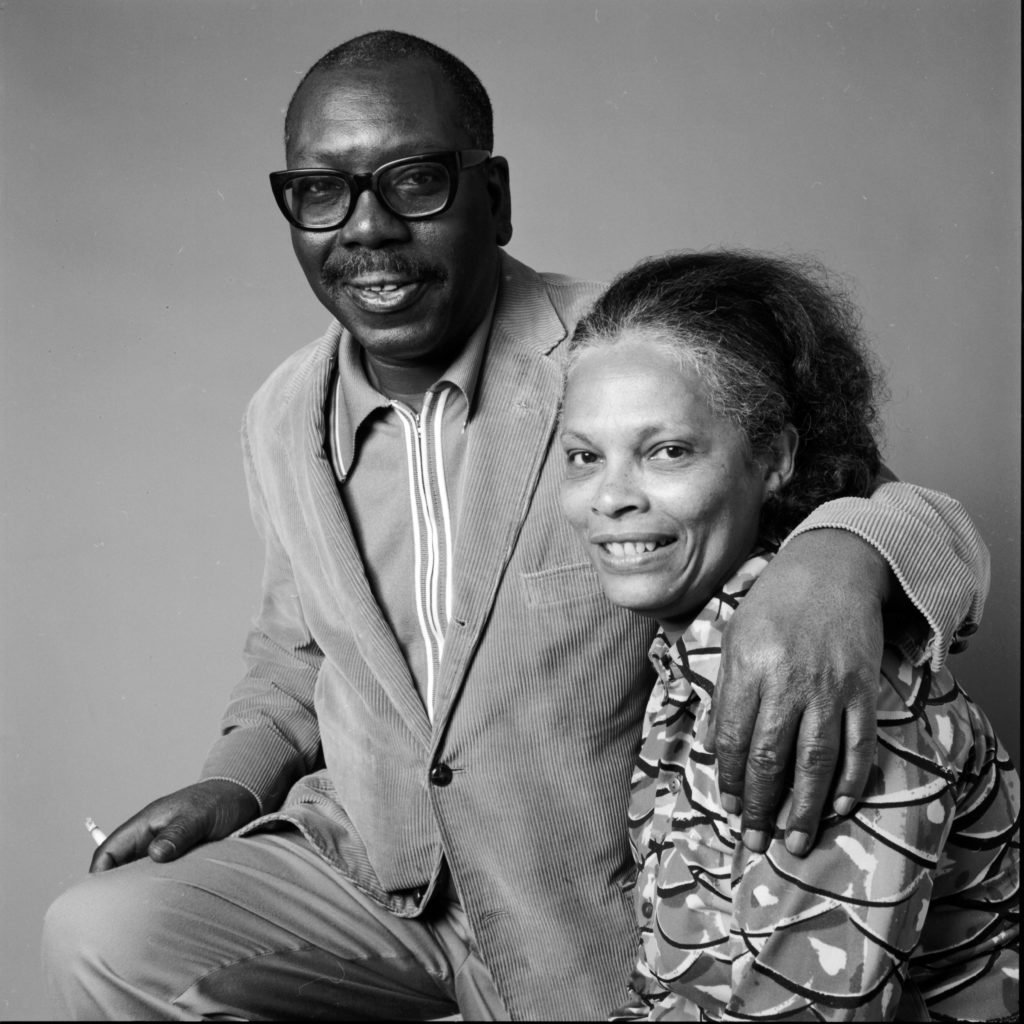
Jacob Lawrence and Gwendolyn Knight, New
York, 1974. Courtesy of Anthony Barboza/Getty Images.
Art-School Sweethearts: Both were students of
influential teacher and godmother of the Harlem Renaissance,
Augusta Savage, while she was teaching at the Harlem Community Art
Center.
Different Pasts, Shared Visions: The
Atlantic City-born Lawrence and the Barbadian Knight wed in 1941
and remained together until Lawrence’s death in 2000. Lawrence was
a complex fellow, having moved frequently with his mother and
siblings as a child, spending time in foster care, and serving in
the military, which was followed by in-patient mental-health
treatment. But he painted and drew resolutely through his
upheavals. A sense of community drew Lawrence and Knight together,
and both worked as members of the Works Progress Administration.
During those years, Lawrence developed his style of “dynamic
cubism,” which was deeply influenced by the shapes, sounds, and
minds of Harlem. The WPA years culminated with Lawrence’s 1941
“Migration Series,” which focused on Black American migration from
the rural South to the industrial North.
Her Time to Shine: The couple relocated to the
Pacific Northwest in 1970, where Knight began to paint in earnest,
often creating intimate portraits of friends. She received her
first solo museum exhibition in 2003 at the Tacoma Museum of Art.
Besides her artistic career, Knight was also an active
philanthropist who worked tirelessly to support children’s
causes.
Elaine
and Willem
de Kooning
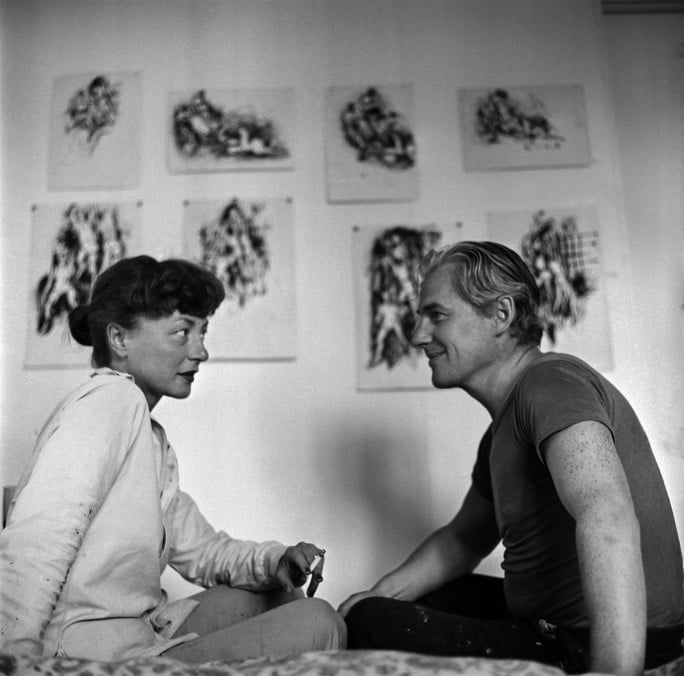
Elaine and Bill de Kooning, 1953.
Courtesy of Bridgeman Images.
The Stowaway and the
Student: The Holland-born Willem de Kooning snuck
into the United States as a stowaway on the British Freight headed
for Argentina and immediately immersed himself in the art world.
His life would change forever when, in 1938, a student named Elaine
Fried would enroll in his drawing class. The work-obsessed and
reticent Willem was seemingly immediately dazzled by the
magnetically charming woman who would later become his
wife.
Turbulent
Times: The de Koonings married in 1943, but there was no
honeymoon period, as the marriage was plagued by the effects of
alcoholism, poverty, mutual ambition, and a seemingly unending
string of affairs from the start. And yet their mutual artistic
admiration never waned. Elaine was convinced of her husband’s
brilliance as he pioneered Abstract Expressionism, and she created
her own distinct form of abstracted figuration. Interestingly,
too—and interpret this however you wish—Elaine’s long list of
daliances often involved men who ultimately helped her husband’s
career, including the art critic Harold Rosenberg and the curator
and editor Thomas B. Hess.
Ahead of Her
Time: Perhaps Elaine was born a generation too early,
as the resolute artist refused keep house at the expense of her art
making, valuing her own career as equal to her husband’s. She also
had an eye for style, and though the couple were known to live on
coffee, she always managed to keep up with the latest
fashions.
Together Again:
Though the couple separated in the late 1950s, they reconciled in
1976, and Elaine left a lucrative teaching position to buy a
property nearby to his in Long Island. She ultimately assumed
management of his studio.
Yayoi Kusama and Joseph
Cornell
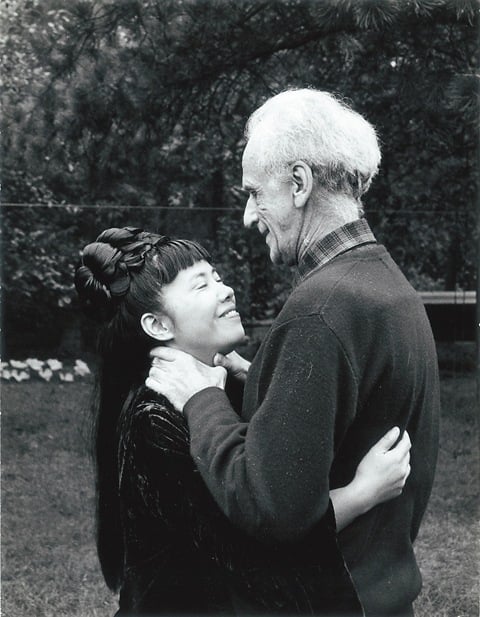
Yayoi Kusama with Joseph Cornell in New
York (1970). Courtesy Yayoi Kusama Studio, Inc.
Are They, Or Aren’t They?: Though Yayoi
Kusama may espouse the language of free love, she’s historically
been rather tight-lipped about her own romances. The Japanese
artist moved to New York in the late 1950s and soon after
befriended Donald Judd, who was also just starting out in his
career. The soon-to-be father of Minimalism reviewed her first solo
show positively in 1959, even buying one of her paintings. Soon the
two were living and working on different floors of the same 19th
Street building. Kusama called Judd “an early boyfriend,” but the
pair were destined for friendship. Instead, it was her intense,
though arguably platonic relationship with the master-of-assemblage
Joseph Cornell that dominated much of her New York life.
Odd Couple: Kusama was in her 30s when
she met the idiosyncratic Cornell, who was 26 years her senior.
Their unusual relationship lasted for years, with Kusama regularly
visiting Cornell at his mother’s home on Utopia Parkway in Queens,
where he lived and worked. Though their romantic interludes may or
may not have been physical, the two were deeply emotionally
enmeshed. Cornell would call her innumerable times a day, pen her
long letters, and when she had no money, gift her works of his to
sell.
A Disapproving Mother: Though we may never know
her side of the story, Cornell’s mother was rumored to be
controlling and overbearing. Vexed by her son’s intimacy with the
younger Kusama, she supposedly once poured a bucket of water over
the two artists while they sat kissing in her backyard.
Dorothea Tanning and Max
Ernst
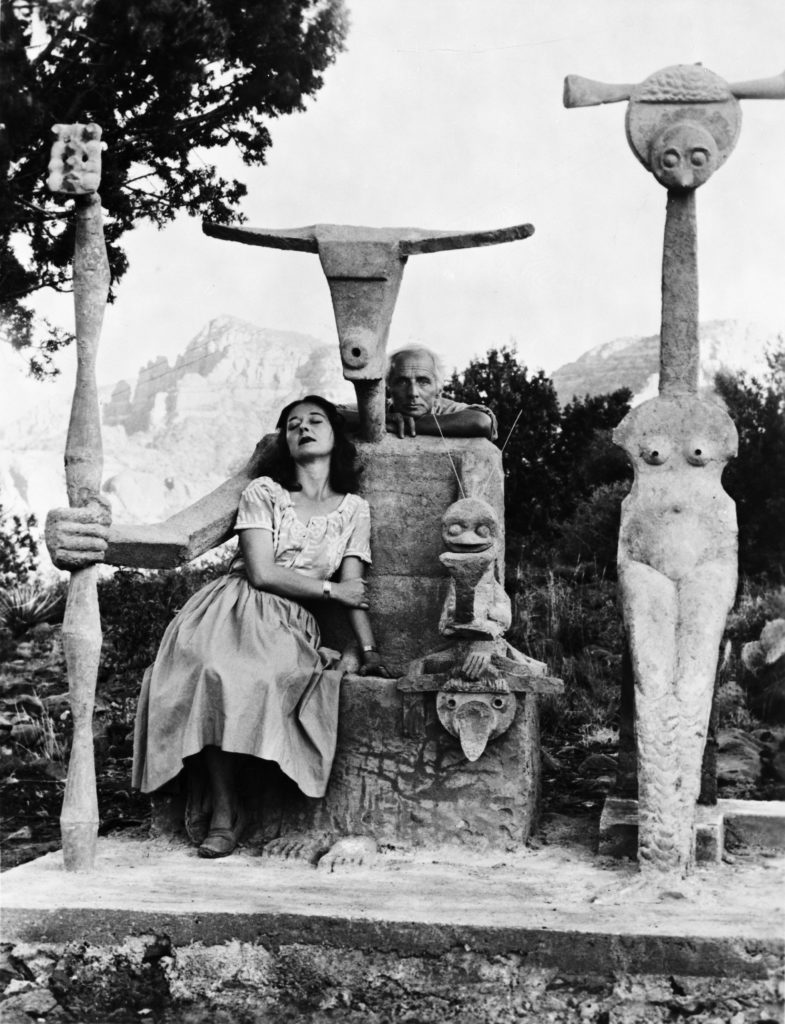
Dorothea Tanning and Max Ernst with his
sculpture, Capricorn (1947). © John Kasnetsis.
Checkmate: Ernst and
Tanning first met when he visited her studio at
the behest of his then
wife, Peggy Guggenheim, who was interested
in Tanning’s
Surrealist-inspired paintings. With a shared passion for chess,
Ernst and Tanning sat down to play a few matches. We don’t know
what transpired exactly, but, a week later, Ernst moved in with
Tanning.
Take Two: Tanning and
Ernst were married in Hollywood in a joint ceremony with their friends, the artist Man Ray
and dancer Juliet Browner.
Scorecard: Tanning
and Ernst were married from 1946 until Ernst’s death in 1976. It
was Tanning’s only marriage and Ernst’s third, excepting his long
relationship with the Surrealist Leonora Carrington.
Georgia O’Keeffe and Alfred
Stieglitz
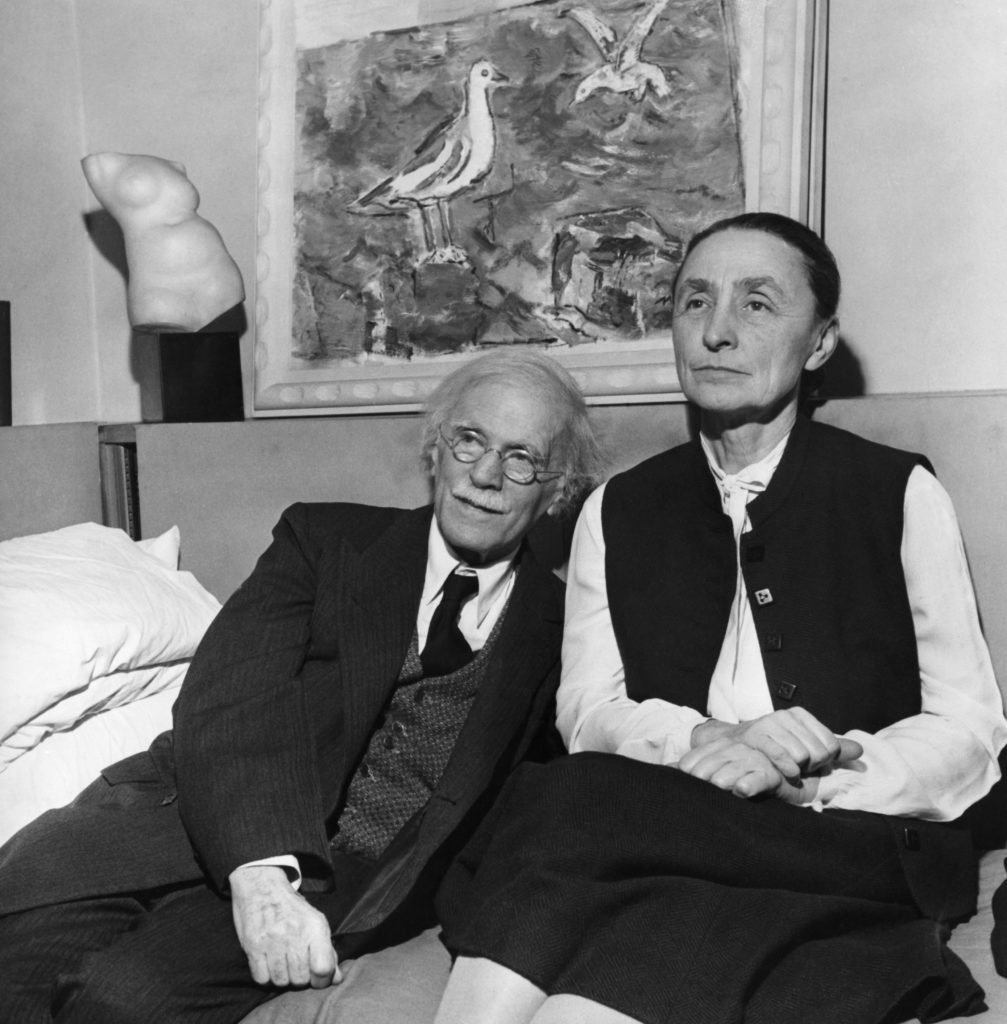
Georgia O’Keeffe pictured with her
husband, Alfred Stieglitz. Courtesy of Getty Images.
American Modern Love: Famed photographer Alfred Stieglitz and
pioneering American painter Georgia O’Keeffe were married from 1924
until his death in 1946. He was older, a photographer, a New
Yorker, and his gallery, 291, was at the center of the push towards
Modernism.
Complex entanglements: Stieglitz was a womanizer with a fondness for
younger women, but also an advocate of promising women artists.
O’Keeffe and Stieglitz shared a profound intellectual and creative
respect for one another, though their marriage was the definition
of tumultuous, with O’Keeffe and Stieglitz living separately for a
great deal of the marriage.
Love letters: In 2011, My Faraway
One, a volume of correspondence between the couple, was
published and revealed the immense struggle, respect, and
complexity within their marriage. Some of the details were perhaps
too intimate for outside eyes, however, including Stieglitz’s many
references to their life behind closed doors.
The post How Diego Rivera and Frida Kahlo Turned Their Love
Affairs Into an Art Form (and 10 Other Wild Romances That Changed
Art History) appeared first on artnet News.
Read more https://news.artnet.com/art-world/famous-art-romances-1763217
Further reading


Leave a comment